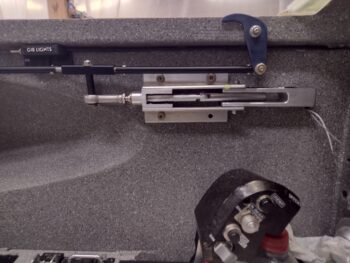
Today my efforts over the last week finally culminated in the completion of the canopy latch handle install. I’m happy to report that it is working quite well, and after a good hour’s worth of work I dialed it in even further after removing the pilot seatback push-pull thru-tube, drilled out the rivet securing the aft threaded insert, trimmed the tube by about 3/8″, made a new threaded insert and drilled/riveted that into place. A couple subsequent rounds of trimming the new threaded insert to length and I had all my latch hooks aligned at the same angle and elevation.
And here we have the installed canopy latch handle, connected to the 4 latching hooks via a HEIM rod-end (this provides just the flex needed in opening and securing the hook push-pull tubes to secure the front hook in place… I stole this design from Howard Caulk). Also note the newly designed, single switch (no extra “Flux Cap.” switch) box for the GIB lights, with the wire “cable” attached under the longeron going forward.
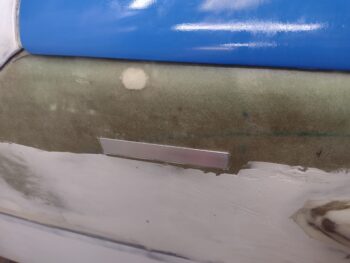
The reason behind this last round of tweaks on the canopy hook push-pull tube lengths and positions was due to a slight angle showing up on the exterior handle when the canopy was CLOSED & LOCKED.
You can see here the aft end of the handle (right side) peaking out just a hair more than the front. This was an indicator that I wasn’t getting full closure of the handle into its locked position. I remedied this with all my shenanigans above… Now, also note the curvature of the fuselage at the longeron underneath the canopy (blue) lip. I wanted the canopy latch system completed and operational to then allow me to rework this area to clean it up and smooth out this interface.
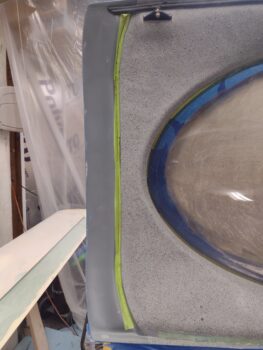
Although my canopy latch system is operational, I still needed to correct the NOW slight mismatch between canopy skirt interior groove that interfaces with the vertical extending aft lip of the glare shield on the aft nose/avionics cover.
To do this, I removed the front seat back cushion, climbed into the cockpit upside down so that my head was just inside the left leg hole under the instrument panel, with my legs hanging over the pilot seat back. I then closed and locked the canopy so that I could mark the aft edge of the vertical extending aft lip of the glare shield inside the canopy skirt groove, which I had added green tape inside of before hand.
This is the result of that effort… note the red Sharpie line on the tape.
Also while I was in this most precarious position, I grabbed a shot of the gap between canopy lip and longeron caused by the glare shield lip being a bit too far forward and not allowing the canopy to seat fully closed.
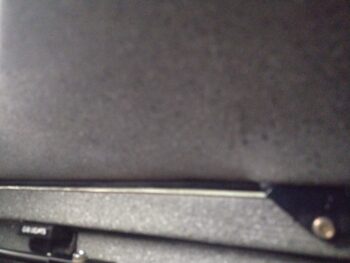
To remedy this issue between glare shield lip and canopy skirt groove, I had to either A) reposition the groove in the canopy skirt, B) reposition the glare shield lip aft, or C) remove the glare shield lip altogether.
I’ll note that since there is a rubber edge that will be attached to the glare shield lip, that then is a seal pressed up into the canopy skirt groove, I did not go through all this work to simply eliminate this feature. So option C was a no-go. As was option A since it would simply be too difficult and time-consuming to rework the groove in the canopy skirt.
So option B it was: move the glare shield lip aft approximately 1/8″ to get it reseating near the center line of the canopy skirt’s interior groove.
To accomplish this, I added double sided tape to the existing glare shield lip, then a thin strip of cardboard covered by electrical tape. Before removing the aft nose/avionics was off the plane, I marked the line where the overhanging glare shield met the instrument panel overhang since I didn’t want to add any thickness in between the pre-existing clearance between cover and nose structure.
This gave me about an inch just forward of the glare shield lip to glass 2 plies of BID over the tape and cardboard I had just added to the lip, but not before I wetted out and laid in a strip of peel ply on the vertical edge before the glass went on.
After laying up the 2 plies of BID, I then peel plied the external/top side of the layup (cover being inverted) and left it to cure overnight.
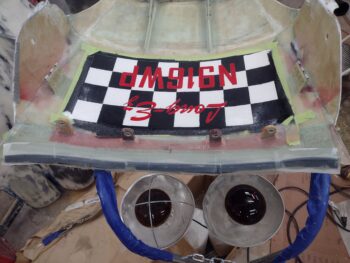
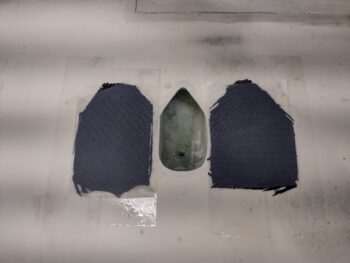
I had a decent amount of Pro-Set epoxy left in my cup, so I cut 4 pieces of peel ply and 4 plies of carbon fiber. I had planned on doing my bottom side wing bolt hole covers actually on the bottom side of the wings, but decided they would be flexible enough to make them on the top. Besides, I didn’t want to waste epoxy.
So I added tape on each side of the upper bolt hole access hole on the top of the left wing, and then laid up the 2-ply CF wing bolt hole covers, with peel ply on both sides of the layup. Again, these are for the bottom sides of the wings. I then left these to cure overnight as well.
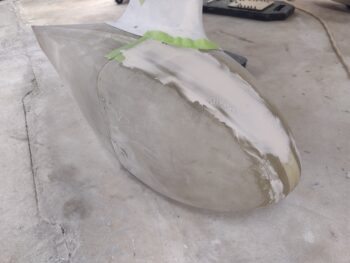
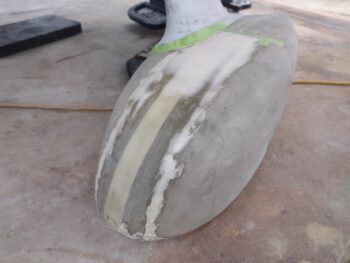
Finally, with the last bit of epoxy I had in my cup I mixed up some micro/West 410 and applied it to the already taped off right wheel pant, on the front half (pic 1). I had already done this previously on the left side (pic 2), but just hadn’t grabbed a pic of it yet to report in a blog post.
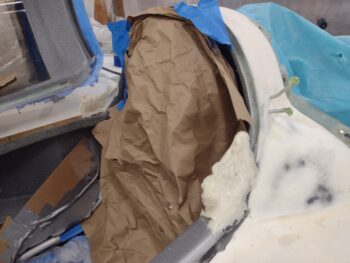
My final task of the evening was to add some filler pour foam in the aft corners of the fuselage-side canopy frame, where the longerons meet the D-deck canopy lip. When I trimmed down the canopy frame at this corner in its curved fashion, it left a decent gap at these corners, so I’m remedying that now.
Here I’ve added pour foam —which I just got a new batch in a few days ago— and have just pulled the forms off the cured foam, so both sides are in their raw state.
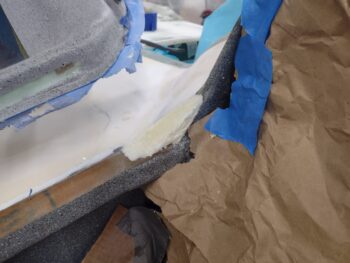
And here we have we the first initial round of clean up and contouring of the added pour foam at the aft longeron/D-deck corner intersections.
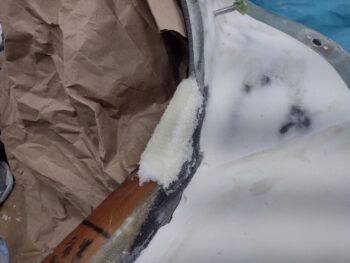
It was fairly late in the evening at this point, so I’m kicking off the final shaping (then glassing) of these pour foam corners until tomorrow.
Slowly gettin’ er done!