
Jess and I got back from our DC trip early evening yesterday. After unpacking and doing an update on my to-do list, I went out to the shop to flip on the Master Switch to check and see if the Mini-X OAT was still alive and reporting believable temps. And it was. I also grabbed the lists for both the GRT HXr and Mini-X that I printed off from the GRT website that covers all the specific features included with the new software updates.
Today I spent a good half hour over coffee looking at the updates and highlighting those I wanted to investigate further.
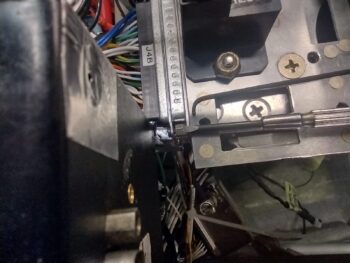
Out in the shop I needed to address a rather tricky task of installing a screw into the HXr’s J4B D-Sub connector’s outboard side. You see, I didn’t account for the J4B D-Sub connector needing to be installed and secured BEFORE the TruTrak ADI was installed. And since there is less than 3/8″ clearance between them, I don’t have an room to get a regular screwdriver in there… and I’m NOT removing anything from the panel to get to it.
So I used a low-profile 4-40 hex-drive screw (visible aft of screwdriver tip) and then lopped off most of the end of a hex key (above screwdriver) to allow me to get in there to first set, then fasten the screw into place. This entire exercise took right about an hour!
Since I plan on creating and installing the GPS antenna puck mounting plate either tomorrow or the next day, I needed to address an issue that just cropped up recently with the Starlink system dealing with both performance and price. If you’re interested, Scott on the Canard Boulevard YouTube channel covers the issues very well here.
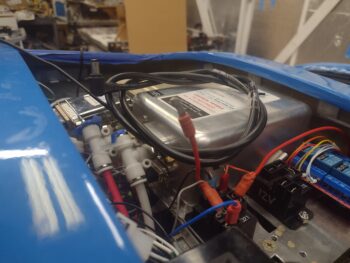
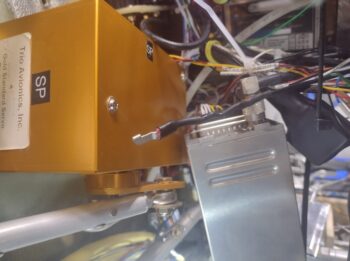
In light of the unfortunate very significant capabilities reduction and price increase for StarLink use in GA, I’m making my power leads for the StarLink antenna swappable to allow me to connect up my WxWorx antenna for SiriusXM Weather (as an option).
Here is the pulled StarLink power cable right behind the power wire terminated with a knife-splice connector for the power side (pic 1) and the a knife-splice connector terminated onto the ground wire (pic 2). Clearly this will allow me to connect up either the StarLink Antenna, the SiriusXM Weather system, or any future weather product, respectively of course, that needs power. Yep, we always need to be ready to improvise, adapt and overcome!
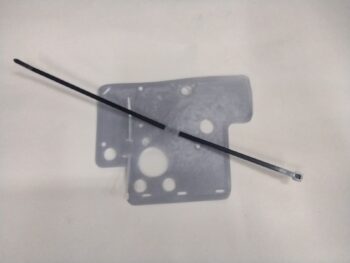
Again, in prep for mounting the GPS antenna puck mounting plate, I updated the zip-tie thru-holes and then printed off a thin version of the plate to check those zip-tie points. This took a good 45 minutes in CAD to do the initial measuring and outlay of these zip-tie points.
That being said, it will need at least one more tweak tomorrow before I plasma cut the plate.
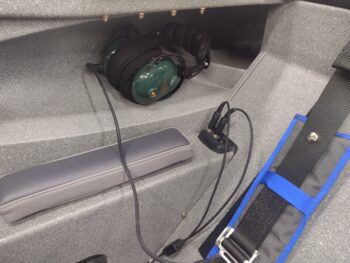
My final quick, but productive, task for the evening was taking a pair of headphones out to the shop to plug into the pilot headset jacks. I prepped this audio check by fusing the AMX-2A 10-channel audio mixer before flipping on the Master Switch.
I then turned on the Dynon Intercom and was met with the alarm audio alerts from the AG6 warning annunciators (one for the canopy open alarm from AG6 #1 and the other an IBBS low volts alarm from AG6 #2). Once I finished booting up the HXr and Mini-X EFISs, I was met with a myriad of EIS audio alarms —since the engine data systems aren’t hooked up (and engine not started).
Clearly these functioning audio alarm outputs are initial indications pointing to good wiring on the audio mixer, intercom, AG6s, HXr and Mini-X.
Pressing forward!