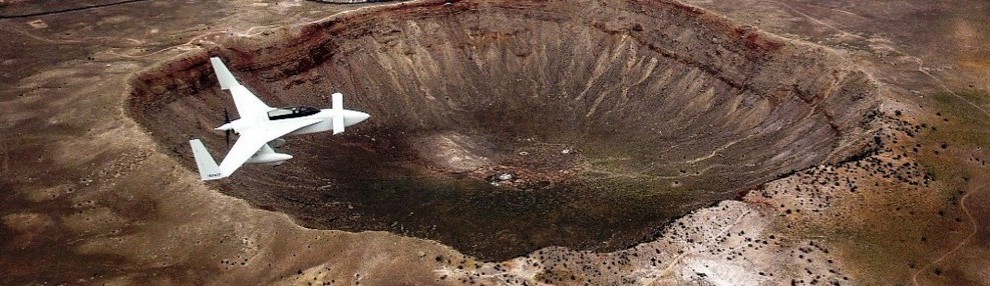
This post covers the past 3 days, where I didn’t get a whole lot done. Christmas day I didn’t do anything, and half the day after I lounged around and took it easy with my wife.
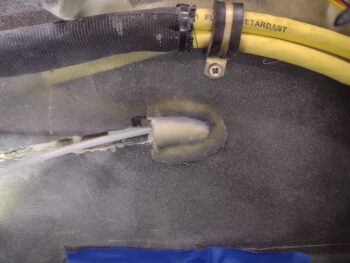
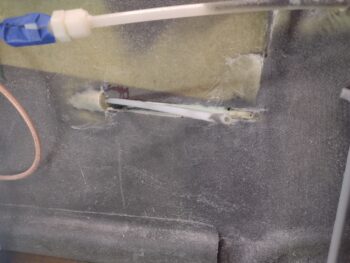
But I did pull the peel ply off the aft side rudder cable sidewall conical protrusions, on the right side (pic 1) and the left (pic 2). This is of course the beginning of the end (or halfway… ahem) of my refilling and glassing the sidewalls where I extracted the rudder cable conduits.
As I mentioned at the end of my last post, I pulled all the wires of the IBBS wiring harness out of the lower exit hole in the Napster bulkhead. I chucked the rubber grommet that was inside that thru-hole and simply replaced it with a length of heat shrink (visible in pic 2).
This allowed me to get ALL the terminated wires going forward and aft through the bulkhead wire transit hole… specifically the pair of power wires that are terminated with knife-splice connectors (center of pic 1) that connect the IBBS through-power to the X-Bus. After connecting the knife-splices, I then secured and protected them with red heat shrink (pic 2).
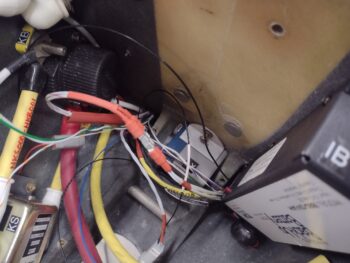
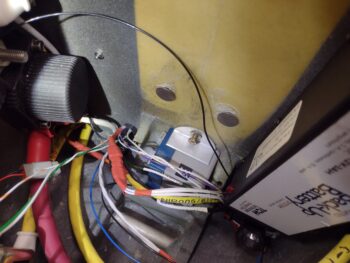
I then got to work on labeling and connecting up the taxi light wiring jack (next to IBBS, blue wire), the nose landing light jack, J0B (bottom center of pic), the nose gear’s small backup battery (emergency down if no aircraft power) pair of wires (green & white, left side of pic), and final switching circuit, power and ground wires for the taxi light stowed/ deployed actuator relay (RL011, bottom right corner). I’ll note that except for one ground wire, and the pair of wires for the gear back-up battery, all wires are labeled.
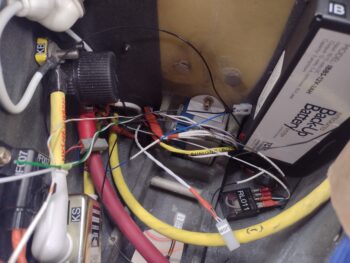
Not shown is my work on the instrument panel mockup wiring, where I removed the outer heat shrink surrounding the relay that controls swapping between the COM1 and COM2 radios. I had on my task sheet to verify that the solders were good, since they were completed with my old $14 soldering iron… not my “new” high speed soldering iron. Out of the 9 tabs, all but one looked fine. The one tab that was a bit thin was an internal wire, but I got to it and got a nice clean good small solder blob on there. Task complete.
Day 2, after another slow, lazy start, I was getting my task list finalized and confirming wiring and circuits before I printed out my wire labels. I ran out of wire label heat shrink, but luckily the labeling heat shrink I ordered last week was in my mailbox. Thus was able to do another batch of labels.
I then grabbed some coffee, fired up the heater in the shop, and was just getting ready to change into my shop clothes when I noticed a text from my local canardian buddy Guy Williams, who was going out for a quick hop in his Long-EZ and was asking if I wanted to go.
So I played hooky for a few hours and went out for a scoot up to Ocracoke Island and back. Guy was testing out his old trusty Garmin 496 to drive his EZ Pilot autopilot for some upcoming cross countries that he wants to take. He was having some issues with them talking to each other, so I had the stick and flew nearly the entire flight as he troubleshot the units.
After helping my wife and stepson assemble some Christmas gifts, I finally got back into the shop a bit later in the evening. My focus was knocking out the heated pitot tube wiring.
Here you can see the power wire coming off the top left corner of the Battery Bus terminated and connected to the Common terminal of the heated pitot tube’s relay (RL005). Below this power wire input on the relay is the red power wire to the heated pitot tube (Normally Open tab) that enters the nose battery compartment with the other large power wires in the lower outboard corner. Terminated on the same connector going to the relay NO tab is a yellow/blue wire that goes to the “PITOT HEAT ON” LED indicator light on the instrument panel.
And, again, I labeled all these wires.
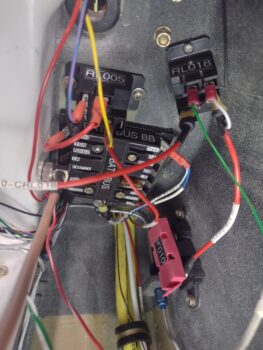
Not much extra to show you inside the busy nose battery compartment, except the new red heated pitot tube power wire, labeled but not terminated yet. And the black heated pitot tube ground wire, labeled and butt-splice crimped/heat shrank to the heated pitot tube lead. Both of these wires end in the lower right corner of this pic.
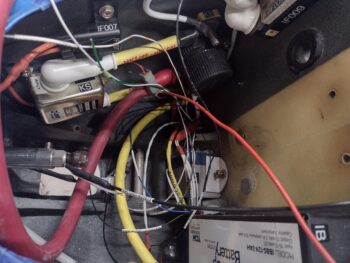
I then spent nearly half an hour slowly and carefully sanding the nose-tip end of the inside of the G10 tube that secures the pitot tube, since some paint got in there during painting. I was able to get it, but not without making my pitot tube look a little rough in the process… I’ll need to buff it out to get it back to nice and shiny (before Marco, who made it for me, sees it!).
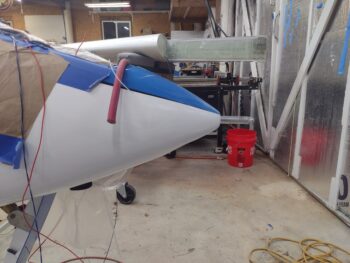
So… my nose battery compartment wiring is pretty much done, minus a couple of labels and a few FastOn terminals getting crimped on.
The last bit of wiring to add will be the 10 AWG cable from the battery contactor (on the exposed stud next to the “KB” on the yellow tab, lower left) to the Master Bus on the Tri-Paragon. Cable #2 will be another 10 AWG size black cable from the battery’s negative terminal to the main ground bus on the Tri-Paragon. The last wire will be the small power wire, that will connect to the Battery Bus, from an ammeter sensor on the 10 AWG Master Bus feed cable above.
These 3 wires will all traverse the Napster bulkhead at the top transition thru-hole where the yellow zip-tie is shown.
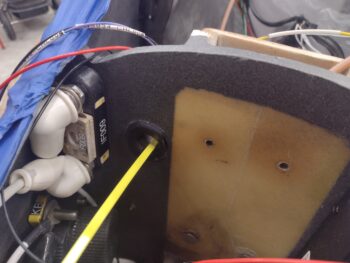
Tomorrow, I plan on getting at least another round of layups done on the sidewall rudder cable conduit “trenches.” I’ll also press forward with my nose area wiring as well as I move aft towards the instrument panel.
I’ll note that Jess and I are taking off to Charleston, SC to ring in the New Years the day after tomorrow, so that will be a good few days off the build.
Pressing forward!