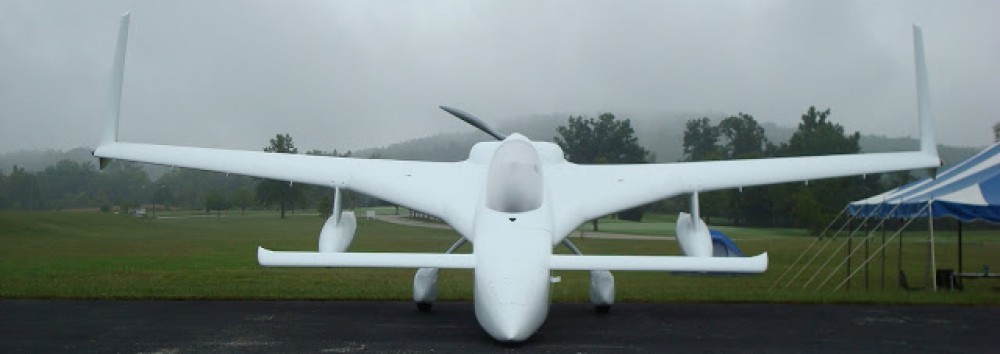
Slowly!
This blog post covers the past 2 days.
Speaking of past… years ago I discussed getting better weather than ADS-B into the cockpit. StarLink was not around then but SiriusXM weather was, and still is, available. Currently the variable remains on exactly how to bring SiriusXM weather into the cockpit, by either A) GRT HXr EFIS or, B) some other display.
After recently updating the software on my GRT HXr, and reviewing the change notes, the assessment in regards to SiriusXM weather on the EFIS is that there has been NO significant increases in display capabilities on the GRT boxes. With StarLink’s current plans being cost prohibitive, I’m being driven back down the cattle chute of my original best-option weather reporting in the cockpit: SiriusXM weather displayed on my Bendix King AV8OR GPS unit… which displays nearly everything SiriusXM reports.
The only current issue with the AV8OR is that it won’t turn on. A somewhat known common problem with these units’ on/off button after they get a little long in the tooth. Not to worry though (at least yet) since the same guy that can magical rejuvenate GNS-480 GPS navigators can work his same magic on AV8ORs as well.
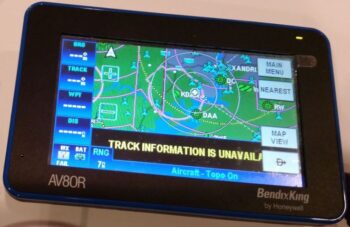 That all being said, my Bendix GPS is now on its way to Chris Short in Minnesota to be repaired and brought back to operational status.
I also did a fairly in-depth review of the process, subscription, etc. to update my nav databases on the GNS-480 GPS. I figured before I pull the trigger on that I should see if I perhaps need to also send the GNS-480 out to Chris for some TLC as well. And, moreover, to make sure the unit actual is working!
Thus, I set up the docking station, mounted the GNS-480, and fired ‘er up.
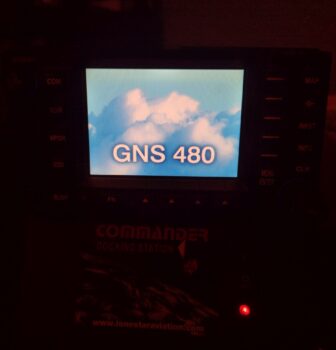 Not surprising at all is that I was immediately met with a Low Battery Voltage Caution that is common on these units as they age. Marco had to have his battery replaced within a couple years of installing his GNS-480. And they actually can operate fine if this battery goes dead, it just takes longer to boot up on every power-up since it no longer can remember where it is in the world.
I actually have the replacement battery on hand and will be swapping it out myself in the near future. I figure I’ll wait until I’m ready to start flying IFR before I send the unit out to Chris to have him refresh some of the older capacitors, resistors, etc. that are known to get a little wore out over the many years these things have been in service.
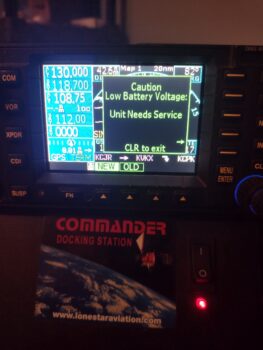 Since the GNS-480 is not in the panel and talking to the HXr EFIS, specifically the AHRS, I got this caution as well.
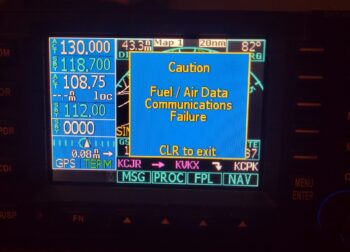 And after all that, I played around and refamiliarized myself with the GNS-480 for about 10 minutes before calling it operational and ready for duty (after battery swap).
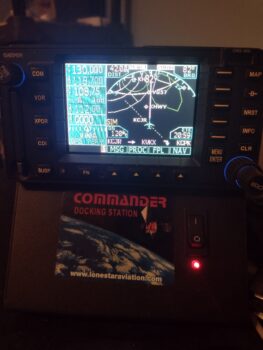 Back in the shop I reset the position of the Taxi Light spring mounting tab before testing that configuration out. Which is still a NO-GO. As you can see, with the angle, height of the light assembly, and slim clearance… it’s just a tight fit in the rotation of the light.
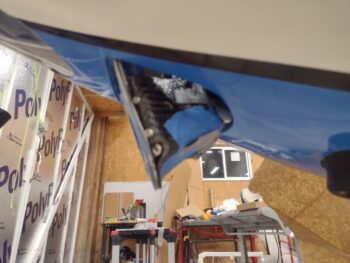 I moved the spring tab forward on the light cover and then tried it again.
Success!
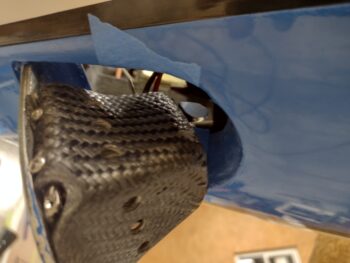 Here’s a shot of the taxi light assembly with the now riveted-in-place spring tab (yes, busy in that nose). I will note that when I removed the carbon fiber light cover to rivet on the spring tab, I also safety wired the light bulb to the frame, which centered it better in the lens.
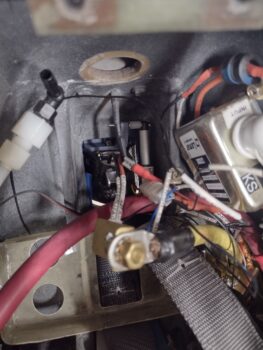 Here is the light in the down position WITHOUT the spring attached.
With the light in the closed/up position, and the spring attached, I then powered up the circuit and tested clicking the switch for the light to deploy. Nothing happened. Or at least it appeared nothing happened, while actually 2 things happened. First, what little movement (or even possibly the spring?) there was, the ABS pivot arm base cracked. Second, the Actuonix L12 actuator proved too weak to deploy the swing-down light assembly with the spring attached.
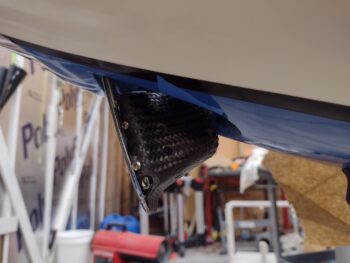 I went back to review the specs of the Actuonix L12. Looking at online resources and reviewing Marco’s mechanical to electrical conversion for his landing/taxi light deployment, I came to the conclusion that I need the more robust and powerful L16 actuator model, versus my standard-strength L12 unit.
Now, here’s the kicker… for the size I need there are no L16 units available anywhere. All are on back order.
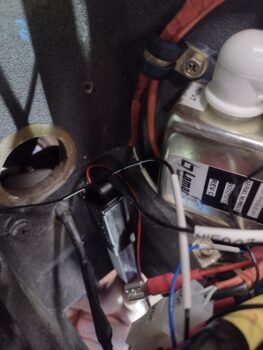
Moreover, I different model actuator means slightly different mounting dimensions… which actually doesn’t matter since I am going to rework the actuator geometry to a more “traditional” vertically oriented top-pushing-down setup somewhat as I have pictured here (now that I know I have the real estate to do it):
 Final conclusion on the Taxi Light? For now I’m beefing up the ABS pivot arm, using the L12 actuator simply to hold the pivot arm/taxi light in the closed position, then mounting the spring to also hold it in the closed position WITH B-seal around the light hole edges to minimize air leaks… Then the electrical connection will be disconnected and I’ll deal with the taxi light system after I get this thing in the air.
In other news.
I took the 3-conductor shielded cable with terminated ELT connector out to the shop and connected it to the ELT-side connector. Note that I’ll secure the connector in the ELT bay under the pilot thigh support so it’s not flopping around.
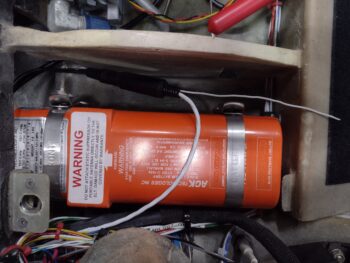 Here’s the page from the ACK E-04 install manual where I’ve annotated the wire colors.
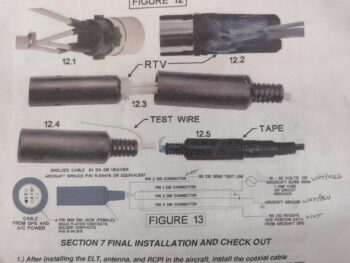 I’m focusing on this task now because this is currently the last bit of wiring that needs to be routed across the top of the left leg hole and down the side of the left panel wiring bundle before I wrangle all the left side wiring into something that looks a whole lot more respectable… to allow for the final install of the GNS-480 GPS and the Trio autopilot into the panel.
Again, as per the install manual above, I spliced one of the 3 wires to power via an inline fuse (yellow) to the E-Bus fuse panel stud. Wire #2 connects to cable shield and ground (still to be labeled and terminated). I then crimped a D-Sub socket onto the end of wire #3 —the entire purpose of this cable assembly— to terminate it into the P1 connector of the GNS-480.
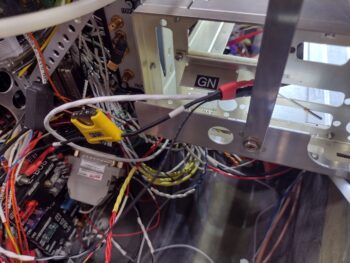 This gives the real juice to the 406 MHz capability of this ELT in that if it experiences enough G-forces that would indicate a crash landing, via the GPS data it can report to CAP, etc. pretty much exactly where you are… reducing search time from hours to exponentially less time.
Pressing forward.