Chapter 25 – Elevators micro’d

Although not really shown in any of the pics below, the last couple of days have been about SANDING, SANDING, SANDING… oh, and more sanding.  Mainly sanding the epoxy wiped areas on the rudders, winglets, inboard wing root edges, cowl shoulders, turtle deck, longerons, and fuselage sidewalls.

Then divot and depression refills with micro, more sanding, more minor touchups and fills… ad nauseum.

As for the glassed inboard ends of the elevators, those layups came out very nicely: I pulled the peel ply, razor cut the edges and then did a quick sanding to clean them up.

With the weather now fairly warm (high 80’s…yeah, all or nothing!) I took the elevators outside and gave them a thorough sanding in prep for micro.

I also took the canard outside (I had already sanded the inboard edges of the canard and micro’d those edges  up) to sand down the new added micro.

Which I did next.  This is to fill the edges that were uncovered by the aft nose/avionics cover.

I couple of years ago I read in the Central States Newsletter that polyester filler glaze is incompatible with composite finishing.  Well, many, many years prior to my reading that, I had followed suit with Nate Mullins as he was just finishing up his Long-EZ build, where he had used Z Grip filler on his bird.

Now, while Z Grip does not claim to be a polyester filler, it is from Evercoat.  And I had a decent amount of Evercoat’s Metal Glaze on hand, which states right out that it is a polyester filler glaze.  Both are a light bluish green in color, and both are applied fairly easily and sand easily (after about a quick 20 minute cure time).

Since my only micro finishing project at the time was the canard, I too employed this type of easy-to-apply/quick curing/EZ sanding filler on the canard (this was my pre-West 410 discovery).

Well, after a quick text chat with Nate today I confirmed that he had had some issues with his Z Grip filler “any application over 1/16″ deep” and again, that’s not even a polyester based filler (that I know of).  My Metal Glaze is a confirmed polyester filler, which its use is again warned about in the Central States newsletter.  With those two data points now converged, it confirmed to me that the Metal Glaze must go… never to be used again! (ok, apparently it’s fine to use over PRIMER, but not before).

Thus, I removed it as you can see below.

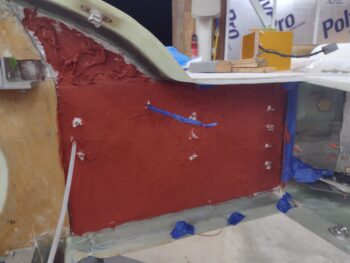
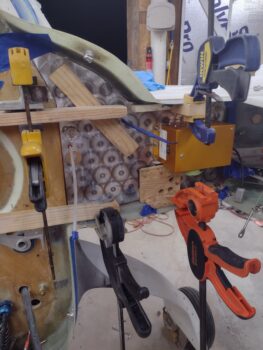
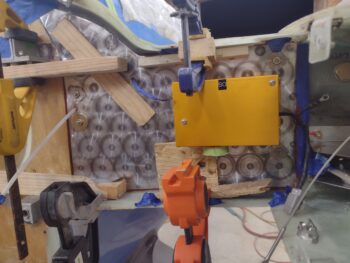
My last build task of the evening was to slather up the elevators with micro [in 2 steps: bottom first → nearly cure → then top side]… which took a good half hour per side, so 2+ hours total.

Then even more sanding and re-microing shenanigans on & around the canopy frame… And more sanding and more micro applications coming tomorrow I’m sure (did I mention it’s an iterative process?!).

Pressing forward . . .

Chapter 11/18/22/25 – Elevators done!

Yep, after all these years I finally completed the elevator builds by glassing the inboard edge with 1 ply of BID.   Success! (haha)

But allow me to back up just a bit first.  Yesterday I did a fair bit of sanding on the epoxy wiped longerons, turtledeck and forward fuselage areas.  I also sanded some micro that I had reapplied to the front edge of the glare shield.

In cleaning up the threaded inserts on the canopy internal lock microswitch block, I realized that the mounting screw hole spacing wasn’t correct, so I corrected that in CAD and kicked off another 3D print of it.

This morning I went to mount the new microswitch block and discovered I had moved the hole in the WRONG direction in CAD, so I (re)moved the hole and reprinted yet another block, which I installed.  And yes, I did an ops check and it works a treat.

My next goal was to get the elevators off the canard to allow me to sand them down and micro them up.  Well, the way the bolt goes through the inboard tube to secure these elevators in place, the canard must come off and both elevators removed together to provide the clearance required to get the bolts out.  Thus began the canard removal operation (first I did a final sanding of the inboard elevators ends to ensure that once glassed and painted, there would still be 1/16″ of clearance).

I was quite expecting some huge drama in getting the 3/16″ stainless steel hinge pins out, but they came out with some vice grips and steady force, but no crazy antics requiring power tools and/or expletives!

Here we have the pair of elevators off the canard.  Note that when I decided to go with the inboard elevator fairings these elevators were mounted on the canard and I didn’t want to waste time removing them, so I trimmed the inboard 1.5″ off in-situ… and that future point to finalize the task is now.

I marked the glass to be trimmed —again, that I couldn’t get in to cut while constructing the elevator fairing when I removed the inboard 1.5″ (pic 1)— then trimmed it off with my Fein saw (pic 2).  I then cleaned up the tube of the old epoxy and glass residue.

Here we have the pair of the elevators ready for a ply of BID on their inboard face, to FINALLY complete the construction of the elevators!

I made a paper template, then cut and prepregged a ply of BID for each elevator. After wetting out the prepregged BID, I then cut it using my template.  After making some flox (near the tube) and micro internal corners and applying wet micro to the blue foam, I then laid up the ply of BID.  I then peel plied the layups and left them to cure overnight (sorry for the blurry pic).

I’ll offer another point of note in that these layups are close to the last of all plans-required layups that I’ll need to finish for this bird.  The only other ones are the underside of the top lips of the wings and strakes at the seam between the two (both sides).

With these layups complete, I then applied some micro on the inboard edges of the canard where they intersect the aft nose/avionics cover as well as some touch ups around the canard mounting notches in the nose (no pics).

Tomorrow my main priority is to finalize the sanding of the epoxy wipes and do any clean up/added micro tasks required.  I’ll then continue to work the canopy, canard, aft nose cover and nose hatch finishing to get all that knocked out and ready for paint.


Chapter 18/22/25 – Key epoxy wiping

My final goal for today was to get the longerons, turtledeck and forward fuselage sides epoxy wiped, and I’m pleased to report that I completed that task.

Of course to get to the point of epoxy wiping all these surfaces required well over 4 hours of sanding…  all in the past at this point.

Here we have the left side epoxy wiped, with the forward nose area, stopping just under the canard (pic 1) and the longeron, cowl/strake shoulder and the turtledeck (pic 2).

I had planned on doing 4 coats total, but besides it getting really late, since I had to use a brush on the narrow longerons I ended up putting more epoxy on per coat than I normally would with a squeegee, so I stopped at 3 coats.

Here we have the right side.  In addition to the right side turtledeck, shoulder, longeron and forward fuselage side, I also epoxy wiped the repair on the right strake leading edge, the top of each wing root edge, and a couple of micro fill spots on the rudders and winglets.

Just prior to initiating the epoxy wipes, I shot this quick video to show the “exciting”  initial operational test of the canopy internal lock handle functioning with microswitch block mounted on the sidewall forward of the instrument panel.  As I mention in the video, I still have some dialing in to do, but the operational design seems to be working.

Still pressing forward!

Chapter 18/22/25 – More sanding please!

I started out today whipping up some micro and slathering up my repair on the right strake leading edge, and finishing off the micro’ing of the right longeron, as well as adding some to the inside of the slanted edge of aft nose/avionics cover.

I had some micro left over in the cup, so almost on a dare I applied it to the perimeter lip of the nose hatch… I had JUST enough to cover the lip.

With a good application of micro curing, I then made up an 8-32 threaded insert on the lathe for the canopy internal lock micro-switch block second screw hole.

I’m reusing this pic from yesterday to give an idea of how I floxed the second threaded insert into place for the canopy internal lock micro-switch block.

I then taped up plastic over the cabin so that I could sand the left side longeron and forward fuselage without covering the inside of the plane with dust.

Here is a before shot (pic 1) and then an after shot after I spent a good few hours sanding (pic 2).

I then did a good bit of sanding on the right side as well, here on some contrast and compare pics of left vs right side, both sanded…. note the intersecting lines of the where the aft nose/avionics cover intersects the front corner of the canopy at the canopy bottom edge line.  This is what those aft corner layups were all about on the aft nose cover (to fix the intersect line).

A closer shot of the right side canopy-fuselage-aft nose cover intersection… yeah, some very slight bit more tweaking required.

I also grabbed this shot to show that the line between canopy skirt and the aft nose cover is no longer some gaping hole like the grand canyon!

Pressing forward.

Chapter 13/22/25 – Pushing nose finish

I started off today by marking the aft nose/avionics cover’s aft corners for trimming, which I did immediately after grabbing these pics.

After installing the aft nose/avionics cover back on the bird, and taping up some seams, I then finished adding micro to the front edge of the right longeron.

In addition, I laid up the final ply of BID on the damaged right strake leading edge.  I then peel plied that layup.

I also did a fair amount micro’ing on the left side as well, in the area in front of the strake along the longeron, and also around and under the canard and aft nose/avionics cover.

I then taped the canopy internal lock micro-switch block to the left sidewall of the avionics bay, forward of the instrument panel, to ensure it would not cause any clearance issues with the GNS-480 GPS navigator mounting tray.

Here’s another shot of the canopy internal lock micro-switch block on the left sidewall, which has a low enough profile to not interfere with the GNS-480 GPS navigator mounting tray (pic 1).  I then drilled the lower screw mounting hole with the micro-switch block in place (pic 2).

I finished drilling out the screw mounting hole and then prepped & floxed an 8-32 Nutsert into the hole (no pic).

And with that, I left the floxed the Nutsert to cure overnight and called it a night.

Chapter 13/25 – When disaster struck!

Well, when it rains it pours… seems like I’m clearing out all the upcoming spring mistakes early.

So it was a late night last night.  I got a lot of things done.  And although it was a nice warm day, as par usual over the last week the nights have been chilly.  I set a box with stuff in it (for weight) on top of a stool, with 2 heat lamps attached to the stiff cardboard —both aimed at the micro I had just added onto the right longeron… the temp was low 50’s in the shop, and very likely to get much colder than that.

Well, this morning as I got about 10 feet from the door of the shop, I could smell IT: the godawful odor of burnt epoxy, fiberglass and micro.

This is what I found.

Apparently, one of the light clamps had shifted, and it toppled the box over with the lights “conveniently” face planting right onto the strake leading edge.  My saving grace was the light with the cross grill across front landed on the BL23 junction, whereas the bare light landed inboard on the storage area side of the strake leading edge.

Here’s a look on the inside of the slightly cooked discolored paint.

Well, after opening up all the doors and windows, turning a fan on and letting the shop air out for a good half hour, I then got to work clearing out the charred fiberglass on the outer surface of the strake leading edge (pic 1).

The burn was very localized to the heat lamp face, and the glass beyond the burned glass was fine… and still very strong in that I couldn’t push it in at all.  The internal foam had melted away about 1/2″ to 3/4″ from the edge of the hole.  The brown stuff inside the hole is the melted foam and micro attached to the inside glass.  I then took my Fein saw and cut the perimeter of the hole at a shallow angle for the upcoming glass repair (pic 2).

To ensure I had “aircraft quality” foam reinforcing the edges of the hole, and as internal dams for the pour foam, I cut 3 blue foam wedges and micro’d them into place (one each side and one on the bottom).

I also discovered a slight delam area between the glass layers on the outboard side, so I cut the exterior delammed glass away.

As the micro’d foam wedges inside the hole of the burnt leading edge spot were curing, I then finished adding micro to the corner junction of the left longeron to left strake.  Here is the front side.

And along the aft side.

I also added about a foot more micro to the front side of the right longeron as well, just beneath the canopy lip edge.

I added pour foam to the inside edges of the burn damaged leading edge of the right strake.

After the internal perimeter pour foam cured, I cut the foam flush with the hole opening, made up a taped cardboard dam and secure it in place with more duct tape (pic 1).  I then whipped up some pour foam and carefully poured it into the dam and left it to cure (pic 2).

After trimming and sanding down the added pour foam (pic 1), I prepped the foam with wet micro before laying up 2 plies of UNI that crossed each other at a 30° bias (pic 2).

I then peel plied the layup and left it to cure overnight.

Tomorrow I’ll add a final ply of BID over the UNI and call the repair good, requiring only more micro finishing at that point.

If you’re curious about the BL23 junction leading edge heat damage, it merely cooked some micro and caused some minor surface cracks. I chipped away the cracked micro to clean it up.  I guess lucky for me the BL23 junction required a bit more (aka thicker) micro to blend it in, so the underlying glass was completely unscathed.

I also added some micro onto the aft nose/avionics cover’s aft corner inside BID layups before then adding a ply of BID on top of the added micro.  I then peel plied the layups and left them to cure overnight as well.

I then shot a quick video showing you the proof of concept testing I have been working on with the wire-manipulated micro-switch block for the canopy latch internal lock lever.

And with a crazy, frustrating day under my belt, I called it a night…

Chapter 13/18/25 – Mystery Screw-Up!

This blog post covers the past few days, where I am still primarily focused on all the centerline areas of the bird in order to finalize the micro-finishing for the canopy intersect areas, as well as the nose hatch and nose.

I started off by adding micro to both the front vertical edge of the glare shield (that makes up the seam with the front edge of the canopy skirt) and the front 1/3 of the left longeron where it interfaces with the canopy edge lip.  I then peel plied both of these micro applications.

The application of micro on the front 1/3 of the left longeron completes the addition of micro along this left longeron for the initial application.  Again, this is essentially a micro hard-shelling task since this addition is too small (IMO) to use pour foam.

A single ply BID tape along this edge seems like it should be a fairly quick job, but it took an entire afternoon.  Here are the aft 2 plies of BID (there were different heights needed to cover the side strip of micro), prepregged in plastic and ready for layup.

After a final sanding of the cured micro strip along the left longeron, and then another application of micro into some of the remaining grooves and divots, I laid up the 1-ply BID tape covering the micro vertical edge and overlapping onto the bare fiberglass just beneath it.  I then peel plied the layup.

Here we have the next day… when I then discovered an issue that for the life of me I swore I had nailed down, since it’s really the core purpose for this task: the new layup over the underlying micro was proud of the canopy edge by a good 0.05″ on the front half of the left longeron.

I was dumbfounded.  I swore I had double and triple checked the edges in relationship to each other on both canopy and longeron.  Of course I was not happy.

Nothing to do but fix this cluster ****!  I grabbed the Fein saw and cut off the glass on the front half of the longeron.  I then stripped off ALL the tape protecting the canopy lip, closed and locked it and then sanded the micro to BELOW/INSIDE the surface level of the canopy lip.

Of course the micro had some significant divots and gouges in it from the Fein saw, so another round of micro was required.

Once the micro was cured, and another round of sanding complete, I then redid the front half layup on the left longeron.  Here is the result of that.

And a shot of the now complete first major task in cleaning up the left longeron and matching it up to look nice with the the canopy frame.

In that vein, I also did a thorough sanding of the right longeron, which I honestly have barely touched since I laid up the top skin of the right strake (pic 1).  To keep the micro jobs manageable, I micro’d only the aft half of the right longeron, including along the corner intersection with the strake top micro (pic 2).

I then did a final cross check of the aft outboard corners of the aft nose/avionics cover where the glare shield front corners start.  I need to round these corners to get those tri-corners dialed in where aft nose cover meets sidewall meets canopy frame.

I laid up a ply of BID each side on the inside of the aft nose/avionics cover, then peel plied both sides of the BID before setting it aside to cure overnight.

I then got back to the right longeron and micro’d up the next section going forward.  Here’s how that looked:

And here’s the entire right side strake/longeron/canopy micro situ at the current moment.  I’ll of course be working this more tomorrow going forward.

Pushing onward!

Chapter 18/25 – More canopy latch tasks

Today I started out by finishing up my micro strip addition just underneath the canopy’s left lip on the forward 1/3 of the canopy.

This micro along the canopy serves a couple of purposes:  First, it essentially serves to widen the longeron under the canopy lip to create a smooth, even flow from canopy lip surface to fuselage/longeron/strake.  This characteristic is more prevalent on the aft half of the canopy to longeron seam.

Second, and possibly more important aesthetics-wise, this micro strip fills in the pronounced original curve of the longeron and creates a straighter line from fuselage/ longeron surface to the canopy lip edge.  This issue is much more noticeable on the forward half of the canopy and increases up to the front corner of the canopy lip.

I’ll note that my finishing “fix” action in regards to this left side canopy lip to longeron interface is essentially a ‘hard-shelling’ operation in that I will sand the micro smooth and blend it in even with the strip of exposed fiberglass just underneath of it.  I will then lay up a ply of BID across this fiberglass-micro junction, covering all of the micro.  This will reinforce the micro and keep it from chipping if a foot, hand, luggage (whatever) dings against it.

I will then finalize the external side of this finishing by adding more micro to connect this new fuselage/longeron-side filler lip to the strake and fuselage side wall.  From there I’ll treat it as a normal micro finishing task as I sand it all to contour and then epoxy wipe [that still leaves the inside edge of this process, which I’ll cover when I get to it].

Now, with the strip of remaining pour foam that I just recently added to the front vertical edge of the glare shield (below), I applied somewhat wet micro to the aft side and top of the foam, before peel plying the foam edge.  Again, this will be somewhat of a ‘hard shelling’ operation as well, in that once I get the foam/micro shaped just right, I will then laying up a single piece of carbon fiber to the glare shield and along this vertical wall of this added foam and micro.  I’ll then deal with the top strip of exposed foam and micro as well (most likely a thin strip of carbon fiber with a flox corner to the previous CF layup above).

My next task involving epoxy was to whip up some wet flox to use in securing the bronze oil sleeve into the canopy latch handle middle block.  Just prior to slathering up the bronze oil sleeve, I hit the outer surface with the Dremel tool to create some flox-gripping grooves.  I then clamped it tightly into place.  Here’s what that looks like:

Now, why did I flox the bronze oil sleeve bearing into the handle assembly middle block?  Well, I noticed just recently that when opening and closing the canopy, and locking and unlocking it as well, I wasn’t getting a full throw of the canopy latch catch hooks fore and aft.

Something was askew… and interestingly I had already taken the pics to show the newly installed canopy latch interior lock when I noted the bronze oil sleeve slipping out of the center block.  Apparently, a week-plus of constant operation on the canopy handle loosened up the press fit between harder bronze oil sleeve and softer aluminum middle block, allowing the sleeve to come loose and exit out of its installed position.  I figured flox (or silicone RTV) was the best way to secure it in place, so I went with that.

Obviously better to have this happen now and find out this issue at this point versus when flying out and about.

I also spent a good chunk of time today assessing and planning out the EXTERNAL canopy handle lock positioning, operation, configuration, etc.  I actually have 2 of these style of locks on hand, one being a bulkier stainless steel lock and the other being a lower profile (chrome?) one.

I assessed the install depth and operation of each lock, and it appeared that the cheaper(?) lower profile lock simply functioned smoother with less fiddly-ness when it came to inserting and rotating the key.  The barrel is also slightly narrower in diameter and shorter, so although it didn’t have the sexier finish between the two locks, it won in all the other aspects.

So here we have the lock position determined and the initial hole drilled into the fuselage sidewall just under the handle.  I have to say I originally planned on placing this lock on the forward (left) edge of the handle, to avoid the 1/4″ Nyla-flo electrical wire conduit running in the sidewall just under the canopy handle (turns out, not the best spot).  Thus, while a royal pain in dealing with my crazy accidental wire cutting issue at the under-longeron GIB Lights switch box… it is now proving quite serendipitous that I had to run those wires under the longeron (vs thru the sidewall conduit) since I will most likely need to cut and remove a decent sized section of the Nyla-flo to create a slot for the lock’s pivoting latch arm.

I’ll continue to work on getting the lock installed into the side wall, with the pivoting latch arm operational, but I am highly considering not machine the interfacing slot into the handle until the exterior paint on the fuselage sidewall is complete (more thought required).

Which leads me to my final task of the evening: sanding the added micro just under the canopy lip on the left side, to ensure a smooth transition from added micro to the fiberglass just underneath of it.

I had planned on doing more work in knocking out the 1-ply BID layup along this added strip of micro, but it was getting quite late and the temp had dropped quite a bit outside,  thus inside the shop as well.  I’ll kick this can ’til tomorrow.

Rock ‘n roll . . .

Chapter 13/18/25 – Canopy latch lock

To be clear, that’s the INTERNAL Lock…

But I’ll first start off by noting that in the push to get the mechanical systems like the canopy latching system or the nose hatch latch configured, the R&D obviously takes up a lot of time and understandably there is a lot of redo’s involved in that.

Case in point is that as I worked on attempting a slight reroute of the nose hatch latch cable —in my attempt to dump the time-busting and involved intermediate bracket— I was 3D printing off my first production version of the canopy latch internal lock handle (in red) vs the previous 3 versions I had made (in black) over the last couple of days (see below), which was further a complete redesign of the first style I created.

That being said, I am happy to report that my nose hatch latch cable reroute worked, allowing me to chuck the intermediate bracket and simply run the cable from handle to latch lever… simplicity in design and function always being best.

As I showed yesterday (while I wasn’t showing all the versions of the internal lock handle) I created a threaded insert to secure the canopy latch internal lock.

Prepping and floxing this threaded insert into the side wall was actually my first task of the day, and here it as installed and cleaned up [Note wires coming from out of sidewall… I had planned on connecting these to a micro-switch mounted inside the internal lock, but there just wasn’t enough room… so the electrical wires are coming out, replaced with safety wire to remotely manipulate the switch —now housed forward of the panel].

And here is the assembled canopy latch internal lock installed.

A few key things to point out:  As I mentioned above, my first design was much larger and focused on latching down on the forward end of the handle.  This caused a clearance problem in both being able to physically grab the handle to open it, AND with the alt-static switch on the panel.  I then simplified the design and made it like a block “C” that simply flips aft over the handle.  My first iteration was, again, too big and I had to bring the size down a couple of notches.  Lastly, the in-wall wire is attached on the bottom arm and pulls the switch (forward of the panel) closed, and small springs manipulate the switch housing and switch open when the internal lock handle is open (forward) as it is here… kinda.

And here it is flipped aft, with the wire pulling the switch closed.  There is a small gap of less than 1/8″ between handle and internal lock, but with the play in the handle before its over-center apex, this play has literally zero opening action at this point.

I then got to some finishing on the canopy to longeron seam.  The main fill needed along the longeron to clean all this up is immediately below the canopy frame edge, near the top of the longeron… essentially flattening out much of the curve at the TOP portion of the longeron (vertically).  Of course more sanding and more micro will be required, since this is just phase 1 on the canopy-to-longeron fills.

Ok… still pressing forward!

Chapter 13/18/25 – Canopy front seam

More iterations today on trying to get the nose hatch latch and cable pull operational.  I kicked off a 3D print last night that was 3+ hours long… it being significantly longer now that I added a projecting arm that will allow me to secure the latch cable.

However, in the area that would specifically secure the latch cable my print didn’t turn out so great.  I ended up having to drill it out and cracked it a bit, so I super glued it back together (thus the clothesline pin).  I then repurposed the old canopy latch handle push-pull rod as the rod that will have the handle pull cable on an upper attached arm, and the pull cable to the nose hatch latch on a lower attached arm (I also worked designing and modeling those up in CAD as well).

Here we have the nose hatch latch intermediate cable bracket inside the nose for test fit of the cable.

I also took the opportunity to reinstall the front left CAMLOC receptacle of the aft nose/ avionics cover.  I ensured to drill the major hole were I had marked it in situ with the cover installed, but in the end I may have gained a 0.03″ delta in movement, so not a great return on investment with this task… oh well, pressing forward.

With the aft nose/avionics cover in place, I then taped up the glare shield and the front edge of the canopy skirt (pic 1).  I then closed and locked the canopy, whipped up a small bit of pour foam and slathered up the seam between the two (pic 2).

About 20 minutes later I cut off and sanded the excess pour foam.

I then used my flat (around 0.07″ thick) Perm-A-Grit sanding board to create a gap between the front of the canopy skirt and the newly poured foam.  I also cleaned off all the protective tape.

Once the pour foam above was poured into place, I then got busy on the lathe making a threaded insert out of 5/16″ diameter 2024 aluminum rod and tapped 6-32 threads into one end.  This threaded insert will get floxed into the side wall just behind the canopy latch handle to allow me to install a canopy latch lock.

And with that, I called it a night.  More to come tomorrow.