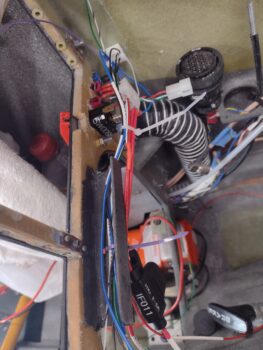
Chapter 22 – Inch by inch…

Over the past few days I’ve finalized all the circuits and inputs to the AG6 warning annunciators.  During my inventory of those, to simplify the wiring, minimize power connections, and optimize flight information management, I’ve decided to pull the carbon monoxide alarm reporting off the AG6 and swap it for the fuel pump, which is currently just an indicator light.

Why?  Well, the CO meter already reports via RS-232 to the HXr EFIS, which is of course part of the warning annunciation system.  It also requires a connection via a resistor to a power bus (unlike the fuel pump), so the swap is on.

As for the fuel pump, the AG6 can use the signal input as both a simple pump ON indication as well as a time-delayed flashing red warning if the fuel pump is left on and needs turned off.  With using the exact same wire for either indicator light or AG6 screen, I find that much more useful than just an “ON” indicator light.

Meanwhile, the indicator light slot left open by moving the fuel pump up to the AG6 will now be utilized to report the Autopilot Servos Disconnect & Pilot Controlled Steering (PCS) function when that button is pushed on the control stick.

All this of course took a couple of days to figure out, and I do have a multi-question email to Rich, the guy who designed the AG6, for some assistance on the respective AG6 units’ reprogramming.

I also finished installing the Tri-Paragon’s top right shelf relay deck plate, which involved drilling out the screw holes and installing a good bunch of platenuts.

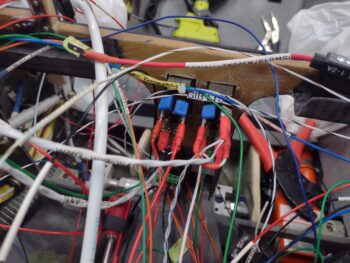
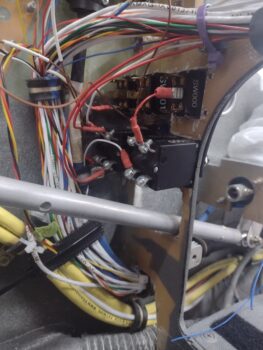
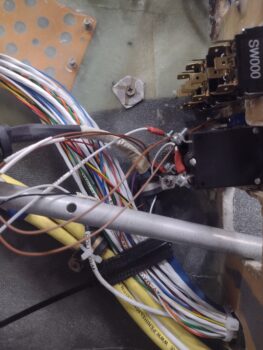
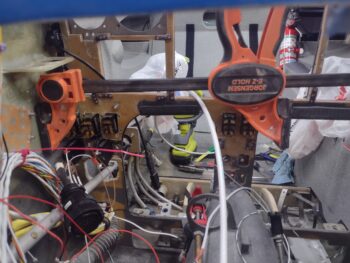
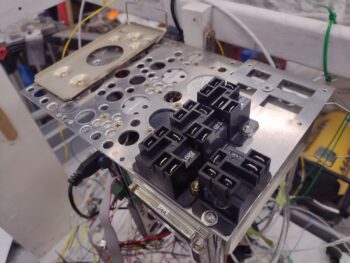
Here we have the Tri-Paragon relay deck installed, with the initial two heavy duty relays installed.  One of these relays will be pressed into service for the StarLink Mini versus Heat component power feed (can’t have both powered at the same time due to excessive current draw).  The other/second relay is a spare… both of these mounted before the relay deck plate was secured in place since I didn’t use platenuts on these.
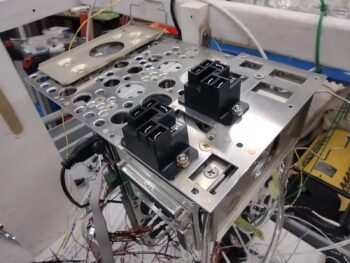
However, through the magic of platenuts at the other 2 relay positions, if need be I can easily add up to 2 additional heavy duty relays… but will leave them out unless called for.  Obviously left off for now for weight reduction.
I then spent a good little bit working on a multi-faceted circuit that involves the canopy latch internal lock:

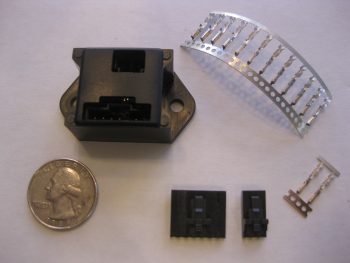
… the JB Wilco canopy & gear warning module:
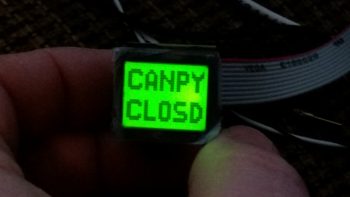
And a feed to one of the AG6 Warning Annunciators:
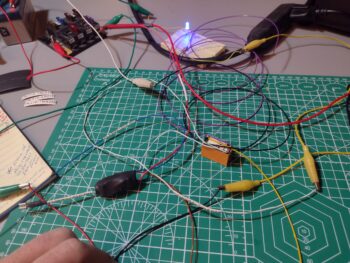
In lieu of using a heavier duty DPDT relay for these circuit machinations, I decided to use 2 of the lighter duty relays on the 4-relay board I was testing this past week.

Relay 1 is controlled by the canopy latch internal lock that remotely controls micro-switch sw085 on/off, which is wired to the Relay 1 control input.  Relay 1 sends power to the AG6 circuit that annunciates a red “CANPY OPEN” screen (opposite the green “CANPY CLOSD” AG6 screen seen above) OR sends power to control Relay 2 when activated.

Relay 2 controls input into the JB Wilco module, connected both via straight off the relay terminals and through a throttle quadrant mounted micro-switch.
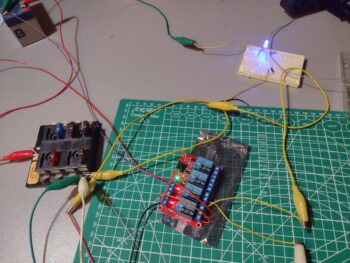
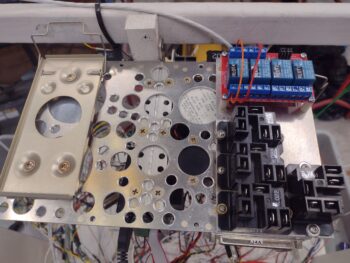
Once I confirmed the 2-pair relay circuit logic was good, I mounted the 4-relay board onto the Tri-Paragon relay deck.
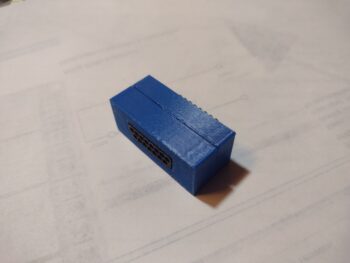
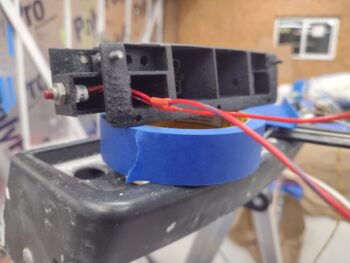
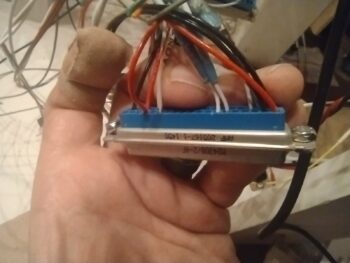
In other news, I ran out of ground points on the Tri-Paragon and in the panel area, so I ordered a few solder-cupped 15-socket D-Sub connectors.  To allow me to easily mount the combined pair of DB15 connectors, I started whipping up a mounting bracket for them, spending 5-10 minutes every hour or so to do a little bit more on this side project.

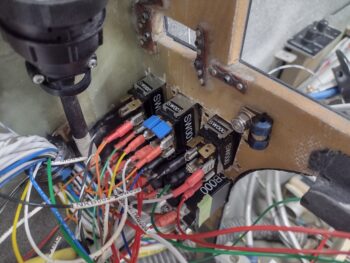
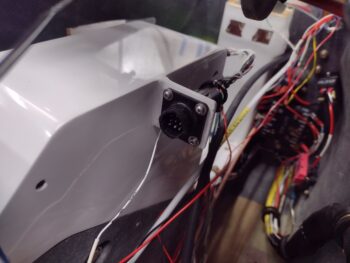
Here is the initial bracket wall test fit with the D-Sub connectors… fit like a glove!
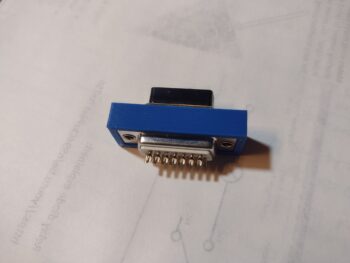
I then created the top piece that fits around the Female (pins) side of this contraption.  Again, a nice tight fit, with the D-sub pin holes showing (pic 1).  And then with the initial bracket body sides slid into place (pic 2).
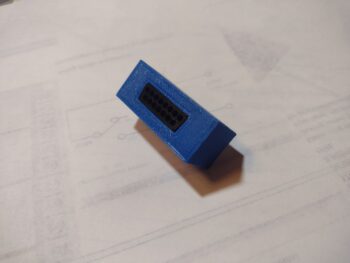
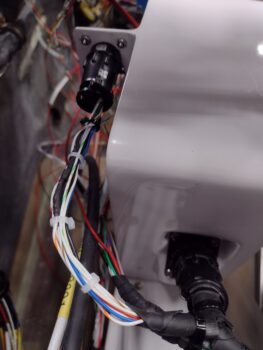
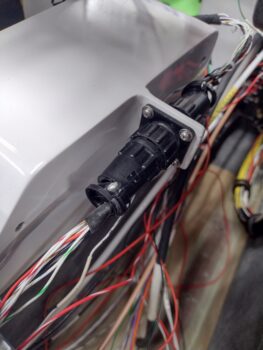
And then the back side of the bracket, which will also get enclosed and mount against the vertical plate of the Tri-Paragon when all is finished.
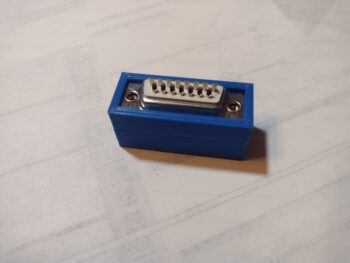
Starting tomorrow, and lasting for the next 2-4 days will be a Nor’easter hitting us, with a LOT of wind, snow and freezing weather… so I will most likely be doing some panel avionics refresher training to brush back up on my GRT HXr & Mini EFISs, GNS-480 GPS navigator, Pro-Pilot autopilot, etc.

Still… pushing forward!
Chapter 22 – Tackling the endless?!

This post covers the past 4-5 days, where I have actually been working some long hours each day on the electrical system…. just hard to grab “action shots” of seemingly endless hours of inventorying and verifying components (relays, inline fuses, micro-switches) etc. that may have been changed out, eliminated or functionally repurposed over all these years as my electrical system has morphed a bit and circuits consolidated in a number of instances.

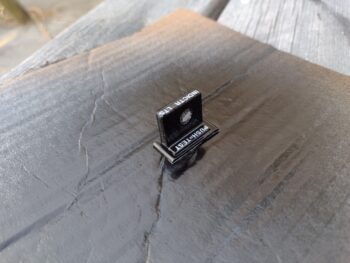
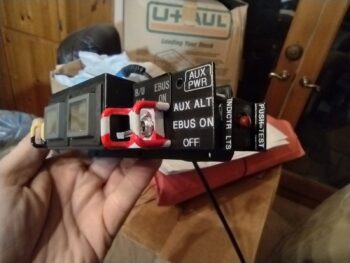
Starting off, I did get the little Push-to-Test button cover glued to the right end of the Warning Annunciator Sub-panel, replete with labels.  I did note in this pic the wisp of glue that seeped out and promptly removed it after the photo-shoot (ha) was done.

On the P5 connector positioning to provide a scooch more slack for the control stick cable, I was able to wrangle another ~3/8″ to get a hair more slack, with both sides of the P5 connector mounted in their original configuration.  I’m calling that more than adequate and will now focus on protecting the cable from chaffing in the area around the bottom of the control stick.  Issue resolved.

Not shown is that I soldered up the inside-conduit wiring harnesses for the Right wing’s leading edge landing/wigwag light and wingtip nav/strobe light.  I did have an issue with the setscrew binding and stripping while installing the nav/strobe light assembly, and have gathered up the bits and tools to resolve that issue (hopefully)… the issue is, as you all may have heard (or are experiencing), the current weather is really darn cold.

Thus, I’ve been holding off on shop tasks until I need to really crank the heaters and do multitude of hours worth of work to justify burning through my Kerosene to heat up the shop to a halfway comfortable working temp.

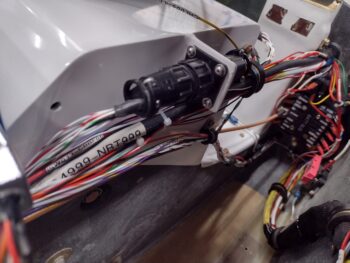
One current and one future capability task I undertook was to connect up my “new” mini-EFIS (MiniUni2) —that replaced my MGL clock/timer in the upper left hand corner of the panel— with the Aviation/MAPCOM data feed out of the GNS-480.  This feed enables the CDI screen and GPS waypoint data displays on the MiniUni2.

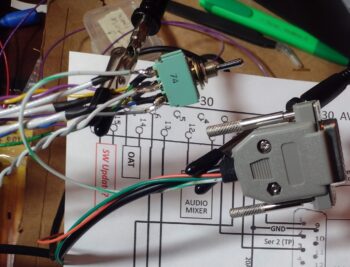
Additionally, since I literally had to create a notch in the case of the MiniUni2 to allow clearance for the outboard bottom corner of the “EFIS vs GPS” (GNS-480) panel switch, I figured I would just tie into this switch for the data feed.  The gray D-Sub back shell lower right is to the MiniUni2 EFIS.

Also on the switch above and tied directly into the GRT HXr EFIS wiring bundle are more ARINC leads to provide for a couple of future capabilities that I’m seriously considering, and much easier to tie into everything now while it’s all exposed and accessible, with a consolidated pigtail to tie into later if I choose to, than to have tear everything apart at a later date… even if I don’t go in any certain direction in the future.

As I mentioned before, the inventorying and verifying of components and parts, which may have been changed/updated on one or two diagrams, but not on others that denote the same components… as well as ensuring that any re-ID’d or renumbered bits get in their final position and true nomenclature annotated.  This includes jacks, plugs, relays, inline fuses, and micro-switches, to name a few.

Then there is the deep dive into each component/system to ensure the circuits are correct both in design and physical implementation, not just on the wiring diagram.

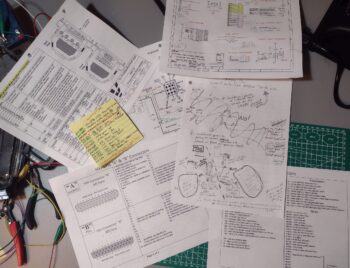
For example, starting in the upper left of the pic below is the AMX-2A 10-channel audio mixer.  I had a question on my circuitry since my pin-out didn’t look exactly as was prescribed in the manual’s primary example.  I couldn’t find any notes or annotations I had made so I emailed Vern Little, the designer of this little gem, to verify ALL my circuits were good.  Within about 10 minutes he emailed me back with a satisfying ALL GOOD (paraphrased)… pressing forward.

At top center is the wiring and pinout sheet for the Video Camera MUX that came to life through a collaboration with Bob Nuckolls (Wichita, KS), Eric Page (Washington), and Alec Meyers (BC, Canada) based on my requirement to connect more than one video feed into my HXr EFIS, and be able to cycle through the feeds.  In the instructions it says that in order to stabilize the video quality and not expose/induce harmful voltage spikes to the board that ALL cameras should be powered from the MUX.

Well… ooops!  The wide angle camera in my pilot headrest looking aft is a 5v camera, that I had powered off of the one 12v-to-5v converter I have in play behind the panel. I queried Eric Page on this, asking if I could use an inline “Buck” converter for this one power source to keep it on the MUX’s power feed… he said he has a small PCB device that he designed for his taxiing camera on his Kitfox which is much more electrically quiet than your typical cheap —but noisy— Chinese-made converter, and that he would make one up for me and send it out…  after being the ringleader in the Video Camera MUX creation, ginning up the “Deslumpifier” for both me and Marco, the mini-amplifier to allow inputting the correct data signal voltage into my EIS for the Electroair’s timing advance monitoring, and now this??  Eric is truly my electronics Guardian Angel!

I’ll note that I also ordered a number of required plugs/components to allow wiring up the video cameras to the Video MUX.

The yellow Post-It pad is me doing yet another inventory of every single micro-switch (aka “snap action” switch) to verify which ones are still in play, which ones have been consolidated and dual-purposed, and which one or two have been replaced with a relay…

Which is pretty much what the chicken scratching page is in the center… although it is my creating a circuit diagram for a relay replacing a regular switch vs a micro-switch.

This new relay, RL019, is a DPDT relay that controls two (2) distinct and separate circuits, both reporting the status of the RAM air can’s valve —open or closed— since that info can range from good-to-know to must-act-now to keep possible FOD out of the engine innards.

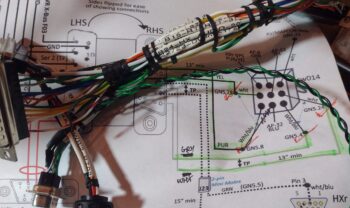
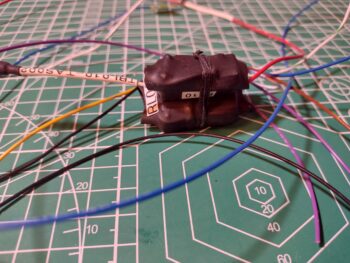
Here is the post-wire soldering to the new Relay 19 (orange) testing to ensure the physical wire solder joints are good as well as the circuit logic.  Both were fine.

As I noted above, Circuit #1 on Relay 19 is controlled (and powered) by the RAM air valve switch being flipped into the “valve open” position.  This powers the relay and the “RAM Air Open” panel Korry indicator light in the row just above the HXr EFIS.  This is an informational light only, denoting that the RAM air valve is open… nothing else.

Here we have the wires of Relay 19 wrangled and tied closely to the relay body (pic 1) which then allowed me to heat shrink all the wires tightly to the relay–and label it (pic 2).

See the short white/blue stripe wire lead between Relay 10 and Relay 19 above?

This is the second circuit that is fed in from Relay 10, it itself which is controlled (on/off) via the #2 airspeed switch.  If the plane is slower than 90 knots, which generally means in the pattern and preparing to land, then Relay 10 powers that white/blue lead to Relay 19’s second circuit common pin.  If the RAM air valve is open via its switch, which in turn powers Relay 19 on, then it closes the Relay 10 feed through the common pin to the NO pin to send power to one of the AG6 warning annunciators with a red flashing “RAM air open” to denote action required in closing the RAM air valve before landing [I would have preferred to use an altitude signal to do this function, but using an airspeed switch based on landing speed profiles was much easier and way less costly].

For ease of mounting on the Triparagon, I then laced the two relays together.

A closer shot of Relay 19 and Relay 10 secured together.

I do have another circuit I’m testing out to keep the canopy-open warning from blaring out when I have the plane parked and the Master switch on… and I had a 4-relay bank board lying around, so am doing a bit of testing on that to see if some of its unique features might work… still underway and to be determined.

My next focus will be confirming, verifying, and wiring up all 12 component alarm inputs into the pair of AG6 warning annunciators, as well as finalizing the wiring and pinout of the separate canopy/gear warning system.

Pressing forward!

Chapter 22 – Warning subpanel wired

Another 3-day post here… where does the time go??

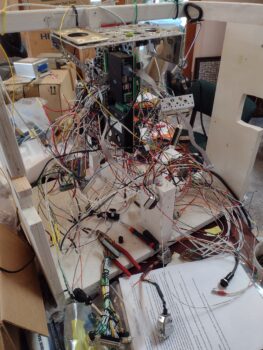
Besides wrapping up my remedial soldering training, and ordering some of the correct consumables for my soldering irons, I’ve been slowly deconstructing my instrument panel mock-up that has been around for about 7 years now.  It houses the venerable (ha) “Tri-Paragon” that is somewhat analogous to a glorified T-shaped motherboard that houses many of my electrical, flight control and avionics system components, as well as electrical system power and ground busses.

If you look closely you can see behind the mock-up is the removed GRT HXr AHRS and Trig COM radio and transponder remote units.  I also pulled all the mock-up specific wiring out to clean it up in prep for the no-kidding wire interfaces that await it inside the bird.

Within the next day or two I plan to get to some no-kidding wire and cable management accomplished to clean and organize it all as best possible to facilitate its move into the airplane.

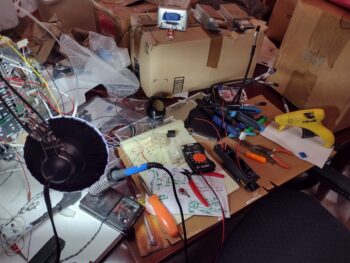
I have a few component and wiring tasks to complete before they too are added into the mix, so just next to the mock-up I carved out a little spot on the kitchen table as a make-shift work space for soldering and assembling those few components remaining.

What components you may ask?

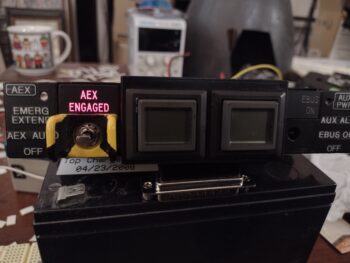
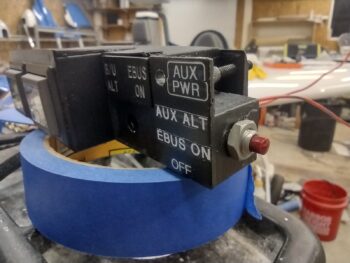
Well, first out of the gate is the Warning Annunciator Sub-panel which sits TDC on the instrument panel.  Besides the pair of actual AG6 Warning Annunciators, it also houses the Automatic Gear Extension System, or AEX, switch and indicator light on the left side [this replaces the original switch and LEDs that came with Jack Wilhelmson’s EZNoseLift nose gear extension system].

On the right side it houses the switch that isolates the E-Bus (cutting off Main Bus power) and fires up the SD-8 backup alternator that supplies the E-Bus with about the same current that it draws.

Here we have the left side AEX switch and indicator light wired up.  Yes, it won’t win any wiring beauty awards, but it’s functional, fits, and works.

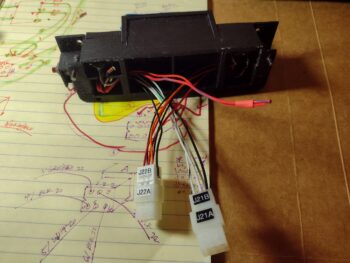
I terminated the wires from each switch/light(s) combo into mini-Molex connectors to both facilitate installing the Warning Sub-panel onto the panel via the two 3/4″ holes I drilled for each AG6 compartment, as well as terminating all the wires after it is installed.

I then tested out the AEX switch/light combo… which worked a treat!

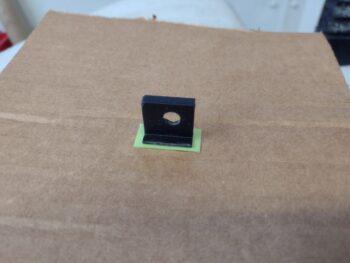
The morning of Day 3 I drew up a surrounding cover in CAD for the “last minute” (circa 2018?) addition of the row of Korry indicator lights’ —which adorns the top edge of the HXr EFIS— Push-to-Test button to get it off the panel (very tight space for stuff!) and into a spot that easily makes it a side note: the right end of the Warning Annunciator Sub-panel.

The somewhat diminutive push-button installed with not too much problem (some finagling required), but I had no viable way of identifying exactly what its purpose was… with no good visible surfaces to affix any labels.  Thus the 3D printed surround that has two vertical edges to attach said labels.

Here is the 3rd and final version, just off the 3D printer and ready for painting (pic 1) and after a few coats of hi-build primer, black paint, then labeled and clear coated (pic 2).  I’ll note that most of the past week was COLD weather, but today it was in the mid-60s… perfect for painting.

I then spent the requisite few hours wiring up and installing the right side E-Bus ON & Aux Alternator (SD-8) power switch and indicator lights.  Here you can see some of the final wiring and the mini-Molex connectors labeled.  Note the pair of red wires which is for the Push-to-Talk button.

And here is a short video that provides a quick overview of the Warning Annunciator Sub-panel, which also covers the functioning of the switches and indicator lights.

I expect that within the next week max that I should have the Tri-Paragon installed in the bird and will be pushing to no-kidding start populating the panel with instruments.

Chapter 22 – Light switches wired

First off, this blog post covers the past few days…  which were a bit busy.  Jess and I spent later afternoon into Saturday evening prepping for, and then attending, the EAA holiday party/potluck, which was a good time had by all.

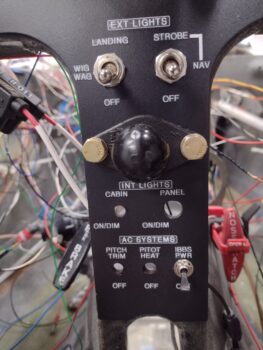
I was able to get most of the landing and wig-wag light switch wired up in the couple hours I had available to work on the plane, finishing it entirely the next day.  I then wired up the Nav/Strobe light switch to finish off the switch side wiring for these 2 light switches (the power and ground connections still need terminated into the appropriate busses).

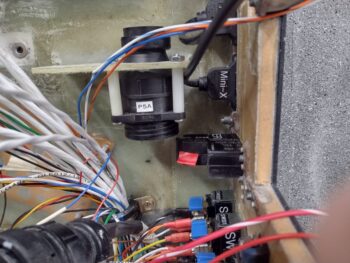
I installed the P5A connector below its bracket (vs on top) with 1″ spacers to assess providing a bit of slack to the control stick cable.  It looked fine until I received the battery for the ELT remote switch, and installed both the battery and the switch (temporarily… not screwed) into place.

As you can see, the ELT remote switch intrudes into the space of the P5 connectors —not enough clearance— so I need to go back to the drawing board and consider one of my other options.

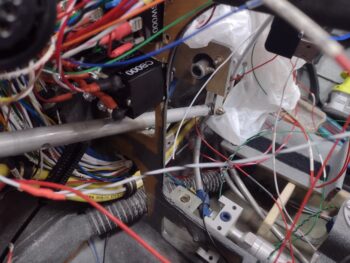
I also hooked up the Landing Brake ground wire (middle of pic – vertical) and the control wire (labeled) that is terminated into the P4 connector (throttle switches’ wire cable).  Both these wires tie into a pair of wires that can be seen just above the top outboard corner of the ELT, and together make up one half of the circuit to the Landing Brake switch on the throttle.

I’ve been having an issue with my soldering iron tip giving me grief during splices, etc, so I did a multi-day, multi-hour deep dive on that to order the correct tips and hone my soldering Kung-Fu skills moving forward.

Day 3 I received my order from Steinair, including a new 5A circuit breaker to replace the one that I destroyed with such manly power installing the screw on the wire tab (ha!).

As you can see the new one is in and wired up, with no issues thus far.

A couple nights ago I copied the wiring circuits from the wiring diagrams and verified the circuits for the Auto Gear Extension system and SD-8 Backup Alternator and E-Bus only switches that both reside in the Warning Annunciator Sub-panel.

In prepping to wire up those switches (thus my critical emphasis on a well-working soldering iron) I drilled/bored out the holes a little on the right side to install the Push-to-Test button for the row of On/Off LED indicators just above the center EFIS.  It took a little persuasion, but for the most part the push-button switch cooperated and went into place (pic 1).  I then solder-spliced (after cleaning the solder tip with a new compound) wire extensions onto the switch leads to allow the wires to be run through the instrument panel fairly easily (pic 2).

After hauling all the tools into the house for a few rounds of soldering to finalize as much possible on the Warning Annunciator Sub-panel and right (which I’ll work tomorrow), I called it a night.

Chapter 22 – Dim(mer) witted!

I started out today by wiring up and then installing the Pitot Heat switch.  I then focused on getting the two (2) dimmer switches installed, which required me getting back into their respective install manuals to get the job done.  Those required wiring up as well.

The new switches will require the Tri-Paragon to be installed to truly finish up the wiring, as with nearly all the switches on the panel.

I spent a good hour organizing, cleaning up and deconstructing my wood panel mockup in preparation for the Tri-Paragon to soon be installed in the bird.  Obviously having a temporary functional mockup meant that I had to run a bunch of temporary power and ground wires.  Thus, after pulling those off the mockup, I repurposed them on these Dimmer switches for both the power and ground —replete with already attached FastOn terminals (power) and D-Sub pins (ground).

Here we have the front side of the panel showing the Dimmer switches installed (and the orange wires peeking out from underneath for the Pitot Heat switch.

It was quite chilly today and my shop heater ran out of Kerosene in the mid-afternoon, so I ran down to get some more.  While out I stopped at a small hardware store that has a good “Aviation Hardware Department” <wink>.  I grabbed some 1″ spacers and SS screws to test out installing the P5A connector lower to provide the control stick cable another inch or two of slack.

The green tape on the panel is where the ELT Remote Switch mounts.  The battery for that should be delivered tomorrow, at which point I’ll install it and verify clearances between the combined P5 connectors, the ELT Remote Switch and everything else.

A backup option that I have for providing the slack I want for the control stick cable is to convert the P5 cable connector to a D-Sub connection, which would be much smaller and easier to fit into such a busy corner of the panel.  But before I lop off all those CPC pins and sockets I want to do my fairly quick due diligence and see if these current connectors will fit into this corner melee.

Inching forward…

Chapter 22 – All about the Bus…

The BATTERY BUS that is!

I finally got my wire label heat shrink cartridge delivered today and quickly pressed it into service to make 2 batches of labels, a number of which I used immediately.

I got a late start in the shop today, and even when I got out there the physical space that is inside my panel area pushed me to call an audible regarding my to-do list.  I had planned on knocking out the top pair of switches (landing and nav/strobe lights) on the center strut of the panel to all my big switches knocked out.  But after assessing the space, I realized I would be making the install of the lower switches and dimmers quite a bit more difficult access-wise and visually.

I decided to start on the lower triplet of switches (Pitch Trim Master, Pitot Heat, and IBBS Master) and work from the bottom up.  The Pitch Trim Switch is currently hardwired to the TCW trim system unit on the Tri-Paragon, so will not be installed until the Tri-Paragon is installed.

The simplest of the two bottom switches left was the IBBS Master power switch, so I targeted that.  However, it had some required prerequisite tasks (par usual) before I could install it: I had to route the wires from the nose aft.

Sitting about the #4 slot on my to-do list for at least a week, which keeps getting squeezed out with new tasks, was the installation of Adel clamps on the NG-30 upright (aka “goal post”) on the aft side of Napster bulkhead (just above/inboard of the Battery Bus) and in a few spots on right side of the NG-30 cover.

Ahhh, but running the wires through the Adel clamps had its own prerequisite tasks (see why I’ve been kicking this can down the road?!): collecting up ALL the wires —to ensure proper Adel clamp sizes— which entailed A) finding them all, B) extending the short wires to make the journey through the Adel clamp “gauntlet” and C) terminating wires coming forward from the panel area to connect to the Battery Buss (plus simply organizing the wires in their appropriate bundle grouping).

I started by solder splicing a length of green/red striped wire to the Relay 18 control wire (upper center of pic).  Later I had to extend the white signal wire of the CS6 ammeter that reports panel current to the HXr EFIS.  Next was rounding up and routing the Landing Brake power wire to the Battery Bus as well as the cigarette lighter charger at the right base of the panel strut (both terminated middle right of the Battery Bus).

Once these wires were terminated, heat shrank, etc. and installed into the Battery Bus, this completes the Battery Bus component wire population (not a bad milestone to reach!).

I then spent the next 2-1/2 hours routing/rerouting, zip-tying, sizing/installing Adel clamps a low bundle of wires and top bundle of wires down the right side of NG-30 and its cover.

I still have a couple of straggle wires that will need extending (or terminated to its mate on the Tri-Paragon) and there is a possibility that I may have to swap out the big grounding cable that connects the “Forest-of-tabs” ground bus on the Tri-Paragon to the battery’s negative terminal (it may be just an inch too short).

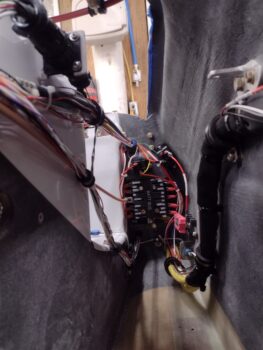
Here we have another shot of newly corralled wires down the right side of the NG-30 (pic 1) and from the F22 leghole looking forward at the Battery Bus (pic 2).

The convergence point of the P2 connector, upper and lower wire bundles coming aft is a single Adel clamp just forward of F22, about an inch up from the very aft NG-30 side plate, but actually on the NG-30 cover.

As I’ve labeled this pic: Yep, that’s a lotta wires!

Don’t forget the IBBS master power switch… which I finally got to nearly 4 hours later!

Yes, now that the IBBS power wire was routed up to the aft edge of F22, I could better ascertain the required wire length since clearly it terminates on the switch itself.  I soldered the IBBS power wire to the switch, and then rounded up, cut and soldered a black ground wire on the other switch terminal.  The label for this ground wire is on the list and will be printed with the next batch and applied then.

Tomorrow I plan on installing the Pitot Heat switch and the 2 dimmer switches above that.

I spent about 45 minutes on my last task of the evening which included installing the battery, which BARELY fit into the battery compartment… it was a struggle and I wasn’t sure if it was going to fit with the IBBS AND the main bus power and ground cables coming in/out the top of Napster.

My main reason for installing the battery was to get an exact recon on the black ground cable that goes to the Tri-Paragon ground bus.  Again, it will be very close on if it fits or not.  And to be clear, this is a repurposed cable that I original bought from B&C, and then decided not to use it where I had originally intended it for (as in, I didn’t cut it to this length, just trying to make it work if possible).

Again, another VERY late night… but slowly getting there.

Pressing on!

Chapter 22 – Big 3 switches wired

I’m not overly happy with the somewhat remote locations of my main and endurance busses on the TriParagon.  I didn’t know what I didn’t know starting out so many years ago, and now with the nose enclosed, nose hatch installed, canard installed, etc. I can see that finding a fuse that has popped, admittedly rare as that is once the systems are dialed in, will at a minimum require a mirror, and perhaps even a flash light.  So I did a good amount of assessment on that issue, with 3D printed footprints of the busses to assess more optimum locations, and an assessment of wire flow, accessibility, etc.

After that exercise, I finally got out to the shop, where I spent nearly 4 hours finalizing all the wiring on all but one post of the circuit breakers, and on all of the Big 3 switches in the lower right side of the panel.

Now, see the green tape on the circuit breaker below the row of Big 3 switches? That was the 2nd to the last final wire I was installing onto the circuit breakers.  I couldn’t get the best angle with my Phillips screwdriver, so I used a larger flat tip.  Well, giving it a firm push down as I installed the screw —as I’ve done with all the other circuit breakers— the tab gave way and the bottom of the CB cracked with a couple of pieces of plastic falling onto the floor of the bird.

Yep, 5A circuit breaker CB000 is no muy bueno.  Este es muerto (excuse my hack Spanish: it’s no good and it’s dead).

Back to my busses for a minute… I texted Marco for pics of his busses.  In our discussion, he pointed out the “Lit when blown” ATC fuses to help with ID’ing a blown fuse in the nether-regions of the nose.  I had already decided on those and had them on a list of items to buy from Steinair… and now I just added another item: the 5A CB.  With that added, I finalized my order and pulled the trigger late this evening.

Lastly, see those blue 3D printed caps on the unused switch top tabs on the middle switch?  I drew those up in just a few minutes in CAD, guessed on all the dimensions and thought I’d have to do another version or 3 to dial them in, but they fit nice and snug the first try.  I have another batch printing and will cover all the unused tabs on my big switches, to minimize any hand impalements while working behind the panel, any errant wires or inadvertent grounding, and simply to better assess circuits on those switches.

Back at it tomorrow.

Chapter 22 – Function over form

… at least for the time being.  I say this because my urge is to overhaul the configuration of my electrical components situated on the Tri-Paragon, but that will have to come later after I get this bird flying.

This post covers the past few days… yes, the electrical system install has been a longer, slower slog than I prefer.  A lot of labeling, cross-checking and mundane work of pulling wires, soldering, terminating connectors, heat shrink, wire management, etc.

I started off today by cleaning out the mounting holes in the right side top tab on the NG-30 cover.  I then installed the forward P2 connector, which would be identified as P2A, with the A designating the connector side closest to the nose.

Here we have a shot of the installed P2A connector from nose looking aft (pic 1), and after I installed the P2B connector… AFTER I spent about 1.5 hours finalizing its configuration with terminating sockets on wires, labeling them and verifying the circuits with my wiring diagrams (pic 2).

My next goal was to get the final circuit breaker installed, which is the “NAV/GPS” 5A circuit breaker for the Garmin GNS-480.  Technically it was already installed and operational, just on my panel mockup in the house.  Thus, some DIS-assembly was required.

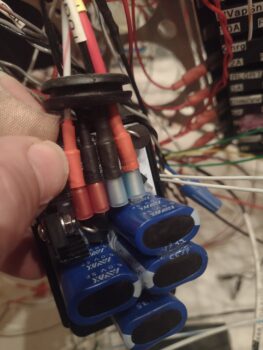
On the first lead coming off the circuit breaker I had to break open the “Deslumpifier” and pull the hot lead out of it (the one at the tip of my thumbnail).

I then had 2 more power wires to pull off the main D-sub connector that connects to the back side of the GNS-480 unit.

After a quick cleanup of the circuit breaker, into the bird’s panel it went.  I then used a 14mm socket to do the final tightening on all the circuit breaker nuts to ensure they were securely mounted.

After some final “engineering” on the circuit for the StarLink Internet Antenna that will be going into the nose, I soldered up the leads of the mini-switch (sw017) and then mounted it just adjacent to the left sidewall in the lower left area of the panel.

I finished off the evening doing an inventory of all the wires that started or ended in the nose battery compartment and the battery buss just on the aft side of the Napster bulkhead from those wires in the bundle from the aft side the bird, the circuit breaker cluster, or the Big 3 panel switches… all on the right side of the panel.  Instead of running these wires in to the center, then forward, the back outboard, I decided to simply piggy back off the big wire bundle already transiting down the right sidewall of the nose.

The next morning, with about a half dozen wires identified, I got to work.  The first wire was from the bundle and comes from the hell hole.  It disconnects the TCW Tech IBBS from charging if the main alternator is offline and I’m on SD-8 backup alternator power.  Obviously this terminates at the IBBS in the nose battery compartment.

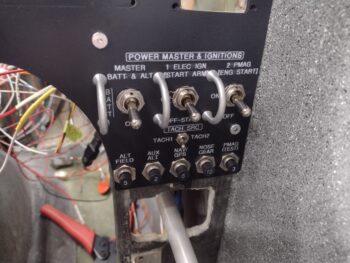
The next wire was the 20 AWG black ground wire from the Master contactor (in the nose) to the Master switch.  When the Master switch is flipped on this wire goes to ground, which fires up the Master contactor.

Another significant wire of note also comes from the aft end of the bird in the bundle that connects the electroair coil pack directly to the battery buss on a 10A fuse.  This was one of those head scratchers with me asking, “Why did I do that?” since I ran an 18 AWG wire.  In my mind I knew that the specs supported it, but later I couldn’t find them in any of my notes or emails.

The next morning I called electroair to figure out why I used an 18 AWG wire vs a 16 AWG or bigger.  The tech said that the average load was less than an amp… ok, makes sense why I used the 18 AWG.  He then said the initial inrush current could be as high as 5 amps.  Ok, 18 AWG still plenty in my book.

BUT…

they recommended a 16 AWG wire (again, as with GRT, I’ll note this is NOT stated in the installation manual).  He said if the wire was buried that 18 AWG would most likely have no issues (with Tefzel wiring, this I believe wholeheartedly).  I told him I would meet him more than halfway, since I knew in my mind I could most likely get a 16 AWG wire from the nose to the area just in front of the GIB control stick.  Further aft would be a MAJOR PITA and I just didn’t believe it was called for….

If this were a single seat bird I would have left the 18 AWG wire and pressed forward, but since I have that back seat I felt that I should follow electroair’s guidance as best able to optimize passenger safety by swapping what I could with 16 AWG, which was about exactly where I figured: just forward of the GIB control stick on the sidewall.  This leaves about 4-5 feet of 18 AWG, which is simply not going to flinch at a 5 amp inrush current, let alone less than an amp sustained current.  So final configuration is about 2/3rds 16 AWG and 1/3rd 18 AWG wire.

And that folks, is how I started the first 2 hours of Day 3: swapping out the majority of the 18 AWG wire for 16 AWG.

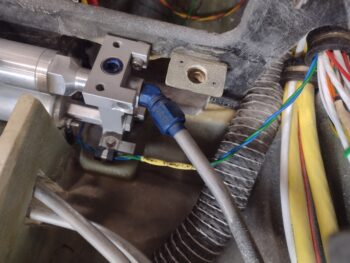
I then spent a bit of time on the EFII fuel boost pump.

For starters, I used some Simple Green and a scrubbing pad to clean it up a good bit.  I then spent over an hour verifying the circuitry (which I simplified), improvising more wire labels (I burned through my wire label cartridge and the new one I ordered hasn’t been delivered yet),  pulling the indicator light wire off the panel mockup to be terminated into the bundle and assessing exactly how the wire runs would go in such a tight confined space (while avoiding the sharp corners/edges of the pump).

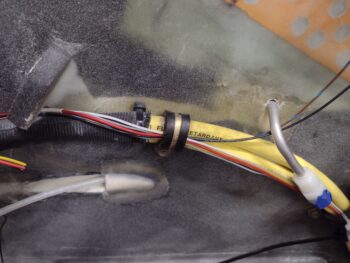
I then ran the fuel pump power wires up the right side bundle and then crossed them over to the left side switch (very bottom pic below).  And with that… Voila! Both my fuel pump AND all the lower left side switches on the panel are wired up and installed.

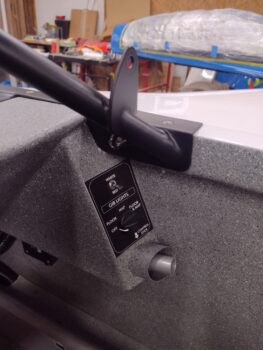
Before I show the last panel pic, as a reminder, here is the GIB light switch control panel.  As the my descriptor strongly infers: it controls ALL the lights in the GIB area.

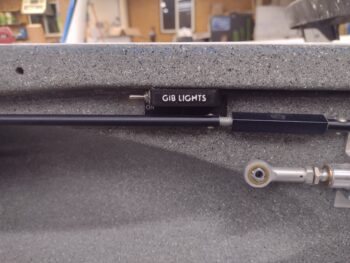
However, my GIB (as in Gal in Back) is prone to fall asleep.  And if I need those lights off for any reason, I have the Master power switch to all of them on the left sidewall just under the longeron.

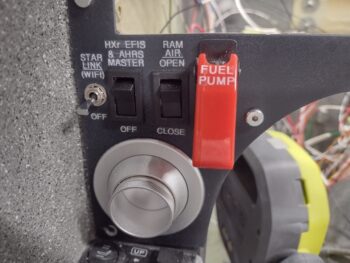
With all that info in hand, here we have the Fuel Pump switch (sw009) wired up, the StarLink switch (blue) near the sidewall, and we have a green (12V+) and white/black wire at the top of the pic (GIB lights Master switch) that is now connected to the wires coming from the right-side bundle for the GIB light control switches. 

Not shown is that I solder spliced the SD-8 control wire to take the IBBS charging circuit offline when the SD-8 is online.  Out of 8-10 amps available when on SD-8 power, I really don’t want to be expending 2.5 of those amps recharging the backup battery (which, unless any event occurs at the very beginning of a flight, the IBBS should be fully charged anyway if/when the backup SD-8 would have to be used).

As you can see, I’m still moving from nose-going-aft to back seat forward in knocking out this wiring.

Admittedly, as I tell my wife, I’m still amazed when I work all day long and have seemingly so little to show for it at the end of the evening as I install this electrical system.  It just takes a crazy amount of time to ensure everything is annotated, confirmed, verified, tested, labeled, routed and installed.  But . . .

I’m still pressing forward!

Chapter 22 – Crawling to finish

I’m getting a lot done on the electrical system install for certain, but admittedly a lot of it is organization, administrivia, wire & component labeling, and final circuitry determinations.

Not shown is my final numbering and labeling of the relay deck that will soon be installed on the top of the Tri-Paragon.

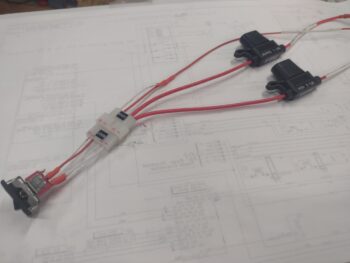
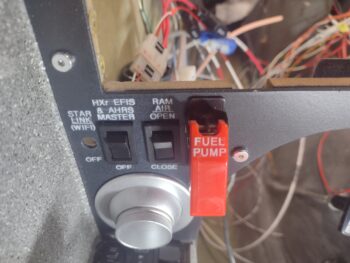
Amazon delivered my inline ATC fuse holders with 18 ga leads (vs the ones with massive 12-14 AWG leads from all the aviation/automotive outlets).  I thought I had ordered another set with 20 ga leads, but apparently both showed up with the 18 ga leads. Regardless, I quickly used these as integral components in my new HXr EFIS & AHRS Master switch sub-harness, replete with a 5-pin Molex connector (I had no preferred 3 or 4 pin Molex connectors on hand) to allow me to split the circuit for physical switch installation into the panel.

Why the inline fuses?  Because on the GRT forum one of the GRT techs stated that power circuits should be fused AFTER any switch (I’ll note that’s NOT stated in the manual).

Why the Molex connector?  Again, because this switch (like its twin RAM air valve switch) mounts from the front of the panel inward.

Once all my switch sub-harness creation and labeling was complete, I then installed the switch into the instrument panel… another domino knocked down, one at a time!
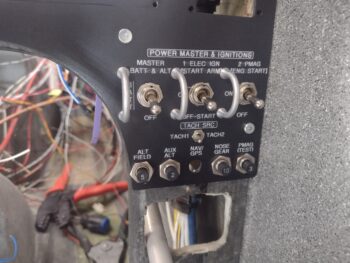
I then installed the ALT FIELD circuit breaker . . .

and then made up and installed the 18 AWG cross connect wire between it and the Master Switch.

I then worked for about 2 hours finishing up the circuitry and wiring change to the P1 nose gear motor connector (front of NG-30 cover/center of pic) segment to the P2 connector (right side of NG-30 cover/top of pic).  I finished up terminating pins and soldering wire segments to add 4 previously loose wires into the P2 connector (front half, “P2A”) before wrangling all the wires together.

Tomorrow, I’ll physically install the P2 connector to the NG-30 mounting tab with screws and finish terminating wires into the aft side of the connector (P2B).

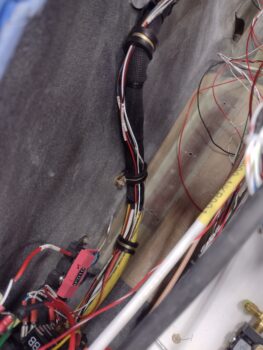
My final task of the evening, which I spent another couple hours on, was the routing of the wire bundle coming from the aft part of the airplane through the newly installed Adel clamp on the sidewall.  I had to pull some shorter wires out that will need wire segments spliced onto them to extend them to reach their final connection points.  I also spent a good 30-45 minutes tracking down wires that I couldn’t find any labeling for (Yes, lesson learned that I should have labeled the VERY END of each wire… <sigh> but it is what it is… )I also identified and labeled the multi-wire cables before calling tonight’s tasks done.

Yep, it was very late (well after midnight) by the time I finished, and I was quite ready to pack it in for the evening.  More to come tomorrow . . .

Chapter 16/22 – My 3 hour 10 min. job!

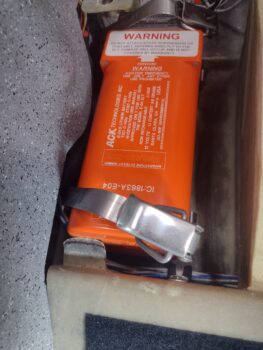
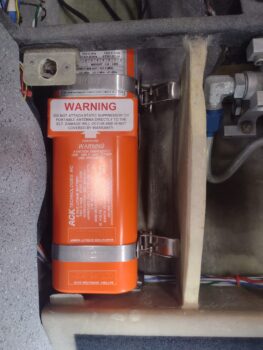
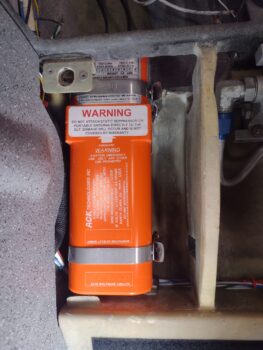
Today was supposed to be the first of a 3 day blitz where all focus would be on wiring up the bird, with small sideline tasks here or there.  As you read below you’ll discover, as I did, that a major portion of my time today was spent with ‘Fein’ saw and Dremel tool in hand making a lot of dust as I cut out stuff to allow the ELT to both install in place and the clasps to work as designed.  So my 5-10 minute “minor” task of installing the ELT mounting tray literally turned into a nearly 3 hour task… but it’s in!

Read on Dear Reader…

I started off today installing my padded carbon fiber wire-flattening plate and zip-tying that into place, before determining that I needed a -11 Adel clamp up higher.  Again, this wire bundle is all the wires coming from the aft of the aircraft —that I had originally planned to run up the edge of the right outboard leghole edge— and it needs to be secured to the sidewall as flat as possible to keep out of the way of the elevator control tube.

After determining the best spot for the Adel clamp to secure the wire bundle, I then drilled a hole, prepped a RivNut and then floxed it into the sidewall.

To keep the floxed in RivNut pressed against the sidewall nice and tight I used one of my clamps as a spreader for a few hours while the flox (MGS 335 with fast hardener) cured.

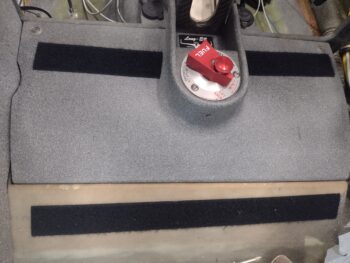
My planned “sideline” (read: non-electrical related) task for the day was removing the GIB seat cores, straightening out the Velcro attach strips, which included trimming the Velcro and cutting it at the seams of the back seat hole covers and around the thigh support sump tank covers.

With the GIB seat cores out of the bird, I then finalized the hardware install on the GIB control stick, with the top castellated nut requiring a cotter pin.

My next “quick kill” was to be a 10 minute install of the ELT mounting tray.  I have to say this went south from the get-go, since after finally finding the right length #6 screws I promptly installed the tray with the securing straps in place… only to find that I missed the stamped “FRONT” and “BATTERY” markings on the straps.  Of course, I had them reversed.  Another 5 minutes to fix those.  Not bad… done, right?!

Yeah, until I actually mounted the ELT into the tray.

I quickly found that the aft/battery end of the ELT couldn’t seat due to the pilot thigh support tab being too wide front to aft.  So I marked that for trim (pic 1) and trimmed ‘er up.  After 2 rounds of trimming and vacuuming up the mess, the ELT actually fit and seated into place.  Success!  . . . right?!

Uh, no.

I then found that the vertical support rib for the pilot thigh support (to ELT’s right) was not allowing the ELT strap clasp handles to flip downward to allow engaging the tang on the clasp (pic 2).

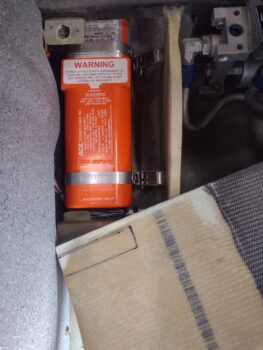
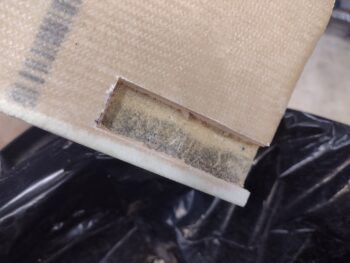
Also, with the ELT seated fully down in its tray, it still wasn’t allowing the thigh support cover to seat into place.  Clearly some relief was needed, so I quickly marked a strip on the aft corner underside of the thigh support plate for cutting…

Which I did next.  After checking its fit, I’ll glass it later.

I then spent the next hour using my Fein saw and Dremel tool to cut a notch on the forward end of the thigh support rib and a channel on the aft side, all to simply allow flipping the ELT strap clasp handles up and down enough for the loop to engage the tang on the tray.   This involved iterations of tray and ELT in, then out for cutting, as well as constantly reorienting the blade on the Fein saw to get the proper angle… and not inadvertently cut anything that didn’t require it!

My perseverance won out and I finally got the darn ELT installed (without connections of course)… Voila!  While it put up a valiant fight, I won the battle!

The cherry on top was that the pilot thigh support cover fit back into place nicely after the aft corner notch was created… again, I’ll glass that later.

After all that unexpected time spent on the ELT install, the right sidewall installed RivNut flox had cured, and I took the spreader clamp out and removed the washer.  Here it is after a quick cleanup.  I’ll let it cure overnight before installing the Adel clamp.

I spent the next hour disassembling the P1 connector (lower right corner) and the P2 connector (upper left corner) to remove 2 unneeded wires in my quest to replace the “Gear UP transit” and “Gear DN transit” indicator lights with just one “Gear IN Transit” light.

I cut the 2 remaining wires that connect to the gear motor positive and negative leads  to the indicator light and soldered in a diode on each wire.  I then combined the diode leads along with one of the pair of wire leads going into the P2 connector, and soldered those up (black heat shrink in middle of pic).  At the indicator light, the other lead will now go straight to ground.  This allowed me to remove the pin and lead of the remaining wire of this pair since it is now no longer needed.

Clearly, this means a total of 3 pins/wires were removed from the P2 connector.  I do have some loose wires that I will terminate and install into those 3 positions to help clean up the wiring in the nose/NG30 area.  Since my stock of AMP CPC pins were in the house, I’ll do that task tomorrow.

My last task of the evening was installing the 10 amp circuit breaker (CB001) for the nose gear power.  The hardest part of that was weaving the CB with its attached wires in tow through all the myriad of loose wires inside the front of the bird.  But it’s in.

Tomorrow I plan on getting the “ALT FIELD” CB installed, which will leave one left (which is currently attached to the TriParagon, still installed in the mockup panel).

Again, I still plan on focusing primarily on wiring and avionics for the next few days before I break back out onto other tasks.