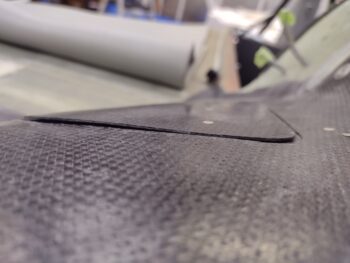
Chapter 19/23 – Wing heat shield tabs

Today was all about knocking out the wing roots’ heat shield mounting tabs for the aft heat shields, which cover a good 2/3rds of the entire wing root.

This specific style of wing root heat shield was designed by Steve Beert after he had a plans spec heat shield break and a part of it go out the back of the cowl through the prop.  Luckily there was no damage, but he changed up the mounting style of his heat shields.

I’m pretty much copying Steve’s design, with a slight modification: due to the oil cooler on the left/port side and the autopilot roll servo on the right/starboard side, the front 1/3 of the heat shield will be inset into the wing root about 1.5″, whereas the aft 2/3 segment will be pressed up against the wing’s cowling mounting flange inboard edge.  There will be an intersecting dogleg at the junction between the two segments.

Here is the left side, with temporary slats to support the vertical portion of each laid up mounting bracket, which is essentially an “L” bracket facing into the wing root.  I prepregged the 5-plies of BID for each 1″ wide x 2″ total length tab.  After laying up each sets of tabs I then peel plied the layups.  I’ll further note that I used the same high-temp resin (HTR-212) on these brackets that I did for the internal carbon fiber engine baffles.

I then did pretty much the exact same thing on the right side.

Now, these layups certainly aren’t crazy hard, but with all the plies of BID that needed cutting (all scraps BTW) and working close to blind laying up the BID on the backside of the slats, it took nearly 5 hours total to get these layups knocked out.

Tomorrow I’ll do some more work on these and also attempt to get the bottom cowl aft baffle seal rib layups started.

Chapter 22/23 – Heat shields prep

Ok, this post covers the last couple of days…

First off, I did a fair bit of assessing and poking around to figure out what to do on my crankcase vent tube issue.  I didn’t want to keep pouring time into the welding solution in case that doesn’t play out the way I would like.  I needed some backup and initially that was the 5/8″ stainless steel tubing that I have on hand, which I originally ordered (a way long time ago) after seeing that is what James Redmond used.  However, after figuring out we’re talking a near 6 oz weight increase, I decided to bite the bullet and order some more aluminum tubing stock, both 6061 and 5052.

After settling on Aircraft Spruce as the source of supply, and paying the small fortune for shipping, I spent another good hour scrubbing all my hardware requirements to add those to the order.  If I’m paying more in shipping than what the tubing costs, I want to maximize what I could add to the order for “free”.  I also spent a good hour looking around for a decent priced 5/8″ tube (not pipe! there’s a big difference) bending tool, which I final settled on one from Amazon… all this stuff arriving early next week.

Administrivia and requisitioning duties complete, I then turned back onto the build.

First up, I took the top cowling outside and sanded down the carbon fiber patch I had just laid up the day before.  There was still a bit of a concave dip on the right vertical aft wall, so I laid up one more carbon fiber strip, about 1/2″ high by 5″ wide.  I then peel plied it.

After some more assessing and figuring out exactly how my wing root heat shields will be configured, I decided that the last little open gap at the trailing edge wing root needed to be filled in to keep any air (or fire in this case) blocked out… since I wasn’t going to cover that with the heat shield.

Thus, as a prerequisite tasks to installing the wing root heat shields, I made up some cardboard dams for pour foam, taped them up and secured them in place on each side.

I then whipped up a small batch of pour foam and applied some to each aft corner wing root.

About 20 minutes later, I pulled the taped cardboard dams off the pour foam, cleaned it all up and shaped the pour foam.

I finalized the prep of the pour foam, made little “flox” corners (micro used here) and cut out a ply of BID for each side.  I then whipped up some epoxy and micro’d up the pour foam.

I then laid up a ply of BID on each side… which is hard to see because the small bit of BID on the edge kept wanting to lift off at the top corner (each side) so after adding peel ply, I taped the layup down at the corner.

While my aft wing root layups cured, I then spent nearly 2 hours with half the shop lights off, with work lights on the top of the engine to find any small gaps in the baffle seals… which I then gooped up and filled with hi-temp RTV.  I finished the left side of the engine, as well as around the alternator and starter on the aft side.  I still have the right side to complete, as well as a big 1 sq. in. hole on the forward inboard left side (I’ll either have to rivet in some aluminum or make an RTV-BID patch for that).

Continuing on with my completely un-sexy, but required, tasks, I then assessed the engine ground strap run from the front right corner of the engine to the firewall.  When I started this final assessment, I thought I was going to have to move the firewall ground block since the routing of the ground strap was virtually right through (or rubbing against) the main fuel feed line from engine fuel pump to fuel injection servo.

However, after simply pivoting the ground strap terminal on the engine inboard about 0.3″, it provided me the clearance and slack I needed to route the engine ground strap around the fuel line to the original ground block position.  And no, I didn’t discover this right off the bat, but rather after about 45 minutes of playing Firewall Tetris with the engine ground and power cables.  Anyhoo….

Tomorrow I’ll be working more engine stuff in attempt to wrap up all the remaining engine install tasks to then allow me to pull the engine and work on the firewall install and also micro finish the top side of the bird in prep for painting.

Chapter 23 – Conciliatory dipstick…

My goal today was to get the crankcase vent tube forward angled segment —which cracked off while I was bending it— welded to the remainder of the tube, and then hopefully move on to getting the dipstick rod joined to the dipstick cap.

But first, I kicked off the morning with some cowling repair by adding some carbon fiber plies to some low/concave spots and divots.  In these small areas I would rather add smaller patches of carbon fiber and sand it down even, then to have thicker applications of micro which tends to crack over time on the ever-vibrating thin-walled cowlings.  So using a small amount of mixed up epoxy and a few selectively cut carbon fiber scraps, I made my repairs (I’ll note that I used the ProSet epoxy which I recently heated up to bring back to liquid vs big glob form).

I then left my cowling repair layups to cure as I did a bit of research on welding 6061 aluminum.

Once back out in the shop, I trimmed down the cracked edges at the break in the crankcase vent tube and got to work on welding that back together.  I first did a good amount of TIG runs on some scrap 6061 and felt I had decently warmed up for this welding session.  However, I have to say that I’m bit flummoxed with the sheer ugliness that ensued.  I’m not a great welder, but I’ve held my own in a number of welding projects in the past: stick, MIG and TIG, so I’m not trying to blame my equipment… it could certainly be me.  But I just don’t seem to be striking good arcs, getting good puddle action or decent melting in of my welding rod.  I’m guessing I may need to do a total swap-out and deep cleaning of my electrodes, consumables, etc. because strange things are afoot at the Circle K.

I really didn’t want to keep attempting a bad position, so I stepped away from welding for a bit and concentrated on another required engine task: the dipstick.

Here we have the older, shorter stock Lycoming oil level tube and dipstick, as well as a 3/16″ diameter 6061 rod and an eBay special properly-threaded and o-ringed cap for the taller gold-anodized Superior oil level tube.  BTW, I found out about this aluminum cap from an RV bubba on the VAF forum.

It was time to join rod and cap to create a proper dipstick.

I started by taping up the knurled edge of the oil dipstick cap and mounting it into my lathe’s chuck.  I then set up a center drill (pic 1) and fired up the late to get me a nice center drill starter hole for my drill bit (pic 2).

I then drilled a 0.75″ deep hole into the underside of the oil dipstick cap…

which allowed me tap 10-32 threads into the hole (pic 1).  I then tested out my tapped hole with an AC grade bolt (pic 2).  All looking good this far.

I removed the oil dipstick cap from the lathe chuck and replaced it with the now cut-to-length 3/16″ oil dipstick rod, and then proceeded to create 10-32 threads on the top end of the rod with a manual die.

Here we have the cut-to-length 3/16″ diameter oil dipstick rod with 10-32 threads at the top end.

I left the dipstick rod chucked up in the lathe as I then secured the oil dipstick cap in the milling machine’s vise, with protective tape on each side as to not scratch the finish!

I then drilled a hole into the side of the cap down into the center of the cap to allow me to tap 8-32 threads into the hole….

which I did next.  This threaded hole will secure an 8-32 setscrew, which in turn will secure the 10-32 dipstick rod threaded into the dipstick cap.

With all my holes and rods threaded, I then gooped up the dipstick rod’s threads with Steve Beert’s magic Toyota hi-temp RTV before threading the dipstick cap onto it.

Last year I had to buy some 8-32 thread-locking cup-point setscrews for my AeroLED Nav/Strobe light assemblies (one would have thought they would be included in the light kit, but I digress…) and have quite a few left over, so I grabbed one to use here (pic 1) and started threading ‘er in (pic 2).

And Voila!  Here we have a new, functional dipstick rod and cap unit.  I put it next to the old one for contrast.

I then installed it into the Superior oil level tube (pic 1) and tightened ‘er up (pic 2).  Appears to work a treat.

Now, I clearly still need to create the oil level marks on the dipstick for it be of any real use, but I’ll do that when the plane is in more of a half grazing position as the bird would be during preflight.

I’ll do some more pondering on my crankcase vent tube issue, but it’s very late and I’m packing it in for the night.  Pressing forward!

Chapter 23 – A bend too far!

My goal today was to get the crankcase vent tube installed to allow me to press forward with other engine installation tasks.  And I almost made it, except on the last bend of the crankcase vent tube it cracked… with enough force that when it let go it popped me on the forehead, leaving a nice little knot.

But that was later in the evening, and I’ll get to that in a bit.  Let’s start at the beginning with making the crankcase vent tube cradles and saddle (AKA “Batman Parts”) to allow securing the aluminum vent tube to the exhaust pipes with hose clamps without crushing the tube.

First, I spent a good little bit doing some research since I’ve never milled multiple parts before.  It’s not overly difficult, but there is a bit to learn in how to set the files up in Fusion 360 to be able to combine all the respective parts and set them up to post process them in CAM.

Moreover, these parts are only 0.58″ wide, where the only stock I had on hand was 0.75″ thick.  I grabbed the best piece for the job and clamped it up in the milling machine vise.  I then probed the stock to zero out the coordinates.

And then did about 5 passes with my Superfly facing tool to bring down the thickness of the stock to just a few thou off: 0.576″ thick.

Since I’m cutting the parts out of the entire thickness of the 6061 stock, I used my tried and true blue painters tape and super glue method to secure it onto a sacrificial wood plywood base.  Moreover, once I drilled the holes in each part (pic 1), I then drove a pair of wood screws into each hole to help secure these smaller parts in place (pic 2… I honestly don’t think they needed it, just insurance).

I can’t take really big cuts on material on my mill due to the TTS quick swap tooling system.  The downside to this system is that without enough clamping force, too big of cuts at the 3000 rpm I have available will pull the tool out of the spindle.  So what I’m saying is that it took a good little bit of time to mill these parts.  Here they are fresh off the mill (pic 1), and cleaned up a bit with their 3D-printed ABS prototypes (pic 2).

After deburring the holes and hitting the corner edges with a file, I test fitted all the crankcase vent tube inserts.  Here is the aft one in place… looking pretty good!

And the middle and forward inserts as well.  Again, they fit really well.

I hadn’t yet bent the 6061 tubing, so I tried out test-fitting the aft 2 inserts with the straight tube.  Still looking good.

I’ll note that I spent a good while working the position of the forward black rubber crankcase vent hose since it was a little close to the “shark fin” rudder cable bracket. In fact, I installed the right rudder cable going up to the nose to get a clearer idea of exactly how much space I had to cram all this stuff into the engine compartment.  As par usual, it’s all very tight in there.

I then used a scrap piece of softer 1/2″ diameter aluminum to get the angles dialed in to allow the aluminum crankcase vent tube to flow with the exhaust pipes.

Again, I did a good bit of research earlier in the day, to include bending 6061 tubing.  What I learned is that bending 6061 can be tricky, but this tubing here is fairly thin-walled at 0.035″ thick, and with the tube filled with sand I thought I’d be good. Especially since the first bend went just fine.  So after playing the 30 minute game of “find me if you can” I located my 5/8″ spring specifically for bending metal tubing… since my tubing bender tool only goes up to 1/2″.  I then got to work.

However, as I regaled you at the start of this blog post the forward bend, which would allow attaching the black rubber hose to the vent tube, let go and snapped as I was applying a good deal of pressure on it to bend.  I had a very thick-walled piece of PVC pipe clamped in my bench vise vertically, and had slid this aluminum tube down into the PVC pipe.  I had the bend at the opening of the PVC pipe, which was about eye level with me.  When it snapped it popped me right on the forehead… so, the ‘ol blood, sweat and tears is real on this build! (actually there was no blood… this time!).

Note the cracked tube in the upper right corner.

The good news as you can see in the pics above and below is that these milled cradles and saddle are functioning exactly as I designed, and fill around the tubing under the hose clamps very well.  Ironically, I may just end up switching to stainless steel since I have that original crankcase vent tubing stock on hand as well.

Tomorrow I’ll try cutting, welding and reinforcing the failed tube to see if I can salvage it. If not, I’ll probably have to order a no-kidding tube bender and either another aluminum tube, or press forward with the stainless steel vent tube.

Chapter 23 – Exhaust pipes cut!

I’m happy to announce that, at least as far as this Long-EZ build, today is a rather historic milestone.  After well over a year and a half of working my cowling vs exhaust pipe issues, both of these have been essentially solved.  Especially since today I finally trimmed both sets of exhaust pipes to length!

Ok, starting out I pulled the crankcase vent tube Batman cradle/insert Version 2 off the 3D printer and test fit it on the pipes.  There was still just a hair too much play at the bottom of the “V” so I added 0.012″ to each side of the gap and reprinted this insert.

Here’s a shot of the approximate location of the 2 aft cradles, which will secure the crankcase vent tube in between the 2 right side exhaust pipes.  The single pipe “saddle” will be on the outboard pipe at about the very right edge of the pic below.

I wanted to trim the exhaust pipes after I had a chance to get the exhaust pipe brackets welded up by my Über-welder buddy James, but I know he’s busy and I wanted to get these pipes cut.  I doubt that the bracket configurations are going to change more than a few thou one way or the other, so I’m pressing forward.

I started on the left, port side.  Now, what I’m dealing with in trimming these exhaust pipes is that I’m not just cutting the ends 90° in the vertical and 90° in the horizontal… not that that’s not exactly what I would prefer to do!

As I’ve noted before, since these pipes have a final curve outboard when looking from the top, and the upward angle of the pipes as they approach the aft cowl opening looking from the side, leads me to leave a bit more pipe on the exit top edge and angle the exits inboard in an attempt to shoot the exhaust straighter aft (vs up) and inboard towards the prop hub.

I took a while —using a measuring tape, yardsticks, plumb bob, and laser level— to dial in the cut angles that I wanted (pic 1), at which point I removed and cut the outboard pipe (pic 2).

With the outboard exhaust pipe to my desired angles, I then used it to verify the cut line for the inboard left exhaust pipe.  I then removed the inboard pipe and trimmed it to length.

Here we have both left exhaust pipes cut and trimmed to their final length and exhaust angles.

Before moving onto the right side exhaust pipes, I quickly mounted the bottom cowling to verify that the left side pipes were good.

I also checked the distance between the end of each left side exhaust pipe and the aft edge of the lower cowling: about 1.2″ for the outboard pipe and 1.4″ for the inboard pipe.  I discuss the difference from the left side in the regard as compared to the right below.

Also before I started on the right side exhaust pipes, I grabbed some coffee from the house and Version 3 of the crankcase vent tube Batman cradle/insert off the 3D printer. Yep, I think this one is the dawg that will definitely hunt!  I’ll start working my plan to machine these saddles/cradles/inserts up on the mill.

On the right side exhaust pipes I pretty much followed the same exact process as I did on the left side: verify the final length and angle of each pipe before marking them for trimming (pic 1).  And then removing the outboard pipe to trim it first (pic 2).

Here we have the right side exhaust pipes —and thus ALL the pipes at this point!— trimmed to the length and angle to get the best exhaust flow out of the cowl as possible.

Here’s an initial shot of the both trimmed exhaust pipe pairs.  And yes, the right side pipes sit considerably lower than the left side pipes.  Also, the right side pipes are situated just over 1/2″ further outboard than the left pipes.

I wanted to get an idea if I would actually need to bend the very aft end of the crankcase vent tube, so I slid it into place… of course checking how the Batman cradles would work out as well.  I’ll need to do a little bit more R&D on the aft bend (I want to be able to get it through the exhaust pipe bracket nub for maintenance without having to bend it back straight).

I then mounted the lower cowling to check out the clearances and how the trimmed exhaust pipes looked in relation to it.

Again, due to the location of the very aft bend on the right side exhaust pipes, and since they are over 1/2″ further outboard than the left side pipes (these right side pipes are as far inboard as they can physically go), to get a decent exhaust angle as inboard as possible (read: pretty much straight aft) I had to trim them farther forward of the cowling trailing edge than on the left side.  Thus, the right outboard exhaust pipe end is about 1.6″ inside the cowling while the inboard pipe is about 1.8″ —centerline of pipe, while the very inboard edge is almost 2″ (pic 1).

I’ll note that on the left side pipes, due to the aft bend, I would have had to trim much further forward to get past the bend to make any real effect on the exhaust.  This would have resulted in the exhaust pipe ends being around 2.5″ to 3″ inside the cowl… just not worth it (pic 2).

And finally, here we have the trimmed exhaust pipes sitting in both the mounted top and bottom cowlings.  Nope, they’re not perfect, symmetrically or stunning in their presentation… but again, I think they’ll work functionally without burning up the cowlings or the prop. Certainly not bad considering the starting point on these cowlings and pipes.

Pushing forward!

Chapter 22/23 – Making Batman merch?!

Yeah, yeah, yeah… I had a whole list of things I was going to get done today, but for an entire litany of domestic reasons I didn’t get close to getting any of them knocked out… theme of this year! (sigh)

I did test out version #3 of the crankcase vent tube to single exhaust pipe cradle.  This version would work more than fine, albeit I may add just some minor tweaks before machining it (still pondering that setup on the mill).

I also tried out making some Batman merch on my 3D printer… ha!  This is what I’m calling a saddle vs the cradle above, but probably should switch those nomenclatures.  Whatever…

This little Batman looking thing is for the aft and forward crankcase vent tube attachments to the right side pair of exhaust pipes.  Again, as to avoid having my aluminum crankcase vent tube crushed, flattened or deformed over the ensuing years of flight.

Here we have the initial test fit on the aft side of the exhaust pipes.  Since there is just a hair of a gap between the pipes I’ll need to slightly tweak this saddle/cradle for a more solid fit.

This shows how the crankcase vent tube will sit inside the new double-pipe Batman cradle insert.

And here is where I plan on securing the crankcase vent tube to the right side exhaust pipes on the forward side.  The single pipe attach point will be just beyond the very upper right corner of this pic.

I also did a fairly thorough assessment of my firewall engine ground situation since my current inside-hell hole grounding point has my engine ground strap trying to displace my fuel pump-to-fuel injection servo hose… not good to have the ground strap trying to gnaw through the primary fuel feed line!  Separation and avoidance is probable best here.  Yet another slight change to my original setup that I’ll be working over the next couple of weeks.

Beyond that, I was able to heat up my Pro-Set epoxy in a big pan to get it back into liquid form versus the big glob of goo that was inside the gallon can just prior.

I do plan on getting a bunch more tasks knocked out tomorrow!

Chapter 3/18/23 – Tidbits n’ stuff

While awaiting clearance and a Tee-time from James to weld up the exhaust pipe brackets, I thought I would knock out a couple of artsy-fartsy craft tasks today.

First off was some Origami, as I bent the new 0.020″ thick 301 stainless steel SC-1 canopy safety catch into the plans shape.  My top 90° bend was a little rounded and not perfect, and the resulting corrective actions in the vise still resulted in a not-perfect part, but definitely functional and not entirely heinous.  Done and moving forward!

I plan on shaping and mounting the 5/8″ diameter aluminum crankcase vent tube to the right side exhaust pipes soon, and in assessing how it would get mounted I noted that towards the front side of the engine I would have the crankcase vent tube strapped to the forward (#4) cylinder lone exhaust pipe with a hose clamp.

Now, I’ve noted on a few Long-EZ’s that over time the aluminum crankcase vent tube deforms and flattens inside the stainless steel clamp, pressed up and secured to the harder stainless steel exhaust pipe.  I guess that’s why James Redmon, IIRC, used a stainless steel crankcase vent tube… but that’d be too heavy in my opinion.

To avoid this deformity on an aluminum tube that most certainly now costs a small fortune to replace, I decided to design what will be an aluminum cradle that will both help secure the crankcase vent tube to the exhaust pipe tube, and help keep the aluminum tube from getting flattened over time.  Here it is, 3D printed in its initial R&D “proof of concept.”

I then did a quick ops check on it with a scrap piece of exhaust pipe that I have on hand.

Not too bad, although there are some gaps from the stiffer stainless steel pipe clamp band not conforming all the way to the cradle sides.

So I added some just a hair more meat to the cradle sides to give it some bigger “hips” and tried out version 2.  Again, not bad, but it needs just a hair more curve to it… yep!  So I kicked off version 3 before heading to bed.

Also upcoming in my adventures is a decent amount of plasma cutting for the firewall and the wing root heat shields.  To ensure my design configurations are spot on for both of these, I want to be able to trace out the parts on cardboard on the plasma cutting table with a Sharpie mounted to the torch assembly.

I talked to Marco regarding this, and he had a good, simple idea of essentially zip-tying the Sharpie to the machine torch and pressing forward.  Naah… his idea, while brilliant in its simplicity, does not waste enough time, nor involve CAD or 3D printing… ha!  Actually, the new shroud I made for the machine torch fits very tightly, and taking it on and off would be a pain, so I’m opting for the longer term solution now: a pen holding bracket that will simply replace the magnetic machine torch mount.

After some more assessment I confirmed that it would be way easier to simply remove the torch and its magnetic mount as a unit and replace it with the pen holder mount, which requires unscrewing and screwing in literally two #10 screws (note: the torch mount is magnetic in case the torch crashes into a piece of metal that tips up during the cutting process.  By having the torch and mount pop off under pressure, this ensures both the torch and the metal don’t get majorly damaged).

I modeled up the mount in CAD in 2 different sessions, both less than 30 minutes each… the first for a test print (not shown) before I fired off the ~6.5 hour pen holding bracket mount 3D print job.

And here it is on the build plate.  The white stuff is stick glue, which helps secure the ABS plastic to the build plate (I was lazy during the thin exhaust pipe bracket mockup prints and haven’t cleaned the glue off yet… it’s a process!).  The tree root looking things “growing” on the bracket are supports, which can be old school standard or new school “tree” supports… clearly these are the latter.

I then removed the supports in about a minute to expose the front and back sides of the pen holding bracket mount.

I had annotated some design tweaks that I needed to do on my actual pen holder (gray thing) years ago when I planned on installing it into the actual torch mount, which would have required removing the machine torch off its mount.  Well, last week I updated the CAD model for the pen holder and 3D printed it.  Again, I’ll note that all this plasma cutting focus is in gearing up for cutting the firewall, CS spar and wing root heat shields.

Here’s the Sharpie mounted into the holder.  Also note I only had one cap screw in the house with me to test out the pen holder clamps, but both worked fine.

Now to check fit on the plasma cutting table.  Here’s the first initial swag, with washers super-glued into the depressions on the back side to hold it to the magnets on the secured torch mounting base.

The magnets don’t have a gorilla grip on the pen holder mount as I would like, but I’m sure I can work around that to secure it.  Otherwise, the fit is good and it appears very functional for marking up cardboard test blanks prior to actual cutting expensive metal sheets (example: a 2′ x 4′ sheet of Titanium is now around $250… don’t want to screw that cut up!).

More tomorrow, calling it a night!

Chapter 18/23 – Final bracket fit check

Over the last couple of days I was able to finish the final cleanup and grinding down of the crazy tack welds I had made on the exhaust pipe brackets.

Here we have the left side top and bottom exhaust pipe brackets, with the sleeves trimmed to length, the tack welds ground down and the surface cleaned up.

And here we have the same on the right side.

To get an initial idea of how the crankcase vent tube will transit through the top right exhaust pipe bracket, I slid it into place.

I then mounted the bottom cowling to check clearance.

The left exhaust pipes —which were the only ones cut and rewelded— now have more clearance between them and the lower cowling (pic 1), mainly because they are positioned inboard over 1/2″ more than the right side (pic 2).  Also, the right side pipes sit a hair lower since not only is that more of their natural positioning, but also to ensure spacing, both physical and exhaust-wise, for the centerline top-mounted crankcase vent tube (I don’t need it depositing oil mist on the trailing edge of the top cowling!).

I then mounted the top cowling to get an idea of what we’re looking at… again, my overall goal here being to merely get the exhaust exiting out of the back of cowlings without burning anything up.  Aim low and meet expectations… ha!

And yes, the right exhaust pipes are still long and poking out the aft opening of the cowlings, and the left side pipes still need final trimming as well.

I texted my welding buddy James about finishing up the welds on the exhaust pipe brackets, and while I await his reply I moved onto just a couple of some of the minor tasks I have on my list.  The first being the removal of the old 0.015″ thick 304 stainless steel SC-1 canopy safety catch, to be replaced with the yet to be bent new 0.020″ thick 301 stainless steel SC-1.  Funny how how 0.005″ thickness and different type of stainless steel can make such a difference.

I had to run to Jess’s house to help her move some furniture for her grandmother, and had about 20 minutes before I had to leave.  Not wanting to waste any time (yep, I’ve done way too much of that during this build!!) I quickly cut up a box for cardboard, then traced out and cut the aft sides of the wing root heat shields.

And yes, I specifically stated aft sides since both forward side wing root heat shields will be set further inside the wing roots (outboard) to also be used as gap seals to block airflow through the wing-to-CS spar gap, each side respectively.  These inset forward wing root heat shields/air gap seals also must be configured as such to account for the oil cooler position at the left wing root, and the AP roll servo position on the right side.

With that, I called it a night and headed over to Jess’s to help her out (ok, and for a yummy dinner too!).

Chapter 23 – Tacky welds finished

It took a bit getting back into the swing of things after our mini-vaca down to Florida.  Plus, a bunch more rain had poured down and, once again, a good bit of the shop was flooded…

Just at the point where I need to do some welding with the lower left bracket mounted back on the engine, only sans pipes.

So after working and dialing in the configuration of the lower left bracket pieces, I then left the bracket overnight to do the final welds the next day since the area immediately under the engine was flooded.  I did do a good bit of mopping, but I needed to let it dry out overnight.  I also spent a good bit dealing with a half-downed ceiling insulation panel: a gift from the squirrels as that war wages on.

Today I did some practice welds before tackling the pair of tack welds to recombine the lower left exhaust pipe bracket pieces.  Yep, it’s not currently looking like a beauty queen, but I think after we weld ‘er up and clean ‘er up it’ll turn out pretty darn ok.

I then spent a good hour drilling out the upper mounting screw/bolt holes in the aft baffle wall and underlying reinforcement plates.  I then mounted a K1000-3 platenut in each upper corner to secure the upper left exhaust pipe bracket, as you can see from the outboard side (pic 1) and from the inboard side (pic 2).

With the mounting screws in place, I then did a number of rounds of final trimming on the pipe sleeves before locking them as tightly as possible to the exhaust pipes with clamps (pic 1) and before hot-gluing the upper bracket plate to the upper pipe sleeves.

After the hot glue set up, I removed the upper left exhaust pipe bracket and took it over to my welding table.

I then tack welded the upper left exhaust pipe bracket with no major issues (a minor issue is that on my last weld the hot glue ignited and there was a fairly decent fire blazing over one side of the bracket!).

I spent a good half hour scraping nearly all the hot glue off the bracket before remounting it into place to check its configuration.  The bracket fits really well and, overall, I’m happy with how all the brackets fit —both left and right sides.

Here’s one more shot of the tack-welded upper left exhaust pipe bracket, from the inboard side looking out.

Tomorrow I’ll clean up all the brackets, then clean up (grind) the tack welds and get these suckers ready to take down to James at some point in the near future to have him work his TIG welding kung-fu magic.

Pressing forward!

Chapter 18/23 – Tacky tack welds

Today was the first test of tack welding the exhaust pipe brackets on the bench and not in-situ on the engine.  I secured the position of the respective bracket pieces and configuration with hot glue, hoping that just a tack weld on one side of the bracket wouldn’t melt the glue on the other side… so in theory I should be able to get 2 good tack welds, which is a decent start.

In general my hypothesis was correct, however I did learn something about hot glue in and around the welding process: it appears to act as a heat accelerant if directly involved in the weld.  I had a couple of welds flare up in spectacular fashion when apparently the glue had melted and wicked down to the seemingly clean section that I was welding on.  The result being I do have one small hole on the perimeter that will need to be filled during final welding.

Overall the op was a success, and after the cleanup I remounted the top right exhaust pipe bracket with good results.

Now, on the lower left bracket the “hot glue accelerant” characteristic really reared its ugly head in a few spots.  It’s essentially analogous to going from 0-60 mph in 0.01 seconds when you’re used to 3.8 seconds (just as an example).

As I was welding the outboard sleeve to the vertical bracket plate my weld apparently hit glue towards the top outboard edge and it blew a small hole out.  I left that weld alone and moved onto a “clean” (or so I thought) area near the thinner edge (bottom center), and between it just being narrow and less metal and an unplanned flair up, it literally just near-instantaneously melted the bracket in half!

The result was the inboard sleeve tack welded in place, and the outboard sleeve gooped up a good bit and the bracket plate now in 2 pieces.  I cleaned up the outboard sleeve in prep for another round of welding, as well as the bigger bracket piece with the now welded-in-place inboard sleeve.  I draw a Sharpie line on the back side of the weld line to ensure the pieces don’t slip out of place (and to tell if they do), so I knew the weld line on the outboard sleeve to tack weld it to the remaining half of the half circle (a quarter circle at this point) closer to the overall midpoint of the bracket.

Here we have both inboard and outboard sleeves tack welded to the major portion of the vertical bracket plate, with the very outboard free and untacked corner of the bracket simply held in place by the mounting screw.

Since I needed to do another round of cleanup and prep to weld in that last piece, and it was getting later in the evening and time for some grub, I decided to punt on any more welding for the evening and do some machining.  I’ll re-engage on the welding Monday with a clearer head.

I started out machining the SC-1 canopy safety catch by first probing the part for zero-zero.

It then took me about 5 minutes to machine the SC-1 on my mill, with some action shots here.

And Voila!  A per-plans spec SC-1 canopy safety catch.  The first one I did, which was a bit of a test, was too thin and bent too easily.  This one should work fine.

And here it is all cleaned up, ready for the metal brake!

And with that folks, I’ll bid you adieu for a few days as I take a quick break down to Florida with Jess.