Chapter 23 – Right bracket’s bracket

Today was primarily about getting all the right side exhaust pipe brackets K1000-3 platenuts and the inboard reinforcement plate installed.

This involved removing the exhaust pipes, which was the first task on the list.  After installing the outboard top platenut, I then positioned and secured the inboard reinforcement plate into place before drilling some holes for some securing rivets.

On the inboard side I installed both top and bottom platenuts to secure the right exhaust pipe brackets mounting screws while also installing a few extra rivets to secure the inboard reinforcement plate to the aft baffle wall…

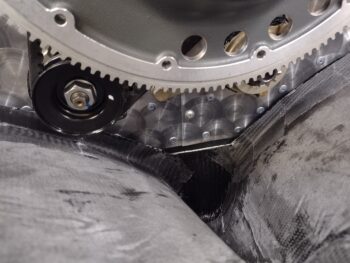
Here is an inside-looking-out shot of that.

I then reinstalled the right exhaust pipes and the lower bracket before setting all the top bracket pieces into place.  After taking a good look at the pipes, I decided not to do any more in-situ bracket welding on the exhaust pipes.  There was no serious damage, but a bit of discoloration due to the heat.  Best to endure some welding process pain to ensure the pipes remain good and undamaged.

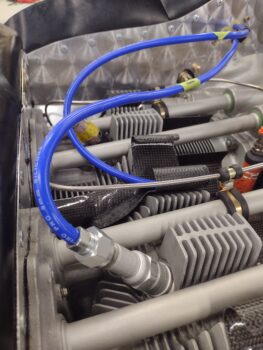
Since the crankcase vent tube pass-thru nub is not directly on the exhaust pipes, I went ahead and tack welded that to the vertical bracket plate.  I needed to make a couple attempts at getting the pieces welded (or “blobbed”) together, since again, I think my 1/16″ filler rod is too big for the task and wanting to go globular vs wetting out nicely.  Oh well, I didn’t blow out any metal so I’ll call it good.  Plus, I consider myself to be quite the adept grinder.

Again, since I’m not doing any more tack welding in-situ, I’m going to try my hand at using hot glue to lock in the bracket’s configuration and hopefully get a few good tack welds in before it melts away… we’ll see.

I also did a fair amount of work on the lower left exhaust pipe bracket as well. I needed to trim the lower outboard corner (and will get to the underlying bracket soon as well) due to it being a tad too close to the cowlings when those are installed.

In addition, I needed to remake the inboard sleeve since after dialing in the bottom bracket it came up a little too short on one side.

I also drilled out the inboard screw position after verifying that the bracket positions were good.  I’ll note that this position will not utilize a K1000-3 platenut, but rather an ‘ol school screw & nut since it also goes through/secures the baffle reinforcement strip.

Finally, I prepped the surfaces at the seams for some upcoming welding (hopefully tomorrow).

We are getting a good bit of wind and rain still from being on the sideline of Tropical Storm Debby, but hopefully it won’t affect my build ops.  In addition, I’ll be out of town this weekend on a short fun trip down to Florida with Jess… so clearly no building for a few days.

Chapter 23 – Top right bracket redo

Many of my peeps out there may have heard that we have Tropical Storm Debby crawling up the Eastern coast of the U.S. with high winds and rain.  I honestly haven’t been tracking it much other than if it will affect a quick trip down to Florida this coming weekend that Jess and I are taking.  That being said, we’ve had rain over the last couple of days… and lots of it.  And when there is what is akin to a torrential downpour, more than the ground can naturally absorb, then my shop floods to varying degrees.  Normally just in a small area in front of the air compressor closet, and maybe a bit in front of my epoxy mixing station.

This time however I was met by flooding well up under the airplane.  And although I do have a mop and bucket for smaller isolated flood puddles, this would have taken way too long to deal with… especially since it was still raining! [Also note the insulation panel under the centerline of the plane: knocked down by the squirrels in the ever-ongoing Squirrel Wars of the Salty Shores Shop].

In short: no welding today.

Not that I’m sure that it would matter if I could weld, given that after a few rounds of dialing in Version 3 of the upper right exhaust pipe bracket I assessed that it would need to be modified too much, causing the top corner mounting screw holes to drop down too close to the edge of the underlying aluminum baffle.  I’m really not sure why the top bracket turned so wonky on me (pic 1).  But, instead of pressing a bad position I simply noted the required configuration changes (e.g. fill the “new” gaps around the sleeves), created and tweaked the Version 4 mockup in cardboard first (pic 2), then uploaded that into Fusion 360 CAD.

By this point I’m getting fairly quick at uploading a cardboard mockup into Fusion 360 CAD, then tracing out the part to model it up before I then post process the new CAD part to create a CAM file for the plasma cutting table (FireControl program).  I then set up and plasma cut the now 3rd top right 316 stainless steel bracket (sigh).

I then cleaned up the edge dross off the bracket, drilled the corner mounting holes, and did some dialing in on the bracket for a few rounds.  Clearly this one is fitting much better right out of the gate.

I’ve got another few minor rounds of dialing in before I’m ready to mount the K1000-3 platenuts that will in turn allow mounting both top and bottom right side exhaust pipe brackets; which will require removing the exhaust pipes.  Since the rain was still coming down hard and I couldn’t get under the plane (in any EZ fashion) to remove the pipes with all the standing water underneath it, I simply called it a night and will tackle it again tomorrow.

Pressing forward… or at least trying to!

Chapter 3/23 – Bracket welding begins!

Again, a couple days accounted for in this post.

With a tropical storm possibly in play for us I desperately needed to cut my out of control lawn.  The problem was my lawn mower wouldn’t start, so a day and a half of testing the battery and then charging it overnight was spent, as well as a myriad of other troubleshooting tasks to figure out what the heck was going on.  I was about ready to pull the trigger on a new battery when I worked all the safety switches on the tractor and apparently one of them was stuck open.  Finally success and I got my darn yard mowed… more domestic duties boogering up my plane-building schedule!

After a couple of hours practice back TIG welding, I felt I had enough time under my belt and was just comfortable enough that it was time to stop the playing around and time to get busy welding for real.  That being said, stainless steel can be a real sticky wicket to weld and I knew my limitations, so I proceeded accordingly.  More on that in a bit.

First off was to get my nicer blue welding helmet back online.  Again, a common hack for these mid-range price welding helmets is to crack open the sealed auto-darkening lens unit to gain access to the one or two batteries that need replaced, to then add an external battery compartment allowing for EZ future battery replacement.  I’ll note that this auto-darkening lens is one I bought as a complete assembly to simply replace the original one on this helmet that had dead batteries… yet another method of replacing dead batteries on these things.  This time around, however, I’m armed with a bit more knowledge and experience.

The battery in this lens assembly sits in the upper right corner; here it’s been removed and only the tabs that were originally “welded” to the battery remain.

Using my soldering iron I removed these battery tabs that were soldered to the circuit board and replaced them with the positive and negative leads from the new external battery holder.  I had to make a small notch in the lens assembly case to allow for the wires to exit through the edge of the lens frame.  Also note the knot in the wires for strain relief.

After some minor surgery on the lens frame of the actual helmet to allow room for the external battery wires, I then remounted the auto-darkening lens assembly back into the welding helmet and secured the external battery module to the inside of the helmet with Velcro.  I then did a final ops test: success, and… Voila!

My spiffy blue welding helmet was back online.  Now it was time to put it to good use!

I spent about 30 minutes doing some TIG practice welds to warm up for the welding of the bottom right exhaust pipe bracket and the half-moon sleeves.  The main issue is that with this thin stainless steel, simple higher amp tack welding —sans filler rod— can be a bit risky and result in blowing a hole right through the bracket/sleeve metal.  Worse yet is what is BEHIND that stainless steel, on the back side: my exhaust pipes.  I simply do NOT want to be blowing a hole through the pipes or damaging them.

The trick in all welding is heat control, and especially here as I’m tack welding this bracket in-situ on the engine.  So filler rod was definitely on the to-use list.  That being said, after a good bit of practice I noted an unseemly characteristic of this specific welding rod used for this 316 stainless steel: it prefers to ball up vs simply melt into the base metal.  I thought this might be due to contamination at first, so tried it on an extra clean blank after prepping it via grinding and acetone… same issue.  My guess is that the rod may be a bit too big in diameter for the amount of amps I’m using, but it’s all I have on hand.

This meant adding just a hair more heat to the weld junction, enough to get this finicky welding rod to work, without melting away or blowing a hole through the thin base metal.  All while working on the bottom side of the engine.  And I’m sure it goes without saying that trying to get enough lighting on the task at hand was problematic in its own right.

Above is the raw, uncleaned bottom right bracket tack welded up.  Ok, so not overly beautiful tack welds for sure, but they did hold very well and I only had a little sticking on the inboard side between bracket and actual exhaust pipe.  A thin flat bladed screwdriver provided the persuasion needed to separate the two and no real damage (i.e. “hole”) to the exhaust pipe occurred.

However, this experience is certainly pushing me to explore how to secure or replicate the positioning of each remaining bracket to allow me to tack weld it on the bench vs in-situ on the engine.  Moreover, any flirting with ideas of welding up these brackets myself is out the window… again, with stainless steel needing that razor’s edge heat control, and this being such thin metal starting out, I’m leaving the major welding up of the joints to James, a no-kidding pro at this stuff.

With the bottom right bracket tack welded, I then spent the next hour and a half measuring, cutting and dialing in the 2 top bracket half-moon pipe sleeves.  As can be seen in the pic above, the bracket plate itself needs some minor trimming to be refitted around these specific sleeves.  Moreover, before any final configuration or tach welding is undertaken, I need to install the K1000-3 platenuts in all corners to ensure I get the very good clamping pressure I need between top and bottom brackets.

And that, my friends, will come tomorrow.

Pressing forward.

Chapter 23 – Brackets… still pushing

Today I cleaned up the right side exhaust pipe brackets and got them fit into place around the pipes, with the pipe sleeves in place.

Here we have the right top bracket in place.

And here we have the bottom bracket fit into place with the sleeves.

My next task was to get the right side inboard reinforcement plate made, which will help secure both the inboard top and bottom brackets’ securing screws.  After getting the reinforcement cut out of 1/16″ thick angled 6061 aluminum (pic 1) I then fit it into place (pic 2)… I have it peaking out from the aft baffle plate simply to be visible.  Moreover, I won’t install the inboard reinforcement plate until I’m ready to install the top inboard platenut, since I’ll need to remove the inboard exhaust pipe to do so.

While looking for a file by my lathe, I noted my eye bolt that I’ll use to weigh down the front of the plane any time I need the nose gear extended.  I had marked the eye bolt for trimming since it’s too long, but never got around to doing it.  Well, since I was doing Dremel work anyway I went ahead and knocked that task out.  This will come in handy since I’m nearing the point that I’ll want to remove all the weights that are currently inside the nose of the plane.  For reference, I’ll note that this eye bolt installs into an embedded hardpoint on the aft wall of the opening for the underside nose taxi light.

Back to another reinforcement plate for the the right side exhaust pipe brackets, this one for the top outboard screw/bolt.  This reinforcement plate is also made up of 1/16″ thick 6061 aluminum.

Once the bottom edge was shaped, I then drilled and riveted it into place using Cherry pop rivets.

It was now time to do some welding, but when I went to open up shop bay 3 for some ventilation, I found this 3″ plus length “sentry” standing guard on a giant web in front of the door.  I “persuaded” him to move with an old branch from my burn pile and continued on with my door opening <wink>.

Once I got my welder, welding station and welding accoutrements squared away, I tried my hand at some high-amp tack welding.  The first welds out of the gate were simply scary, and I had to dial down the amperage quite a bit.  Still, the risk of blowing out the thin walled stainless steel was just too high after a good dozen tries, so I decided I needed to use filler metal and just do small “normal” welds with normal power for my tack welds.  Then I’ll turn over my tacked up pieces to my expert buddy James to finalize the welds… at least that’s the plan.

Tomorrow is a busy day with my EAA chapter meeting in the morning and couple other social events, but I do plan on at least getting an hour or two of welding practice in on thin walled material, etc. before tackling the exhaust pipe bracket tack welding.

Moving forward… cautiously!

Chapter 23 – Dialing in exhaust brackets

Today I finally got the right side exhaust pipe brackets dialed in to a point that allowed me to re-plasma cut them out of 0.036″ 316 stainless steel.

But first, after spending another couple of hours dialing in yesterday’s scrap steel test brackets, I then traced them onto cardboard with any required corrections added in.

After ensuring the latest cardboard bracket mockups fit well, I then scanned them into Fusion 360 CAD and remodeled them for plasma cutting out of scrap steel, which I’m doing here:

I soaked the test brackets in white vinegar in my “parts cleaning bin” outside for a good bit to allow easy cleaning off of the rust.  When I went to check on the brackets I found this cool looking butterfly sitting on the edge of the plastic container.  It flew a few feet away, but I zoomed in and a grabbed a shot… something to break up the hours of working on these damn brackets!

Also while the brackets were soaking, I gathered up and cleaned up my welding helmets before performing a quick ops check on each one.  My nicer, older, more expensive blue one (left) failed the ops check, and will need a new battery (I ordered an external battery holder to allow me to change it whenever I need to without having to crack open the sealed lens unit… a common hack for these helmets. Note: a lot of newer mid-price-range helmets now have easily accessible compartments on the lens assemblies for replacing batteries).

Back to the right side exhaust pipe brackets.  After cleaning off the minimal dross and the surface rust, I then spent about 45 minutes doing a final dialing-in on the top steel test bracket.

And then the same for the bottom bracket.

Now an aside: Jess noticed that her linen closet ceiling either had a foot crash through it from the attic or it simply caved in on its own, so after an investigation and some measurements a few days ago I cut a sheetrock replacement for it.  Jess made dinner tonight as I gathered up a bunch of my tools and the sheetrock piece to head over.  I installed the new sheetrock in short order and then hung out for a few hours.

It was late when I got back to the shop, but not too late to do some plasma cutting!

Earlier I had ensured that in all the dialing-in of the brackets I did during this latest round, that none of it was additive in nature.  This means that I can use the scrap steel brackets as templates for the stainless steel no-kidding real brackets, which is good since no matter how hard one tries, there is always a little too much taken off here and there when fitting the brackets in place (meaning I can start back at zero and minimize mistakes in trimming the brackets to fit).

I post processed my latest CAD files using Fusion 360’s CAM function, and then grabbed my piece of 0.036″ thick 316 stainless steel.

Here we have the second and last top right exhaust pipe bracket plasma cut out of 316 stainless steel.

And the same for the lower right exhaust pipe bracket.

As I said, it was quite late at this point so I quickly dried off the brackets and will de-dross them, clean them up and drill out the holes tomorrow.  Then work the final fit for each of them.

Pressing forward!

Chapter 23 – Right exhaust brackets

I continued on with dialing in the right side exhaust pipe cardboard mockup brackets after having moved the exhaust pipes as far inboard as they could physically move… again, about 1/8″ from where they were.  Is this worth all the trouble?  I’m not sure, but I did/do want these pipes as balanced and symmetrical as possible with the the left side pipes (the right side still about 1/2″ further outboard than the left side).

I will say that it’s pretty much starting out from square 0 when I rewicker any position on any part of these brackets.  I would equate it to being on a 6-way seesaw with different sized kids and trying to get them all to stop and balance at the same height.  Because of the slight variance in pipe heights, matching the sloping angle of the aft baffle, and of course the angles of the pipes themselves, even knocking off an offending 0.015″ high x 1/4″ wide “bump” on the inboard pipe side of the bracket can shift the configuration to then cause a significant, say 0.030″, gap where none existed previously around the outboard pipe.  At times it really seems like a lesson in futility!

Thus the myriad of iterative cycles to dial in these brackets.  Or I am really just that bad at all this?! haha

With my cardboard templates dialed in to a good point, I scanned them into Fusion 360, created a third version model of these right side brackets, and then plasma cut them out of scrap steel.

I had an issue with my top right exhaust pipe bracket in CAD from me scanning in the cardboard bracket where it was showing up as a mirror image of my bracket (a lesson learned now), and only allowing me to cut it that way.  For test-fitting purposes I pressed forward and plasma cut this reverse 2D model, but then wasted a good hour fixing the mirror image issue for when I cut it in 316 stainless steel.

Regardless, here’s the result BEFORE I removed any dross, but AFTER I knocked the majority of rust off the surfaces (a major point here being that my plasma cutting table feeds-and-speeds are proving to be very good).

As crazy as it sounds, I then spent over 3 hours very slowly dialing in the top and bottom right side exhaust pipe brackets.  Here we have the top bracket.  From the center moving outboard the bracket needs very minor tweaks.  However, the left inboard side of this bracket needs to get shifted outboard about 0.025″, so I will transfer this to cardboard, finalize configuration, rescan, remodel, recut and confirm tomorrow.

And here we have the bottom bracket.  From these angles it looks pretty good, but there are unacceptable gaps between the pipe sleeves and bracket circular cutouts, both on the outboard sides.  This makes sense due the fact that the bracket was tacking inboard when I was first test-fitting it… again, way too easy to overshoot (per all the angles, etc. mentioned above) as material is removed to make the bracket fit into place.

Am I getting burnt out on dealing with these darn brackets?  Yes, somewhat.  But the good news is that I am clearly close to having the right set of exhaust pipe brackets dialed in and ready to be welded and mounted.  Moreover, in full disclosure I should note that I spent nearly 3 hours watching videos and re-reading my notes to reacquaint myself with both my TIG welder and the TIG welding process… all in prep, as it’s been a good while since I’ve done any welding!

Chapter 23 – Left exhaust brackets

Yep, I spent way too long today dialing in the left side exhaust pipe brackets and sleeves in prep for welding.

With the brackets and sleeves dialed in, the final configuration has the left inboard pipe ending up about 1/8″ further inboard than I had planned.  While this actually results in both left exhaust pipes being more parallel to each other than what I had planned on, it does place the inboard pipe about 3/16″ total closer to the prop spinner lampshade flow guide.

That being said, I’d be more concerned with the inboard exhaust pipe being positioned closer to the prop spinner lampshade if it wasn’t for the fact that with the curved pipe end it STILL points outboard in its current untrimmed state.  Thus my plan is to trim the pipe end to have it —and all the other exhaust pipes— to simply point as straight as possible aft, out of the cowling [in an attempt to attain Mike Melvill’s configuration of having the pipes aimed more towards the prop hub… where the prop doesn’t generate hardly any power].

I confirmed the left exhaust pipes near-final configuration by mounting the prop spinner lampshade and the bottom cowling. However, with the left inboard pipe even a bit more inboard, it made me no-kidding push the right exhaust pipe pair as inboard as possible in an attempt to balance out the left and right exhaust pipe pairs in relation to the prop spinner lampshade.  The bottom line was I was able to squeeze them inboard another 1/8″ (I’m at max inboard now).

This of course blew my current right brackets’ configuration out of the water and requires me to make new ones.  Oh well… need to get it all as correct as possible.

Below is cardboard template #4 that I slowly dialed in.  I worked until late into the evening before calling it a night.

Tomorrow my main push will be to get the third version of the right brackets dialed in and recut out of 316 stainless steel on the plasma cutter.  Also, as I did on the left side I’ll be adding in screw mounting reinforcement brackets on the aft right baffle wall to buttress up these assemblies as best possible.  Then on to welding (at least tacking) these brackets up!

Pushing forward… slow and steady.

Chapter 23 – Exhaust bracket brackets

Today was all about the left set of exhaust pipe brackets.

I started out by cutting the outboard lower sleeve after determining its configuration.

In assessing the fit of the pair of exhaust pipes in the brackets, I determined that the inboard edge of the aluminum baffle where it’s close to the inboard pipe needed trimming for clearance.  I have expected this might be the case for some time, but wanted to verify before I started chopping more stuff out.

I had to remove the exhaust pipes to allow trimming of the aluminum baffle, so at this point was the time to do some more unsexy, mundane work of creating reinforcement plates for the pair of inboard screws, and also the upper outboard screw hardpoint.

After a decent bit of assessment and seeing what material I had on hand, I landed on using 1/16″ thick 6061 aluminum angle.  Here it is after I’ve cut and shaped it using both the band saw and Dremel tool.

I also drilled a 3/32″ hole at each screw attach point through both the baffle plate and the reinforcement angle to determine and secure alignment with clecos.

Here’s a shot from the inside (forward→aft, pic 1) and after I’ve peppered the perimeter with holes for securing it with rivets (pic 2).

Here we have the left exhaust pipe inboard reinforcement screw mounting plate riveted into place.

I then did a bit of scrounging to come up with another 1/16″ thick piece of aluminum, this one is 2024, to press into service for reinforcement of the left exhaust pipe bracket top outboard screw position.

After shaping it, I then secured it in position, drilled two 3/32″ holes and secured it with clecos.  Again, this is from the inside looking aft.

Here we have the left exhaust pipe bracket top outboard screw reinforcement plate cleco’d into position.

I then riveted the left exhaust pipe bracket top outboard screw reinforcement plate into position.

Yeah, not the most exciting stuff here… but definitely required.

Not surprisingly, there is a decent little bit of tweaking to get the left exhaust pipes nestled into their final positions with the brackets and sleeves, which I’ll work on tomorrow.  I plan on knocking out the left exhaust pipes before moving onto the right side.

Chapter 18/23 – Bracket cut, cleanup

To start off, here is a shot of the 2 canopy SC-1 safety catches that I plasma cut yesterday, taking the opportunity to do so while my plasma cutting table was in “stainless steel cutting mode.”   Again, the top SC-1 was cut pretty much to the plans dimensions while the bottom one is oversized for me to cut out on the milling machine.

Here we have the majority of today’s work all in one pic.  I removed all the plasma cutting dross from the edges of the exhaust pipe brackets and the canopy SC-1s, as well as removed all the part edge discoloring with a good soak in white vinegar and then a vigorous wipe-down with 320 grit and then 1000 grit wet sandpaper.  After the brackets get welded to the sleeves there will of course be some final cleaning and buffing of the parts.

Speaking of sleeves… I then used one of my 3D printed sleeves to make a template for the top side of the left exhaust pipes.  I then cut out the sleeves from the 316 stainless steel tube and curved them a hair more in the vise to fit these 1.75″ diameter pipes.

These sleeves are just cut, so some fine tuning will occur before I weld them up to the bracket plate.  But here’s a general idea of how they will look once installed.

I’ll further note that my initial length for these sleeves is around 3″, and I can of course trim them down as configuration and weight dictates.

Tomorrow I’ll remove the bottom cowling and finish cutting the remaining sleeves for all the exhaust pipe brackets.  After that, I’ll start prepping for welding these brackets up.

Chapter 3/23 – Plasma table updates

This post covers the past 3 days.

Before I start telling my tale of woe and then subsequent victory, I wanted to grab a modern art shot of the myriad of test-fitting mockups I made to get these exhaust pipe brackets dialed in.  A good number of the repeats was when I moved the exhaust pipe positions and had to restart the bracket configurations.  Yes, in short, inputting a shape into CAD to make for both a successful cut and repeatable part is rarely the most efficient process… at least in the beginning!

Speaking of successful cuts…  a couple evenings ago I assessed that everything was a go on 3 of the 4 exhaust pipe brackets.  I had the upper left bracket mockup printing out on the 3D printer to check a final few tweaks, and I was ready to start plasma cutting the 3 other brackets out my piece of 0.036″ thick 316 stainless steel.

Alas, despite all my previous successful cuts on mild steel, my plasma cutting system apparently sensed the change and refused to cut the new stainless steel material… hmmm? (I’m compiling a video on the making of the exhaust pipe brackets, so you’ll be able to see the footage of this fail in that).

My failed cut led to 2 days of tasks to ensure my plasma cutting table, cutter and processes were all up to snuff, including updating my Langmuir Systems Crossfire Pro FireControl software as well as the Torch Height Control system firmware .  I also found a modified Post Processor for Fusion 360 —that was placed on the forum by a fellow Crossfire Pro user— that allows the plasma cutting system to simply pierce the center of each hole to mark it for drilling later rather than attempting to plasma cut it out (which can be a bit messy at times).

Moreover, since it’s been nearly 4 years since I’ve actively used this plasma cutting table, I found some “feeds and speeds” data on the forum from some fellow PrimeWeld Cut60 plasma cutter users where they had confirmed cutting amperages, torch travel speeds, air PSIs, etc. for mild steel, stainless steel and aluminum.  This was a virtual goldmine of information, although it still took nearly 4 hours for me to cobble it together into one usable chart.

I also rediscovered that there is a somewhat esoteric issue with this system between the control box and any connected computer involving the computer ground.  If the computer has a 3-pronged electrical plug, which my laptop does, than that ground spade can cause issues during the cut.  In short, I modified my plasma cutting operations sequence to now ensure I unplug the laptop prior to initiating a cut.

In related news, you may have noted in these pics that there is a shroud around the base of the plasma torch.  This shroud both keeps the sparks corralled and, more importantly, greatly limits water from splashing up on the Z-axis torch carriage assembly and X-axis crossbar.  I noted the shroud during my research where a user was using a modified silicone rubber funnel for his shroud.  For my shroud I simply drew it up in Fusion 360 and 3D printed it out in stunning <wink> gray ABS.

With all these updates, mods and test plasma cuts under my belt, I then finally got to plasma cutting the exhaust pipe brackets out of 0.036″ thick 316 stainless steel.  Here we have the upper left bracket getting cut (again, these will be shown in the video).

And a look at the upper left exhaust pipe bracket successfully cut out of the 316 stainless steel plate.

I then plasma cut the lower right exhaust pipe bracket and confirmed it was good.

And then the lower left exhaust pipe bracket…

And finally the upper right exhaust pipe bracket.  All cuts were successful, even with my tweaking the cutting speeds a bit on each round (120 ipm, then 130 ipm, and ending with 135 ipm).

If you look at the water in the plasma cutting table you can see reflections of trees since I had the shop doors open.  Stainless steel gives off some nasty gasses when it’s being plasma cut (grinded, welded, cut, etc…), thus the open doors and a fan blowing the gasses out.

Since I was set up for cutting stainless steel, I took the opportunity to recut the SC-1 canopy safety catch out the plans specified 0.020″ thick 301 stainless steel, versus the thinner stuff I had on hand and used when I originally cut it back in September 2020.  I actually cut one to the plans dimensions directly, and then another one with all the edges bumped out by 0.15″ to allow me to create it on the milling machine —for a nicer appearance (pics forthcoming… this will be a test to not only appease my curiosity, but provide a spare SC-1).

Jess invited me over for one of her wonderful homecooked meals at her house, so I closed up shop a little early tonight to go celebrate my successful plasma cuts with her.  Tomorrow I’ll clean up these brackets and press forward.