Chapter 13/25 – Nose hatch latch tweaks

Today was all about refining the operation of the nose hatch latch —interspersed with a good bit of sanding on the newly applied micro on the turtledeck.

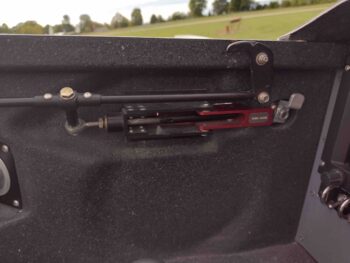
After designing an angle bracket to attach to the front of the existing canopy latch that will secure a spring plunger to pop the nose hatch up and off the latch catch, I then 3D printed a model of it.  As the model was 3D printing out, I went to a local hardware store and picked up a few springs and a rubber top cap for my plunger.

After testing out the spring plunger on the 3D printed mockup (which broke after a few cycles), I confirmed my design was good and milled a piece of 1/16″ thick 6061 aluminum angle.  Here’s a couple of machining “action shots.”

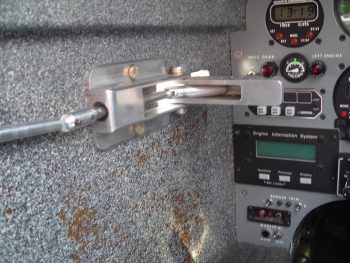
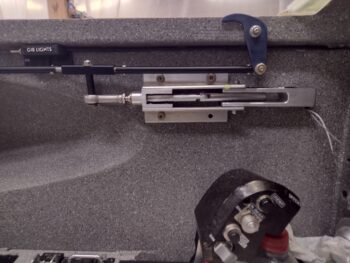
And here we have the spring plunger installed on the face of the nose hatch latch. It definitely works a treat now (see video below).

I’ve also been designing and testing an intermediate nose hatch latch cable assembly that will have a pivot setup to allow me to get much straighter pull vectors on both cable and latch assembly.

And here’s a video I did up covering pretty much all my current issues that require some tweaking on the nose hatch operation.

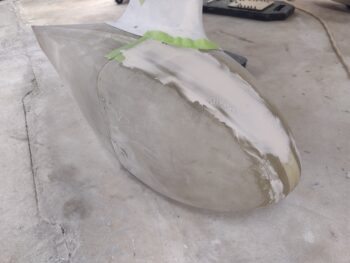
I also did well over an hour of sanding on the turtledeck, knocking down the freshly added micro down to about 80% (guestimate) done.  I will definitely need some touchup micro here and there before a final sanding and then on to epoxy wipes.

Pressing forward!

Chapter 13/18/25 – D-deck Micro Redo

I started out today by pulling the peel ply off the newly aft positioned glare shield lip.  I then did a pretty decent amount of sanding on the added BID ply seam to get it as evened out as possible.

I’ve been kicking around my final finishing solution of the glare shield for literally years, and now with this required rebuild on the glare shield lip my final layup will be a single ply of carbon fiber.  Which I’ll finish in a dull but visibly appealing final appearance.

Also, with the canopy latching handle assembly and system complete, I ensured all the seals were in place and then checked the fit of the canopy.  What I found on the aft end was not exactly giving me any warm and fuzzy feelings.  There was quite a height difference between the canopy and the turtle deck at the intersecting seam… note the light coming in underneath the straight block.

I hate redoing things, but now was the time to get the turtle-deck spot even with the closed and locked canopy.  I guess long gone are the days of my nice tight seams betwixt canopy and it’s interfacing components.

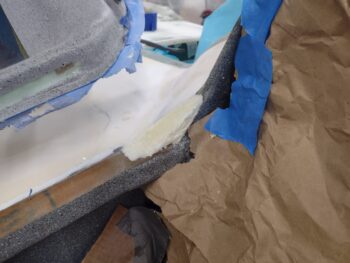
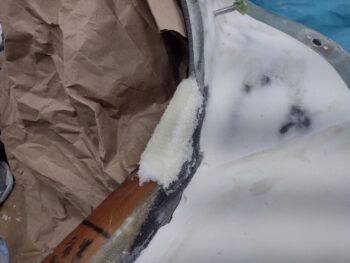
So after taping up the aft canopy edge and the front edge of the top cowling (and mounting the cowl), I mixed up some micro/West 410 and slathered it on the left (pic 1) and right (pic 2) sides of the turtledeck.

On my list of things to do that I kept can-kicking down the road was sanding the aft edges of the wheel pants that I both micro’d up/sanded and epoxy wiped.  Here’s the right wheel pant.

Here are the tail ends of the micro’d, epoxy wiped and now sanded wheel pants.  On the left pant (pic 1) I had to add a little more micro in a divot that appeared while sanding.  The right wheel pant aft end (pic 2) was good to go after sanding.

Still keeping to my to-do list (today anyway), I also sanded down the added micro on the top/front of each wheel pant.

Many hours later, when the micro on the turtle deck hit the “green” state, I used my razor knife to clean up the seams and remove the excess micro.  I plan on knocking out the initial sanding tomorrow after a good overnight’s cure.

I then spent well over another hour once again assessing and planning out my way ahead on the nose hatch fitting, latch functioning and intermediate latch cable bracket.

At this point it was once again quite late in the evening, so I called it an evening, headed into the house and did another couple of hours of CAD work.

I’ll continue pressing forward with this stuff tomorrow.  Hoo-ah!

Chapter 13/18 – Top centerline efforts

I started off today finalizing the shape of the canopy aft corner gap pour foam fills at the intersection of the longeron and the turtledeck, on each side.

I checked each round of sanding by placing a light beam on the added pour foam fill, closing the canopy tight, and then looking through the opposite side strake window… it really worked quite well.

After finalizing each added pour foam fill contour on each side, I then cut a single ply of UNI to go on as the first ply, and then a ply of BID over that.  Here we have the right side with the glass laid up and peel ply added (pic 1).   I figured I would get a shot pre-peel ply, so here’s the left side layup (pic 2).

And here we have both aft corners of the longeron-turtledeck intersection —to minimize any gap with the aft rounded corners of the canopy— the layups completed and peel plied, at which point I left them to cure overnight.

But wait… there’s more!  More layup that is! <yes, singular>

Back on the aft nose/avionics cover, I sanded the top line where the old glare shield lip was to knock it down a tad before adding a good bit of dry micro that I had left over from the layups above (the gap was not that much) as both a filler and bit of a fillet.  I then cut and added a single ply of BID (pic 1) and then wetted it out (pic 2).

I the peel plied the layup and left it to cure overnight.

It’s a bit hard to detail all the minute assessments (well over an hour’s worth) I did on the front nose hatch, and a good many notes that I took.

The action on the front hinges work very well, but the angle is just slightly off so that when the nose hatch door is closed, the front side shift towards the right a little over 1/16″.  This creates a bit more of a gap along the right front edge than I want.  It’s easily remedied by simply pushing the door back over to the left, but I want it to close in the right spot every time without further manipulation. I’ll work on fine-tuning that.

Now, the more serious issue on the nose hatch is the clearance between the latch catch on the door and the latch assembly mounted on the aft inside of the nose hatch.  I assessed that for a good while, before taking the cylinder “striker” off and trimming it down a little on the lathe.  I also used the Dremel to take off a decent bit of material on the aluminum tab (door side) that striker is mounted to, since that tab was not clearing the front face of the latch assembly.

I made some progress, but realized that the latch assembly needs to come off and I need to reduce down the thickness of the glassed tab that the latch assembly mounts to move it aft just a hair… literally only 0.05″ would do it. Again, to get the clearance I need.

But, it was again quite late in the evening so I will attack that tomorrow, among other things.

Moving forward… sporadically!

Chapter 13/18 – Glare shield lip redo

I started out today trimming to shape the 2-ply carbon fiber wing-bottom bolt hole access covers, and then removing the peel ply.  This completes the making of both top and bottom wing bolt access covers.

I then did a couple more rounds of refining the contours of the added pour foam fills in the aft corner junctions where the longerons transition into the D-deck.  These fills are to ensure the canopy seals nicely at these corners to help prevent any unwanted incoming air or noise at these points.

I had planned on glassing these canopy interface corner pour foam fills above, but just ran out of time.

I did however get another step closer to finishing the task of moving the glare shield lip aft about 1/8″.

I started off by removing the peel ply from the inside surface of the 2-ply BID layup surface that makes up the new lip (no pic).  I then marked the existing glare shield lip for removal (pic 1), by using my Fein saw to cut off the existing (old) lip (pic 2).

I marked the new edge of the new 2-ply laid up BID glare shield lip and cut off the excess glass with the Fein saw (pic 1).  I then pulled the double-sided tape, thin cardboard and electrical tape off the new BID lip before then removing all the inside peel ply.

My last step was cleaning up and sanding the inside edge of the old (forward) glare shield lip, and the trimmed edge of the new glare shield lip.

Before I do any more layups on the new glare shield lip, I wanted to make sure it was in the correct position… so I mounted the aft nose/avionics cover and closed the canopy down on top of it.  I also used my cell phone to take videos from the inside of the canopy and glare shield looking up to evaluate the new glare shield lip positioning inside the interfacing groove on the underside of the canopy skirt.

All looked good, so I’ll proceed with the construction of the new glare shield lip tomorrow (aka “more layups”).

Also note above the too-wide seam between the front edge canopy skirt and the aft nose/avionics cover.  Somewhere down the line between installing the aft nose/avionics cover in place with all the hardware and hinges, as well as possible different final cure cycles between the two (my canopy was stored in the rec room in my house for years as compared to the glare shield stored in the shop… different temps?)… whatever the reason, I need to fill this gap as part of my final finish efforts pre-paint.

Also, I’ll note that I’ve started the effort to create a new intermediate cable latch bracket to fix my configuration issue with the pull cable on my nose hatch latch.  The tight curves and mandated path inside the nose to route the pull cable is just too bendy and tight to allow for an EZ actuation of the nose hatch latch… it simply needs a redesign.  Thus, I’ve started modeling up some test fitting blanks in CAD for the intermediate latch bracket to start the R&D to get that part made.

Again, I want the nose hatch fit and latch system 100% operational before I do the final micro in and around the nose hatch on the top of the plane’s nose.

Finally, in much of the same vein as the nose hatch latch, I’ve also been doing initial design and test 3D prints to nail down a workable canopy latch safety catch, or “lock” if you will, to ensure that nothing (air, wind gusts, weak latching mechanism, caught sleeve) allows or throws the canopy latch handle open.  I plan on this secondary canopy latch handle locking lever to also manipulate the “Canopy Locked” micro-switch that goes to the canopy and gear warning system.

More info to come on both of these projects as they mature.

Chapter 18 – Canopy frame interfaces

Today my efforts over the last week finally culminated in the completion of the canopy latch handle install.  I’m happy to report that it is working quite well, and after a good hour’s worth of work I dialed it in even further after removing the pilot seatback push-pull thru-tube, drilled out the rivet securing the aft threaded insert, trimmed the tube by about 3/8″, made a new threaded insert and drilled/riveted that into place.  A couple subsequent rounds of trimming the new threaded insert to length and I had all my latch hooks aligned at the same angle and elevation.

And here we have the installed canopy latch handle, connected to the 4 latching hooks via a HEIM rod-end (this provides just the flex needed in opening and securing the hook push-pull tubes to secure the front hook in place… I stole this design from Howard Caulk).  Also note the newly designed, single switch (no extra “Flux Cap.” switch) box for the GIB lights, with the wire “cable” attached under the longeron going forward.
The reason behind this last round of tweaks on the canopy hook push-pull tube lengths and positions was due to a slight angle showing up on the exterior handle when the canopy was CLOSED & LOCKED.

You can see here the aft end of the handle (right side) peaking out just a hair more than the front.  This was an indicator that I wasn’t getting full closure of the handle into its locked position.  I remedied this with all my shenanigans above…  Now, also note the curvature of the fuselage at the longeron underneath the canopy (blue) lip.  I wanted the canopy latch system completed and operational to then allow me to rework this area to clean it up and smooth out this interface.
Although my canopy latch system is operational, I still needed to correct the NOW slight mismatch between canopy skirt interior groove that interfaces with the vertical extending aft lip of the glare shield on the aft nose/avionics cover.

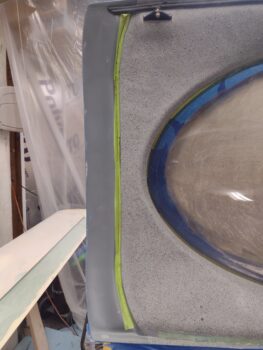
To do this, I removed the front seat back cushion, climbed into the cockpit upside down so that my head was just inside the left leg hole under the instrument panel, with my legs hanging over the pilot seat back.  I then closed and locked the canopy so that I could mark the aft edge of the vertical extending aft lip of the glare shield inside the canopy skirt groove, which I had added green tape inside of before hand.

This is the result of that effort… note the red Sharpie line on the tape.
Also while I was in this most precarious position, I grabbed a shot of the gap between canopy lip and longeron caused by the glare shield lip being a bit too far forward and not allowing the canopy to seat fully closed.
To remedy this issue between glare shield lip and canopy skirt groove, I had to either A) reposition the groove in the canopy skirt, B) reposition the glare shield lip aft, or C) remove the glare shield lip altogether.

I’ll note that since there is a rubber edge that will be attached to the glare shield lip, that then is a seal pressed up into the canopy skirt groove, I did not go through all this work to simply eliminate this feature.  So option C was a no-go.  As was option A since it would simply be too difficult and time-consuming to rework the groove in the canopy skirt.

So option B it was: move the glare shield lip aft approximately 1/8″ to get it reseating near the center line of the canopy skirt’s interior groove.

To accomplish this, I added double sided tape to the existing glare shield lip, then a thin strip of cardboard covered by electrical tape.   Before removing the aft nose/avionics was off the plane, I marked the line where the overhanging glare shield met the instrument panel overhang since I didn’t want to add any thickness in between the pre-existing clearance between cover and nose structure.

This gave me about an inch just forward of the glare shield lip to glass 2 plies of BID over the tape and cardboard I had just added to the lip, but not before I wetted out and laid in a strip of peel ply on the vertical edge before the glass went on.

After laying up the 2 plies of BID, I then peel plied the external/top side of the layup (cover being inverted) and left it to cure overnight.
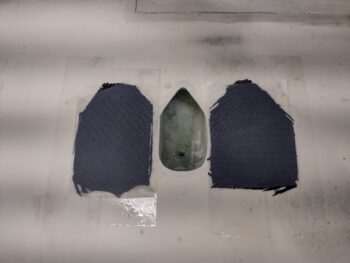
I had a decent amount of Pro-Set epoxy left in my cup, so I cut 4 pieces of peel ply and 4 plies of carbon fiber.  I had planned on doing my bottom side wing bolt hole covers actually on the bottom side of the wings, but decided they would be flexible enough to make them on the top.  Besides, I didn’t want to waste epoxy.

So I added tape on each side of the upper bolt hole access hole on the top of the left wing, and then laid up the 2-ply CF wing bolt hole covers, with peel ply on both sides of the layup.  Again, these are for the bottom sides of the wings.  I then left these to cure overnight as well.
Finally, with the last bit of epoxy I had in my cup I mixed up some micro/West 410 and applied it to the already taped off right wheel pant, on the front half (pic 1).  I had already done this previously on the left side (pic 2), but just hadn’t grabbed a pic of it yet to report in a blog post.

My final task of the evening was to add some filler pour foam in the aft corners of the fuselage-side canopy frame, where the longerons meet the D-deck canopy lip.  When I trimmed down the canopy frame at this corner in its curved fashion, it left a decent gap at these corners, so I’m remedying that now.

Here I’ve added pour foam —which I just got a new batch in a few days ago— and have just pulled the forms off the cured foam, so both sides are in their raw state.
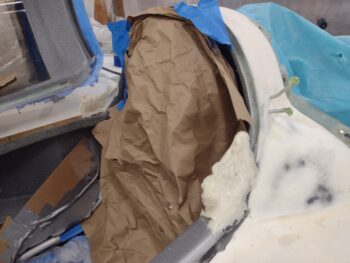
And here we have we the first initial round of clean up and contouring of the added pour foam at the aft longeron/D-deck corner intersections.

It was fairly late in the evening at this point, so I’m kicking off the final shaping (then glassing) of these pour foam corners until tomorrow.

Slowly gettin’ er done!
Chapter 18/22 – Helluva way to build!
OK, so I was out of town for a 3-day weekend, and upon my return got some more stuff done in regards to the canopy latch assembly.

Here is the canopy latch handle that I machined all cleaned up, as best possible, with a few minor nicks & scratches in the aluminum still showing.

Another shot of the cleaned up canopy latch handle.  These shots were taken just immediately PRIOR to me drilling the small hole all the way through the handle in the lower left corner (as situated in pic below) for the forward push-pull rod securing roll pin.

I then had a series of near-laughable (if not all-out angering!) events happen that knocked me off my plan and down a diversionary rabbit-hole for a good couple of days.

I had redesigned and modified the “GIB master lights switch” box —the switch allowing me as the PIC to control the power to all the lights in the back seat (say someone leaves a light on unintentionally or falls asleep with lights on)— to be much narrower in height to provide clearance for the canopy latch rod.  I even painted up TWO subsequent new versions of this box.

The issue started in that I had to shorten the wire leads exiting out the sidewall near the underside of the left longeron.  My wire stripper —unbeknownst to me— grabbed one of the other exiting wires as I was stripping a different wire.  The stripping action worked fine on the subject wire, but cut the other wire to a nub just exiting the sidewall.

After trying in vain to get the 4th cut wire out, I simply remade the switch box with a single switch since I still had 3 wires remaining.  [Note canopy latch assembled and new setup appears to work near flawlessly… one good thing out of the last few days!]

I should have left well enough alone since I did not remember how I ran the wires through the sidewall, but at one point I wrapped the remaining 3 wires around a pair of needle nose pliers and tried to gently pull them to coax the 4th wire to exit out the sidewall hole along with the other 3 wires… well, there must be a 90° turn inside the wall because with some slow but firm tugging, all 3 wires snapped off at the exit hole.

In the ensuing day and a half attempt to find the wires and extract them, pull the remaining wires out to try to install a single pair, all while remaking yet another wire box with a bigger flange to hide the extra excavation holes I made in the sidewall, I finally gave up and simply ran the wires down the sidewall under the longeron, using alternating dabs of hot glue and silicone RTV to secure it.  At this point I was simply using the wire box to hide the holes in the sidewall!

As happens all too often, what should have been a fairly simple task turned into a giant cluster event and took up way too much time in dealing with it.

I also spent way too much time in between paint drying cycles in editing this video I did for making the new canopy latch center block.  Here it is… yes, another machining video!

Pressing forward….

Chapter 18/22 – Canopy latch CLOSE!

Another post covering the last couple of days on the plane build, still focusing on the canopy latch system.

My primary focus starting out was to ensure that I could redesign the GIB cockpit light master power switch box which also contains a spare switch for any future switch requirement (why not, eh?).

Instead of mounting the switches’ long flat sides up-and-down against the sidewall (inside the box), I turned them 90° so the thin side was parallel the sidewall and the long side was underneath the bottom of the longeron.  On the 2nd or 3rd iteration of this new design, I angled the thin sides of the box inward a bit to give the switches a bit of an angle (to better get my finger behind the switch paddle when against sidewall).

I then checked the new GIB lights switch box clearance with the position of the canopy latch rod as it was straight and level from the aft end (equidistant from longeron all the way down its full length).  Not outstanding, but definitely within the normal tight tolerances on these Long-EZs!

I then checked the clearance of the canopy latch rod and the SC-1 canopy safety catch… again, close but definitely workable with the rod under the longeron…

Speaking of which, here’s a shot of that forward canopy latch rod tucked up underneath the longeron its full length.

In my testing and manipulations of the canopy handle with my 3D-printed test aft push-pull handle rod installed, I stressed it a bit too much and it cracked.  I did get some good operational data from these tests, and even it cracking gave me an idea of where the stress points were.

I then re-3D printed the canopy handle aft push-pull rod with a lot higher infill % to make it stronger, and also cut the rod-end to C4 bracket bolt slip sleeve spacer to connect the handle to the canopy hook manipulating rods.

Here we have the new test set up with the handle open (pic 1) and closed (pic 2).

I’ll also make a special note that with the remaking of the canopy handle center block, the forward push-pull rod can now traverse much farther aft inside the handle bracket channel.

And here we have yet another check with the SC-1 canopy safety catch, with all clearances still good!

I then got to work on making a new canopy handle aft push-pull rod.  I started by chucking up the 5/16″ diameter 2024 aluminum rod in the lathe and narrowing down the threaded end to a little under 0.250″ (pic 1), after which I used a 1/4-28 die to create threads on the narrowed rod segment (pic 2).

Here we have the 1/4-28 threads created on the 2024 aluminum canopy handle aft push-pull rod.

Of course an ‘operational’ test fit of the rod-end was required… and all looked good.

I then cut the 5/16″ diameter 2024 aluminum canopy handle aft push-pull rod on the horizontal bandsaw (pic 1).  And here’s a shot of the real aluminum canopy handle aft push-pull rod with its 3D printed twin (pic 2).

I then fired up the mill to machine the opposite end to create the flat that will get secured into the canopy handle forward push-pull rod.

And Voila!  The freshly created 2024 aluminum canopy handle aft push-pull rod.

I then installed the newly made canopy handle aft push-pull rod into the canopy latch handle, at which point I climbed inside the cockpit to test it out.  After a few rounds of tweaks I am pretty darn sure that I am VERY close to dialing this canopy latch handle in so that it is 100% operational.  The aft throw is very acceptable and the latching pressure needs some tweaking (appears to be easily remedied), while the over-center action is VERY noticeably improved.

I’m heading out of town for a quick 2-day getaway with Jess, but when I return I plan on finalizing this canopy latch handle operational configuration.

Pressing forward!

Chapter 18 – Canopy latch in focus

The last couple days has again been focused on getting the canopy latch system installed and 100% operational.

I worked installing the newly machined canopy latch handle center block in between the 2 angled top/bottom brackets by setting it in place, then carefully tracing out the screw holes in the top.

I then CAREFULLY drilled out those top screw holes…

tapped the holes with 10-32 threads . . .

and once in place with screws I repeated the process for the bottom screw mounting holes.

I also press fit the 5/16″ ID bronze oil sleeve bearing into place inside the cylindrical barrel of the new center block before mounting it into place (pic 1).  I then slid the old push-pull rod into place with the rod-end mounted on the end to get a general idea of how it would look and function (pic 2).

I made some measurements and quickly modeled up a new push-pull rod in CAD before 3D printing it and installing it into the handle.  Also note that I installed not only the old forward rod from the Mike Bowden design (why change things if no reason to), but also swapped out the new aluminum handle to the old 3D printed handle as I finalize the position [read: redrilling holes for repositioning during testing may be required].

Here we have the mockup components in place for configuration testing in the closed (pic 1) and open (pic 2) positions.

And unfortunate side issue that reared its ugly head —which is my fault for lack of planning— is the size and placement of the already rather diminutive switch housing for the GIB lights master switch, and a spare switch that I affectionately labeled “Flux Cap.” . . . this switch housing being too big and must be redesigned to make clearance for the canopy handle lever push-pull rod that runs down the sidewall next to the pilot seat to manipulate the canopy latch hooks.  The requirement here being to keep the push-pull rod UNDER the longeron as best possible.  Why?

Because the real issue isn’t the clearance between switch housing and rod.  But rather a secondary issue that if the rod is pushed inboard too much (and not that much) it then has no clearance with the canopy safety catch (SC-1)… that is specifically what I failed to take into account.

Thus, switch housing redesign and clearance testing will commence post haste.

Lastly, I’ll note that my installation of the new C4 bracket on the 3# (from front going aft) canopy latch hook (C2) was also not without some machinations, mainly constant removing/re-installing of both rods (forward and aft) to trim down the threaded inserts to allow for all aft 3 latch hooks (#2 thru #4) to be positioned to work in unison with each other (same profile).  This also required some expanding of the short #2 hook-to-#3 hook rod’s transit thru-holes in the pilot seatback housings (center right in pic below).

My current mission is to continue to press forward on the canopy latch system, which once in place and fully operational will then allow me to work the canopy skirt-to-fuselage/nose final fit/configuration and micro finishing.

Chapter 18 – Canopy latch center block

The past 2 days have been focused solely on the canopy latch system, which I need to finalize before I can complete the micro finish on and around the forward canopy-fuselage area.

Although I didn’t report on it in my last blog post, I’ll note in the last few days I tried my hand at some “Poor Man’s Anodizing” in an effort to not only anodize these newly machined canopy latch components for hardness to strengthen them for long-use wear, but of course to permanently color them as well.

That being said, the actual anodizing process worked well, but I think my amperage was too high (sulfuric acid/distilled water solution with positive & negative power applied) on the test part (modified canopy C4 bracket), which created such a hard surface (no open surface pores that occurs in normal anodizing process) that it wouldn’t accept or take up any color.  Now admittedly I was using cheap dye, but it didn’t accept ANY of it, which leads me to my over-amp condition assessment.

So, with my mechanically anodized modified C4 bracket, to change its color, I accepted the fact that for time’s sake paint was the only practical way forward.  With that decision made, I threaded in some cheap handling bolts, and taped up the threads to protect against paint —which clearly served to protect the internal bracket threads from paint as well.

I then hit the C4 bracket with 2 light coats of primer.

After the primer cured, I painted the C4 bracket black.  I let it cure for about 30 minutes so the paint was dry, before then baking it in the oven at 175° F for over an hour.  Here’s the result after it cooled down.

With the C4 bracket taken care of (finally!), I got to work re-designing the center block on the canopy latch handle where the aft opening-closing rod transits.  My effort here is to attain a better over-centering action as the latch is closed.

In this effort to meet my optimized over-centering action goal, I made 2 significant design changes to the canopy handle’s center block:
1) I opened up the middle area of the block to create clearance to allow for a much longer throw rearward of the aft opening-closing transit rod, and
2) I moved the transit rod position in the block from an outboard position to as far inboard as possible.

Of course the first step in this center block redesign took place in CAD.  Here’s a snapshot of that process . . .

As a reminder, here is both the position of that center block in the canopy latch handle, as well as the design of the original, previous center block:

A final word on this center block before I cover the making of it, and that is that this design switch is a move from its design concept as I received it from Mike Bowden (top pic: his configuration worked, but my setup is slightly different so I need to modify it) to how Howard Caulk implemented his version of this style canopy latch handle (bottom pic).


I had a length of 1″ x 1″ 6061 aluminum bar stock on hand which I used to create the new center block.  First, I cut the piece to be machined off the bar stock on my horizontal band saw.

I then essentially used my mill as a planer to reduce the block down on each side to the final dimensions (0.75″ x 0.82″) using my facing mills to knock down the faces on each side.

I then did an entire plethora of other machining tasks (possible new video coming on that?!) to get to the final new canopy latch center block created here:

Again, I moved the rod thru-hole from the outboard edge (pic 1) to the inboard edge (pic 2).  Also see pic below these.

Here we have the new center block showing the hole on the inboard edge —looking from the aft side— as compared to the old version where the hole is outboard.  Clearly I’ve also moved the transit thru-hole area further aft with the cylindrical addition, which will house a press-fit bronze oil-bearing sleeve for the aft opening-closing rod.

Here’s a look at the thru-hole and the clearance of the aft opening-closing rod in the center block assembly.

Since the center block is secured with 2 screws each side to the top and bottom “L” mounting brackets of the handle assembly, I intentionally kept the top and bottom interfacing surfaces of the center block as thick as possible to provide a decent amount of meat for the securing screw threads.  Moreover, I did this specifically to avoid having to remake new top and bottom “L” mounting brackets.

Here’s a final look at how the center block will appear when mounted in-between the top and bottom “L” mounting brackets (obviously some cleanup will take place before install).

Tomorrow I plan on working to get this center block installed into the canopy latch handle assembly and get the canopy latch handle much closer to being fully operational.

Pressing forward!