Chapter 19/22 – Wing light mounts Pt. 2

I started off the build today by checking out the fit and configuration of my newly modified wing leading edge light mounting bracket… specifically, the 3D printed mockup of it.  As I’ve highlighted before, it’s amazing what less than a 1/4″ difference makes on this build, and here on the light bracket it has made a huge difference in allowing me to both position and center the light in the wing leading edge light pocket.

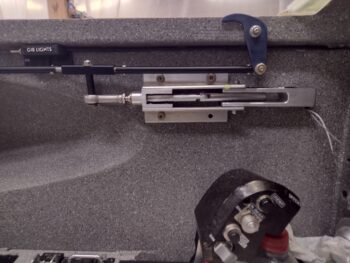
To ensure I had enough clearance between the light body and the light bracket aluminum support standoffs I went ahead and mounted those to my 3D printed bracket mockup.  And as I expected, it all passed muster.

I then spent another couple hours finishing up the wing light mounting brackets’ 3/8″ diameter 6061 support standoffs by tapping and threading the 3 right wing standoffs with 10-32 threads, and then knurling the aft half and creating flox grip grooves on the lathe for all of them.  As you can see, these guys are all ready for install into the aft wall of the respective wing leading edge light pockets.

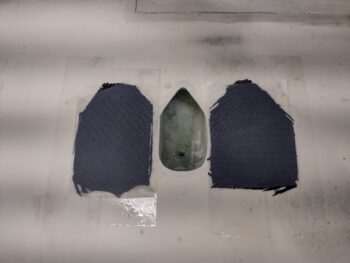
Earlier in the day I had redesigned my wing leading edge light mounting brackets’ support standoff holes drilling jigs in CAD to match the footprint of the new brackets.  I thinned them down considerably to eliminate over an hour of print time, and was able to get them both printed in under 4 hours.  And here they are, hot off the 3D printer!

Tomorrow is Christmas, so first off, Merry Christmas! everybody.  I’m not sure how much work, if any, I’ll get done but my next task is to machine the new wing light mounting brackets (which I didn’t get to today) before getting the wing lights set into position in each wing leading edge pocket.  I’ll then get the support standoffs floxed/micro’d into place.

Yes, this has been about a 2 week detour on getting these wing leading edge lights installed, but I think in the end they will add a lot of needed visibility to my bird, as well as extra light during night ops… not to mention add at least 20 knots to my ramp speed! (Smile)

Chapter 19/22 – Wing light bracket redo

I started off today pulling the peel ply, razor trimming the overhanging carbon fiber and cleaning up the edges of the right wing leading edge light lower flange.  As on the left wing yesterday, this completes the construction of the right wing leading edge light compartment.

I then started working the configuration and the placement of the light inside its bracket inside the left wing leading edge light pocket.  Just as with the drilling jig, I hit a snag as I realized that the bracket for the light is just a skooch too big.  As with too many things on this bird, I’m now in the realm of dealing with 1/16″ to 1/8″ clearances to get things to fit.

So back to the drawing board, er, uh, CAD modeling in Fusion 360.  I pulled up the wing leading edge light bracket CAD file that I had completed in January this year —nearly a year ago— and reworked its dimensions.  I narrowed the height by 0.11″ each side, so nearly a quarter inch total in height.  This may result in the light-retaining screws (middle 4 screws) overhanging the bracket a bit, but “engineering” compromises are king in this build.  I also narrowed the bracket over 3/16″ (~0.2″) as I brought the corner screw positions in closer towards the light body at an angle, so both vertically and horizontally… in line with my height and width reductions.  The single screw and standoff attach on what is the inboard side remained unmodified.

As per my modus operandi, I kicked off a 3D print of my new reduced-in-size light bracket as I headed back out to the shop.

Out in the shop I took 3 of the four 6″ lengths of 6061 aluminum rods that I had ordered eons ago from McMaster-Carr and cut them in half on the horizontal band saw.  I then chucked one up in the lathe, faced off the cut end before I drilled & tapped it with 10-32 threads.

Here we have the 10-32 thread tapping (pic 1) and testing the threads with a #10 screw (pic 2).

I knocked out drilling and tapping the left wing leading edge light bracket’s 3x support standoffs with 10-32 threads before calling it a night.  I will knurl and groove the other ends of these bracket supports since they will get embedded in flox/micro in 3 holes drilled into the leading edge light’s pocket aft wall (thus the drilling jig).

Yes, as quite often happens during this build, adjustments and redo’s must be done. Tomorrow I plan on verifying/finalizing the brackets’ new configuration and machining a pair of new ones.  If all goes well I may just knock out machining the final (also modified!) fuel cap security tabs as well . . .  pushing on!

Chapter 19/22/25 – LE lights glassed

I started out today pulling the peel ply, razor trimming the overhanging carbon fiber and cleaning up the edges of the left wing leading edge light lower flange.  This completes the construction of the left wing leading edge light compartment with only the actual light & bracket install along with running the electrical wire cable left to do (ok, and attaching the lens at some point down the road).

On the right wing leading edge light pocket, I pulled the peel ply off of the 2-ply BID layup and cleaned up the remaining peel ply boogers.

Then, as I did on the left wing light flange, I taped it up with green tape to make the marked cut line more visible (pic 1) before I trimmed off the excess flange, making it 1/2″ wide all the way around (pic 2).

I then removed the tape and the clecos to take a look… not bad!

I test-fitted the lens, which took a little bit of sanding down the bottom edge and outboard corner to get it dialed in and fitting snugly.  There are still some slight gaps around the perimeter that I will most likely fill in with micro.

Also, as I did on the left side, I laid up a single ply of carbon fiber on the floor of the light pocket, overlapping the bottom perimeter edge of the flange and continuing about half way up the inside leading edge of the flange.  I then peel plied the layup and left it to cure overnight.

With my final layup done on the right wing leading edge light compartment, I then tried out my 3D printed wing light mount drilling jig inside the left wing light pocket.  It was then I realized —which may not be overly obvious or visible in the pic below— that the outboard corners of the jig were preventing me from centering the jig in relation to the light opening in the flange.

As a certified Neanderthal airplane builder (that’s not really a thing…) I simply grabbed my belt sander and trimmed down the outboard corners of my 3D printed jig.  While the smell of burnt plastic wasn’t the greatest, it did do the trick.

And now the light mount support drilling jig fits inside the left wing light pocket… I still have to do this (most likely) on the right wing light mount support drilling jig as well.

And here’s a clearer pic without my ham-fisted hand in the way… my plan is to work on the 3 light mount standoffs (per wing) on the lathe to get them cleaned up and tapped with 10-32 threads for install.

My guess is that as Christmas draws nearer, my build time in the shop will both be shorter and more sporadic.  In addition, Jess and I are heading to Ashville for a few days over New Years, so clearly no airplane building —at least physically… it’s always going on in my head!  Hoo-ah!

Chapter 19/22/25 – Right wing light

Ok, starting off here are the two respective wing leading edge light mount standoffs’ drilling jigs that will provide 2.5° inboard and 7° downward angles to the lights as they are mounted onto the aft walls of the light pockets, which are themselves very close to 90° perpendicular to the centerline of the bird.

On the left wing leading edge light with the now cured in place lens flange, I removed the clamps for access but left the clecos in place as I taped & marked the 1/2″ flange width (pic 1) and cut my marked lines with the Fein saw (pic 2).  Although the flange-securing flox is cured, I didn’t want any extra pressure on the flange so simply left the clecos in place during the cutting ops.

I then removed the clecos and tape to reveal the installed flange.  You may note that I cut the bottom of the flange in two to allow me to get it into the light pocket without having to trim too much of the internal flange lip off.  Also, I didn’t want to stress the flange too much or crack it trying to get it into position.

I did a quick fit test of the lens on the flange and it looks fantastic so far (IMHO).

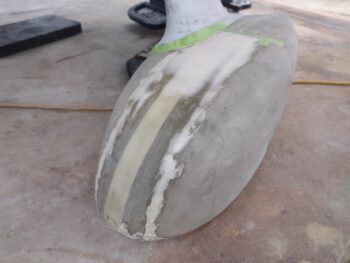
Now, I did the layup below along with right wing leading edge light pocket layup further below… but to smooth out the hard edged transition of the lens flange inside the light pocket, as well as to further physically secure the flange via glass/CF to the light pocket AND remedy the minor cut gap in the bottom center of the flange, I simply added a dry micro (vs flox, to minimize weight) transition around the sides and aft edge of the lower flange before laying up a ply of carbon fiber.  I then peel plied the layup.  [Also note that I filled in the cleco holes with micro]

On the right wing leading edge light I set the flange in place and drilled out the cleco holes as I installed each cleco along the way.  When I was finished installing the clecos and verifying this dry run install was good, I pulled the clecos and removed the flange.

I then cut 2 plies of BID which were very close in size to the BID plies I used on the left wing leading edge light pocket.  I also cut the major peel ply piece that would cover the majority of the glass after applied.

I reversed the BID ply layup order on this side as compared to the left side, with the smaller of the 2 plies going in first, which covers just the blue foam on the sides and aft wall of the pocket, and really doesn’t overlap onto any glass (pic 1).  I then partially laid up BID ply #2 by only wetting out the aft wall area and NOT wetting out the overlapping top, bottom or side portions of this BID ply (pic 2)… but rather turned them inward out of the way to allow me to then install and flox the carbon fiber lens flange into place.

I was scrambling to get this all done, so no intermediate pics before this one with the carbon fiber flange floxed into place, secured by clecos which in turn allowed me to finish laying up the light pocket BID ply #2.

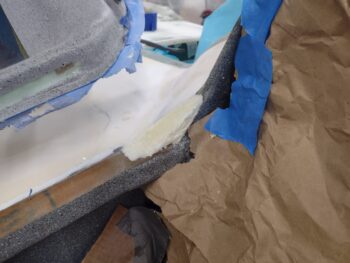
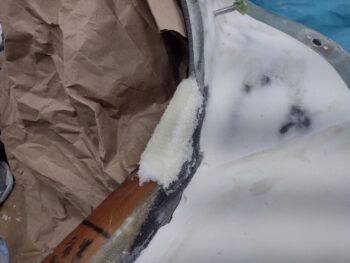
Here we have another shot of the floxed/clecoed in place flange as well as the glassed internal surfaces of the right wing leading edge light pocket.  As you can see, I also peel plied the majority of the layup inside the light pocket.

With the requisite shots of the inside light pocket BID layups completed, I then clamped the top and bottom horizontal edges of the flange to the wing skin to ensure a nice tight attachment of the two surfaces.

And with another round of tasks out of the way on the wing leading edge lights complete, I left these layups to cure overnight and called it a night.

Moving onward!

Chapter 19/22/25 – Porcupine wing!

I started out today by razor trimming the cured layup inside the left wing leading edge light pocket.  I then pulled all the peel ply and cleaned it up.  I’m very happy with the results.

I then started work on trimming down the carbon fiber flange for the left wing leading edge light.  After I got the flange trimmed and fitted, with a little extra sanding on the inside of the leading edges to knock down some extra thick glass, I drilled and test fit it into place with clecos.  With the dry run good, I then added flox to the edges and clecoed and clamped the left wing light pocket CF flange into place.

I also razor trimmed and pulled peel ply on the right wing leading edge light pocket edge layups, before working on that flange as well.  First I got the flange trimmed enough to fit into the light pocket.

And then trimmed it down just a bit more around the exterior edges, while also making the internal notch a bit bigger as well (pic 1).  I also pre-drilled the cleco holes around the perimeter of the leading edge light pocket opening (pic 2).  Since I’m not building an RV, I only have a few smaller diameter clecos on hand and they were currently all employed securing the floxed left flange in place.

I did a final test fit on the flange, which was good.  Tomorrow I will drill the cleco holes into the flange and set it in place to check all is good before floxing it into place.

I will note that on this right side I plan to layup the interior of the pocket first with 2 plies of BID before I install and flox the flange into place… kind of a do-it-all-at-once deal.

Oh, and I’m back to the plan of using a drilling jig to drill the 3 light bracket securing standoff holes.  In fact, I’m actually making up 2 drilling jigs —one for each side— that will allow me to aim the light inboard an extra 2.5° and down about 7°.  Yes, a bit of a compromise, but those are the numbers I’m comfortable with as I’m hoping to install and wire these lights, test them and press forward with nothing but final minor adjustments and lens install after the wings are painted.

The pic above is a screenshot from my CAD file, while the actual one is currently printing out (nearly 3 hours) on the 3D printer.  I’ll have shots of the jigs tomorrow.

Chapter 19/22/25 – Pocket sand to glass

Today was all about the wings leading edge lights again, in getting the glass inside the pockets cleaned up, sanded and prepped for glass layups.  I spent at least 45 minutes per side using my Dremel tool with a cutoff wheel to knock down the thick layer of cured micro, and then the small sanding drum on the Dremel to clean out the fine thin layer of micro that was still left over after the main stuff was cleared out.  I finished it off with a good bit of hand sanding with my Perma-Grit tools and 32 grit sandpaper.  Of course the really fun part of it all was getting the underside of the wing skin inside the pocket.

Here we have both the right wing (pic 1) and the left wing (pic 2) leading edge light pockets internal glass surfaces ready for more glass layups.

Another tip I got from the Cozy Girrrls was to check the wing edge thickness around the perimeter of the pocket since it needs to be a minimum of 0.065″ thick to allow the 1/16″ thick light lens to seat fully and flush with the wing surface.  Good point here, because just slapping and floxing the internal flange into place might be on the sequential task list, but some measuring and assessment is required to ensure the final pieces all fit together nicely in the end.

On the right side I got varying thicknesses when I measured all the way around.  The bottom leading edge was plenty thick enough while I got some readings in the 0.05-ish range on the upper leading edge.  Same with the top and bottom edges.  So I figured one ply of UNI should do the trick, and I’ll assess from there.

Here we have some plies of UNI laid up on some of the edges of the right wing leading edge light pocket.  I of course peel plied the layups.

On the left side I was getting a number of light pocket edge measurements around 0.047″… hmmm?  Definitely a couple plies of filler glass to get that edge thicker before the flange goes in.

My quandary was do I knock out the major glassing now, that will also add the required plies to the perimeter pocket edges?  Or do I simply do the pocket edges as I did on the right side? (and as the Cozy Girrrls recommended).

Well, not one to always listen to conventional advice (clearly!), I decided to do the whole enchilada on the left side.  I took a myriad of measurements, created a 3-ply (BID, UNI, BID) layup schedule, and made patterns for each ply of glass.  And then cut the glass (and peel ply!).

It was very late, but I wanted to get this thing glassed and curing while I was sleeping… so I pressed forward by mixing some Pro-Set epoxy and whipping up some micro, which I applied to the blue wing foam surfaces.  I also used thicker micro for the corner fillets and a few sanding divots.

The first ply in was BID and it covered the entire internal surface of the left wing’s leading light pocket.  A bit tricky going in —not surprisingly— but after working it a bit, and being patient, I coaxed it all to lay in nicely.

Ply #2 was UNI, and it only covered the aft wall, then forward on the inside wing skin (top & bottom flange edges) and just covered the inboard & outboard side edges of the pocket. In short, it covered everything but the foam sides inside the pocket.  Hard to see, but if you look closely at the conduit access hole and right side aft wall you can see wisps of the UNI strands.

Ply #3 was BID and crossed 90° to ply #2, covering the pocket aft wall and foam sides, but not the top and bottom original wing skin.  I grabbed this shot as soon as I put the BID into place so it was visible —before it wetted out completely.

I then peel plied all the just-laid up glass inside the left wing leading edge light pocket.

The layup went smoothly, but with all the prep and pattern-making for the layup plies, it made for a very late night by the time I was done.  Tomorrow I’ll press forward to get as much knocked out on these wing leading edge lights as possible.

Chapter 19/22/25 – Move to the light

Today I started out spending about 30-45 minutes per wing shaping the leading edge light pocket and also trimming down the light lenses on the top and bottom edges to get the respective lenses to sit flush within the wing light pocket/lens cutout.  I wasn’t overly thrilled about having to take the Fein saw to the lenses again, but it was the only way to get them to fit flush without making the light pockets deeper than they already were.

I started on the right wing (pic 1) and finished up on the left (pic 2).

I ran string across the back of rudders to create a reference line 90° to the centerline of the plane.  Then, using a large T-square up against the string, I marked parallel to that line to obtain the aft pocket wall, again 90° perpendicular to aircraft centerline (on green tape).

By shaping and aligning the light pocket internal aft wall this way, then by mounting the light parallel to the internal aft wall automatically gets you a straight, forward facing light.  That being said, I’ll still probably angle the light in a few degrees in the aim (literally, pardon the pun!) to get the beams to touch 150-200′ in front of the plane.

Again, I did this on both the right (pic 1) and left (pic 2) wings [you can just barely see the string at the top of pic #1].

I then dug the foam out of the right wing leading edge light pocket and shaped it in prep for glass.  Note that the dark spot in inboard corner is the wing cable conduit, and this will be the spot where this wing leading edge light’s wires will enter the cable conduit.  I’ll note that being forward of and leaving the vast majority of the wing cable conduit hidden is NOT how Nick Ugolini does his version of these wing lights, but rather he makes the pocket deeper and exposes the entire cable conduit and runs the cables behind the light bracket.  This results in a hole on each side wall of the pocket where the conduit enters one side, and exits the other (or obviously vise versa, you get my point).

This little inboard corner conduit access/not exposing the majority of the conduit trick is one I picked up from the Cozy Girrrls during our discussion.  I’ll further note that it does make the placement of the 3 light bracket standoffs a little trickier, since that conduit needs to be avoided… so some educated guessing comes into play to not block off that cable conduit whilst installing the light bracket!

To verify my wing light pocket aft wall during foam removal and shaping, I simply used the tip of my LED shop light to shine it through the fiberglass wing skin and Voila… reference position known!

I then repeated the process on the left wing leading edge light pocket.  Now, I’ll again note that I’m clearing the foam out of these light pockets by hand using a cheap box cutting razor knife (narrow long blade) and a hacksaw blade.  I’m almost “shaving” the surface of the foam by scraping it as to have no major chunks break out past the dimensions, and to not overshoot my pocket dimensions.  Needless to say, it took a good little bit of time on both sides to clear these pockets.  And again, you can see the cable conduit peaking out in the inboard corner of the pocket.

I also again employed my shop LED light tip trick to verify the aft wall depth as compared to my 90°-to-AC-centerline reference line up top on the green tape.

Besides annotating a bunch of notes regarding upcoming tasks regarding these wing leading edge lights, my last official act of the evening was simply getting a visual on how the actual light assemble will look once mounted inside my left wing leading edge light pocket.  I think we’re getting there!

…. slowly but surely.  Pushing onward!

Chapter 19/22/25 – Flange ‘n splash

For what seems like should be a rather straightforward sub-project has had many twists and turns in the methodology, tasks and requirements to get it done.  In my notes from discussing the installation and creation of the wing leading edge lights with Nick Ugolini, he reiterated the importance of using an angled wood block jig for drilling the holes into the back wall of the wing LE light pocket to then install the 3-legged light bracket.

Now, I have a picture of this wood block jig, so I have a good idea of its overall size, angles and dimensions.  I also have a diagram of the light pocket that Nick sent me… the problem I was having was reconciling the two together in my mind to make it work. And as I tried for nearly an hour first thing this morning to cobble it all together in CAD. It just wasn’t working.

So I decided to ask Nick what the deal was… but kind of a funny thing is when I went to text him, I saw that my last text to him nearly a year ago was regarding the wing leading edge lights as well.  His reply was along the lines, of: “It was too long ago for me to remember, ask Randi and Chrissi since they just did it recently!

Haha… fair enough (and I know how he feels!).  So, I didn’t bug Nick and went straight into an hour+ long consultation with Chrissi and Randi (aka “The Cozy Girrrls”) on the wing leading edge lights.  And I’m glad I did because I confirmed in my mind that the jig was NOT a mandatory, critical component to this task.  And I got a few tips and tricks as well on creating these lights.  Thanks Girrrls!

Ok, so a few hours of my day was gone… lost to information gathering.  But always better to have good intel in hand, so no major worries.

In the shop I grabbed a shot of my wing leading edge light lens and pocket perimeter cutout template.  This is for the left wing.  Clearly if you simply flip it around it works for the right wing.

I then spent about 5 minutes removing the initial exposed foam out of the wing leading edge light pockets.  And then a good 45 minutes more doing some initial edge sanding on the pocket edges and writing out notes from my assessments.

It’s “funny” in building a Long-EZ how a “simple” task can still be simple, but can take so long to get it done.  Well, that was the case with getting the layups done on the wing leading edge light pockets’ carbon fiber flanges.

I started with cutting the carbon fiber: 2 whole plies, a ply of maybe 2 pieces, and then a 4th ply (buried in the middle) of cobbled together wide edge strips (think picture frame). I also cut a piece of peel ply to cover both sides of these layups.  And let’s note forget the plastic sheets for pre-pregging all this!  [“Poor man’s pre-preg” I’ll remind you all…]

I then again spent way longer than I expected removing the cotton material from inside the splashes and taping up the inside —first with blue painters tape, then 2 plies of black gorilla duct tape, and then topped off with clear packing tape for a nice mold release.

I then wetted out the 4 plies of carbon fiber and after they were good to go, opened up the prepregs and added the peel ply.  Once all was nice and wetted out (of course not too wet!) I trimmed the edges and laid each layup in its respective splash.

I left the inside plastic on until I got a good squeegee in on all the flange carbon fiber surfaces, making sure it was settled in nicely to the splash.  Because the weather is cooler, I set a couple of heat lamps up off just a bit away enough to keep the ambient temp nice and warm for a good cure.  Then I left them to cure overnight.

Again, I had planned on doing a lot more than just these flange layups, but man were these things a time bust!  Regardless, they are done and curing now, so another task off the list.

And no major worries, as I’ve said countless times: I’ll just keep pressing forward!

Chapter 19/22/25 – Splash for lights

I started off today using my laser crosshairs to verify the vertical cut lines on the leading edge light pockets (I did this on the right side as well).

I started on the left side by making up a tape outline of the lens cutout.  I then placed lens blank #1 over the tape outline, traced it onto the lens with a non-permanent whiteboard marker and cut the lens to the shape.

I discovered that, unfortunately, if you don’t thoroughly tape up the lens that you may get a small crack as I did on the left (inboard) side of this lens.

So lens #2 got all sorts of taped up on both the interior and exterior surfaces before I started cutting with the Fein saw (pic 1), and this time it cut without any unwanted cracks (pic 2).  This is exactly why I made at least 2 lenses for each side!

Here we have uncracked lens #2 with the tape peeled off (pic 1), and back in place for a test fit (pic 2).  Then, after I retaped the lens and cleaned up the edges, I used this lens to do a final outline on the wing leading edge to cut out the perimeter of the light pocket.

Here we have the perimeter of the light pocket marked for cutout (pic 1) and after cutout doing a quick check fit of the taped lens (pic 2).  Not surprisingly a bit more refinement will be required on the perimeter cut for the lens to fit just right.

And here we have a wider angle shot of the left wing light pocket —with all the protective tape removed— initial cut on the leading edge.

I then did pretty much the same thing on the right side with both lenses.  Here we have lens #1 taped in place (pic 1) and the initial perimeter cut made on the lens (pic 2).  I’ll note that I made a copy of the lens outline of the left side, flipped it and applied it to the right side… so both sides’ lens size and shape are very close to each other.

I then cut out lens #2 and set it back in place after the final cuts (pic 1), and then removed it to show the green lens template (that I copied/mirrored from the left wing) underneath (pic 2).  [Note: in my haste to get this done, I labeled lens #2: “Lens #1 red” and lens #1: “Lens #2 blue” to denote the color of ink I was using to outline each lens on the leading edge to assess my final cut line].

I then used the Fein saw to cut out the lens perimeter on the right wing leading edge for the light pocket.

I then test fit both lenses back in the right wing leading edge light pocket cutout.

And just as the left wing, here we have all the protective tape pulled and the right wing leading edge light pocket ready for further install tasks.

My primary goal for tomorrow will be to convert the splashes by adding tape to the insides of those and using them to layup 3-ply carbon fiber flanges that will go just inside the wing skin and provide a mounting surface to secure the lenses in place on the wings… nice and flush with the wing surface.

To be clear: I’m knocking out these wing leading edge lights now to clean up all the collateral install “damage” so that these light installs will be complete and clean prior to primer and paint.

Chapter 19/22/25 – The lens master

If you find him, or know of one, can you tell him that I’m looking for him?!  Haha

I started off today by pulling the left wing splash off the wing, cleaning it up and trimming it around the edges.

I then did the same thing on the right wing leading edge light splash.

I deferred working any more on the splashes until later in evening, and got to work doing the final sanding on the left strake leading edge RAM air intake.  I sanded the epoxy-wiped internal expansion tube first with 100 grit, then 120 and finally wet sanded it with 150 grit.  That whole process took well over 30 minutes.

Then I spent about another 30 minutes using the orbital sander to knock down the added micro fill on both strakes’ lower leading edges.  My goal was to get them to a state where I could re-epoxy wipe them and be done with them, but I think the contouring of these lower leading edges is a bit more nuanced than I want to deal with upside down. In short, I think there is a fuselage flip coming up in the near future (for a number of different reasons).

I then re-drilled the top cowling’s right shoulder CAMLOC hole and remounted the top cowl.  I am very happy to report that my oil-canning issue on this right shoulder has been eliminated.  There is no depression of the cowl lip as I install the CAMLOC, and it is rock solid.  However, since the cowl lip is much higher now than when I put micro on the right shoulder, I will need to add micro to match the strake shoulder to cowling edge for final contour finishing.

I had also sanded down the edge of the micro-fill on the strake side of the top cowl-strake intersection seam, but there is still just a tad too much material in the way for the top cowl right corner to sit flat against the flange.  Thus, one more cowl OFF will be required before I get a “final” sand on the right side horizontal transition fill of the top cowl.

With the top cowl back on the bird, I then used my sanding blocks to knock down even more of the micro fill on the top center spline and aft lip areas.  With 80 grit on the orbital sander I also hit the open areas of the carbon fiber skin to rough that up for some upcoming epoxy wipes.

I took 45 minutes to do yet another round of sweeping and vacuuming the shop floor around the bird, slowly trying to clean up all the micro dust as most of my micro fill jobs are on a much smaller scale now and the cleanup more manageable… although the entire shop is still covered in a fine layer of micro dust.  I try to knock out a significant cleanup round once a day in the shop…. bit by bit.

Back in the house I configured the splashes for some plexiglass lens-making by finding an old white T-shirt, ironing it to remove any wrinkles, cutting out a piece for each splash and taping the cotton material into place (see 2nd-to-last pic below).

With 3 of my previous lenses that I made and discussed in a post (there were 4, one is hiding somewhere in that shop) I did a test to see if I could heat them up, flatten them back into essentially raw plexiglass stock again and start over.  I was pleasantly surprised to find that was indeed the case and not overly difficult to do… one just has to watch the heat exposure and time, as is always the case during any shaping of plexiglass.

I tried out my new “retread” process on the 2 throw-away scrap lenses first, and those worked fairly well with some minor tweaks to the process.  Lens #3 was a viable good candidate I had made months ago, and fortunately I was able to flatten it, heat it up to temp (300° F) and form it in the left wing splash.  I then test fit on the left wing leading edge (below).  I then used a brand new piece of 8″ x 8″ plexiglass and made a pretty decent lens for the right side, which is sitting on the left wing top below…

… and which I then test fit on the right wing leading edge light location.  I taped the lenses in place (in case the squirrels decided to do something even crazier) and closed up the shop for the night, as it was getting late in the evening.

Back in the house I used fresh new plexiglass stock for another left and right side leading edge light lens, respectively.  I started with the left side, where the heating and timing were about perfect.  It went in the splash nicely and I formed it around to ensure it cooled pressed as flush into the splash as possible.

However, as it started to cool I could feel 2 very minor bumps in the center leading edge curve.  Once cooled, sure enough when I pulled it from the splash I had a couple ripples, or bumps, in the center leading edge.  Not huge, but definitely noticeable if this were mounted on the bird.  So, my new plexiglass lens immediately became a “retread” as I heated it back up (in my kitchen oven, due to its height) and then remolded it in the splash once to temp.  Thankfully round 2 went fine and I got a good left lens out of it.  Even more thankfully is that I didn’t have any issues with forming another right side lens in the right splash.

Here we have another right side lens (#2) pulled from its splash after it cooled.

Tomorrow I’ll finalize the shape and angle of the leading edge light opening on the wings, make sure they match and are symmetrical, and then trace that opening onto all the lenses I’ve made.  I’ll then cut the lenses to shape, clean up the edges and use the best lens from each side as the template for the final markup on the wing leading edge to then cut out the light pocket.

Once my leading edge light lenses look squared away, and the light pockets cut out, I’ll then pull the cotton material out of the splashes and tape them up to use as a mold for a 3-ply carbon fiber layup for the leading edge light mounting flanges.  Clearly one for each side.

Get ‘er done!