Chap 17 – Finishing up the Roll Trim

The only I thing I needed to construct to finish up the roll trim as per Waiter’s detailed instructions was the two 1/16″ thick 2024 aluminum angle tabs.  These tabs hold the X-Tube to the control tube (which transits down the side of the fuselage).

I didn’t find any angled 1/16″ 2024 aluminum as I rooted around in all my metal stock, but I had a nagging feeling that I had ordered a piece.  Thus, last night I carved out some time specifically to research the case of the missing angled aluminum (queue dramatic music).  A significant motivation for me to look was that it was going to cost about $17 to have a $3.50 piece of aluminum sent to me from Aircraft Spruce.

First, I found it in on my master spreadsheet and I had even listed it as being for the roll trim build.  That meant that I should have it on hand.  With various parts of my EZ project literally having been scattered about 5 locations around the world, I thought maybe I might have lost it in transit.  Well, I then checked my invoices and found the box that it had been shipped in, along with the aluminum tubing for the fuel lines.  Since it was wrapped in brown paper at the bottom of a tall box, I had missed it at the bottom, dimly lit corner behind & below all the various tubing and wire bundles.

Anyways, an hour blown on looking for my aluminum angle piece, but the mystery was solved & case closed!
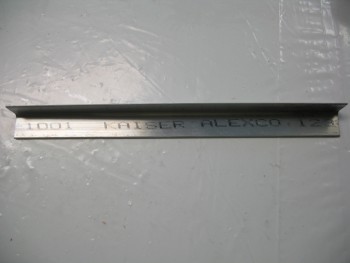
Roll trim tab construction

After I finished the aft seat 2-ply BID reinforcement layup and while it was curing (detailed in the post above ) I set my sites on knocking out the tabs for the roll trim assembly. This will finish up the actual construction of the roll trim assembly, and all that will be left is the installation & wiring up of the roll trim system.

I checked each end of the 1/16″ angled 2024 to ensure it was square, which both sides were. Then after making a mark at 3/4″ I simply used my small chop saw with a wood blade, and very slowly cut the aluminum.  Repeat for the second one and voila!  Two tabs.

As per Waiter’s plans, I marked the spots for the mounting holes in center going top to bottom (3/8″) and 1/2″ from the side (this is 1″ x 1″ angled 2024).
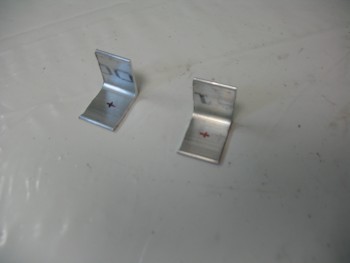
Roll trim tab construction

I drilled a small pilot hole in each tab, then finished up with a 3/16″ hole.  I deburred the holes & then checked the fit of the AN3 bolt.
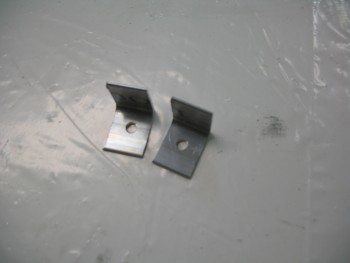
Roll trim tab construction

I then cleaned up the edges with the Dremel Tool and gave the non-drilled side tabs just a bit of a radius where the pipe clamps will be located as they hold the roll trim assemble to the control tube.

I then mounted the tabs to the assembly.  They fit great and everything looks good.  I’ll Alodine these tabs later on when I do another batch of aluminum components.

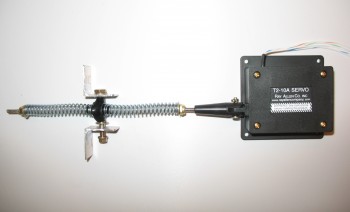
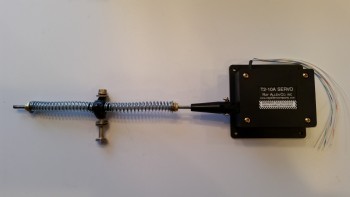
Here’s a few shots with the mounting tabs in varying positions on what I’m going to call the COMPLETED Roll Trim assembly!
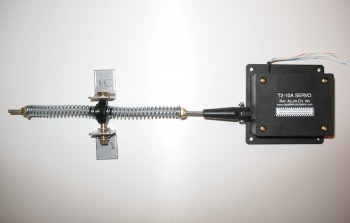
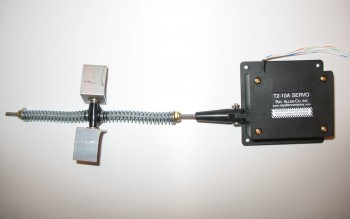
Roll Trim Assembly

Roll Trim SystemRoll Trim Assembly


Chap 17 – Roll Trim Complete

Well, let’s say it’s 95% complete.  I still need to cut two 1/16″ 2024 aluminum “L” brackets to attach to the X-Tube (via the 3/16″ bolt) to then be attached to the aileron control tube with a stainless steel hose clamp on each aluminum “L” bracket.  I don’t have any 1/16″ angled aluminum on hand, so I’ll wait until I put in my next consolidated ACS order to pick some up (to save on shipping costs).

Nonetheless, here is my new, completed Roll Trim system:

Waiter's Roll Trim

VSWR what?!

In the December 2013 edition of Kitplanes magazine I found yet another useful piece of information, and like so many other times during this build, it came a year or so too late. The article was written by Jim Weir–maker of many canard antennas–and discussed checking the VSWR (Voltage Standing Wave Ratio) of each antenna before burying it under the skin of a plastic airplane such as the Long-EZ, at which point if you have a problem . . . well, better think up some good solutions!

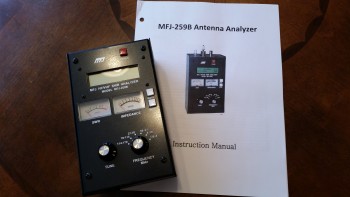
Jim recommended a MFJ-259B Antenna Analyzer to check the VSWR on each antenna to ensure they were good.  Again, my antennas already being installed, I still wanted to check them to A) know if any had a VSWR too high to count as good, and B) pick the best between the COM antennas for COM1, and the best between the NAV antennas for NAV1.  The goal is a VSWR ratio less than 3:1, because anything higher is a lot electrical energy traveling back along the OUTSIDE of your antenna coax cable to the transmitting device (ie, radio), which will drive your available Tx wattage to unacceptably low levels and could damage your transmitter in the process.  In addition, as with so many other units of measurement in the weird & wonderful world of electrons, VSWR readings are logarithmic.  Any increases above a 1.5:1-to-2:1 ratio and things start getting real hairy real quick!

I of course started hunting around for a good, used antenna analyzer at an acceptable price anywhere I could find one.  That pretty much drove me to eBay, where I picked one up for about half the price of a new one.  And thar she be below.

MFJ-259B Antenna Analyzer

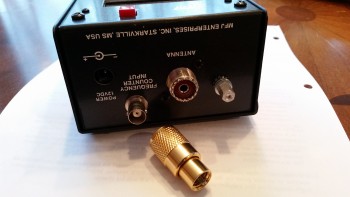
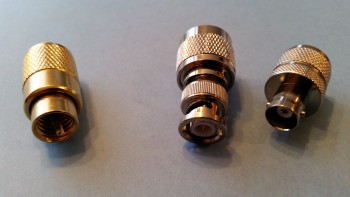
The only problem with my newly won prize (which I actually bought a while ago), was the antenna cable adapter that came with it.  These analyzers can be used for checking any antenna and are common in the HAM radio world, so perhaps the antenna cable adapter that came was used for something even more exotic by a HAM radio bubba.

Old Connector ???So although I didn’t know what the mystery adapter was used for, I did know that to check the BNC connectors used on the Long-EZ antenna cables that I would need a BNC adapter for the antenna analyzer.  So, last week I ordered a couple of them, one male and one female, and I got them in today.

New BNC connectors M & F

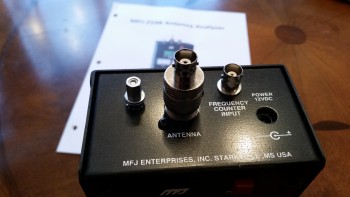
You can see the new BNC antenna cable adapters on the right, and the old one on the left. Below is a shot of one installed on the antenna analyzer.

It fits!

Since the weather is still too cold to economically heat my workshop for glassing, I plan on terminating all my antenna cables with BNC connectors and then checking the VSWR of each one with this MFJ-259B antenna analyzer.

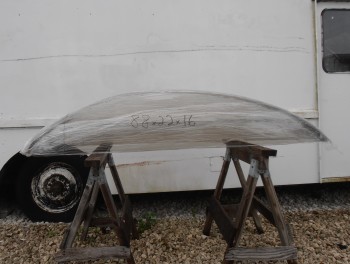
New Canopy Arrives!

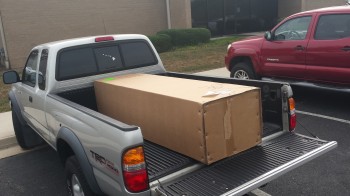
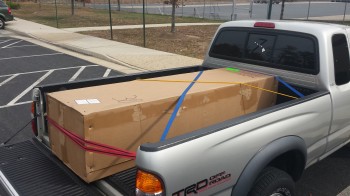
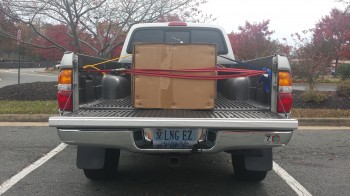
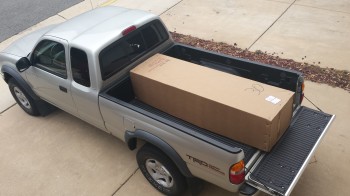
Today I went down to a freight terminal 40 miles south of my house to pick up my new canopy that Todd Silver sent out last week.  Todd had shipped out the canopy in hopes of getting a look at the canopy mocked up on my fuselage when he stopped through town as part of a multi-state canopy install tour that he was on.  Unfortunately, Todd stopped by last night (Tuesday evening), but since I had originally received an estimated delivery for Wednesday (today), that’s when I picked up the canopy.

New Canopy

Canopy - SecuredCanopy - with plate!Canopy Overhead Shot

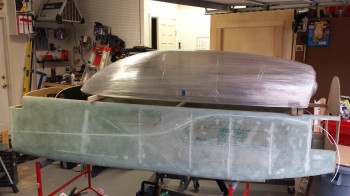
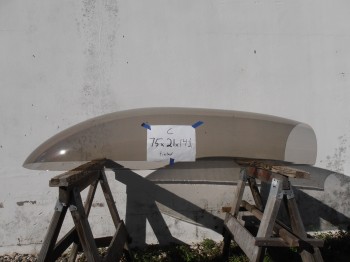
Here’s a shot of the new canopy that Todd had hoped to see!

New Canopy Profile

As you can see by the pic above, the new canopy’s profile is excellent and the dimensions are spot on.  I am VERY happy with this canopy!


Main Landing Gear Fairings

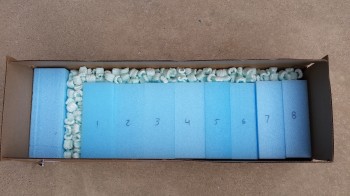
Today I received my Main Landing Gear Fairings from Steve at Eureka CNC.  Although I got a delivery confirmation from FedEX an hour before I got home, the box was nowhere to be found.  Apparently FedEx delivered them to the wrong house, requiring me to go on a 45-minute goose chase for my box.  My neighbors let me know that was a common occurrence so I eventually found them at the house at the end of the street!

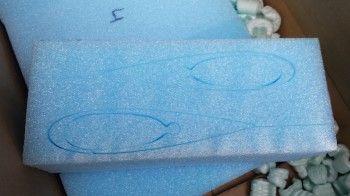
These gear fairings are often called “Wortmann” gear fairings, and as I’m sure most of you know they solve a big drag problem on the Long-EZ by streamlining the main gear in two ways:  First, it takes the oval shape of the main gear and converts it into an airfoil shape, which is exponentially more aerodynamic than virtually any other shape.  Second, it twists the  gear’s angle of incidence so that it meets the oncoming air straight on and fixes the stock gear’s offset profile (read “dirty”) which creates a lot of drag.

After the delivery drama was over I opened the box to find some very precisely (of course!) hot-wired gear fairings!

Gear Fairings

Eureka CNC Gear Fairings

I can’t wait to get these babies glassed onto the main gear.  Thanks Steve!


New Canopy

I’ve been talking with Todd Silver for a number of months now on getting a new canopy.

Why?  Well, here’s the story:
The first canopy I got from Todd was one that I went down and picked up out of his shop in Ft. Lauderdale in early 2013 while I was deployed to Tampa, FL.  I had wanted a little bit larger/longer canopy so that I wouldn’t have the windscreen up so close to my face, and a little bit taller to have just a little bit more “cabin” space.  However, I should have analyzed the shape of the canopy more thoroughly before throwing it in the back of my vehicle and hauling it back up to Tampa.

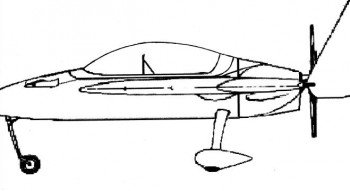
Fast-forward to late 2013, once I was settled into my job in Qatar, where I had more time to ponder various build aspects since I wasn’t actually making layups or sniffing epoxy fumes.  I took my pics of the canopy, traced them out (poor man’s CAD) and then overlaid them onto an outline of a close depiction of my fuselage.  I checked this out a number of times from as many angles as I could find.  The main depiction of what I found is here:

Old CanopyThe canopy profile is very close to a true section of a circle on a standard curve. What this meant is the highest point of the canopy sat behind the rollover structure and really wasn’t adding any usable space, but was most certainly adding drag.  Now, to be clear I picked this canopy out of a lineup and the result of my dissatisfaction with it was my fault, not Todd’s.  Todd was nothing but exceptionally helpful as I was looking at his canopies.  In addition, the shape of the canopy also meant a fairly flat and low profile directly in front of the pilot’s seat, and a sharper curve aft where the canopy met the firewall structure.  To be clear on another point: this canopy is beautiful.  It just happened to have the wrong characteristics that I was looking for.

Now, I confirmed my misgivings with the canopy when I came back to the states for a couple of weeks from Qatar in March 2014.  I hauled the canopy down to my buddy Marco’s shop (since my project–but obviously not my canopy–was in storage) and we trial fitted it on his fuselage.  Now, I widened my fuselage 1.4 inches at the pilot seat, but the rest of the fuselage is widened at the same ratio as the original plans fuselage (except my firewall).  Being more of a maverick, Marco chose to widen his fuselage 2 inches the entire length.  When we put the canopy on his fuselage it displayed and confirmed the characteristics I was concerned about (see pic above), but it also proved to me that the dimensions were just too big, since the canopy was close to being oversized even for Marco’s bigger fuselage.

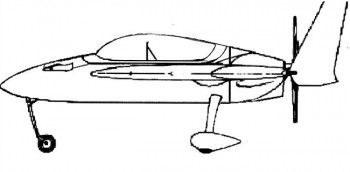
With confirmation in hand, I approached Todd and let him know my concerns.  I sent him the pic above along with this pic below depicting more of the shape I was looking for (BTW, I used Steve Volovsek’s canopy as a style reference).

Desired Canopy

As you can see, the most “bubbly”part of the canopy is directly over the pilot as it flattens out behind the pilot for a good intersection angle with the firewall.

Thus began a conversation over the next few months about the size, shape, etc. of the canopy I was wanting.  Since I wasn’t in a hurry to get a new canopy until after I returned from overseas and settled in, Todd and I waited until I got back to finalize my choice of a new canopy.  Well once back, Todd of course delivered in spades.  He sent me a lineup of pics of a few different canopies (I think knowing full well which one I’d pick) that were all very close to what I wanted, with one being spot on:

New Canopy

Compared to my existing canopy on-hand:

My CanopyTodd was a champ and gave me a great deal even though I was the one who initially picked the “wrong” canopy.  Once I picked out my new canopy he shipped it out the same day.


More toys!

Well, after numerous initial discussions with my good OZ-based EZ-building buddy Dave Berenholtz (check out his build log here), the Sky Dynamics engine gurus, and my engine guy Tom, I decided to forego the pain that would ensue if I decided to go with a traditional Slick mag along with my Electroair electronic ignition, and then swap the initially cheaper Slick for a PMag many hours later.  Yes, after Dave so graciously shared his tale of woe as to the difficulty of doing exactly what I had in mind, and after researching the electrical connections required, and the switches, and the  . . . you get the idea.  Much easier to just bite the bullet, design it right the first time, and then get ‘er done with one shot/one kill. [See my 12 May 2014 post]

Thus, being able to fully & justly blame my mate Dave for a much lighter wallet, I called (from Qatar) up Brad at E-Mag back in late May and had a wonderfully enlightening conversation on the myriad of capabilities of the P-Mag system.  Convinced that I was VERY CLOSE to making the right decision, I told Brad I would call him back to pull trigger once I was 100% sure I was going in the right direction and had researched every option. In addition, I knew with Oshkosh looming on the horizon that I would want to put an order in not too far out to ensure that Brad wouldn’t be sold out when I wanted to have a P-Mag on hand.

Well, after some more intense research and another half-dozen discussions with home-builders around the world, I called Brad back a few weeks later and told him that I was completely sold on the P-Mag and would need a unit come late August/early September.

But why did I need a P-Mag then?  Well, I had discussed with my engine builder Tom at Aero Engines in Winchester, VA, that after arriving back in the States I wanted to get the engine built within a month or so.  Although it will be delayed just a bit, within the next month or two I should be building my new ECi IOX-340S under his watchful eye. The PMag was the last major component for the engine build that I needed, and I wanted to make sure that I had it on hand so that an experienced engine builder–knowledgeable on P-Mags–would ensure that I installed it 100% correctly.

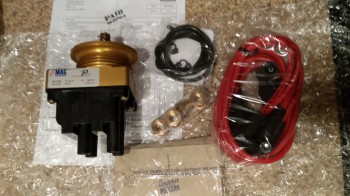
P-MagWell, sure enough Brad gave me a call in late August and my P-Mag unit arrived just a few days later, with a bag of microwave popcorn included no less!  Now that’s customer service!


Chap 23 – Oil Drain Valve

I was putting together my last big Aircraft Spruce order before I left the Middle East to head back to the States and got to the spot where I needed to order my SAF-AIR oil drain valve. I mean everyone uses SAF-AIR right?!  But man, oh man, are these things expensive!  I decided to do a bit more research to see if there were any alternatives out there.  Well, as you all know I spend a lot of time checking out what our RV brethren are doing over on the VAF site.  There I found a bunch of RV’ers singing the praises of an oil drain valve that is used in just about every type, make and model of vehicle around the world… from huge mega dump trucks to Caterpillar tractors to, well, uh, airplanes!

Chap 23 - Fumoto Quick Oil Drain Valve

The valve they were talking about was the Fumoto oil drain valve that carries all the features of the SAF-AIR oil drain valve: it has a quick drain lever and a nipple attachment to allow permanent or temporary mounting of a hose to help in directing the oil flow while draining. It got rave reviews from both the VAF folks, and by just about everyone else that has ever used one. Maybe one of the best features of the Fumoto oil drain valve is the price.  I found it on Amazon for way less than half the price of the equivalent SAF-AIR valve.  Another thing it got high marks on feedback from its users was that it doesn’t leak or drip!

One thing I was concerned about was weight.  Since the Fumoto valve is virtually all brass, while the SAF-AIR is aluminum & stainless steel, my initial thought was that the Fumoto might be significantly heavier.  But much to my surprise (and delight) the Fumoto is almost exactly the same weight (literally within a few grams) as the SAF-AIR valve. With that knowledge in hand I pulled the trigger and ordered my new oil drain valve.  I also ordered one for my truck while I was at it.


Chapter 22 – More Electrical Subsystem Diagrams

As I said in my last post, I’ve been really busy trying to get everything in order to relocate out of the Middle East back to the States.  I’ll be visiting family on the west coast for a couple of weeks when I get back, so I’m trying to set-up all my travels once I get back as well.

I was able to do a fair amount of work on my Electrical Subsystem Diagrams, and I added a few more to the list.  Unfortunately I haven’t had time to take any pics of them.  Here is the new updated list nonetheless:

Z.  Z-13/8 Electrical System
–    Switch Configuration
1.  Panel Components
1.1 Panel Components Power
2.  Radio & audio system
3.  Main Bus
4.  Batt Bus
5.  E-Bus
6.  Nose Gear
7.  Pitch & Roll Trim Systems
8.  Lights: LDG, TAXI, NAV, STROBE
9.  Engine Info Management
10. Fuel System
11. Cockpit Lighting
12. Landing Brake
13. Throttle Switches
14. Control Stick Wiring
15. Integrated Back-up Battery System
16. Alarm & Warning Systems
17. Charging System
18. Heater System
19. Electronic Ignition
20. P-Mag Ignition
21. Component Connections
22. Starting System
23. Panel, Battery & Avionics Grounds
24. Cockpit, Firewall & Engine Grounds
25. Heated Pitot Tube
26. Trio Autopilot
27. ELT
28. Connectors/Pin IDs
30. Long Wire Runs

This will probably be my last update on these Electrical System Subsystems for a while.  I should get back into the swing of things on the build starting early to mid-August when I’m settled back in my house in Northern Virginia.


New Old Pics

Hey Folks!  I found some old pics off my cell phone from Germany and am not quite sure if I posted them previously or not.  Yes, I’m being lazy right now by not going back to look through my myriad of posts to see if they were previously posted or not.  My excuse is that I’m in a mad rush to get everything wrapped up here because I’ll be leaving the Middle East in a few weeks and have a ton of non-build related stuff to get through to get out of here on time in early July.  I’ve got another assignment to the Pentagon and will be heading back to the States sometime in early July.

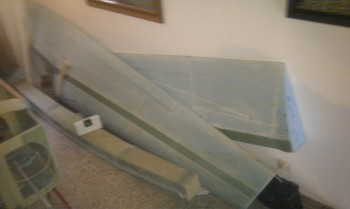
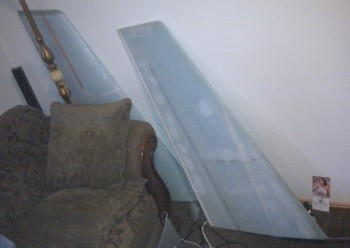
So here goes.  Some are a bit blurry, but I included them anyway.  Again, these are all build pics from Germany.  A number of them show the assemblies in storage in my Climate Controlled Storage Facility (again, my house… hehe!)

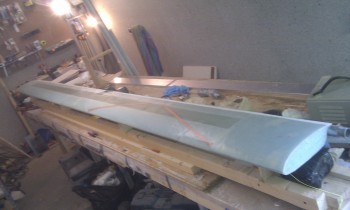
Chap 7 - FuselageChap 11 - Elevators

Chap 10 - Canard

Chaps 19 & 14 - Wings & CS SparChap 20 - Winglets

As oddly as it sounds, I’m going to title the picture below: “Why Microsoft Sucks!”

Normally I use Google Chrome as my browser, but it had uncharacteristically locked up on me, so I opened IE to build this post.  This is the first time I’ve used IE to create a post in probably 6 months.  And I couldn’t even get one post loaded without issues.  I had created this post in it’s entirety, but then when I saved it to go live on my site, it only saved from the first two pics up.  So I guess this post helps support the adage that 40% of work is rework.

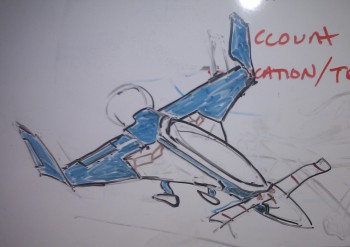
Now, (back on Google Chrome) this pic below is a crude drawing that I made on my whiteboard at work since the folks that worked for me would ask me almost daily as to the progress of the plane building project.  This was long before I built this web site, so I would color in the completed components in blue, and would use this crude diagram to answer any questions they had.  I would guess that this pic was taken circa late August-early September 2012 since the CS Spar wasn’t completed yet.

Long-EZ Build Progress Tracker Cheers!