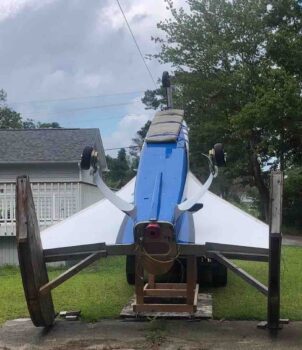
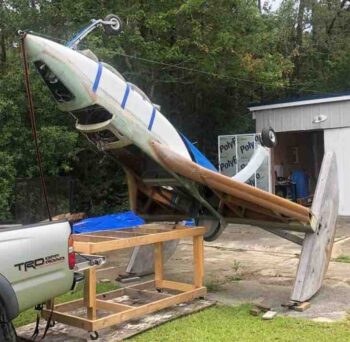
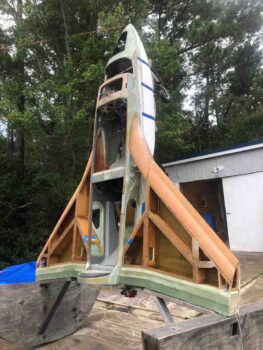
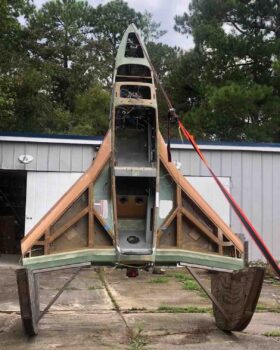
Chapter 21 – GIB windows installed

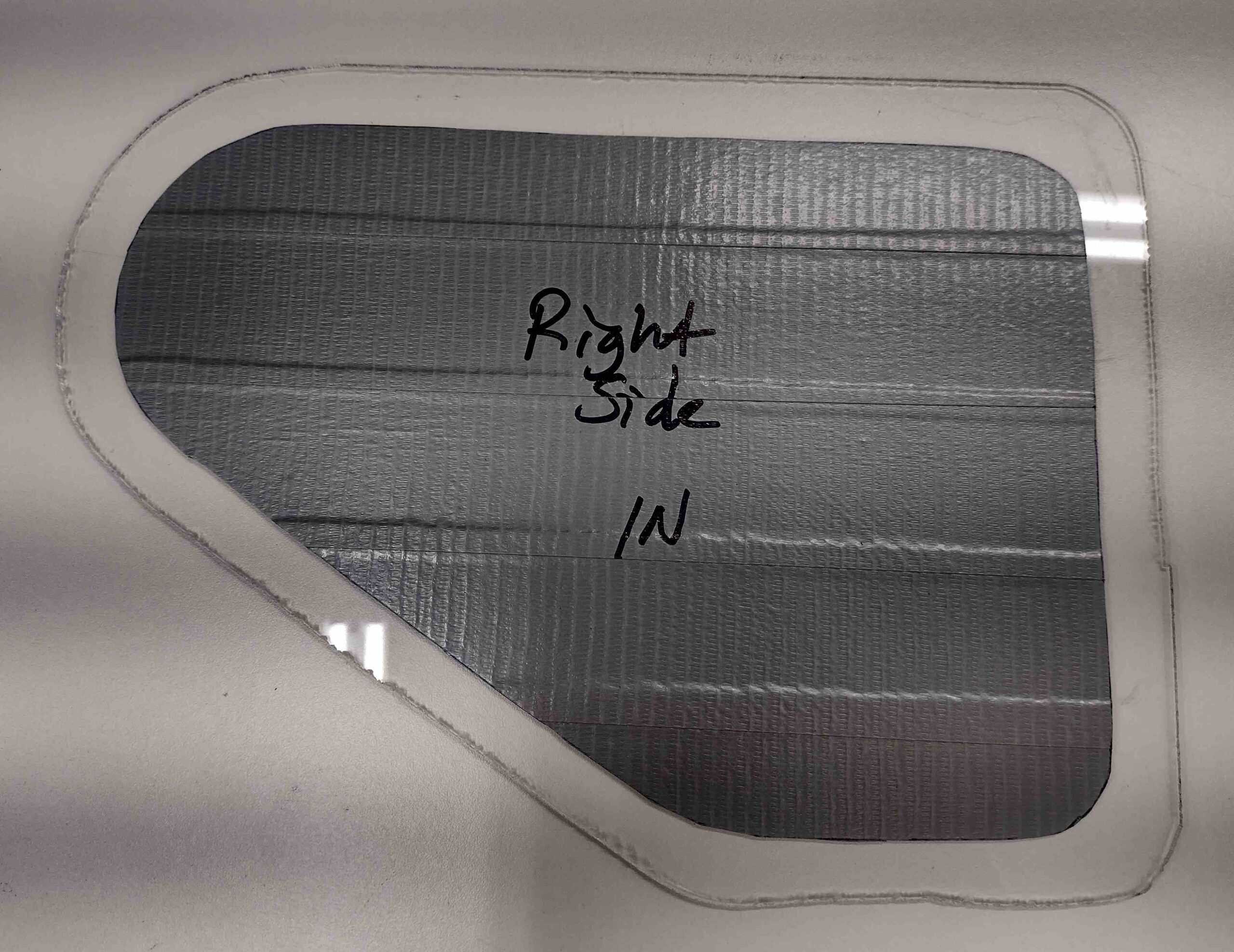
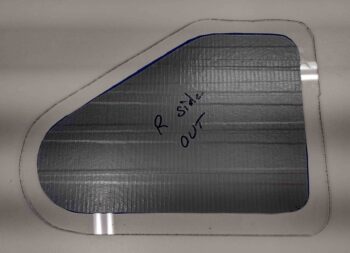
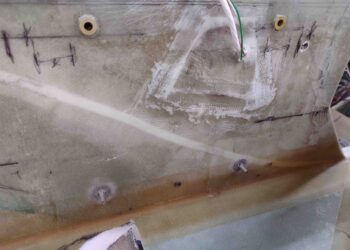
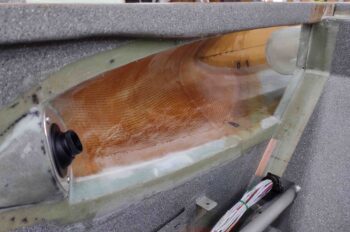
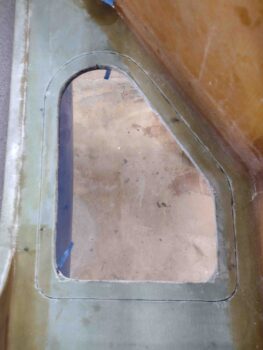
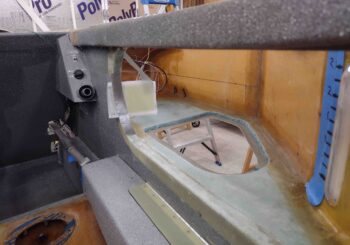
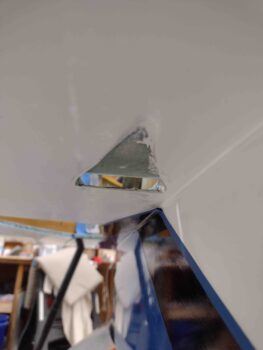
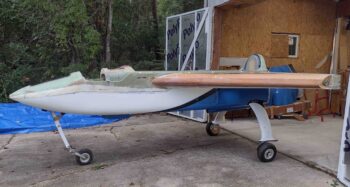
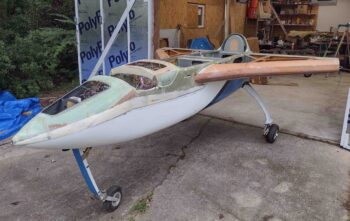
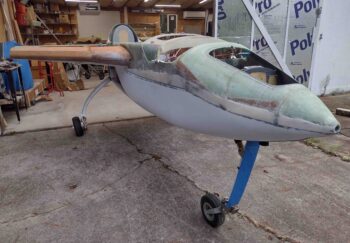
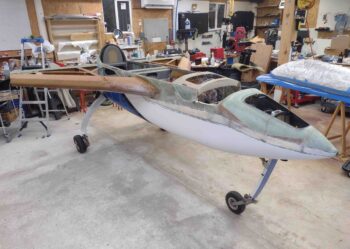
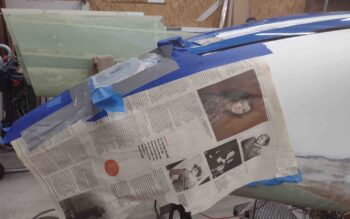
A day after getting back from Rough River I wanted to get right to work, with the goal being to finalize the GIB strake windows install.

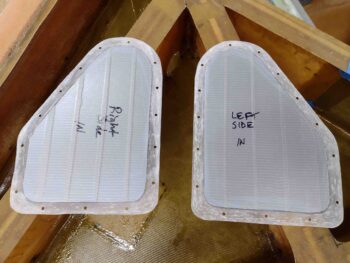
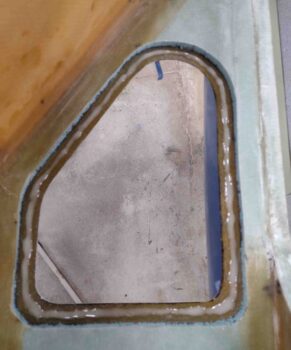
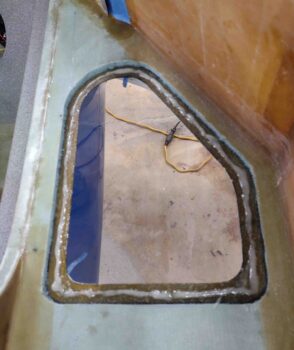
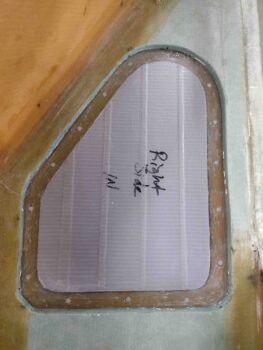
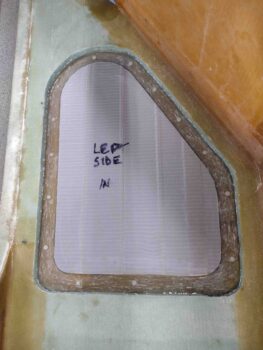
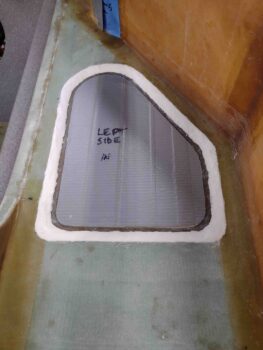
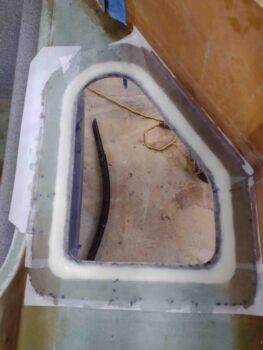
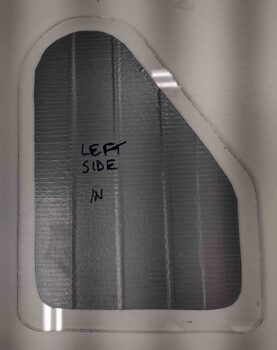
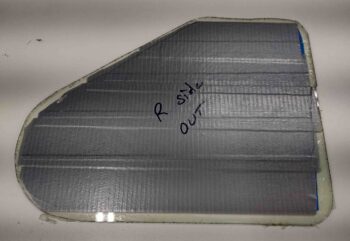
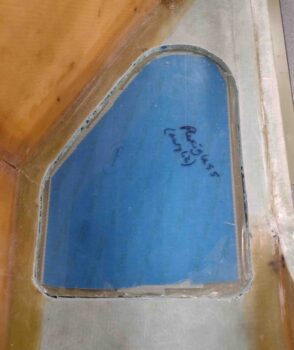
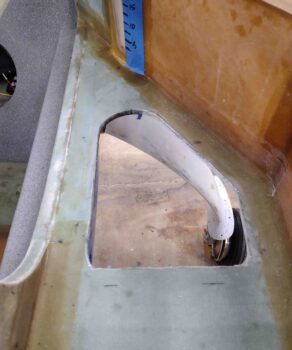
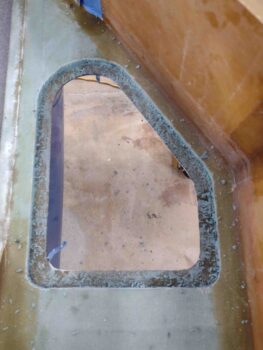
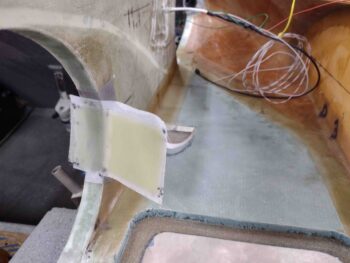
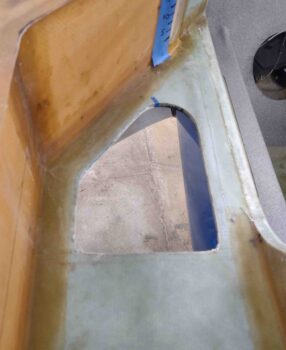
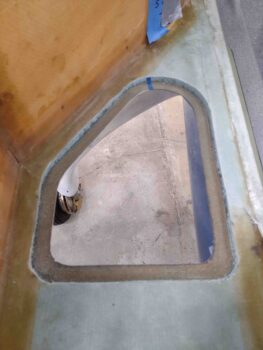
I started out by hitting each edge —inside and outside— with a sanding drum on the Dremel Tool.  I then hit it with 60 grit and finally 220 grit.

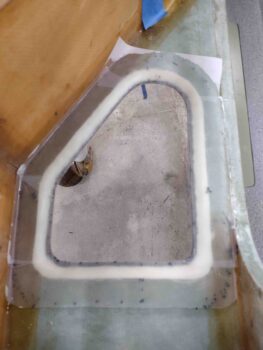
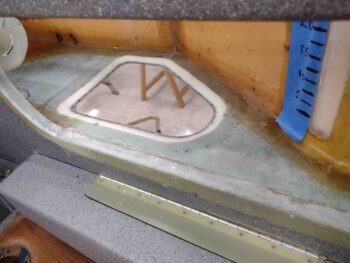
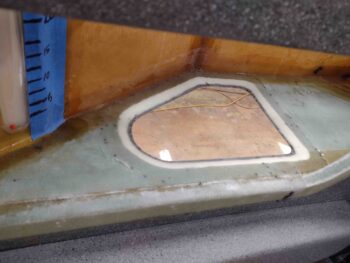
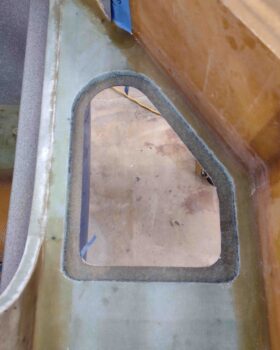
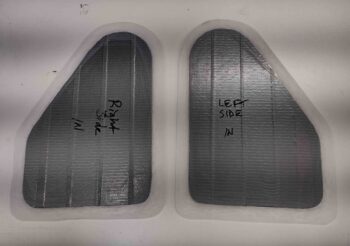
It may be a bit difficult to see the sanded edges above, so I grabbed another shot of it with a darker background.

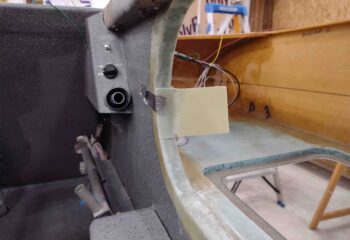
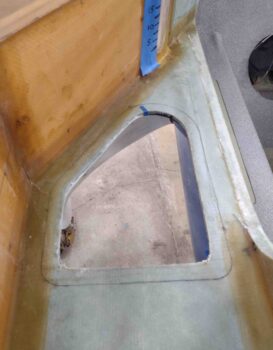
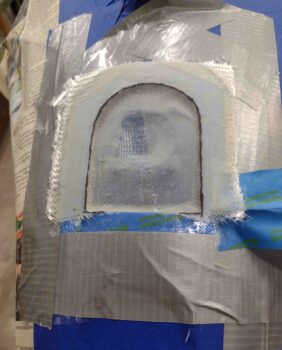
I then drilled holes around the perimeter of each GIB strake window pane to allow a better grip on each window by creating flox “studs” in each hole.

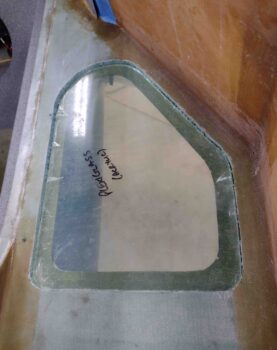
I then whipped up some flox using MGS 335 with fast hardener and laid down a bead on each window flange, one at a time.

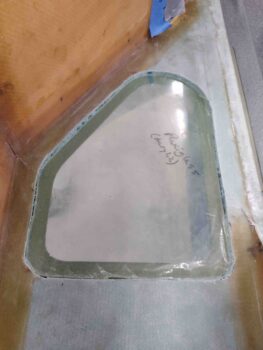
I then set each window pane in place and weighed it down with ~2-pound diving weight bag.

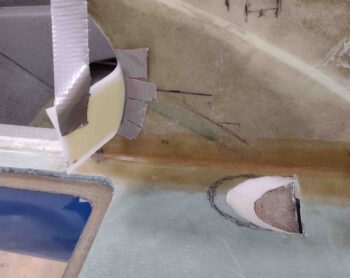
After about an hour I pulled the exterior protective tape panel on each window and cleaned up any excess flox that had squeeze out on the exterior perimeter of each strake window.

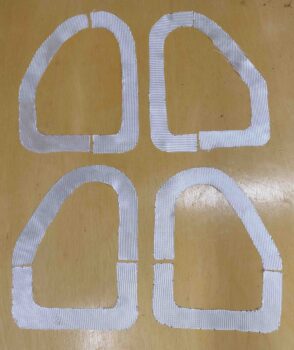
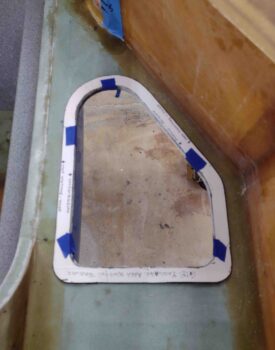
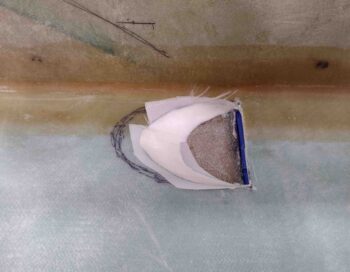
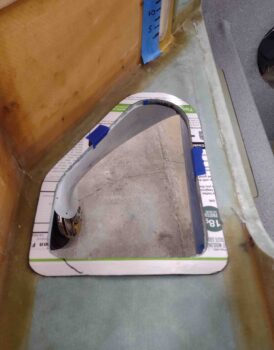
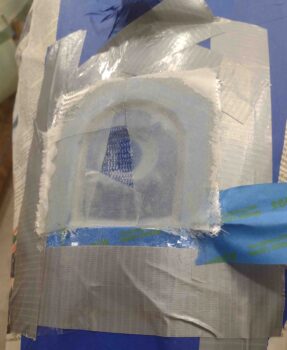
As the GIB strake window pane flange flox cured, I used my window template to cut 2 sets of BID with seams at 90° to each other for 2 plies total to secure the windows in place.

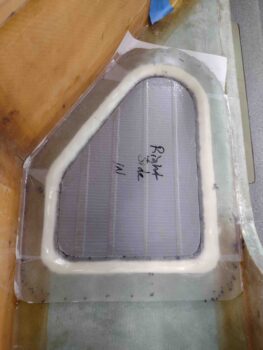
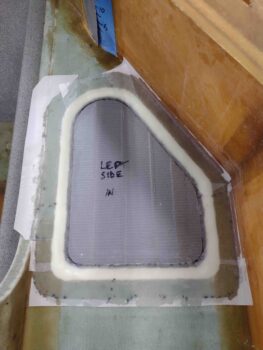
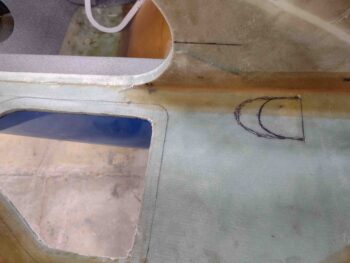
It may be hard to see in these pics, but I then mixed up some wet flox to fill in the gaps around the window panes to more fully secure the panes to cutouts/sides in/of the strake window cutouts.

A big reason I did this was to ensure that from the edges of the window panes down along the opening flanges I wanted secured with flox since from here on out I would be using dry micro for the transition of the strake baggage floor (~3/8″ thick) down to the surface of each window pane (~1/8″ thick).

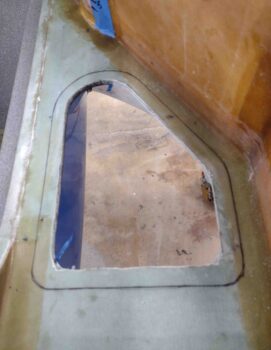
I then whipped up some dry micro and laid/shaped it in along the edges of the windows to create a sloped transition from the top of the strake baggage floor down to the edge of the window panes, leaving around 1/4″ of the window’s surface to secure the glass to.

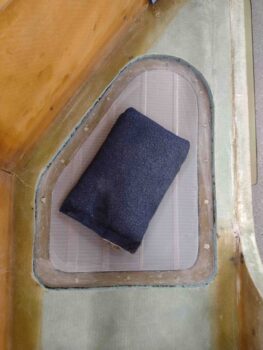
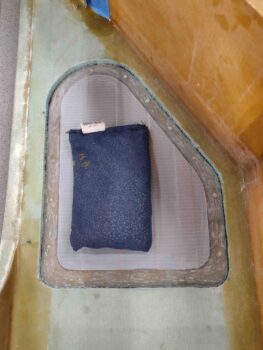
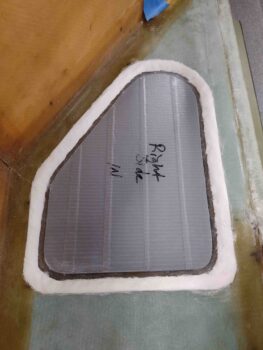
I then laid up the 2 plies of BID on each window pane to secure the windows in place. After laying up the BID plies I then peel plied the layups.

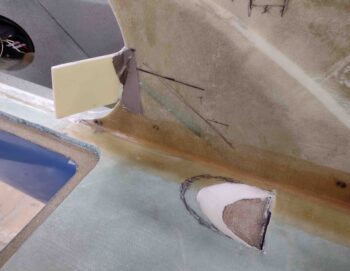
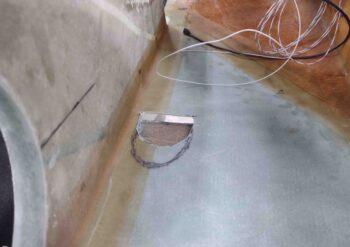
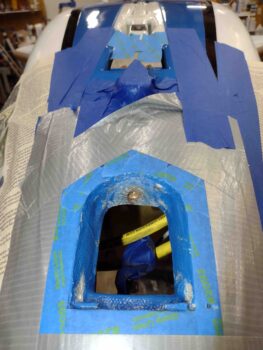
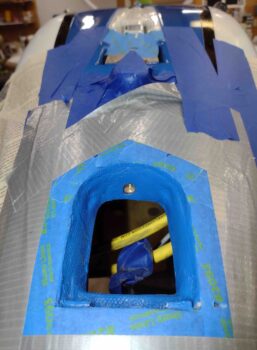
After a little over an hour, with the epoxy mostly cured, I then pulled the protective tape panels off the windows and cleaned up the edges of each window to remove any overhanging glass and micro.

A few hours after I pulled the protective tape and cleaned up the layup’s window edges, I pulled the peel ply and cleaned up the layups.  With that, I’m calling the install of the GIB strake windows complete.

After completing this significant milestone on the build, I called it a night.

Rough River 2022!

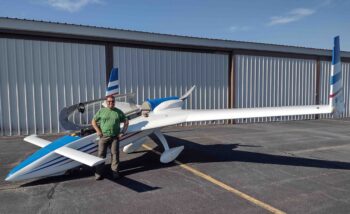
Well Marco and I decided to get the band back together and hit the road… to Rough River 2022!

I arrived at Marco’s place later in the evening Wednesday and enjoyed yet another awesome meal cooked by his beautiful wife Gina.  We gabbed a bit before hitting the rack to start another adventure the next day to Falls of Rough State Park, Kentucky… aka Rough River.

We arrived at Chesapeake Airport around 0930 with a plan to launch around 1000.  We packed our bags (the bigger ones going into Chris Cleaver’s Long-EZ), preflighted the plane, closed up the hangar and were ready to go right about 1000.

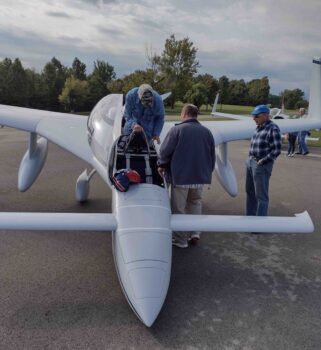
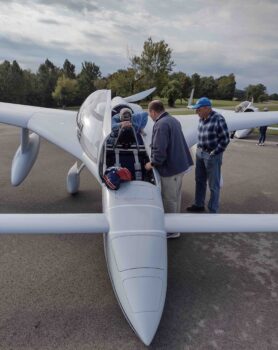
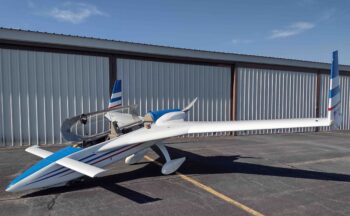
I grabbed a few preflight pics below before we climbed in to take to the skies.
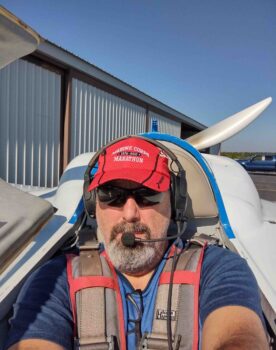
After climbing in and strapping the plane on (you essentially wear a Long-EZ!) I grabbed a selfie and another shot looking forward at Marco just buckling up.
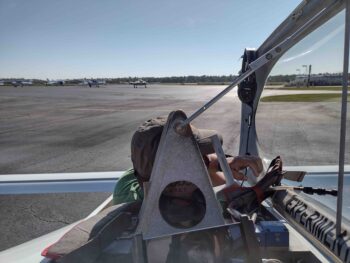
Our taxi out to the runway didn’t take long since we had NO RIGHT BRAKE… all we could do in front of the hangar was spin circles to the left.

No good.

So with Chris’s help we pulled JT back into the hangar and spent a good 45 min bleeding the right brake.  Then Marco took ‘er out for a spin and tested the brakes.  All seemed good so it was go time.  We packed back up in the plane and headed for the runway.

However, this time the plane was pulling severely to the RIGHT and Marco had to get some higher RPMs to keep it on the centerline.  Again, no good.  We did a high speed taxi back down the runway and after arriving the parking ramp had to spin 3 brodies before finally being able to get on a track back to the hangar.

When we pulled up to the hangar, Chris was already there and out of his plane.  He ran up to tell us our right wheel was smoking a lot.  We got out of the bird quickly, and while Marco ran to grab a drill to remove the wheel pant screws, I judiciously poured water into the seams of the wheel pant to cool down what I could.

Apparently the right brake had seized up.  With the wheel pant off we set up a huge shop fan to cool it down.  Then we bled the brakes again.

But just as all seemed fine, and we were ready for launch attempt #3, we noticed a puddle of brake fluid under the right brake caliper.  Ugh!  Under further inspection we realized that the brake caliper o-ring seal had most likely gotten fried from the heat, so we replaced it with one that Marco luckily had on hand!

With the right brake essentially rebuilt, after a bit of discussion we decided to leave the wheel pants off in case we needed to work on either of the brakes (clearly and mainly the problematic right brake).  We also packed up the extra brake fluid and tools to bleed the brake if need be.

With that, we finally launched out of Chesapeake mid-afternoon.  We had some clouds to dodge and a fairly good headwind, making our trip to Rough River about an hour longer than usual.
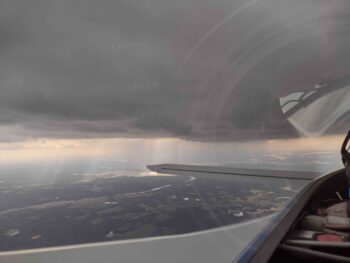
Still, it was great flight and we made it into Rough River a little bit before the sun went down.  Here’s a shot shortly after landing at RR.

We met up with Terry Lamp, Mike & Marcy Toomey, Rodger and the gang and hung out with them for the night before heading back to our cabin and hitting the rack.
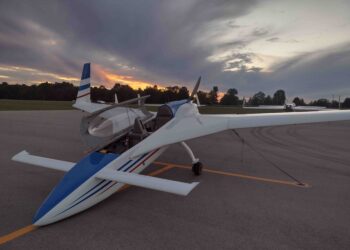
The next day, Friday, Mike Beasley arrived to RR, with his usual penchant for the dramatic (nice go-around buddy!).  This was the first time I had seen his bird “Scooter” other than in pictures.  What a great Long-EZ and awesome job he did on it. Of course I scoured it looking for any final build tips I could find before finishing my own build.

Here I noted the aft edge of the baggage pod pylon and the intersection of it with the aft pod cone.
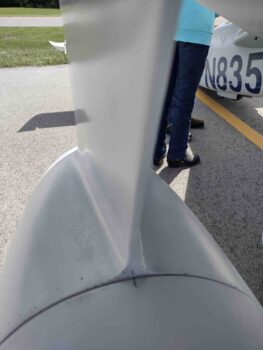
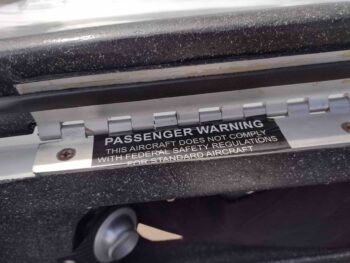
I also really like where he placed his mandatory Passenger Warning sticker.  Very visible but out of the way… good use of space.
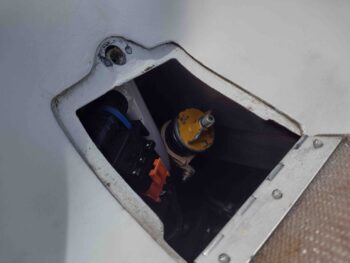
Mike’s oil door was preset in his upper cowling and a little forward of the actual dipstick, making him get creative to make up a flexible oil dipstick.  Quite ingenious really.
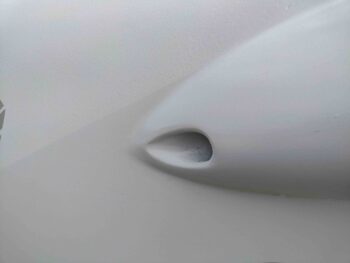
I also took note of the shape and position of his pilot fresh air vent intake at the left strake intersection with the fuselage. Mine is on the right side, and it’s always good to get ideas.
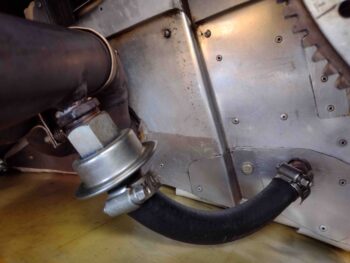
Talking with the Iowa canardian contingent, Ron White and Terry Sherman, I had a good discussion with them on how they set up a one-way valve attached to the exhaust pipe to pull a slight vacuum on the crankcase vent line.  This not only provides better pressure control in the crankcase, but all the small amounts of oil, etc. simply gets burned up as it exits the exhaust.  Very clean and less unsightly residue on your prop.

Here’s Ron White’s setup.
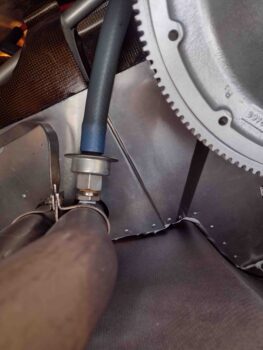
And a couple of shots of Terry Sherman’s setup as well.  Very crafty and something I may very well copy.
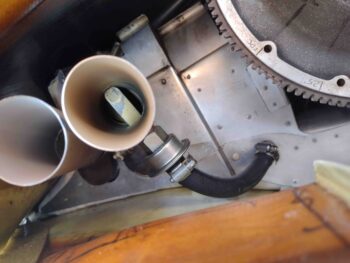
I met Howard Caulk from Baltimore for the first time (that I remember) this Rough River. He has a crazy number of the same components in his Long-EZ that I do, resulting in me spending a good bit of time at his bird picking his brain.

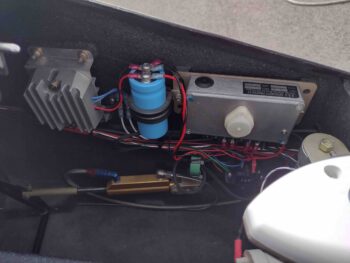
Below you can see both the main voltage regulator for the B&C alternator, and just aft of that (left side) is the capacitor and smaller voltage regulator for the backup SD-8 vacuum pad mounted alternator.  I have these SD-8 components in the GIB headrest, where Howard clearly has his in the nose.
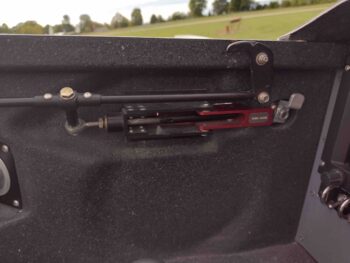
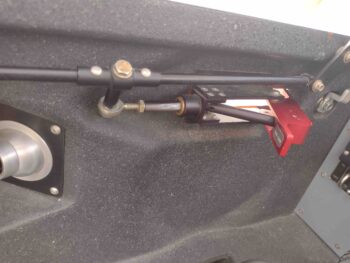
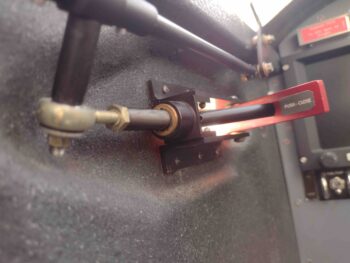
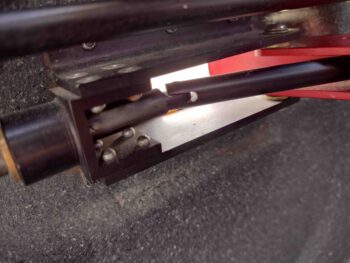
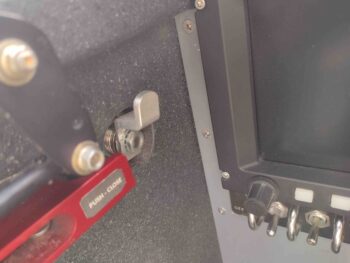
A key nagging question that I’ve had regarding my canopy latch handle is the attachment configuration for the handle lever to the aft and forward latch hook rods.  I think I found my answer by looking at how Howard did his very similar canopy latch handle, as we have here in the pics below.

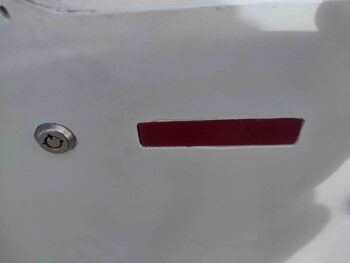
Finally, this is close to how my canopy latch handle will look from the outside as well.
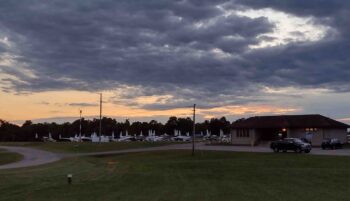
As we were walking back from dinner at the lodge we grabbed this shot.  All in all we estimate there were about 50 planes total at this RR.
Our other cabin mate for this RR 22 besides Mike Beasley, was the venerable canardian, EJ Johnson.  On Saturday Mike took EJ for a ride and I snapped a few shots as EJ climbed into the back of Mike’s Long-EZ.

Here’s a good shot of Mike Beasley’s Long-EZ (aka “Scooter”).
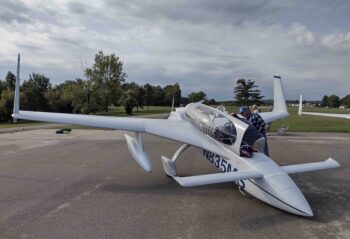
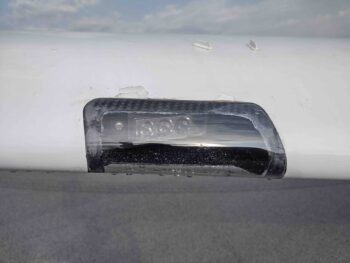
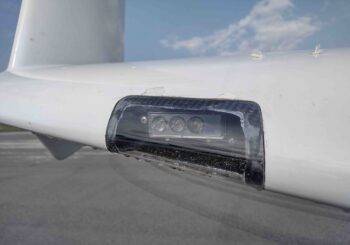
Nick Ugolini showed up in his new-to-him (a couple years now) Cozy IV.  He added the same style wing mounted landing lights as he had on his Long-EZ, so I grabbed a couple shots of those since I intend on following suite.
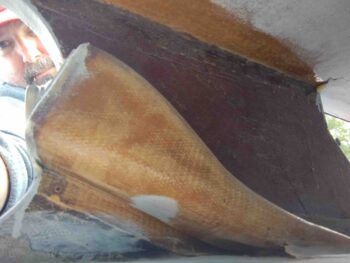
Although I see Chris Cleaver’s bird quite a big since he’s based at Chesapeake with Marco, as I was talking to the builder of Chris’s Long-EZ, Mike Toomey, about the GIB air vent, I took the opportunity to grab a shot of the construction.  I of course am just getting ready to knock this out on my bird as well and wanted any to get as many tips and tricks as I could on it.
I’ll note that I may have gone with a much simpler design on my canopy latch handle setup if I had seen Jim Evan’s Long-EZ beforehand.  This is a very simple setup that doesn’t require a bracket coming off the instrument panel.
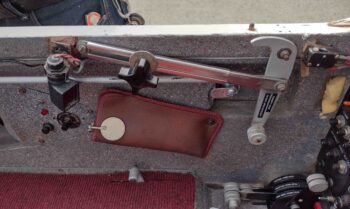
Jim also has a handle in the back seat which is nice to allow the GIB to open the canopy if need be.
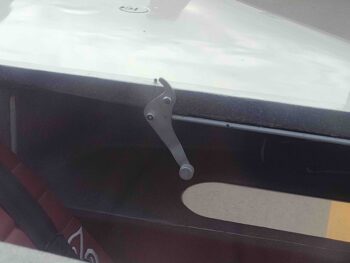
I may have grabbed a shot of this previously, but since again I’ll be adding a forward right hand side latch to my canopy, I wanted to note how Curtis Wray did it on the Long-EZ he built.
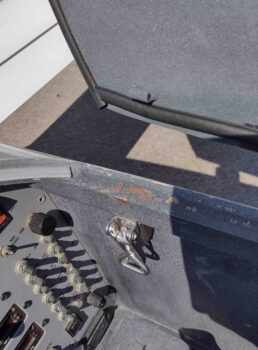
I love the gray and blue paint scheme on Curtis Wray’s built Long-EZ (now with a different owner)… I wanted to capture how he painted his upper cowling.
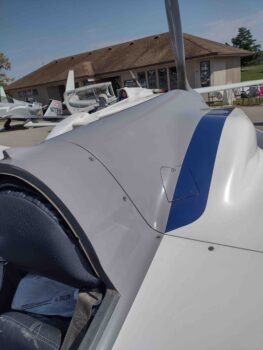
Speaking of paint schemes, I really like the simplicity and color scheme of this Cozy IV… something I could learn from. Ha!
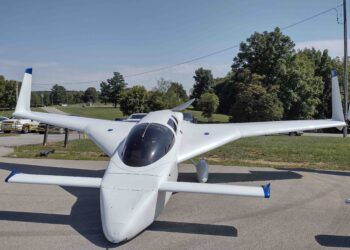
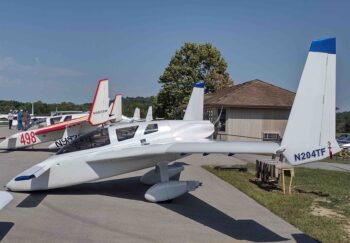
I didn’t meet the owner, but we had a Long-EZ fly in from Canada and I grabbed a shot of how he has his wheel pant venting set up.
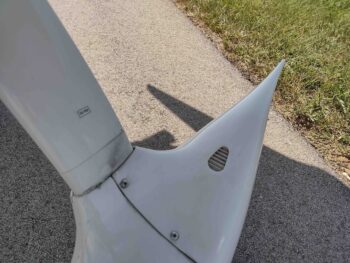
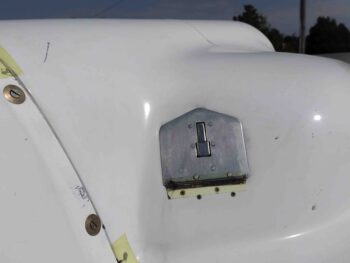
Also, I don’t remember if this was on a Long-EZ or Vari-Eze, but I’m currently very interested in oil dipstick access doors on the upper cowling since I’ll be dealing with that in the near future.
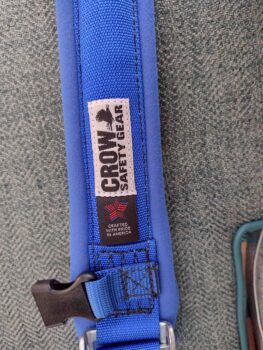
Fred Wimberly sold his Long-EZ and bought a Cozy III.  I hadn’t seen these harnesses before so I grabbed a shot for possible future reference.
On Sunday we all had breakfast before packing up and heading out back home.  Initially the weather looked great on our way from Rough River back to London, KY for some cheaper gas and a quick break.

However, the clouds had other ideas and we had to head north somewhat before finding a break that allowed us to get to the airport.  With Chris in tow —with no IFR capabilities on his bird— we stay VFR, which can be a bit challenging at times.
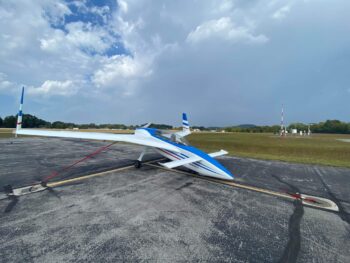
Here’s Marco’s bird tied down at London, KY airport (we heard some thunder in the distance, thus the tie downs just to be cautious).
We had invited Mike Beasley to fly to London, KY with us before breaking off and heading south to Georgia, but he wanted to go as direct as he could.  Oddly enough, as weather events dictated, he ended up filing IFR (his first real word time) and got himself over to London to rendezvous with us (he couldn’t stay away from us… can you blame him!).

We took the opportunity to position all the birds for a group photo… first with just the Long-EZ’s…
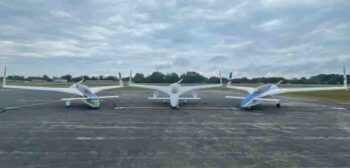
Then with the pilot/owners: Chris, Mike and Marco.
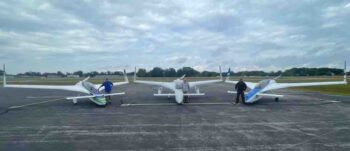
Here’s one more shot from an angle.
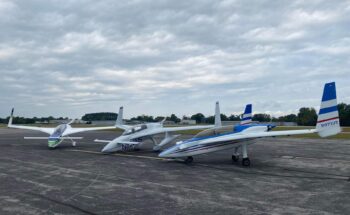
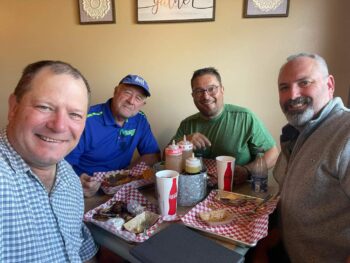
With some time to kill to let the weather clear up a bit (it was all moving East), we grabbed the airport courtesy car and made our way to a local BBQ joint for lunch.
The weather looked pretty good once we arrived back to the London, KY airport from lunch.  Although our new flight plan had us traveling much further south via Knoxville, TN to Asheville, NC, up through Greensboro, NC back to Chesapeake.

Here’s me and Marco in JT taxiing out to the end of the runway to launch.
Mike’s weather heading to Georgia was quite a bit iffier, so he made the call to stay the night and head out in the morning. Here’s his bird all wrapped up for the night.
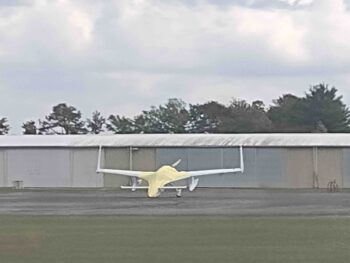
Once in the air, our path south looping around all the weather wasn’t as strictly required as we initially thought.  The cloud coverage wasn’t nearly as heavy as we anticipated so we were able to fly a good bit north of our tracks… saving a decent bit of time and distance.

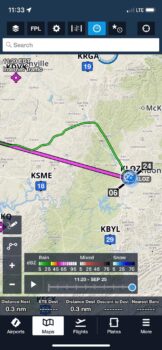
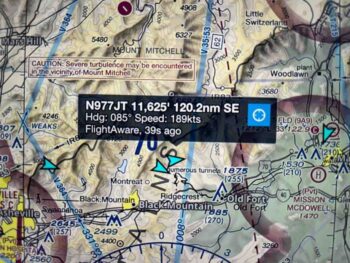
Here’s a screenshot Mike Beasley sent me of our track on FlightAware after we just passed north of Asheville (lower left). We had a tremendous tailwind heading east that kept us pretty fast all the way back to Chesapeake.  Note our altitude at about 11,500′ which we needed to stay above the clouds and mountains.
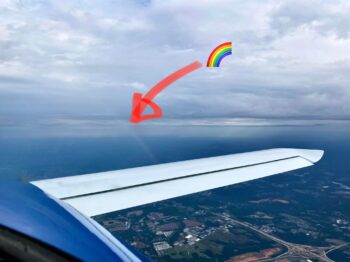
As we were nearing Greensboro, NC we saw a very distinct rainbow off our right side. Marco grabbed this shot, although the camera didn’t pick it up nearly as well as we could see it.
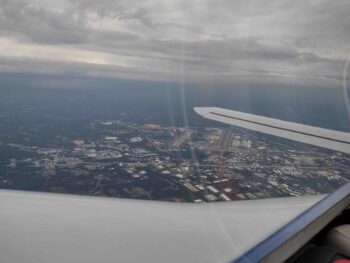
We skirted above Greensboro’s Piedmont Triad International Airport (KGSO) just to the south, which is visible just under the left canard tip.
Not too much later we were coming into Chesapeake Airport… another successful Rough River in the books!  A great time looking at airplanes and visiting all our canardian friends.
I really do plan on having my bird in the air by next Rough River, so this may be one of the last times flying back seat in my best bud’s awesome Long-EZ… thanks for the adventures and memories Brother!

Chapter 21/24 – GIB strake windows

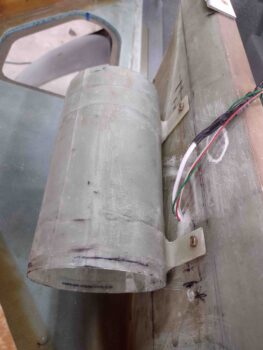
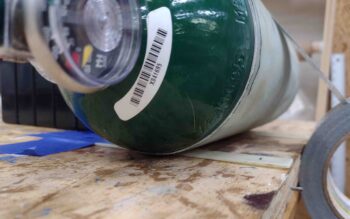
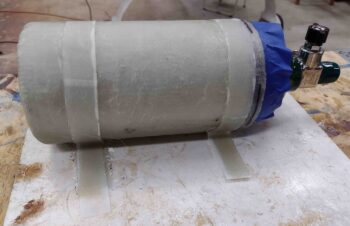
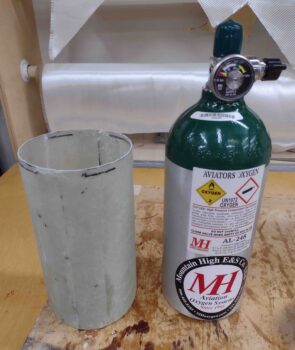
Starting off, I grabbed one more shot of the O2 bottle mounting sleeve to show the tabs attached to the sleeve.

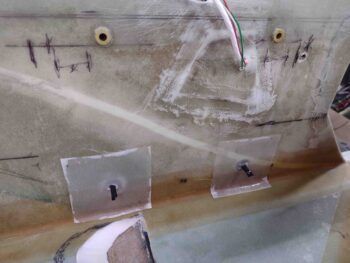
After some sanding, cleanup and prepping of the Clickbond threads with black electrical tape, I then whipped up some MGS 335 with fast hardener to first make flox to add a small fillet around the edge of the Clickbonds, then wet out the 2-ply BID patches to secure the Clickbonds to the fuselage sidewall.  I then peel plied the BID patches.

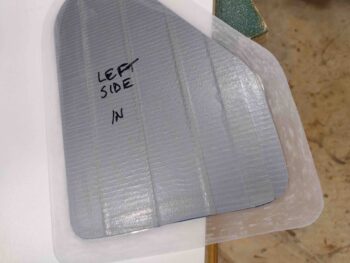
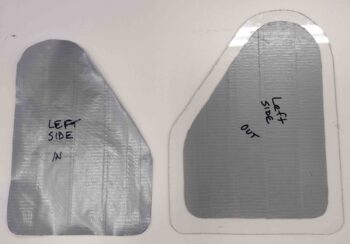
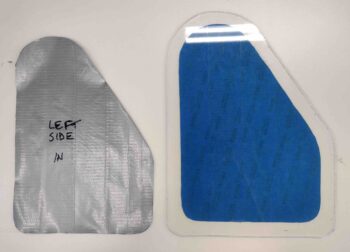
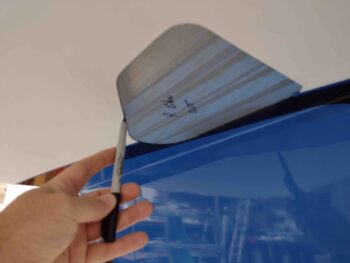
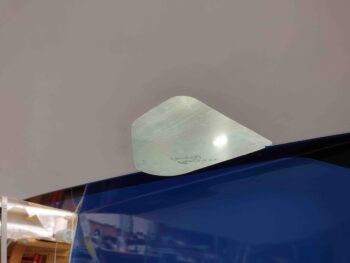
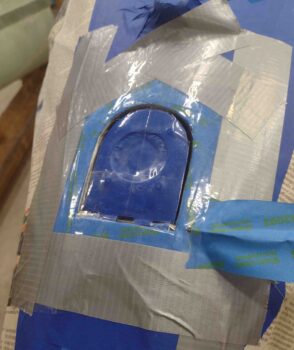
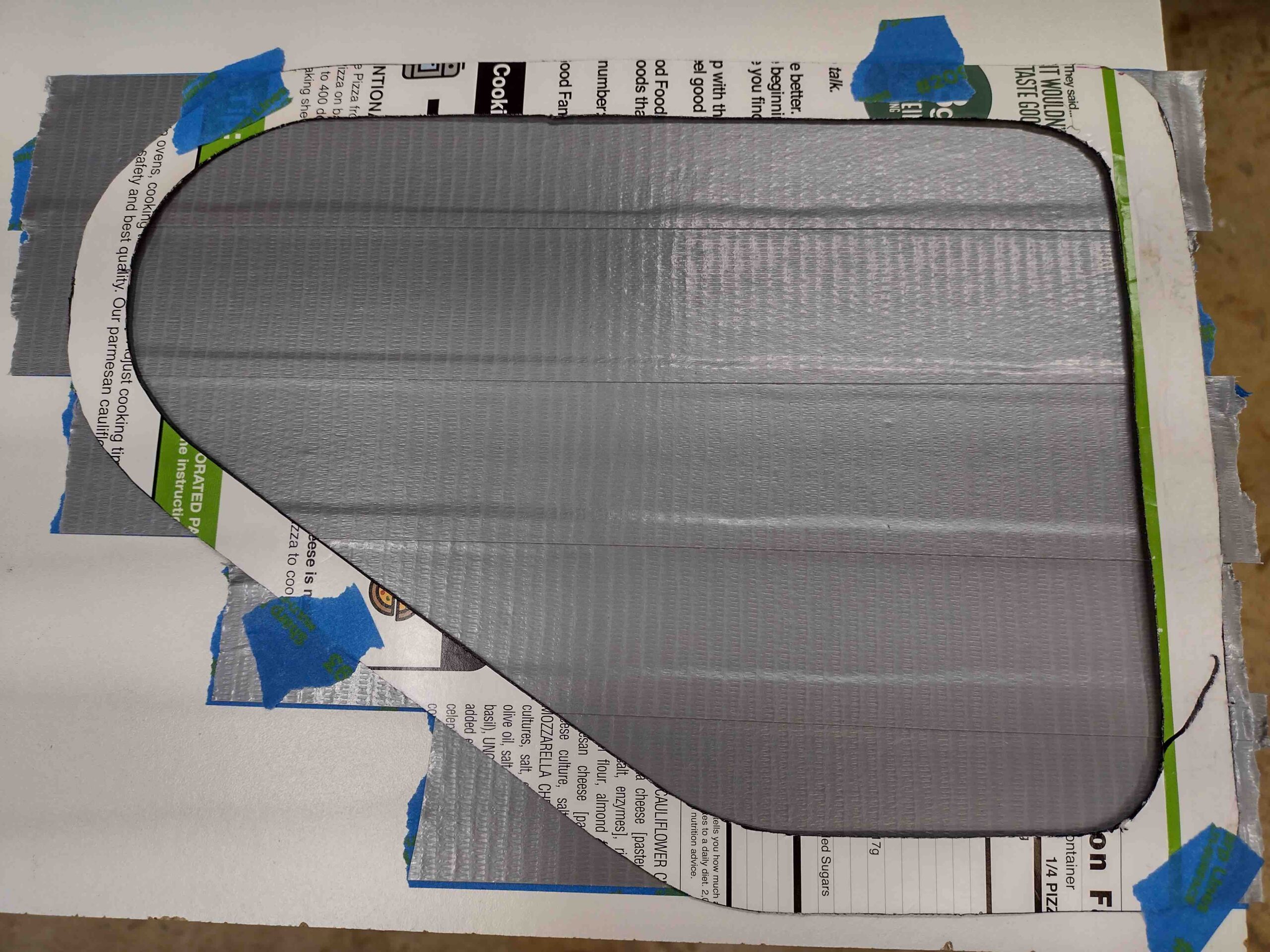
I then marked and trimmed (see right window pane below) the left side GIB strake window pane.  Pressing forward, I used my template to mark and cut out a 2-ply tape protective cover —blue painters tape first, then grey duct tape.  Here it is ready to be applied to the inside surface of the strake window pane.

And here it is applied to the inside surface.

I then applied the same 2 plies to the outside of the right strake window pane.  Note that it’s not trimmed yet.

I then set the right strake window in place… note the blue tape.

I then marked the perimeter of the strake window frame with a Sharpie.

I then used a sharp razor blade to cut along the marked line to remove the perimeter edge tape.

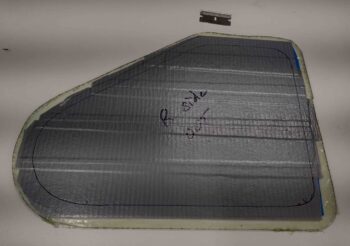
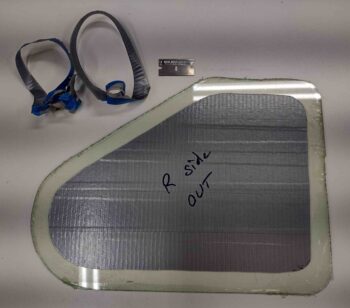
As above on the left side, I laid the 2 plies of tape down on a white board and used the template to mark the inside protective tape sheet.  I then used scissors to cut the along the line.

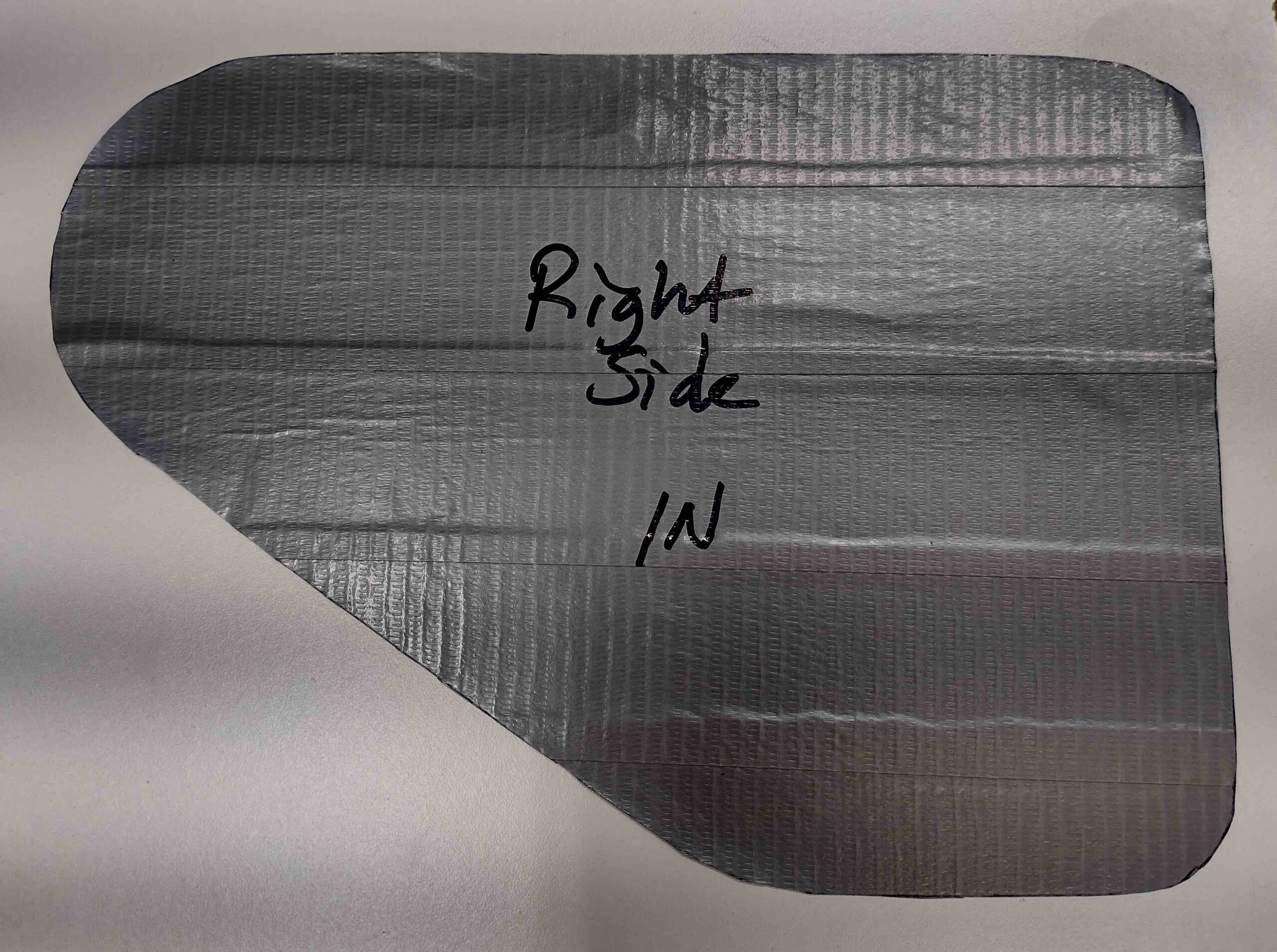
Here we have the right strake window pane with both sides taped up.

A few hours later I removed the protective electrical tape off the threads and the peel plied from the Clickbonds.

I then temporarily remounted O2 bottle mounting sleeve and grabbed a shot of it from the front seat into the strake baggage area.

This will be the last post until next week, since tomorrow I’ll be heading out to Rough River with my buddy Marco.


Chapter 21/24 – More strake prereqs

Today first thing I started off by adding a single ply of BID over the “backside” of the O2 bottle sleeve mounting tabs where they attach to the sleeve.  There’s a decent amount of glass holding the ‘front’ face of the tabs to the sleeve, but I wanted one bit more on the “back” to help secure these tabs in place.  The bottle is decent size & weight, and especially with any G forces applied during flight I just want to have a little bit extra insurance that it will stay right in place.

I added dry micro fillets/transitions at the edge of the tabs where they met the sleeve body, and then I peel plied just the face of the tab where it would rest against the sidewall of the plane.

While the O2 bottle sleeve mounting tab layups cured, I then got busy cutting out the interior perimeter edge of the left strake GIB window.  Here’s the requisite BEFORE shot:

I then taped my GIB strake window template in place, marked the cut line, cut the line, and then removed the foam and glass…

I then took a few minutes to give the freshly exposed left GIB window perimeter glass edge a good cleaning off… removing the dead foam and scraping off epoxy residue.

I then test-fitted the 1/8″ thick plexiglass pane into its spot… fit like a glove!

By this point, the MGS 335 resin with fast hardener was nearly fully cured.  I pulled the peel ply and cleaned up the layups on the “backside” of the O2 bottle sleeve mounting tabs.  Not shown is then I marked and drilled a 3/16″+ hole in each of the tabs to allow for AN3 bolts on the top tabs going into embedded RivNuts, and ClickBonds on the bottom tabs.

I prepped the respective RivNuts (top) and Clickbonds (bottom).  I then determined and set the final position of the O2 bottle sleeve mount to allow me to drill the top holes for the embedded RivNuts.

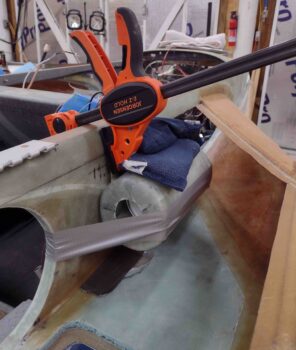
I then whipped up some as-wet-as-possible flox using MGS 335 with fast hardener, and set the O2 bottle sleeve mount in place with both the 2x RivNuts secured in the top tabs and the 2x ClickBonds secured in the bottom tabs.

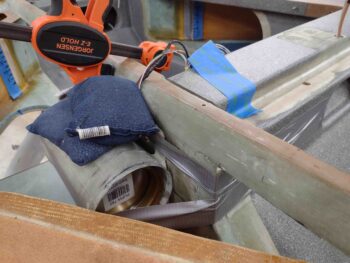
Because of the very slight curve of the fuselage I had to clamp the only top tab I could get to, the aft one, to fully seat the RivNut as far as possible into the embed hole.  This caused the bottom tabs to pop outboard away from the fuselage side, so I had to weigh down the entire O2 bottle sleeve.  I also needed a bit of duct tape to help press in the top forward RivNut as well.  But in the end, my Frankenstein securing method worked!

After nearly 4 hours I pulled the clamp and impromptu weights off the O2 bottle sleeve and removed it.  The flox that had invariably oozed out around the RivNuts and ClickBonds was just barely pliable enough to allow me to remove it with a razor blade and some elbow grease.

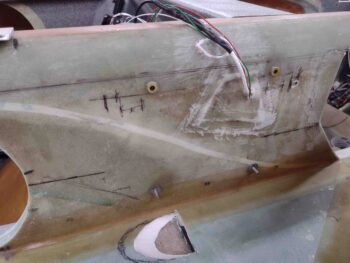
Here we have the result: the top two hard points, the RivNuts, are ready to go after another good 12 hours of cure.  On the bottom I’ll add 2-3 plies of BID over the ClickBonds to secure those in place.

I then set the O2 bottle mounting sleeve back in place to double check my fit. I’m really happy with how this is turning out so far.

Because of the angle and tolerance, I’ll need to run the drill through the bottom holes in the mounting tabs to make them just a hair bigger to allow them to slide over the ClickBonds without imposing any side or twisting forces on them.

I’ll clean up the lightening hole on the aft end of the O2 bottle mounting sleeve to make it symmetrical and nicer looking, as well as add some lightening holes in the center area of the sleeve as well.

Chapter 21/24 – Strake Prereq Stuff

This first task I knocked out the first night back from Reno, with a 1-ply BID layup on each seam inside the O2 bottle sleeve mount.  I then peel plied the layups and left them overnight to cure.

Here, a couple days later, I started on the GIB direct fresh air NACA scoop by further deciding how I was going to tackle this beast… with a bit more refined plan.  I’m going to use a direct aluminum tube glassed at each end: one side here at the NACA scoop, and the other at the eyeball vent mount.  With the angle of the tube, I reduced down the interior slope area of the NACA scoop… denoted below with the new cut line.

Which I then cut just the glass away, then shaped the underlying foam.  I also gave the interior bottom glass of the scoop a good sanding as well.  I then laid in dry micro and peel plied it to help shape it.  Once cured, I’ll sand to final shape and contour.

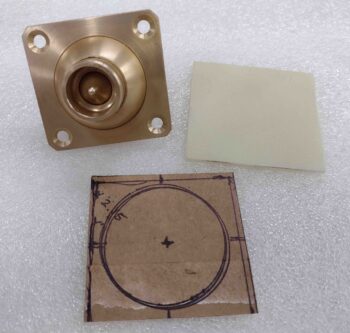
I then got busy designing the GIB direct fresh air eyeball vent mount, using cardboard as a template to then cut out the eyeball vent mount out of G10 phenolic.

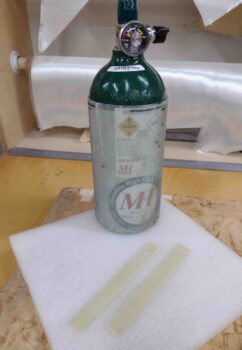
I also determined the required length and width of the O2 bottle sleeve mount attaching tabs.

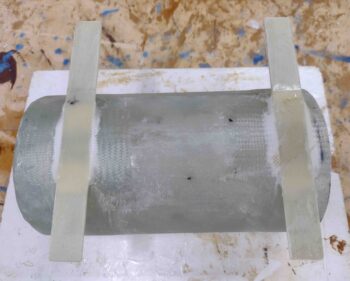
I then 5-minute glued the O2 bottle sleeve mounting tabs to the sleeve tube.

Here’s a closer look.

I had already laid up 2-plies of BID on each side of the GIB eyeball vent mount G10, with an extra couple of plies on the inboard edge of the G10, where I had just over an inch of extra glass to make up the curved attach point onto the aft edge of the GIB strake baggage area opening.  This will give that 1″ x 2″ tab 6 plies of BID so it will be nice and strong.  I also peel plied both sides.

I used fast hardener and once the layup was well on its way to being cured, but still pliable, I taped it into place on the curved attach point at the aft edge of the GIB right strake baggage area opening.

Here’s a shot from the GIB seat to give a general idea of how it will look once it’s installed.

I then got to work on creating micro fillets between the freshly attached O2 bottle sleeve mounting tabs and the sleeve tube itself.  I then laid up 1 ply of UNI that covered from the end of the top tab, around the sleeve tube, to the end of the bottom tab.  I then added another ply of UNI that covered the tab and overlapped onto the sleeve tube about an inch.  Then a final ply of BID that covers the mounting tab and overlapped onto the sleeve tube also about an inch.  I then peel plied the layups and left them to cure.

Here’s a shot of the bottom side of the O2 bottle sleeve mounting tab layups.

A bit after I finished the O2 bottle sleeve mounting tab layups, the GIB eyeball vent mount layup was cured, so I pulled the top layer of peel ply and marked the inside mounting tab edge for trimming.

I then took the GIB eyeball vent mount off the sidewall opening edge, pulled the peel ply, razor trimmed and sanded the edges, and trimmed the interior edge of the mounting tab before taping it back in place for a test fit.

Here’s a shot of the GIB eyeball vent mount from the back side (technically front) as it’s taped in place for test fit.  It’s looking good so far!
And with that, I called it a night.


Chapter 21/24 – Strake Top Prereqs

With the plane flipped upright I now need to knock out a laundry list of prerequisite tasks that need to be completed before closing out the strakes.

This pre-strake closeout list includes:
Outboard storage compartments on the top strake side initial tasks
O2 bottle mounting in composite sleeve
Installing main fuel tanks drain screens
Wiring and install prep main fuel tanks fuel probes
Installing/terminating main fuel tanks vent lines
Cleaning up fuel site gages edges (cosmetic)
Wiring fuel site gages LED lights
Installing/glassing GIB strake/baggage compartment windows
Installing/glassing right strake GIB NACA vent duct and eyeball vent
Installing/glassing GIB strake/baggage compartment cross support mini-bulkheads
Installing/glassing/wiring GIB map light
Designing/constructing/installing left/right fuel site gages video camera mounts
Wiring/installing fuel site gages video cameras
Constructing/glassing/installing left strake RAM air scoop/ducts for oil heat system
Prepping/priming/painting strake baggage and final cockpit areas

I started off with a good 15 minute look and assessment of the hinge configuration for the outboard strake storage compartments.  I noted my initial plan and gave this mod the mental go-ahead.

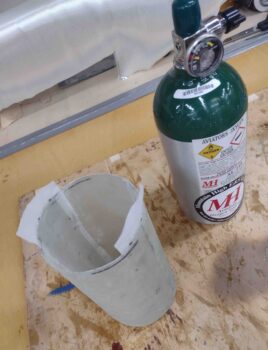
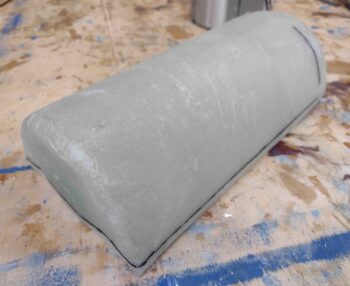
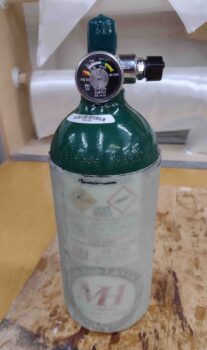
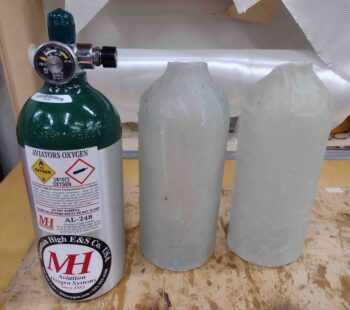
I then got to work on the Oxygen bottle composite mounting sleeve.  I trimmed one side to nearly perfectly half of the bottle, then marked a Sharpie line on the underlying tape.  I then set the other side (below) onto the bottle and marked the midpoint line that I could see through the fiberglass.

I then trimmed down the second side using my trusty Fein saw.  Here we have the initial fit of the two halves that will make up the O2 bottle fiberglass mounting sleeve.

A few more rounds of judicious final trimming and I was ready to glass the two sides together.

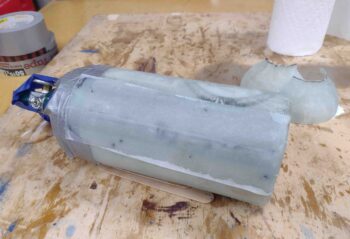
Which I did here, using a 2-ply BID tape on each side.  I then peel plied the layups.  I used MGS 335 here with fast hardener, so I could see the results and remove the bottle from the sleeve ASAP.

While the combined/glassed composite sleeve cured, I got to work on the right strake GIB window.  Here’s a “before” shot of how it looked from my initial cut from the exterior side.

I then taped my template into place and marked the exterior perimeter edge for the inside-baggage compartment cut line.

As you can see here.

I also marked the cut lines for the GIB NACA scoop.  These 2 separate lines are not mistakes: the inside curved line is for the flat area on the inside of the exterior skin.  The aft cut line is for the angle from top skin to bottom skin, which I’ll carve into the foam and smooth out with micro.

Using the trusty Fein saw again, I carefully cut just the inside skin along the marked line to allow me to remove the glass and foam to emplace the plexiglass (acrylic) window piece.

Which I did here, as a test fit.

Here’s what the GIB strake window looks like from the outside… I have to say I’m very pleased so far with the results!
Here we have the NACA scoop initial cut line complete, with the foam and interior glass removed.  Note how you can see through the NACA scoop opening.

And a shot of the NACA scoop from the exterior side as well.

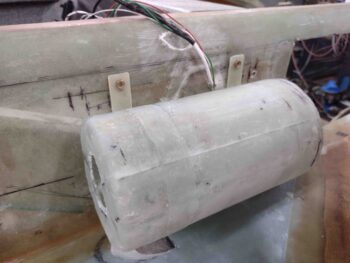
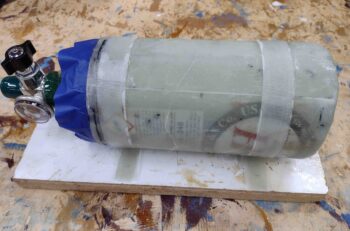
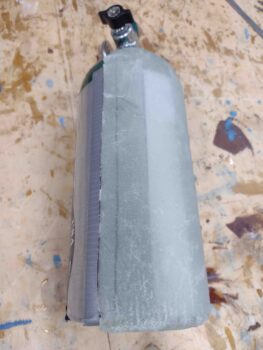
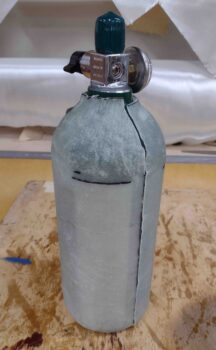
By this point my O2 bottle composite mounting sleeve layups had cured. As per usual, it was a bit of pain and struggle to get the bottle out, but I won the battle.  Here we have the bottle inside its mounting sleeve, with a nice tolerance fit.

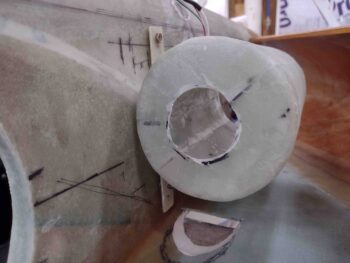
Here we have the O2 bottle composite mounting sleeve, ready to have G10 mounting tabs glassed onto the exterior and some lightening holes drilled into the sides and aft end. Once I mount the sleeve into the right strake baggage compartment, I’ll assess/test different options for securing the bottle into the sleeve.  Right now I’m thinking criss-crossed velcro straps that will keep it in place.

I’ll be attending the Reno air races with friends and visiting family in California for the next 10 days, before I get back for a few days before then taking off again for Rough River.  I’ll squeeze as much work as I can in those few days I’m back, but rest assure that when I return from RR I’ll be pulling out all the stops to get this bird completed ASAP!
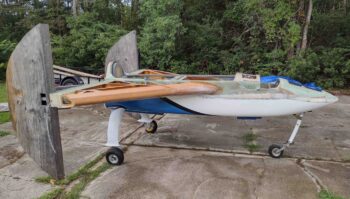
Chapter 21/25 – Bird flipped upright

Well, today was the day.  I finalized some wet sanding on the bottom of the strakes and also applied some fine line tape along the black paint edge with the white paint. Clearly way easier to do this last task while the bird is still inverted.

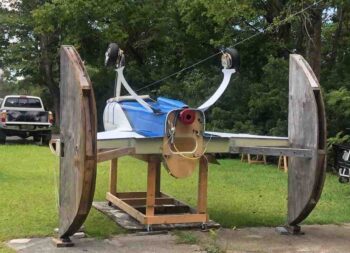
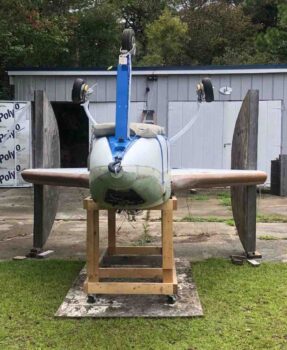
I then went into Star Wars “TIE Fighter” mode by installing the half moon flip brackets.

I also hooked up the winch components and got it online before attaching the cable to the front of the nose.

Since i didn’t want any rubbing of the winch cable on the nose/belly of the bird, I taped padding to the bottom of the nose/fuselage.

In addition, I wanted the nose gear down so I didn’t have to mess with the wiring or the battery, but it presented a slight problem since the winch cable would press/slide up against the nose gear strut fairing.

I used a few plies of blue painters tape and some duct tape to ensure that the winch cable didn’t extract any paint from the side of the nose gear strut fairing.

I manually lifted the nose a significant way off the ground, as I did the first time, to ensure no untoward rubbing or scraping occurred between the fuselage and the fuselage dolly, and to get the winch cable off the belly/nose and further up along the nose gear strut fairing.

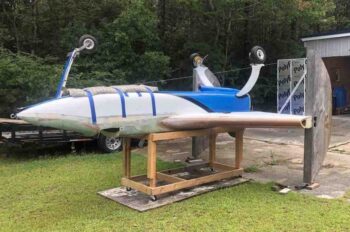
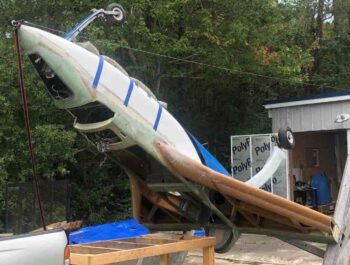
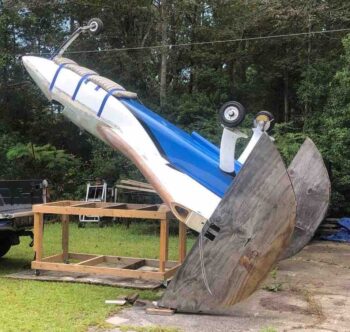
After a bit of time, Jess (my helper) and I got the bird into the now infamous shuttle lunch position.

Here’s a couple more shots of the bird in the shuttle launch position.

We then used tie down straps attached to the nose to very slowly lower the nose down onto the nose wheel strut.  The other end of these tie down straps were attached to my truck trailer hitch and we simply backed the truck up very slowly to ease the nose down.

And Voila!  The bird has been flipped and ready to press on.

A side shot of the just flipped bird with the half moons still attached.

Here we are a bit later after the half moon flip brackets were removed and the bird is about to get moved into the shop.

A couple more side shots of the just-flipped fuselage/nose/strakes.

And one from the other side, for posterity’s sake.

And finally, the bird is where it belongs (right now) in the shop, ready to be finished.

Once back inside the shop, i gave the upper side of the bird a fairly good cleaning with Simple Green. I also removed the longer “wing” bolts from the CS spar.

Here’s a video that recounts our bird-flipping adventures!

With a good day’s work under our belt, we were ready to call it an evening!


Chapter 25 – Closer to flipping

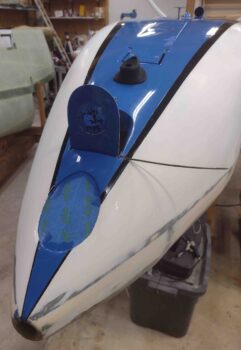
Before I flip this bird back upright I need to make a lightweight faceplate to attach to the front of the taxi light to cover the gap between it and its pocket in the nose.  Besides the aesthetics of how the taxi light sits in this nose pocket, I’m also concerned about air leaking around it and both causing the fuselage to be drafty, and causing drag.

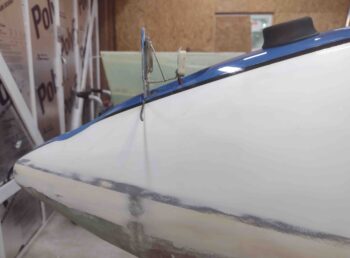
Here’s a side view of the current taxi light front face.

I taped up the current taxi light face separately than the surrounding nose, since I wanted to capture the current gap with the 2-ply BID layup.

Which I did here.  I then peel plied the layup.

Another shot of the soon-to-be new taxi light front face 2-ply BID layup.

I then marked the outline with a Sharpie of the current taxi light opening in the nose.

A bit later, after I had identified and taped a few more spots requiring blue touch up paint, I sanded and prepped the taxi light opening for paint.

And then painted it, along with extending bits of blue on each side of the nose gear strut well towards the very top of where the nose gear fairing rests in the closed position … since there were still scant traces of white showing on the edges when it was closed.

I also touched up the inside edges of the laser altimeter openings in the hell hole with blue paint, as well as sanded and touched up the perimeter edges of the nose gear strut fairing.

I then swapped out the wing bolts for longer ones to allow me to attach the half-moon assemblies to flip the bird upright.

If all goes well, including weather, I plan on flipping the fuselage back upright tomorrow.

Chapter 13/21/25 – Underside Wrap-Up

I have literally 2 tasks left to complete before flipping the bird back upright.

The first is to clean the blue paint off the drop-down taxi light bracket, then tape up both the bracket and the surrounding nose for a 2-ply BID layup.  Later, I’ll trim & attach the cured layup to the taxi light and work it into the current opening in the nose to better seal the gap around the taxi light when seated in the nose hole.

Secondly, I will tape the edge of the black stripe with fine line tape to allow me to avoid having to climb underneath the plane later on to tape up the current paint before shooting the remaining paint.

In addition, I made a video to provide a wrap-up/overview of all my bottom-side plane shenanigans before I flip the bird back upright:

Chapter 13/25 – Close on Underside

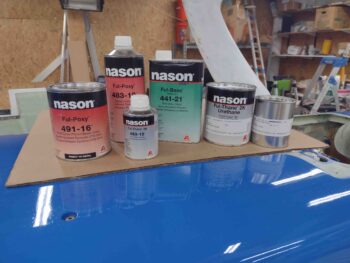
Let’s talk paint starting off.  In reviewing some past posts to see where I was before I jumped back in on this blog, I noted that I had communicated how not happy I was with the current 2-part polyurethane boat paint.  Again, it looks great from 6-10 feet away, but upon closer inspection it shows the inherent dust of this shop, and some irregularities in the application.  As I’ve recently mentioned, I’m calling it good for the bottom of the plane and rear fuselage sides, but no more than that.  I’m willing to live with those areas not having the greatest paint, but definitely not the topside (aka “most visible”) of the plane.

One day while down at my local NAPA auto parts store, picking up some painting supplies, I overheard the paint tech talking on speaker phone to an older gentleman who was restoring a vintage pickup truck.  The customer couldn’t find a color code anywhere and was perplexed on how to get the right color, given that he had a couple of parts with the original color.  Somewhat serendipitously, I overheard the NAPA paint guy tell the man on the phone that this particular NAPA store apparently had a phenomenal color matching system for auto paint.

A month or so later, after I had expended all efforts in salvaging my boat paint system in trying to make it work, I recalled that conversation and went back to NAPA —with my blue painted nose hatch cover in hand—to learn what options I had.  I had never hear of “nason” paint before, but I was shown where it had won the contract as the paint for the Marine One Presidential V-22 Ospreys.  We also got a very knowledgeable company rep on the phone and I discussed with him at length my requirements. Out of that discussion I was convinced that this system would meet my needs and I pulled the trigger.

Yes, I will clearly need to do some blending of the paint systems (not the actual paint, but on the bird) and masking off of the pre-existing paint, but I think this will get me a lot closer to what I want as far as paint quality, durability and color scheme.  It better, because I have zero plans on switching systems (again!).

I started off today by taping off the perimeter of the GIB air vent NACA scoop to protect the surrounding paint, then used a razor blade and sand paper to clean up the interior of the NACA scoop… located on the bottom of the right strake, near the fuselage sidewall and just forward of the GIB strake window.

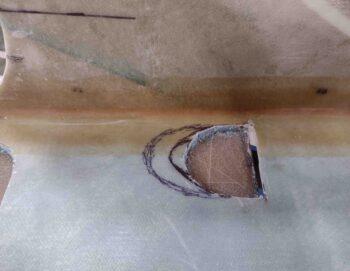
I left the interior of this NACA scoop in raw fiberglass because I need to overlap more glass onto it when I build the remainder of the scoop structure on the inside of the baggage compartment.  To mark the aft line of the scoop, I drilled a small hole in each corner, then took a broken drill bit and placed it inside the inboard hole to mark my starting point on the NACA scoop once the bird gets flipped upright.

Part of my blue touch up paint machinations included painting the remaining internal horseshoe-shaped edge of the taxi light opening.

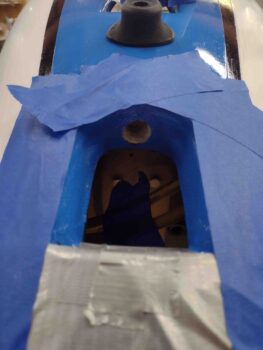
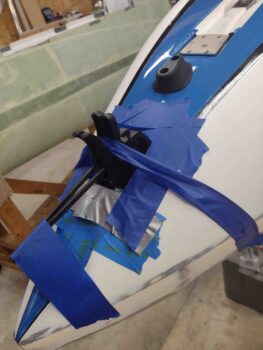
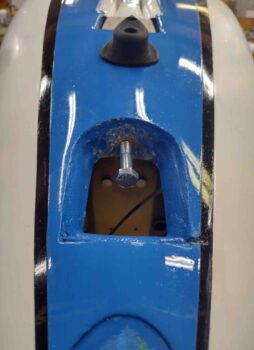
I’ve had discussions with various builders (specifically Dave Berenholtz) on the topic of having a good sized diameter bolt or pin to allow for securing the nose of the plane with heavier weights when its needed to have the nose raised all the way up.  I talked with Marco about how he uses the nose gear actuator, but since my nose gear fairing is a bit wider than his and free-floating I felt more comfortable just putting in a simple hardpoint on the aft side of the taxi light well.

I actually used the wing bolt hole 5/8″ spot face tool to make the final hole for my brass 3/8″ bolt insert.

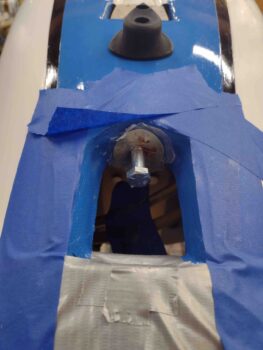
I taped off the interior open face of the threaded 3/8″ brass hard point, and then prepped the hole.  I used grease on a 3/8″ bolt that I placed through a taped-off (mold release) thin aluminum washer that I found in my scrap pile, in turn the bolt was threaded into the 3/8″ insert.

Since my spot face was a bit dull, the resulting hole was a bit oversized.  So I cheated and stuffed in a couple of plies of wetted out glass before slathering flox into the hole, then inserting the 3/8″ threaded insert slathered with flox as well.  As you can see below, I then wedged some small clamps into place on each side of the protruding bolt, pressed up directly against the oversized aluminum washer.

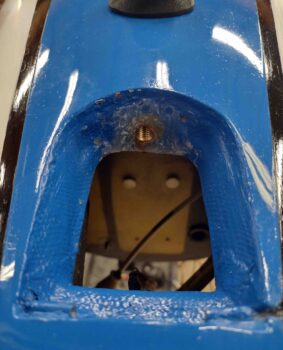
I used MGS 335 here with fast hardener, and here’s the results a few hours later.

I removed the bolt and washer and spent a good 20 minutes cleaning up the excess flox and glass around the perimeter of the 3/8″ brass insert.  I’ll sand the area after it cures fully and touch up the blue paint.

Here’s another shot of a final test fit with the 3/8″ bolt.  This particular bolt is 2-1/2″ long… clearly I could use one another inch longer, or even an eye bolt, to secure/tie off a weight to.

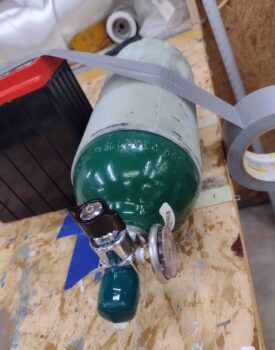
My final task of the evening was extracting the nearly fully cured Oxygen bottle mounting cradle sleeve, side 2, off the bottle.  This is always a fun-filled endeavor and took a bit of effort to accomplish.  Once off however, with the O2 bottle all cleaned up, it looks like it will work just fine.  I’ll note that I’m working the O2 bottle mounting now since once the bird is flipped back upright this will be a prerequisite task before closing out the strakes.

With that, I called it a night.