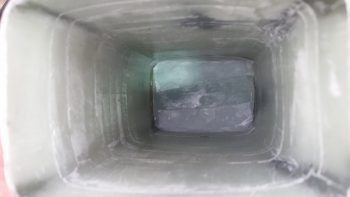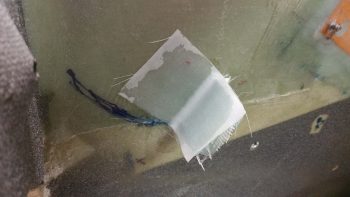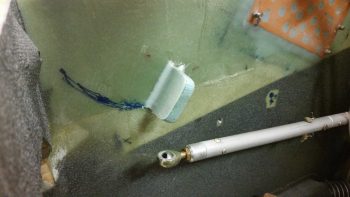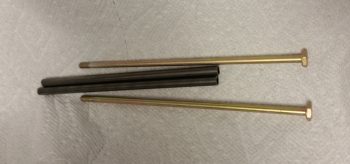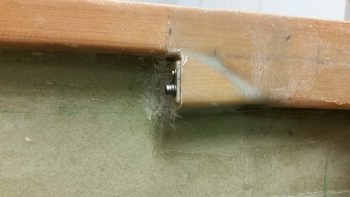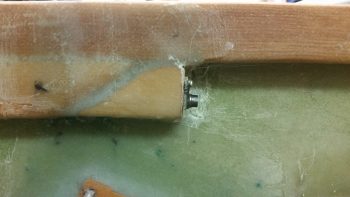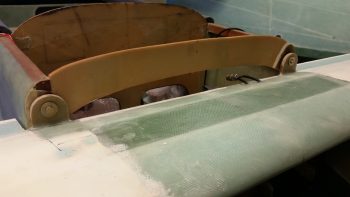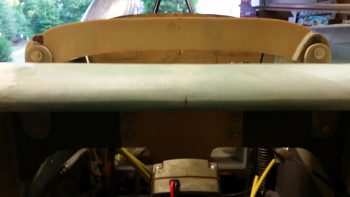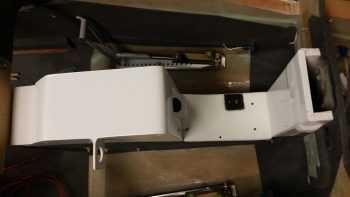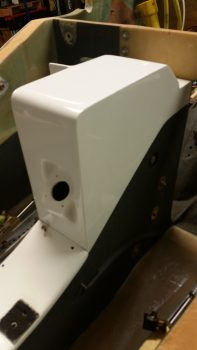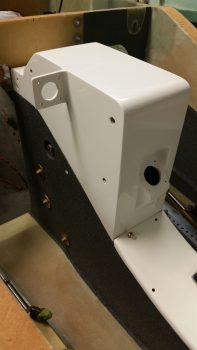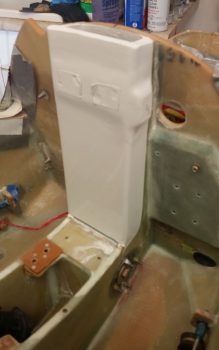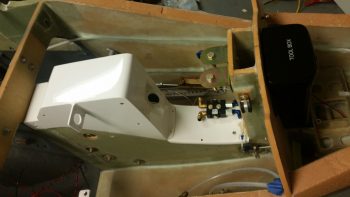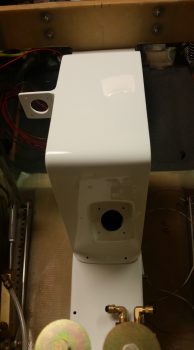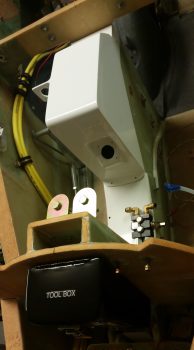
Chapter 16/22 – B-Lead fuse link install

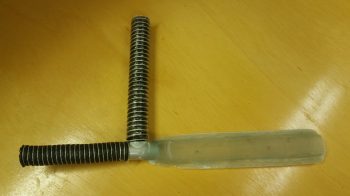
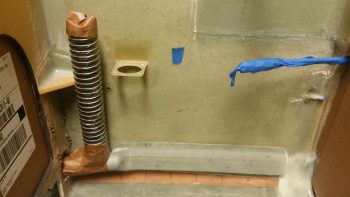
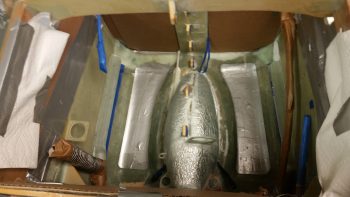
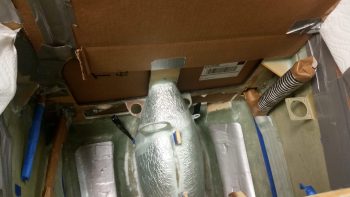
Since I know I’m off my engine removal schedule by a day or two, while I await the fittings to finalize the fuel/oil lines I worked on something that I want to get done as a self-perscribed prerequisite to drilling the 3-1/8″ hole in the firewall for the RAM air canister: mounting the ANL40 fuse link and base.

If you recall, after much consideration I modified my starter and charging circuit design by separating out the B-Lead into its own dedicated cable and by moving all the associated components to the nose-located battery compartment as such.

However, even though this configuration has been implemented successfully (reportedly), I was never too keen on the ANL40 being so far removed from the line it was protecting.  I chalked it up to 2 things, made a mental note to assess it, and then pressed on.  Those 2 things were that A) Again, its working in a real-world install, and B) 10 feet is not a huge distance to electrons that travel the speed of light.

However, as I pointed out a couple of days ago, Bob Nuckolls reminded me of a core principal that I was not following in regards to my ANL40 Fuse Link location when he stated, “Recall that circuit protection is for WIRES . . . and that the protective device is installed as close as practical to the SOURCE of energy that puts the wire at risk.

Again, as a result, my ANL-40 fuse link is going back on the firewall, on the hell hole side. However, instead of employing a 1/8″ thick x 1/2″ wide copper strip, I went with my optional configuration and am using 8 AWG cable to connect the forward (hell hole) stud of the Blue Sea terminal to one side of the ANL40 with the GRT EIS HALL EFFECT SENSOR placed in-between, then run the B-lead from the ANL40 forward to the battery contactor. Therefore, my new starting & charging circuit configuration now looks like this:

My 2 goals for the day were to install both the ANL40 base, fuse link, etc. and the GRT EIS Hall Effect sensor.

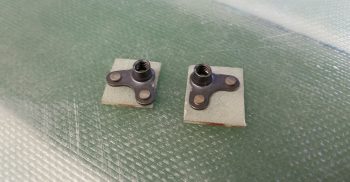
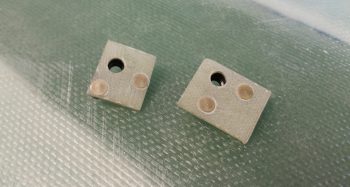
I started by ginning up a phenolic nutplate assembly with the same #10 screw pattern as the ANL40 base.  Since the fuse link sits in the middle of the 2 posts on the base, the only screws that can be used are countersunk screws.  Since I’m mounting the unit on the front face of the firewall I clearly can’t put nutplates on the aft firewall face, so I had to go with a in-Hell Hole surface mount solution.

Here’s the aft side of the ANL40 nutplate assembly.

And a couple shots of the nutplate assembly installed on the ANL40 mounting base.

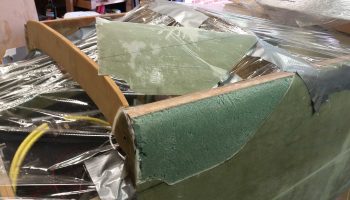
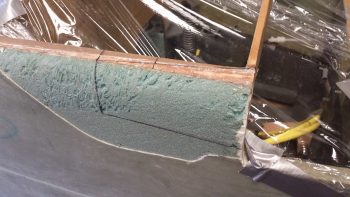
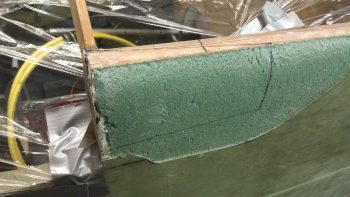
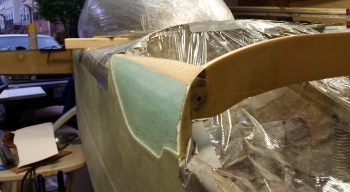
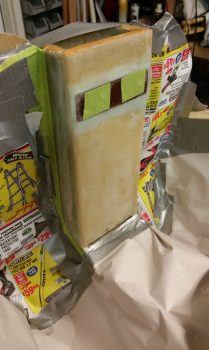
To embed the nutplate assembly onto the forward firewall surface in the Hell Hole, I made a mounting pad for the ANL40 mounting base from 3/8″ PVC foam.

I then carefully carved out a notch for the nutplate assembly in the foam mounting pad.

Here’s a bottom shot of the foam mounting pad with the nutplate assembly installed.

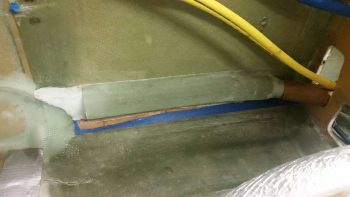
I then used 3 plies of glass (BID/UNI/BID), prepregged, and glassed the ANL40 foam mounting pad with the nutplate assembly flocro’d into place (with all the typical pre-work: micro-ing foam, etc.).  Again, the mounting pad was glassed onto the forward side of the firewall in the hell hole.

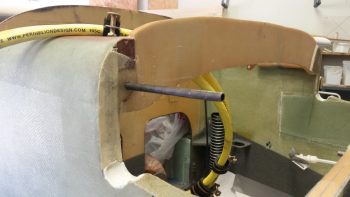
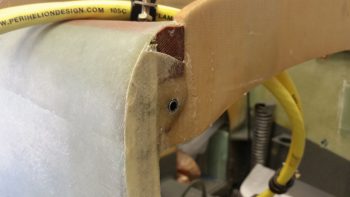
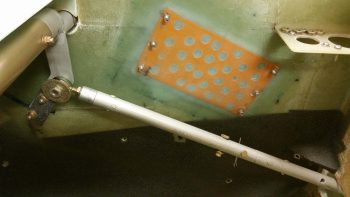
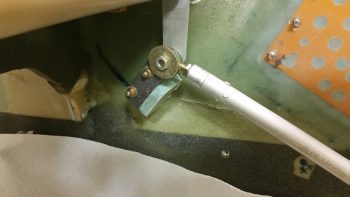
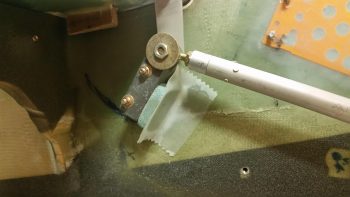
Off topic a bit here, but as the layup above cured, I decided to finish off the elevator control rod by drilling a #10 hole and mounting an AN3-7A bolt into the hole (IRRC this is a Ken Miller mod….).  The bolt will be in addition to the clevis pin that secures the forward side of the elevator control rod to the aft side.

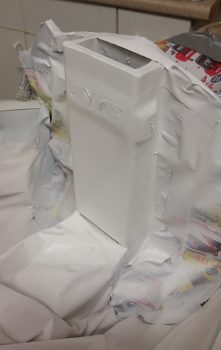
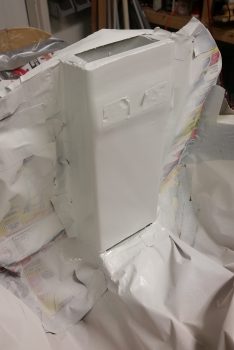
A few hours later I cleaned up the cured layup (yes, I used fast hardener) and test installed the 2 ANL40 base mounting screws.  I also trimmed the glass overhanging the existing firewall electrical package component holes and redrilled the upper holes for the mounting screws.

I then mounted the ANL40 base into place with the 2 countersunk screws.

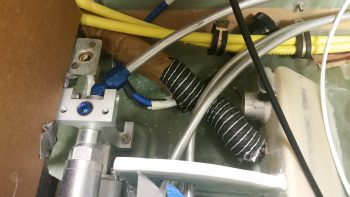
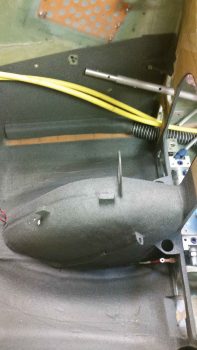
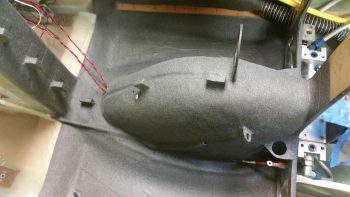
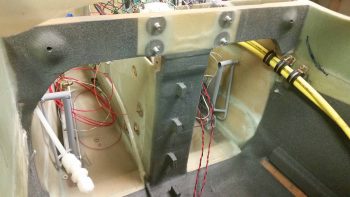
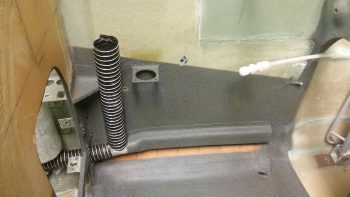
And remounted all the firewall electrical package components (again, except for the ANL40, these are all temp mounts until the Fiberfrax and 6061 aluminum firewall cover are in place).  I uploaded both pics of this since they show a bit different viewing angles.

Being able to get a feel for the space between the Blue Sea B-Lead connector (it’s red) and the ANL40 base, I then got to work finalizing the GRT EIS Hall Effect sensor configuration.  I trimmed the long 8 AWG wire and terminated the Blue Sea connector end with a 3/8″ terminal.  I also labeled & trimmed the ground wire, then terminated it with a Fast-ON PIDG terminal.

I slipped on the white rubber boots, and Voila! Ready for install.

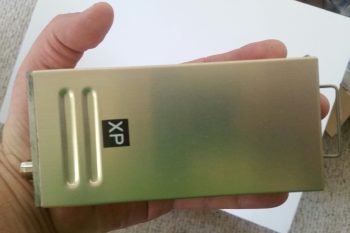
Since I’ve had the actual ANL40 fuse link for a number of years, there was a bit of tarnish on the metal blade connectors so I used a Scotchbrite pad and some white vinegar to clean them up a bit.

I then installed the ANL40 fuse link into its base, on top of the glassed-in foam mounting pad (with the embedded nutplate assembly) and then got busy connecting all the cables to their appropriate mounting lugs.

I also co-ran the red 14 AWG SD-8 backup Alternator power feed wire through the GRT EIS Hall Affect sensor a couple of passes (both the primary alternator B-Lead and the SD-8 backup power feed get passed through the Hall Effect sensor twice to place the readout scale on a 0-50 Amp scale vs a 0-100 Amp scale… the latter which I don’t need since my primary alternator only puts out 40 Amps max).

The route of the electrons is this: Alternator current runs via B-Lead to the firewall side of the Blue Sea pass-thru connector (red fitting), then on the inside of the Blue Sea pass-thru a cable runs to the right post (in pic below) of the ANL40 fuse link VIA 2 passes through the Hall Effect sensor donut.  Then, from the ANL40 left post (again, as depicted in pic below) an 8 AWG B-Lead cable carries the current up to the nose, connecting to the Master Battery Contactor (as depicted in my updated diagram way up there ↑).

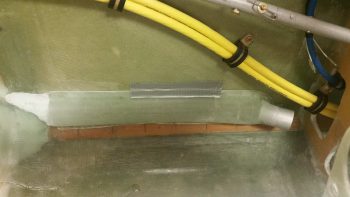
Here’s a closer up shot of the installed ANL40 Fuse Link.

In addition, you can also note that I used a decent sized piece of heat shrink to seal and cinch up all the wiring going through and wrapped around the Hall Effect sensor donut.  It may seem like the Hall Effect sensor is left to sway to-and-fro in the wind, but with the robust 8 AWG cable securing it in place, and the amount of force I had to apply to get both terminal ends in place (not excessive, but it’s tight) …. that puppy ain’t budging!

Another angled shot of the ANL40 fuse link for the alternator’s B-Lead feed and the GRT EIS Hall Effect sensor . . . plus note the additional “big” wire runs that are deemed big enough to hang out and traverse the fuselage with the big yellow cables.

And a final parting shot for the evening.

Tomorrow I’ll continue to work my tail off to get all the engine & firewall components/hoses installed, ID’d, configured, and/or mounted AND data collected before I pull the engine off the fuselage.  [I will note that I baked 2 batches of pinkish colored desiccant to refresh the engine dehydrator].


Chapter 23 – Cowl me crazy!

I actually spent quite a few hours today building a lower cowling dolly that you’ll see in a number of the pics below.  I saw one of these in Walter’s hangar as we were helping remove the wings off of his Long-EZ and thought it was a good idea.  Well, although I got the dimensions from Marco, they didn’t translate over for whatever reason to my cowling and build dimensions (possibly since my fuselage isn’t loaded all the way down?).  I still used it to a degree, but I will have to mod it much further for it to really be helpful.

My goal today was to mock up the lower cowling in its close to final position (as best possible) to check the clearance between it and the engine air induction system… specifically the fuel injection servo.  To better ascertain the position of the lower cowling, I went ahead and set the top cowling in place, which I was going to do in short order anyway.

I then used duck tape to help wrangle the 2 cowling halves into some semblance of order. I’m definitely happy with the fit of the cowlings, and although Mike Melvill had an IO-360 inside of them, trust me, they are still a close fit to an IO-320 sized engine.

I taped the cowling at the top cowling-firewall interface, and was glad to confirm I have a good firewall fit, with the shape of it matching the cowling shape.

Since I had the top cowling close to its final position (I double-checked the plans, my notes, other builders’, etc. to ensure I had it close to where it needed to be…) I then made some templates to use for the cowling angle interface with the canopy and D-deck/ turtledeck assembly.

Here’s another view of my canopy-top cowling interface angle template.  Clearly I will most likely need to throw a curve into the mix as I mount the canopy, but it gives me a good starting point.

I also drew hash lines on the longerons and marked the extended angle of the top cowling contour about 18″ forward of the firewall.

Here’s my version of the lower cowling dolly.  Mine needed to be much wider front to back and much taller than the one that Walter built for his airplane.

As you can see, I removed the top cowling to better check the clearance between the bottom cowling floor and the fuel injection servo.

Here’s the best shot I could get of the fuel injection servo position inside the lower cowling. It may be hard to tell, but in this configuration there is NO clearance and the cowling is actually just touching the fuel injection servo. In fact, the very bottom nub sticking out to the right on the servo is the main fuel feed line attach fitting… clearly no room even to connect the fuel feed hose!

Very frustrated and perplexed on my no-clearance issue with my lower cowling, I took a break and grabbed something to eat.  After about an hour, with the worst case scenario of having to extend a trough under the lower cowling in my mind, I went back down to the shop to assess the clearance issue.

As I was literally sitting under the engine just looking at the layout, I came up with a very viable solution.

You see, my paradigm was that the main fuel line was coming in from the right side, and the hose coming in from the fuel distribution spider on the top of the engine was from the left.  No need to change any of that, but I did need to rethink the one thing that was really causing my clearance issues: the -4 AN 90° fitting on the top of the fuel injection servo. I had it pointed to the left as I lamented the lack of clearance between it and the bottom of the oil sump . . .

But if I moved the servo about 1/2″ forward (which I could do since I had spacers installed in between the elbows), not only did it push it forward to where the cowling was lower, but if I faced the top fitting to the RIGHT then it put the fitting right into a V-shaped channel on the bottom of the Superior cold air induction oil sump.  This allowed clearance to get the hose end fitting onto the servo outlet fitting!  Yes, I would have to spend another $20+ on yet another hose end fitting, but by doing this configuration change it gave me 2 options: A) Run the fuel distro spider hose above the fuel injection servo and in front of the air duct elbows with a 150° U-turn hose end fitting, or B) Run the fuel distro spider hose aft of the air duct elbows with a 90° hose end fitting (I’ll admit that to acquire the best solution here I bought both fittings…).

I’ll have to assess this when I get the fittings in and test these fuel line runs.  This leaves the right side main fuel feed line unaffected and it will still attach to the fuel injection servo on the right side (low).

The resulting change in my configuration will require only about a 3/16″ phenolic spacer between the lower 85° elbow and the fuel injection servo.  I will also have to replace the threaded studs on the cold air induction plenum for connecting the upper elbow to the plenum (at a minimum the lower studs, since it is virtually impossible to get a nut with so many washers on them with the current configuration).

In figuring out the final install point and configuration of the RAM air canister (not pictured here) I needed to install the 1/2″ NPT elbow on the bottom of the oil sump to assess how to route the hose from the sump to the firewall…. around the RAM air canister.  I tested a 90° hose end elbow (blue & red) but think a straight hose end may work as well.  However, since the oil heat feed line from the sump looks like it will enter the firewall on the lower left side, this will require the associated hell hole oil line to crossover from the right side oil pump fitting over to the lower forward left side of the firewall (again, crossover in the hell hole).  Not a big deal, but I will have to avoid and go above the RAM air intake expansion chamber ( . . . never-ending ripple affects!).

The bottom line is that it looks like all the components should fit, but the clearances from one component to the next are all AMAZINGLY CLOSE (but, I will note not too close to allow vibration to cause issues).

Here we have the oil drain valve with the oil heat feed 90° fitting just behind it (pic from right side of engine).

I’m fairly confident that this configuration will give me just enough of the clearance I need below the fuel injection servo and allow for all the critical air induction and underside oil sump fittings to play nicely with each other.

Of course I will have to also rotate both the fuel injection servo’s throttle and mixture levers to avoid hitting the lower cowling (I planned out the mods on those a few days ago), but again, I don’t foresee any issues with those as well.

I think with these sideline tasks taking a bit more time than I expected, my timeline for getting the engine back off the firewall and onto its stand will have to slip a day or two. Tomorrow I should be close to finishing up the firewall configuration tasks and pulling any more data I need to from the engine being mounted.


Chapter 16/23 – Air, MAPs & Elevator

I started off today by making a decision on my electrical system, one that had been nagging me a bit in the back of my mind.  The impetus for me making this decision today was a response by Bob Nuckolls on the Aeroelectric Connection forum that brought it all home for me.  In a discussion on something else related to protecting wires with fuses and circuit breakers, Bob noted: “Recall that circuit protection is for WIRES . . . and that the protective device is installed as close as practical to the SOURCE of energy that puts the wire at risk.

Thus, my ANL-40 fuse link is going back on the firewall, on the hell hole side.  I’ll most likely use a piece of 1/8″ thick x 1/2″ wide copper to connect the forward (hell hole) stud of the Blue Sea terminal to one side of the ANL-40, then run the B-lead from the ANL-40 forward to the battery contactor (however, I’m leaving the option open to use 8 AWG cable and use this connection as the location for the GRT EIS Hall Effect sensor).  This configuration will add a hair more weight aft, but puts better protection on the source of the B-Lead and cleans up my busy nose battery compartment a bit.

I didn’t mention conversations I had yesterday with both Rod Bower (RAM air unit) and Precision Airmotive (Silver Hawk fuel injection) as Marco and I were convoying in our separate trucks to his hangar.  I asked the Silver Hawk guys if I could attempt to thread the -4 AN fitting on the top of the fuel injection servo as far as it would go into the unit in order to attain as much clearance as possible with the bottom of the cold air induction plenum situated just above the fitting.  They said this would be no problem and that I wouldn’t damage anything internally/inside the fuel injection servo.

I queried Rod on some specifics about moving my RAM air box forward and mounting it directly to the aft side of the firewall, but he couldn’t picture it mentally and I ended up sending him the pic below much later after I arrived back home.

Rod got back to me today and we discussed mounting his RAM air unit with the nose of it sticking into the firewall, with about a 5.5″ gap between it and the front face of the fuel injection servo intake plate.  The requirement for this gap between the RAM air canister –which would normally mount to the front of the fuel injection servo– is twofold: 1) The RAM air canister is too wide at the aft side of it (note that it’s shaped somewhat like an Apollo capsule) and would interfere with the bottom cowling.  2) There would be no clearance for neither the oil drain valve (brass valve in pic below) nor the forward-placed sniffle valve.

To allow for enough clearance with the aft end of the RAM air canister with both the oil sump above it and the lower cowling below, I determined that it must be mounted in the clear space just forward of the oil sump.  This spot will allow the RAM air canister to be mounted an inch or so higher and still clear all the top side oil sump/cold air induction plenum and the lower cowling below . . . barely! 

[In the pic below you can see the location of my initial planned hole for a 3″ bracket (shown bottom left corner), then a piece of 3″ SCEET tubing, then the RAM air canister mounted to front face of the fuel injection servo.  Clearly, the reality of limited space and conflicting requirements for use of that space significantly changed the configuration of my air induction system.  Currently the plan is to install the nose of the RAM air canister approximately 1″ higher than the circle depicted on the firewall below].

After some discussion Rod was able to see what I was talking about and signed off on the plan.  In response to my question, he stated that he saw no ill affects in his assessment of my running a 2.5″ piece of SCEET tubing from the aft side of the RAM air canister to the front intake of the fuel injection servo (note smaller diameter than that previously planned 3″ SCEET tubing preceding the RAM air canister).

After getting Rod’s sign-off on the new air induction configuration, I then got busy mounting the Electroair MAP sensor unit on the front face of the firewall in what will be the GIB headrest/D-Deck component housing.

I marked the holes and here you can see the top 2 holes are drilled.

I then had to make some minor adjustments for hole alignment as I drilled the remaining 2 holes.

I then test fitted the MAP sensor, but will hold off on the actual screw install since I don’t have good access with the engine installed to the aft side of the firewall (the screws will get floxed in from the aft side of the firewall to the front side to create 4 screw posts… analogous to click bonds).

And another shot of the final placement of the GRT and Electroair MAP sensor units.

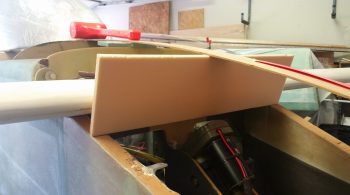
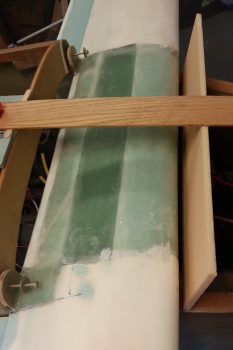
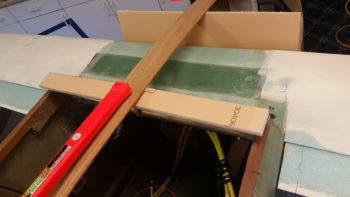
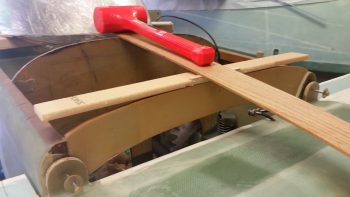
I then got busy assembling the new 5/8″ elevator control rod that would replace the old one that I so haphazardly decided to drill an extra hole into.  I used some larger rivets that Chris Seats gave me and got busy drilling and mashing rivets!  Here’s the assembled product.

Here you can see the internal rod that Marco lathed down the diameter of and cut to length.  We of course cut the 2 main tubing pieces to length as well.  Since I have so much real estate on the top end of the quick disconnect internal solid rod, I’m going to drill an extra #10 hole and actually install an AN3 bolt and nut in addition to the clevis pin.

Here’s a shot with the Atkinson pitch trim actuator bolt slid into the bolt hole that I drilled on this new 5/8″ elevator control rod.  Again, the internal solid rod that makes up the quick disconnect also extends down beyond the pitch trim actuator bolt hole so the hole is much more robust than on the previous elevator control rod.

And here’s a view of the other side of the pitch trim actuator connecting bolt.

Tomorrow I’ll continue to finish up engine-related tasks and will specifically focus on the final placement and configuration of the air induction components.

Chapter 16/23 – Lathing about

Marco, his wife Gina, and I all attended a very nice memorial service for a fellow Canardian, Walter Grantz, who sadly went West a few weeks ago.  Marco spoke at the memorial and told some wonderful stories of our friend Walter, who will be missed greatly.

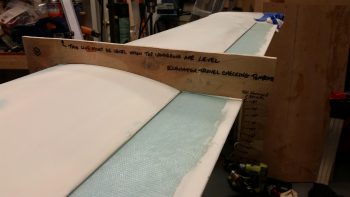
The next day Marco and I had the privilege of helping Walter’s son, Art, and grandson, Christian, remove the wings off of Walter’s Long-EZ to ready it for transport down to NC State University, since his beloved Long-EZ is being donated as a static display for the university’s Engineering Department.  During the time we spent at Walter’s hangar, Art was kind enough to give me Walter’s long level board that Walter had used to build his Long-EZ back in the 1980’s.  It will truly be an honor for me to use it when I build the strakes, and here it is hanging on my shop wall.

Later that evening, Marco was gracious enough to do a bit of machining for my build and lathed the midpoint quick disconnect insert bar on what will be my new elevator control tube [If you remember, I drilled an “extra” hole in my other one and didn’t want to fly with it with an unnecessary hole that only would serve to weaken a critical flight control component.  Moreover, Chris Seats gave me some info and components to help me upgrade to a 5/8″ diameter tube vs the 1/2″ stock… not that the stock version is deficient, it just happened to be easier for me to build a 5/8″ version].

Marco lathed the midpoint quick disconnect insert bar from a 5/8″ rod of 2024 aluminum down to just a bit of over a half inch in diameter.  We also cut it to length to allow for not only the quick disconnect clevis pin(s) & rivets to be mounted, but also long enough that the new (and correct) pitch trim actuator connecting hole will now be drilled through both the control tube and the lower side of the quick disconnect insert bar… clearly a much stronger mounting hole since it will be solid metal for the entire width of the hole. (Sorry… I don’t currently have any pics of these parts, but I should in the next day or so…)

After we got the more important elevator control tube out of the way (we also cut the new 5/8″ control tube pieces to length), we then cut two 1 foot lengths of 6061 3/8″ rods into 3 lengths that fit in-between the mounting tabs of my oil cooler.

Marco then used the lathe to drill out a 3/16″ hole down the center of each one of the oil cooler mounting spacers.

Here are the 6 oil cooler mounting spacers with holes drilled to accept AN3 sized mounting bolts.

Here are the top 3 oil cooler mounting spacers set in place, with the middle one mocked up with an AN3-41A mounting bolt.

And here are another couple shots with the top 3 oil cooler mounting spacers in place with a test fit of an AN3-41A mounting bolt.

Of course Marco did an outstanding job on all the parts he machined/lathed for me (Thanks Brother!).

I wanted to get some glass curing overnight after I got home from Marco’s, so I spent a good half hour figuring out the best spacing and mounting for the 2 MAP sensor boxes… one for the GRT EIS and the other for the Electroair EI.

Originally I had planned on mounting them both vertically, but when I assessed the internal configuration and best spacing within the GIB headrest/D-Deck area, I decided to place them both mounted horizontally, as the GRT MAP sensor is below (with the Clickbonds 5 min glued in place).  The Electroair EI MAP sensor box will get mounted directly below the GRT MAP sensor box.

After letting the 5-min glue cure about 10 minutes, I then removed the GRT MAP sensor box.  I cleaned up the excess 5 min glue and sanded around each of the Clickbonds.

I then laid up 2-plies of BID over each Clickbond, peel plied them both, and then left them alone to cure.

I should note that Marco also used his big metal cutting bandsaw to cut up a 36″ piece of angle iron that I will use to weld up a mount that will allow the engine mount to be connected to the engine stand.  Over the next few days I’ll be getting that ready to go as well, after I get just a bit more data from having the engine mounted.


Chapter 23 – Hosed!

I started off this morning inventorying a much-needed order from ACS that I just received. Included in the order was -20 sized Adel clamp for the fuel filter, that I immediately pressed into service.  I cleaned the fuel lines fore and aft of the fuel filter then mounted them “permanently” (albeit servicing will occur…yes) to the filter, as well as permanently mounted the origin of the incoming line of the fuel filter (on left in pic below) at the FT-60 Red Cube fuel flow transducer.

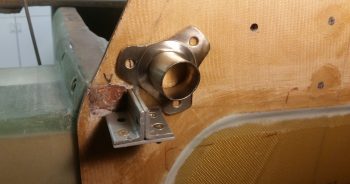
I also received the 45° -6 AN bulkhead pass-thru for the fuel line and a 45° -8 AN bulkhead pass-thru for the oil heat return line.  I finished drilling out those pass-thru holes to size and mounted the fittings through the firewall.  As you can see I then mounted the fuel line and the oil heat return line to the 2 new firewall pass-thru fittings.  To be clear, these pass-thru connections are NOT permanent installs at this point since they’ll need to be removed when the Fiberfrax and 6061 aluminum sheet cover get mounted to the firewall face.

Here’s a firewall shot of the 45° -8 AN pass-thru for the oil heat return line and the 45° -6 AN fuel line bulkhead pass-thru.

I then gathered up all the accouterments that I needed to make up some engine compartment stainless steel braided hoses with hose ends.  Here’s the first hose I made, which is a -8 hose for the oil heat oil return line.

I then made up a -6 hose for the main fuel line feed to the fuel pump.  One thing I honestly didn’t count on mentally was how SHORT these hoses would turn out based on the confined space of the engine compartment.  I mean, really, the actual length of the hose component of the oil heat oil return line is only 3.7″ long!  Crazy!

Since I had all the stuff out to make hoses I went ahead and terminated some ends ahead of time, like this hose end for the fuel pressure sensor line with the 90° hose end fitting on it.  I was going to do the fuel pump side hose end on the fuel line that goes to the fuel injection servo, but realized I had a head space/timing issue (Browning 0.50 cal reference there) when I ordered the fitting and apparently the fine print said for PTFE hoses only…. oops and dammit!  Ok, another hose end fitting order coming up!

I also attached a hose end fitting to the -8 oil line hose stock and –unrelated– installed the upper fuel spider hose end fitting to the -4 hose that will go from the fuel injection servo to the fuel spider.

Here you can see the hose peeking out the bottom of the engine.  I’ll of course cut this hose to length and terminate it with a -4 AN hose end fitting once the fuel injection servo is set in its final configuration.

I know the bottom shot is a little blurry, but it’s a decent view of the 2 hoses I just made up today.

And another one from below the engine, at the bottom of the firewall.

I also worked for a couple of hours in assessing the bottom engine area, to include the location of the oil heat sump feed line, the oil drain valve, the fuel injection servo, air intake elbows, and the RAM air intake.  Believe me, there was a lot of musical chairs going on in setting up the configuration (read: major configuration changes) to even begin to work.  I even had to pull out the lower cowling and mock install it a number of times to check for clearances.  Not surprisingly, there is just so LITTLE space for everything to get crammed in there, and I had to resort to a myriad of small, constant changes to even being to get close to the configuration I want.

One immediate change (that I was allowing for) that happened after ascertaining the amount of clearance between the lower cowling and the cold air intake tubes is that I moved the alternator and starter power wires to traverse the engine heading forward on the inboard side of the cold air intake tubes vs the outboard/lower side.

So . . . the air induction system should become much clearer over the next week and I will definitely share more as it all unfolds.

I’ll be heading down to Marco’s for a very short 2-day trip and when I return I really want to finalize the firewall aft configurations and get the engine back off the fuselage and onto it’s engine stand.  Moreover, I plan on starting on the canopy and nose at the end of next week.


Chapter 21/22/23 – Configuring firewall

Today was all about getting as much of a jump as possible on the firewall configuration to get that stuff knocked out early.  I did take about half an hour to clean up all the rough edges on the wheel pants’ tire hole reinforcement layups that I did the other day, and then cut, shaped and sanded the bigger layups I did on the back of each wheel pant tire opening.

After reviewing some info on installing NPT fittings I felt I should do my due diligence and check the torque on the 45° AN6 fitting exiting the FT-60 Red Cube fuel flow meter.  It was tight, but I thought it could be tighter.  However, if you’ve seen the install manual there is explicit warnings not to over tighten a fitting on account the transducer’s case might actually crack.  In the AFP-30 Air Data Computer install manual there’s some literature on the FT-60 that states to torque the fittings to 25 ft-lbs.  Since I had a box wrench adapter on a short extension mounted to my torque wrench, I dialed the torque down to 23.5 ft-lbs to ensure I didn’t crack the FT-60 case.  Surprisingly, I was able to get one more entire revolution out of the 45° AN6 fitting… with how much pressure I had to exert to get to that 23.5 ft-lbs (again, remember I was using an protruding box wrench adapter on a short extension… both serving to add a mechanical torque advantage), I’m surprised people go further than that to crack these darn things!

Once I got the aft fitting on the FT-60 squared away, I then did some minor tweaking of the fuel filter and lines to get the filter flat again the front face of the firewall.  I then marked the position of the Adel clamp hole and the fuel line exit point on the firewall.  From inside the hell hole I drilled small holes out using my right angle drill.  I then drilled from the aft firewall side coming back into the hell hole.  You can see the drill bit in the pic below peaking through the firewall and aligned with the fuel line fitting.

Here’s a shot from the firewall side of my initial 2 holes through the firewall for mounting hell hole and firewall assemblies and pass-thrus.

I then took a #10 screw and Dremelled the head of it to create indentions for flox to better grip it.

After drilling out the fuel filter clamp screw hole and then counter sinking the hole, I then floxed the fuel filter Adel clamp mounting screw into place in the hole.  After it cures I’ll layup a small ply of glass over it.

I then took a fair amount of time to figure out exactly where to place the Electroair electronic ignition coil unit on the upper firewall.  I marked off a 1″ Demarcation Zone around the edge of the firewall to ensure I had space for both laying up the fillet glass to the upper cowling mounting overhang, plus room enough to run 1/4″ fuel vent lines as well.  I also needed to stay as far left as possible to give myself room to get the oil filter out for oil changes.

I even called Electroair and conferred with Denny on the location and orientation of the coil unit.  I played around with placing it just aft of where the CS Spar crosses in front of the firewall in the midpoint area of the firewall, and while there’s enough space in that area the spark plug wires would have funky runs to get to the spark plugs.  So, in the end I decided it had to go on the upper firewall, but at an angle.  It sits about 1/4″ above the SD-8 alternator and does very slightly impinge on the Demarcation Zone.

Here’s a closer shot of the mounting location of the Electroair EI coil pack.

I then got busy making four K1000-4 nutplate assemblies for the AN4 bolts that would be used in mounting the Electroair EI coil pack.  I cut and sanded the phenolic pieces and then riveted the nutplates to the front side of the assemblies.

Here’s an aft view of the Electroair EI coil pack K1000-4 nutplate assemblies.

Using the coil pack as a template to keep the AN4 bolts in their exact mounting configuration, I then floxed the 4 nutplate assemblies to the front of the upper firewall.

I then focused on installing the B&C Firewall/Engine ground stud and forest of tabs inside the hell hole [the usual configuration for the firewall/engine ground stud and forest of tabs is to have a forest of tabs on each side of the firewall.  However, since I only have two items that require ground on the hot side of the firewall, I forewent installing the forest of tabs on the aft side of the firewall].  Although I didn’t get a pic of it, the engine ground strap is temporarily secured on the engine side where I plan to mount it permanently, so the length I ordered for the braided engine ground strap is spot on.

On the hell hole side of the forest of tabs, I then installed the big yellow ground cable that runs the length of the firewall to the negative ground post on the battery.

I then spent the next hour or so drilling and mounting the big yellow power cable that runs from the starter contactor in the nose battery compartment to the starter through a stainless steel firewall pass-thru.  Inboard of the starter cable, I then drilled and mounted a Blue Sea connector for the Alternator’s B-lead that also heads up to the nose battery compartment.

Although this pic is a bit fuzzy, here is a final view of the firewall configuration tasks that I completed today.  From the upper left hand corner you can see a hole drilled for the Oil Heat oil return line to the engine oil sump.  Slightly lower and to the right of that is the main fuel line that feeds the engine driven fuel pump.  Towards the middle is the #10 (3/16″) screw that I floxed into the hell hole as a mounting stud for the fuel filter’s Adel clamp. Then of course is the electrical firewall pass-thru package, starting from the left with the Blue Sea fitting for the Alternator’s B-Lead, a stainless steel firewall pass-thru with the starter power cable running through it, and then the engine grounding strap that connects to the the firewall ground stud that is opposite the forest of tabs inside the hell hole.

In the pic below I added in the Alternator’s B-Lead which will be paired together with the big yellow starter cable as they both exit the engine compartment via the firewall.

Here’s a wide-angle shot of the major engine component electronics, with the big yellow power cable of the starter, the Alternator’s white B-Lead, and the connected engine grounding strap connected to the firewall ground bolt.

Here’s bit closer shot of the starter and alternator power leads.  Note that the Alternator’s B-Lead is terminated on the Alternator side but not yet at the Blue Sea firewall pass-thru. Also note that the starter lead cable is not terminated yet, and won’t be until I get the Fiberfrax and 6061 aluminum sheet affixed to the firewall.

Here’s the hell hole view of all my firewall-based shenanigans. Note that the fuel filter mounting screw is visible in-between the 2 yellow zip ties.

Here’s a little broader view specifically showing the Adel clamp that secures the pair of big yellow power cables.

Tomorrow I’ll continue my firewall configuring tasks.  I should receive some more fittings, so I’ll most likely mount some of those while I’m at it.
 

Chapter 23 – Engine mounted!

My goal today was to get the engine mounted.  Having the engine mounted for a bit will again allow me to figure out firewall component placement, firewall pass-thrus, the engine compartment hose requirements, firewall/engine electrical wiring requirements, upper cowling fitting (specifically for canopy/D-Deck angle), initial baffling requirements, lower cowling fit and air intake (fuel injection servo & RAM air) configuration.  Then I’ll remove the engine and mount it to an engine stand.

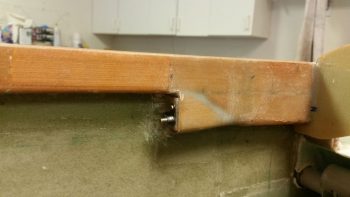
Since A) I needed to remove the engine mount from the engine to get the fuel pump OUT fitting installed, and B) do a final clean and painting of the engine mount, I decided since that since the engine mount was secured in place for the moment that I would trim down 3 of the 4 engine mount stubs to allow for clearance of the firewall face’s Fiberfrax and 6061 aluminum sheet covering.  About an 1/8″ at most getting trimmed off any of the stubs… with the top left already short enough for clearance.

I cut and placed a box that I had just received the second shipment of hoses and hose end fittings from Summit Racing (pretty much finalizing all my hose/fittings orders) over the engine mount/accessory case to protect all of it from sparks and metal debris.

Here’s a closeup of the right side engine mount stubs that needed just a hair trimmed off the front side.

I then spent about half an hour trimming them all up.

Here the right side stubs are trimmed up and filed smooth.

On my errands yesterday I picked up some hardware and some Automotive & industrial strength fast-drying White Rustoleum paint.  I spent a good 30 minutes sanding down the engine mount surfaces with 220 grit sandpaper.  Then I filed off a couple very small weld spatters that I missed before, then washed in hot water and Simple Green.  I then let it air dry.

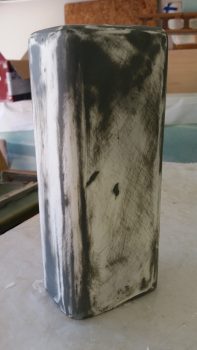
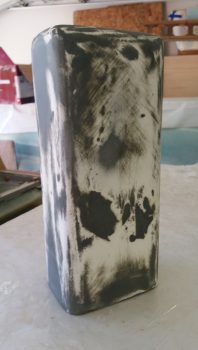
While the engine mount air dried I spent a good 3-4 minutes shaking the can to mix up the new paint… in painting, preparation is everything, right?!  I then started spraying.  It looked good and sprayed like normal spray paint, but then about 5 minutes into painting the bottom side of the engine mount… apparently my normal spray paint decided it wanted to be a can of textured spray paint.  Within a matter of seconds I had the bottom, bottom right corner and right side of the engine mount peppered with what looked like textured, speckled paint.

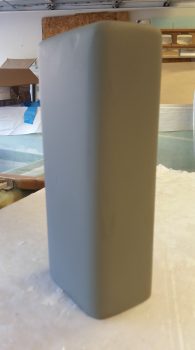
Needless to say I was quite pissed.  My saving grace was that this was fast drying paint, so after about 5 minutes I felt a spot and it was what I considered in it’s green state. Another minute more and I was able to rub down the surface with a paper towel with a decent bit of force to remove the spackles of paint over nearly a third of my engine mount. That didn’t leave it feeling the smoothest, but at least the speckles were nearly completely gone. Apparently a glob of paint or something got caught in the sprayer head…. which I cleared out.  And a number of test sprays in the air to be certain, I continued on painting the engine mount.

As I waited the requisite 15 minutes for the fast drying paint on the engine mount to dry, I then preheated my kitchen oven to 175° F.  I then popped the fairly dry engine mount into the oven and baked it for 30 minutes.  My goal here on the engine mount paint is of course to have as nice as paint as possible in a reasonable amount of time, but, moreover, I want the engine mount protected against corrosion and for it to be visually inspectable for cracks (thus why no powder coating).

As the painted engine mount baked upstairs, I got to work on the engine mounted mechanical fuel pump.  I took some BEFORE pics from both the right and left sides…

I then mounted the OUT side fitting on the fuel pump, which is a 90° steel fitting that also includes a 1/8″ NPT port straight out for installing a 45° reducer fitting for the fuel pressure sensor line (on the left in pics below).  I also mocked up an AN6 90° hose end fitting (blue & red) to test out the angle for how the fuel feed to the fuel injection servo would run, and an AN4 90° hose end fitting (silver & red) for the fuel pressure sensor hose.  The aluminum AN6 hose end fitting is just to test the angle.  After I verified the angle was the best possible solution I pulled the trigger on a steel AN6 90° hose end fitting from Summit Racing (as well as a 90° 1/8″ NPT to AN3-3/16″ MAP port fitting).

I then installed the fuel pump fuel line feed IN fitting on the right side (as oriented in right pic below).

After getting the fuel line fittings squared away, and turning off the stove to let the just-baked engine mount cool, I took off for a bit to run some errands, grab some lunch, and pick up some 1/8″ thick steel angle from Home Depot for the engine mount mount that I’ll weld up for the engine stand.

Upon returning home I then grabbed the cooled and cured engine mount and proceeded to remount it back onto the engine.  [A point of note: the paint on the engine mount is about a 1 meter paint job…. it looks great unless you actually get fairly close or touch it…. if it were an external component I would probably wet sand it and hit it with one more layer of paint, or clear coat even.  Obviously it will be subject to high heat, oil, dust, dirt, etc. in the engine compartment, so I’m more concerned about a robust paint job vs. a sexy one.]

After I got the engine mount remounted to the engine, I then installed the last of the fuel pump’s fittings: the overboard vent line fitting.

Yet another shot of the fuel pump fittings.

After my airplane building credentials were called into question by a yet to be named Aussie (ok, I give . . . it was Dave Berenholtz!)  Ha!  I had to prove my mechanical prowess by actually getting the amazingly challenging cotter pins installed on the engine mount castle nuts.  Seems like it shouldn’t be that difficult, but the angles and clearances are just killer! (All in fun my friend!).

Here are the top side cotter pins installed in the engine mount bolts and castle nuts.

And the bottom left cotter pin installed.  I still have no intentions of trying to do this under cylinder #4 and will swap out that castle nut with a lock nut a bit later.

With the engine mount re-mounted on the engine and everything torqued to specs, there was nothing left to do but mount the engine!  It was go time!

So here she is . . . engine is mounted!!!

I only had minor issues with getting the last 2 bottom horizontal bolts in place on the engine mount, but after a few minutes of finagling and some light tapping they went right in.

As you can see, even with the eventual fiberfrax and aluminum sheet firewall covering, the clearances are pretty good (by Long-EZ standards) with the firewall.  The only clearance concern I have is between the fuel pump overboard vent fitting and the left aileron control tube…. I’ll have to watch that closely.

The engine looked a bit small and compact mounted to what I have so far of the fuselage, so wanted to see the cross-section of the engine…. here’s a taste of what that looks like:

Tomorrow I’ll move forward with my engine data collection tasks that I outlined at the beginning of this blog post, and any related tasks as well.  Next week I plan on starting on the nose and canopy, and hope to have all this engine stuff put to bed for a while… until final engine install crops up.


Chapter 23 – Turning it around

The fuselage that is . . .

I did some major spring cleaning on my shop today, pulled a ton of stuff that I had buried against the wall that all in all still stole away 2 feet of depth on that side.  Long before I got in deep into custom motorcycle or airplane building, I did a lot of woodworking.  So I have a fair amount of nice wood that all went into the back room awaiting transport down to NC.

I also removed a couple of high shelves and the 4 padded hooks I had up high for the canard, since it won’t be going back up on those hooks.
After a number of hours I was finally ready to move the fuselage out and put it back in the shop nose first.  Here’s some pics of that short trek.

And a head on view of the fuselage’s new setting for a good while.

And an aft view.

Saturday I received an order from B&C with my engine ground strap, a couple of oil filters and a couple of the shorter Gates 7312 alternator belts.  Before I got to moving the engine around I went ahead and slipped a new alternator belt into place.
Another shot of the new alternator belt in place.

Before I mounted the engine mount to the engine, I reviewed my notes.  One Canardian had a trick he swears by using a “silver bullet” . . . You start with a standard 7/16″ bolt.

Chop the head off and grind it into a bullet looking pin.  Now, he said 2-3″, but I don’t know what engine he was installing.  The concept is simple, use the silver bullet to align the last two Lord rubber vibration dampener assemblies (one at a time) to the engine mount holes and then press the actual bolt in behind it, pushing the silver bullet out the other side.

The concept works great, but for an 320 case I think 1.5″ is the max length you can use since there’s not enough clearance on the other side.  The one I made is about 2-5/8″ long and would get blocked from coming out the other side by some part of the engine.

So I didn’t use the silver bullet, but installing the engine mount to the engine versus mounting the engine to the engine mount with the latter pre-mounted to the firewall made it EZ enough anyway (albeit, still a ton of the usual fiddling about).

I had bought 4 castle nuts to use but I will say that I’m wimping out on using these at every point, especially under cylinder #4…. no way.  So I put a mini-order in with ACS for two AN363-720 lock nuts as called out for in the Long-EZ plans.

Also, for a newb like me, I was concerned at first that my AN7-35A engine mount bolts weren’t long enough since I couldn’t get a thread showing until I compressed the installed dampener mounts a bit with squeezes clamps.  However, in the end I needed to put 2-3 washers on to keep the cotter pin hole within the castellated part of the nut and not end up well past it when all was properly torqued (450-500 in-lbs).

I really don’t like doing things twice if I can avoid it, and I was going to make every attempt to make this engine mount install onto the motor my last one.  But alas, it was not meant to be.  While doing a good round of patting myself on the back for a job well done … haha! I noted that fuel pump looked awfully close to the engine mount… REALLY close as a matter of fact.  Well, when I tried to thread in the FUEL OUT fitting onto the pump the engine mount wasn’t having any of it.

Thus the engine mount will have to come off at least once more AND I have to buy another 90-150 degree extended fitting (which means steel now) to get by that engine mount reinforcement tube.  It will be a really tight fit, but if the fitting goes in first I don’t foresee any clearance issues . . . again, just all really tight (but then again, we’re talking about a Long-EZ here!  Everything is really tight clearances…)

Tomorrow I’ll work more on getting the engine mounted to the firewall to get a ton of much needed data . . . which, as was evident tonight, I already am!


Chapter 9 – Wheel pants final glass

I had to run some errands today so I didn’t get into the shop until late afternoon.

My goal today was to finish the last bit of scheduled layups on the wheel pants.  So unless some odd requirement pops up for extra glass on the wheel pants, this should be the last of any fiberglass layups that I’ll need to do on these wheel pants.

I started by assessing the tire clearance with the left wheel pant.  I needed to do some judicious trimming in the front and along both sides, but the back side was a completely different story.  Since I had originally miscalculated the forward positioning of the front wheel pant, the result was that I ended up cutting the aft side of the wheel opening way too big, with over an inch extra gap for the tire.

Thus, as far glassing was concerned, my goal was to reinforce all the side and front edges with 2 plies of BID, as Gary Hertzler calls out for in the install instructions.  What Gary doesn’t specify is the width of the reinforcement glass, so I planned for 2 plies of BID at 3/4″ wide.  As I said, the aft edge was a different story and needed a fair bit of glass to fill it back in. So I prepregged all the glass and got started.

I then laid up the interior reinforcement BID for the left side wheel pant (shown farther below).  As the left side glass layups cured, I then assembled the right side wheel pant onto the gear and mounted it using nothing but screws (no Clecos).

I then assessed and determined the wheel opening spacing requirements with the tire.  I cut and prepregged the BID for the right side just as I did on the left side, and then laid up the reinforcement BID around the wheel opening in the right wheel pant.

Here’s a shot of the left and right front wheel pant halves’ tire opening reinforcement BID.

And the same thing on the aft side, only with some filler glass on the aft end of both rear wheel pant halves.  As you can see, the aft side wheel pant tire opening on the left required a lot more filler glass than the one on the right side.  Once the filler glass cures, I’ll cut it in an oval-type/rounded-corner rectangle fashion for wheel clearance.

After the last bit of glassing on the wheel pants, I then took a break for some chow.  When I returned to the shop I then spent about 2 hours organizing and cleaning the shop in prep for bringing my wings back inside, flipping the fuselage around so that it’s situated in the shop nose in… opposite of what I have now.  In addition, tomorrow I plan on mounting the engine to the firewall to mockup the firewall pass thru fittings, hoses and electrical connections.


Chapter 9 – Another pant day

I started out the day by updating my wheel pants (or “spats”) task list before heading down to the shop.  My plan was to get to the point I could knock out a few layups on the wheel pants then roll into finalizing the shop reorganization… with the wings inside and the fuselage having done an about face.  But that didn’t happen.

What did happen was a whole lot of mini-tasks getting completed on the wheel pants, which of course has moved the completion bar to I’d say the mid-90% area (excluding finishing of course).

My first task of the day was to trim down the Gear leg to wheel pant bonnet fairing on the aft side of the bonnet.  I just couldn’t pass up the opportunity to make a swoosh-style fairing here because when I see canard aircraft with wheel pants without this swoosh fairing  . . . well, something is just missing mentally for me.  So in they went.

Obviously here is the before-trimmed shot.

And then after I trimmed down the jagged swoosh fairing edge.

Here we have the right side swoosh fairing after I trimmed it down.  I would like to point out that these are initial trimmings, and I’ll dial them in most likely when I finish the wheel pants to paint.

I then set my sights on drilling out the left side bonnet’s front 3 mounting holes for #10 screws.  After drilling the front hole I set a #10 screw in place with a narrow Tinnermam-style washer.

I then did the same after drilling the outboard mounting hole.

With the front side screw holes drilled out (remember, the aft end gets CAMLOCs) on both the left and right wheel pants and bonnets, I then pulled the wheel pants off.  I then sanded down the interior edge of the tire openings for the upcoming 2-ply reinforcement BID those will get.

I then laid up 2 plies of BID on “top”  (the inboard sides) of the outboard support doublers. Again, this was due to delams caused by the extreme angles from the sides of the doublers to the “top” surface, and something I had a good notion might happen.  No worries, small EZ layups and a little flox and they’ll be right as rain.

[Although I forgot to take any pics, I also laid up a ply of BID over each line of flocro that I used to hold the stainless steel brake lines into the gear fairing after bending them out to flare and terminate the ends.  The bonnet layups covered the bottom 2/3rds of the channels, but the tops were just bare flocro on the inboard side of the gear legs].

Since my plane has the wide main gear fairing and thus a longer bonnet, I then added a ply of BID on the insides of both aft wheel pants where the CAMLOCs will get mounted. The area where I added the BID is much lighter glassed than the more robust areas of the wheel pants.

As the glass cured I then got to work sanding and shaping the edges of the wheel pant bonnets that are now permanent fixtures on the gear legs.  In addition, I spent about 10-15 minutes per side digging out the transition-fillet-creating Play-doh from under the bonnet.

Here’s the right side bonnet cleaned up and sanded.

A few hours later here are the cured and trimmed support doublers.

And here’s a shot of the K1000-3 nutplates I riveted into place as the glass layups were drying.

After all the layups had cured and I pulled peel ply and cleaned them all up, I then mocked up the left wheel pant using only screws… no Clecos.

Here you can see the top front 3 screws in place.  In actuality I need to get some more screws since only the outboard centerline screw is the right size #10 screw, and doing the lion’s share of the work.  The front and inboard are #8 screws that I used to show visually how it all would look.  BTW, if you’re wondering why I ended up going with #10 screws, it was simply a matter of visual balance with the CAMLOCs, whose studs have the same size head as the #10 screws.  With 5 screws total for each wheel pant, the weight increase is minuscule going with #10 screws vs #8’s.

I did what I could to countersink the 1/4-28 side mounting screws, but I will need to pick up an actual 1/4″ 100° countersink from ACS to finish the job.  Although the Tinnerman washer sits just a hair proud, this shot of the outboard mounting screw still gives you an idea of how it looks.
Here’s a shot of the screws from the inboard side.

And here’s a shot of the inboard 1/4-28 mounting screw with Tinnerman washer.

Tomorrow I’ll check and make any required adjustments for tire clearances.  After/if any cutting is required, I’ll then layup the 2-ply reinforcement layups around the perimeter of the tire openings.  After that, the wheel pants will be completed except for the additional mounting hardware that needs to installed (screws, CAMLOCs, etc.) and finishing of them to paint.