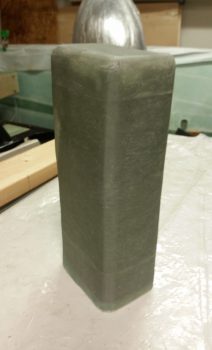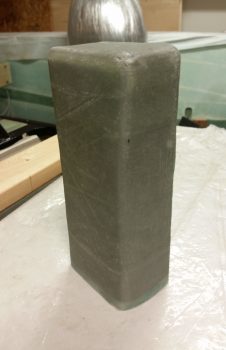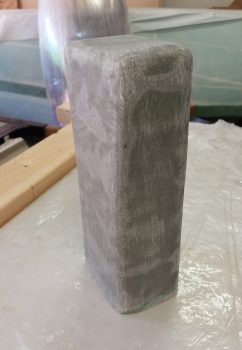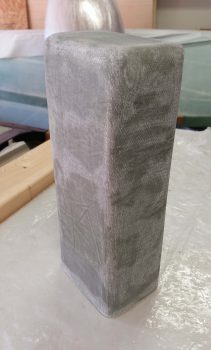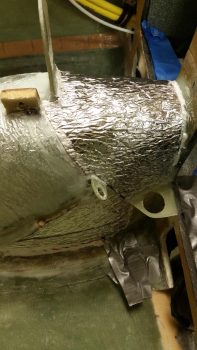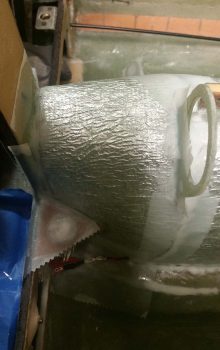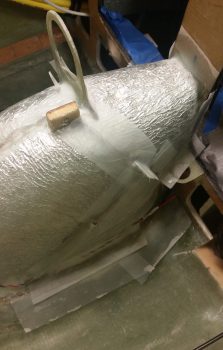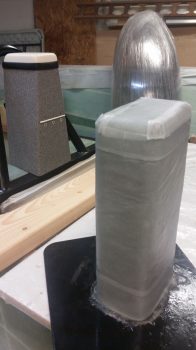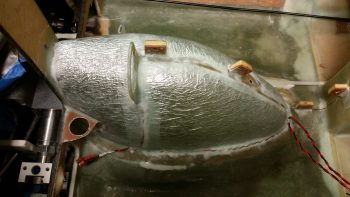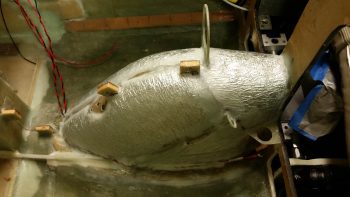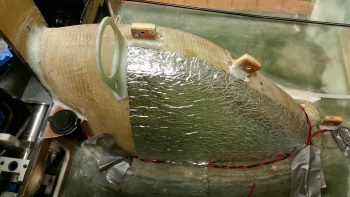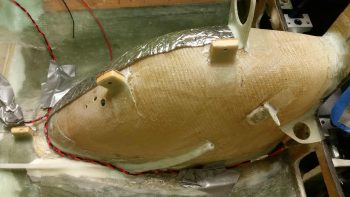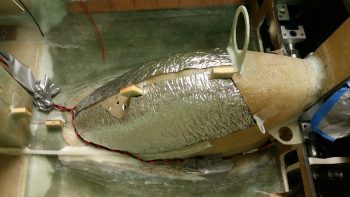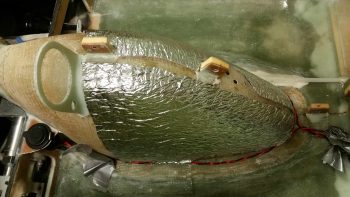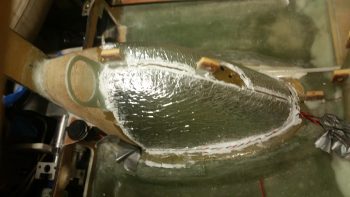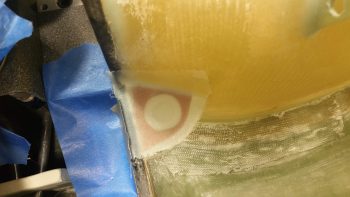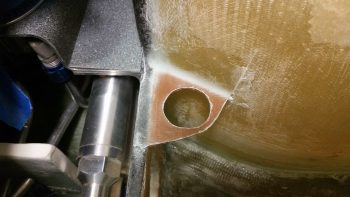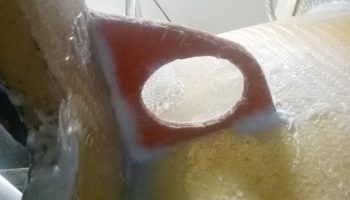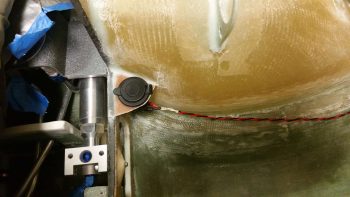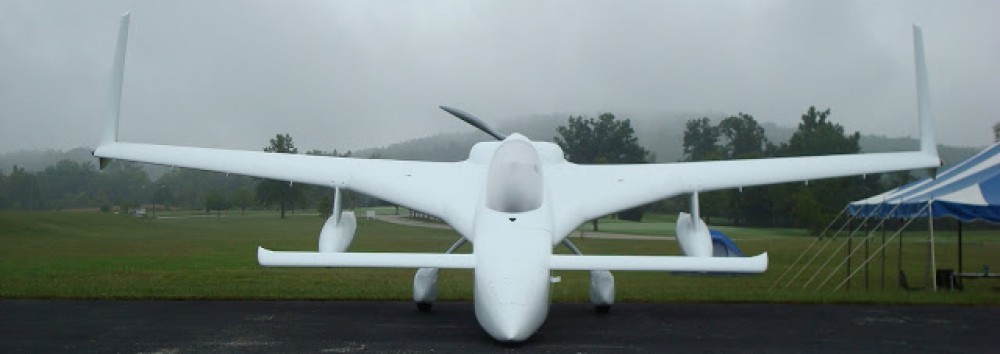
Chapter 9 – Wheel spats finished 2.0

My buddy LG taught me some trivia last night when he kept using the term “wheel spats” for my wheel pants.  We looked it up online and sure enough, wheel spats is another term used for wheel pants . . . apparently a bit more in Britain.  I actually like the term better so I will begin using it as a part of my lexicon! ha!

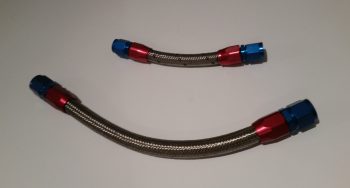
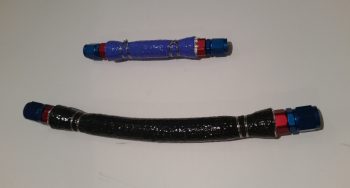
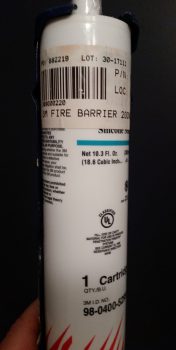
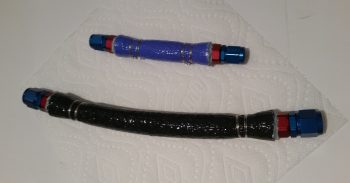
Last night was a late night with quite a bit of socializing going on, so let’s just say I was moving a bit more slowly this morning.  I took a couple hours to do some research and finalize my last couple of orders to acquire all the hoses, fittings and fire sleeve I will need to roll my own engine fuel, oil, MAP and sensor hoses.  I also pulled the trigger on some more MGS epoxy and some CAMLOCs for the wheel pants.

I then spent a couple of hours reconfiguring and cleaning out the shop.  My wings have been outside in my driveway (covered) on the wing dolly for a good number of days since I started working on installing the wheel pants.  I want to get them back in the shop, but more against the sidewall and out of the way.  I will say it’s great to have the wings built, but they do really get in the way when you don’t need them.

I then started in on the wheel pants.  First off I’d like to note that on the profile shot that there is clearly no smile.  To be fair, I widened these wheel pants 1″ at the widest point, and with the benefit of hindsight –again– I think that 3/4″ would have most likely been plenty enough to do the trick.

I’d also like to apologize ahead of time for the crappy quality of a number of these pics… I was in a rush and unless I blow up each pic on my phone, I don’t realize often how bad they are until later.  I guess it’s because they essentially make camera phones for Millenials to take selfies rather than actual pics…. at least for my phone because it just does not have a camera that likes to focus very well…

Moving on.

Now, of course it’s my biased opinion, but since the 400×5 wheels/tires –thus the subsequent wheel pants (or wheel spats)– are significantly smaller than the 500×5 wheels, then my widening the wheel pants hasn’t seemed to make them overtly fat in appearance. Again, IMHO.

I started out my short work evening by marking the wheel pants’ bonnets for trimming.  I originally had planned on making the flange of the bonnet 1.6″ wide, but that was a bit too narrow so I settled on 1.8″.

I also switched around the screw locations on the front side from 2 each side forward of the wheel pant split to only 1 each side with a lone screw at the front center position (the bold dot on the front flange “corner” <pic below> is a screw position that I had originally planned for, but that I eliminated from the lineup).  Going with 3 screws up front vs. 4 provided me with more equidistant spacing for the next 2 fasteners (CAMLOCs) aft of the split.

Now, the fact that I have 2 CAMLOCs aft of the split on each side is change #2.  Sitting upstairs on my couch as I planned out all these fasteners, I just didn’t really realize how long the side of the bonnet flange was until I was actually downstairs in the shop looking at it…. this means I’ll be short 2 CAMLOC receptacles in the order I submitted today.  Oh well, that’s why I like to build stuff like the wheel pants as early as possible to flush out all these minor hardware issues, etc.

As a point of note, the total hardware for each wheel pant is 5 screws and 9 CAMLOCs…. of which 4 screws and all 9 CAMLOCs will need to be unfastened to remove the aft side pant for checking/filling tire pressure, maintenance, etc.

After I got my screw/CAMLOC locations dialed in, I carefully drilled a hole at each location… adding Clecos as I went.

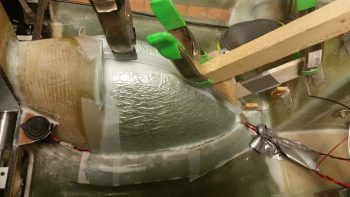
Here’s the inboard side of the left wheel pant bonnet, marked for trimming and holes drilled at the fastener locations.

I then spent a good 10 minutes extracting the wheel pant halves from the iron grip of the bonnet.

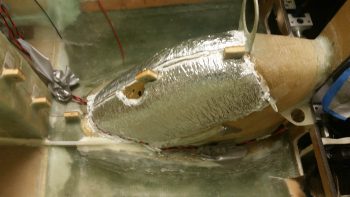
Here we have the inboard view of the untrimmed bonnet.

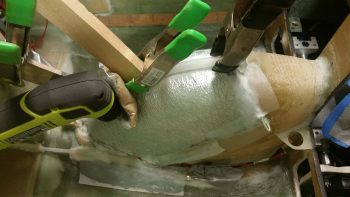
And the same view, only with the bonnet trimmed with the Fein saw.

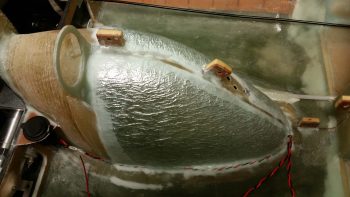
And a couple more shots of the trimmed wheel pant bonnet on the left gear.

Since it was later in the evening, I wanted to get my loud Fein saw cutting shenanigans out of the way as early as possible, so I immediately headed over to finish up the right wheel pant bonnet.  I started off by measuring and marking it in the best emulation of the left wheel pant bonnet as possible.

Then I drilled the screw/CAMLOC holes and Clecoed those.

Here’s an inboard view of the marked, drilled and Clecoed right wheel pant bonnet.

I then trimmed the right side wheel pant bonnet with the Fein saw.

Here’s the outboard view of the trimmed right wheel pant bonnet (again, sorry for the pic).

After I had made my loud noise for the evening, I excitedly got to work reassembling the wheel pants onto the trimmed bonnets.  Hoo-ah!  I’ve been waiting for this point for a LONG time!

I first reassembled the left wheel pant, installing both side mounting screws and all the Clecos.

And then did the same thing for the right side wheel pant.

I would like to point out that these bonnets are in their rough cut state and there are obvious minor differences between the right and left sides.  And while I’m realistic in accepting that both sides won’t match perfectly, I will shape them as close as possible to minimize any differences between the two…. and I honestly think the resulting differences in shape will be so minimal that it will be hardly noticeably out on a flight line.

The bottom line is that I LOVE these wheel spats (hehe), and man do they make this bird look sexy!  As I mentioned before, I still have a few more minor tasks before I can claim that they’re totally complete, but we’re pretty darn close.

Woo-hoo!


Chapter 9 – Final Brake Line install

Finished!  As are all the major install steps for the wheel pants . . .

I started off today checking the alignment on the right wheel pant with both the inboard and outboard doublers’ glass cured.  I need to reglass the top of each outboard doubler for some minor air pocket/delam issues I had on each with such sharp bends of the glass (even though I weighed them down during cure).  Regardless, the doublers are solidly in and the re-glassing a minor issue.

With the Clecos, outboard and inboard mounting screws in place the right wheel pant was dead on parallel with the A/C centerline marks.  However, what is a slight ailment to the left wheel pant (below) in windage, my right wheel pant suffers from a very slight 0.1″ difference in elevation between aft/tail wheel pant height off the jig and the nose.  So, while the nose nail comfortably rests on the jig, the tail nail hovers –again– about 0.1″ above it. Of course, this is all imperceptible if no jig is present.

Here’s a shot the right wheel pant with the outboard mounting screw installed.

As well as the inboard mounting screw installed.

The left was not bad at all, however it was about 0.1″ off wheel pant nose vs. tail as compared to parallel to the A/C centerline marks.  Not a big deal, and really took some work to find it against my marks (Instead of moving the entire wheel pant jig left or right, I simple went off how far from my A/C centerline mark the nail on each end was.  Say, if both were 0.3″ from the mark it’s the same as being right over the mark on each end…).

I tried to capture this with pics, but the cell phone’s camera is off to one side, so by looking at the angled sides of each jig upright you can see if I’m straight overhead (the two angled edges should be equal).  I took a number of pics but never got exactly overhead… the bottom line is I’m about 1 nail widths off between front and back on the left wheel pant.

Of course 0.1″ is not at all noticeable on just looking at the pant, and I doubt has very minimal –if any– impact on aerodynamic performance.  With the wheel pant locked in position with Clecos, inboard and outboard screws in place, I’ll take the 0.1″ off and press on.

Here’s a shot of the outboard mounting screw installed on the left wheel pant.

And the inboard screw as well.

Two things had to happen before I would get to the point that I was ready to glass the bonnet onto each wheel pant.  The first was a WANT and was related to making the second REQUIRED task a little easier . . . attaching the 3/16″ SS brake line to the 9.25″ SS braided brake line coming from the brake caliper.

I started by removing the lower part of the gear leg fairing that was situated inside the wheel pant.  With both wheel pants in place I marked the gear leg opening of the wheel pants to depict the no-kidding line where each wheel pant intersected the gear leg.  Just to ensure that I had no clearance issues pop up on me, I dropped the line down approximately another 1/4″ as my cut line.

I then removed the extraneous portion of the gear leg fairing that would have been inside the wheel pant whenever the wheel pant was mounted.  Not only does this give me more maneuvering room and space inside the wheel pant and saves a tiny bit of weight, but the main thing is that it allowed me access to the brake line that runs inside a plastic tube inside the gear leg (visible just aft of the gear fairing mid-point in the pic below).

I then eyeballed how the brake line tube plastic conduit traveled up through the gear leg fairing.  Now, hindsight being 20/20, if I had known then what I do now, I would have simply ordered a 6″ long -3 braided SS brake line . . . but I didn’t, and these things are expensive as all get out.  I don’t normally like burying things that are a probably a good idea to have access to when there’s a potential spot for leaks (aka “fittings”).  So if required, I’m making this so I can simply cut out a rectangular piece of glass and have the fitting right at my disposal… it won’t be pretty, but it will be accessible, in a PITA sort of way.

Optimal? No.  Am I doing it? Yes.  I figure unless there’s a leak, it will most likely serve as any other brake line does in these birds and become a distant memory of the oddball installation.

I cut out a channel a few inches high to gain access to a good portion of the 3/16″ SS brake line that I had just ran last week into the hell hole.

I then managed to get the plastic tubing conduit cut away.  What I was after here was enough length of brake line to bend it out, flare it with a fitting end attached, and then stow it away (bend it) back into the gear leg fairing.

With the length of the -3 hose, I needed access to a bit more tubing to cut and flare the end, so I cut a narrower channel going up the gear leg fairing.  This allowed me to pull enough of the brake line out to cut it, then flare it.

Which is exactly what I did, with just the barest amount of space enough to get the crimping tool on the end of the 3/16″ SS brake line.

But I prevailed in the end, with a pretty decent flare if I say so myself (smile).

I then shoved it all back into the ugly gaping channel that I had just made on the inside of the left gear leg fairing.

I then did the same thing with the right brake line on the right gear leg fairing.

Then, just as I did on the left gear leg, I connected the 9.25″ -3 braided SS hose to both the brake caliper fitting and the (now) in gear leg fairing 3/16″ SS brake line fitting.  This finishes the brake line run from wheels all the way to master cylinders.

I forgot to snap any pics, but my next task was to whip up some thick 30/70 flocro paste (heavy on the micro) and embed just the 3/16″ SS brake line in the gear leg fairing.  This was after I wrapped the fitting in protective plastic wrap and covered it with a piece of electrical tape.  To be clear, the fitting did not get any flocro covering it, just the brake line tubing.

While the flocro cured, I developed my layup schedule for the wheel pants bonnet layups, and then got busy cutting a bunch of BID.

After having craft hour with Play-doh making the fillet at the intersection of the main gear leg to wheel pants (this was after re-reviewing Terry Schubert’s very informative presentation on drag) I then proceeded —for the next 5 hours!— to layup the wheel pant bonnet on the right wheel pant . . .

And the left.

I then peel plied the bonnet layups.  Allthough I still have some reinforcement layups to do around the wheel openings and a ply or two on the face of each outboard reinforcement doubler… and let’s not forget the drilling and installing of nutplates, screws, and CAMLOCs… clearly the lion’s share of the wheel pants install is COMPLETE.  Thus, I’m calling my 3-DAY . . . er, ah, 4-DAY BLITZ a success!

Tomorrow I’ll be prepping to have a good friend come to stay overnight and we’ll be heading out for social hour with some other friends…. so not a lot of build work will get done.  I’m going to celebrate finally getting these darn wheel pants installed!


Chapter 9 – 3-DAY BLITZ…day 3

Well, as with all currencies in the world, including building currency, we must account for inflation . . . so, unfortunately, I see my 3-DAY BLITZ turning into a 4-DAY BLITZ…. ha!

I need those couple hours of cleaning up the firewall that I spent on Day 1 back (wink). And what I didn’t count on today was everything about working the inboard wheel pants mounting brackets taking 3x longer than I had anticipated.  I figured 1.5-2 hours to finish the brackets, but it ended up taking well over 3.5 hours to finish them.  I am of course super happy that they are done and in the history books.

Starting on the right gear leg, the top 2 gear bolts were tight enough that I could get the temp thin-line nuts off the bolts.  However, the bottom two just spun freely, so I had to Dremel a slot in the end of each one to enable using a slotted screwdriver to remove each nut.

As an aside, when I chose the lengths of the axle bolts I had in mind a wheel pant bracket of 0.050-0.060″ thick, not about twice that which I have on these brackets.  So, the wheel axle bolts will need to be swapped out for longer bolts, but LATER since I’m only concerned about getting the wheel pants on at this point and time.

Once I got all the securing hardware off the axle bolts, I was then able to test fit the right inboard wheel pant mounting bracket.  I will say that looking at the pic below, for some odd reason the upper right bolt hole came out a good 1/16″ out of position, so I widened the hole into an oval shape to get the bracket to fit into place.

I then marked up the bracket for cutting and shaping.  I used my power miter saw, Dremel, hand files and sandpaper to get the bracket that started out looking like this . . .

To this state.  I think a fair bit easier on the eyes, eh?!  I still need a good half hour on each bracket to do a final clean and prep, perhaps even Alodine, which I’ll do when I replace the axle bolts with the final set for the final time.

I then started in on the left side.  This time it was the upper pair of bolts that required me to Dremel a slot into them in order to remove the temp thin-line nuts I had in place.  And I’ll be darned if I didn’t have the top right (as pictured below) bolt hole about 1/16″ off!  Not sure what is going on there (maybe I lose interest on bolt hole placement after the third hole and my mind starts wondering . . . haha!)

Here’s the left side inboard wheel pant mounting bracket after I cleaned ‘er up a bit. Again, not bad, but it will need just a bit more to reach its final clean state.

I then spent a good hour dialing in the final position of the right wheel pant.  My initial swag of the outboard vertical alignment of the mounting screw position –which is supposed to be 1.5″ forward of the pant seam (get it?! … ) — was off a bit and I needed to remove about another 0.5″ of material in the U-shaped gear leg cutout on the forward half wheel pant.  This enabled to move the entire wheel pant aft, as I noted after having to move my jig assembly aft a couple times when the tail of the wheel paint was being physically restrained from free movement by the aft jig upright.

Well, removing material from the top gear strut area alone wasn’t the only requirement of course for getting the entire pant moved aft, since there’s quite a large protrusion called a TIRE at the bottom that had its say as well.  So this whole machination of course called for some tire hole lengthening and just a hair of widening to allow the front pant half to move aft, keeping the vertical split line perpendicular to the ground.  Of course I eventually got it, was able to get the Clecos in AND align the wheel pant in both pitch and yaw.

Here’s an aft shot of the right wheel pant in its aligned positioned.

I then got to play “whack-a-bolt” for the first time on the inboard side of the right wheel pant.  With the short “whack-a-bolt” pointy thingy installed in the right inboard mounting bracket (which I threaded into place before I aligned the wheel pant above), I then gave it a sharp rap with a rubber mallet.  As you can see, it does leave a very nice visible mark to let your know where to drill.

With my first inboard mounting screw position known, I then needed some 1/8″ thick inboard support doublers (I call them spacers, but I want to keep my verbiage understandable….!).  BTW, these wheel pants work great with 1/4″ doublers on each side… little did I know what can of worms I was opening by placing all my widths on 1/8″ increments.

Thus, since I didn’t have any viable 1/8″ material on hand, I then decided I need to make some 1/8″ thick support doublers.  I cut out a 1″ circle by using a socket with a diameter just a very scant over 1″, then used my Saber saw to cut out the disk.  I cleaned it up with my hard sanding block before using my nifty German saw to cut them right down the middle.

With the resulting interior surfaces looking like this (anyone thinking thick flox . . . cuz’ I am!!)

But the thickness were right in the ballpark I needed, so clearly these little dogs can hunt!

I radiused the edge of the 1″ diameter support doubler disk and sanded the inside edge of the wheel pant A LOT.

I then floxed the 1″ round ~1/8″ thick support doubler in place and covered it with 2-plies of BID.

I then set my sights on the left wheel pant and worked on it for a good hour or so as the layup on the support doubler cured.  I then drilled out the hole in the center of the doubler to 1/4″ and Voila!  She works!

I then set the “Whack-a-bolt” in the VANs outboard wheel pant bracket and reassembled the right side wheel pant with the 1/4″ inboard mounting screw in place.  I ensured the alignment looked good and left the right wheel pant alone for a bit while I focused on the left side.

Getting the left side wheel pant to its final alignment state took about 20 minutes of course since I knew I had a bunch of material to remove on the front wheel pant half and wasn’t as gingerly in my initial removal of the wheel pant fiberglass.

I then did “Whack-a-bolt” round 2 on the inboard side of the left wheel pant, floxed and glassed the 1/8″ support doubler in place, drilled out the center hole to 1/4″, then tested the 1/4″ mounting screw and doubler placement by reassembling the wheel pant and aligning it (after it cured of course).

By this point I had already played “Whack-a-bolt” round 3 on the outboard side of the right wheel pant.  Here’s the 0.4″ thick support doubler I made up for the right side wheel pant. To get the correct thickness I cut out a 1.3″ diameter disk of 0.375″ (3/8″) thick plywood (dense), removed the top ply of the plywood layers for a resulting thickness of ~0.34″. I then simply 5-min glued a 1″ diameter disk of 0.063″ (1/16″) thick phenolic to the top of it. I then continued the taper of the lower wood disk onto the phenolic to come up with my ~0.4″ thick support doubler.

I then drilled out the 1/4″ mounting hole on the right outboard wheel pant, installed a greased up bolt through the support doubler that I had floxed to the inside of the forward wheel pant.  I then reassembled the entire wheel pant, with Clecos holding in place and the inboard 1/4″ mounting screw installed.  I then aligned the right side wheel pant as the outboard support doubler flox cured.

I then repeated the process for the outboard support doubler on the left side, although it required a 0.5″ thick doubler [this makes sense since I could tell while determining and marking the wheel openings that the left wheel pant was slightly larger than the right]. I first played the final round of “Whack-a-bolt” (as shown below), disassembled the wheel pant and drilled out the 1/4″ hole where the point thingy left its mark.

[Some points of note on my wheel pants: I followed a combined set of instructions, primarily based on Gary Hertzler’s original instructions as interpreted by Wayne Hicks… with some smattering of Bernie Siu’s processes here and there.  Although I don’t see an issue since the 3/8″ gap on the top is the determinant measurement and I kept the wheel pant sides parallel to the wheel side…. however, on both side wheel pants my outboard mounting bolt hole is 1.2″ lower than the center waterline.  This actually appears to be in line with what is shown –but not stated– in Gary Hertzler’s installation instructions.  One final point on this is that my outboard mounting bolts are 0.8″ lower than my inboard mounting holes on both wheel pants.  Thus, the outboard side is canted up a bit if looking at the wheel pants from the head on view…..technically, since I don’t see anything that looks off.]

Then, just as on the right side, I floxed the outboard doubler in place and used a greased bolt to hold it in place tightly against the VANs outboard wheel pant bracket (taped up to protect against nasties).  I then reassembled the wheel pant with Clecos and the inboard 1/4″ mounting screw while assuring it was aligned both in pitch and yaw.

Here’s a final overhead shot of my left wheel pant with the outboard support doubler floxed in place and clamped down with a bolt into the outboard mounting bracket.

I let the flox cure (I used fast hardener) for about 1.5 hours before I removed the wheel pant and laid up a ply of BID over the outboard support doubler.  With all my support doublers then glassed, I called it a night.

Tomorrow I’ll have some fun with Play-doh as I finish the last major step on the wheel pants installation: fabricating the gear leg bonnet.  I know I missed finishing my wheel pants within my 3-DAY BLITZ, but hey, if I can knock them out in 4 days, with a few minor outstanding tasks to do… I’ll take that any day!


Chapter 9 – No smiles allowed!

3-DAY BLITZ: Day 2

By “no smiles allowed” I am of course referring to the “smiles” that wheel pants that are too narrow often end up with…. a common occurrence in the canard world since wheel pants made primarily for RVs end up looking a bit different on our birds with gear bows.

The cure for this, at least according to Wayne Hicks (and after today, I’m a TRUE believer) is to simply widen the wheel pants… which I did.  Of course we discussed this, it’s just been quite some time since I’ve done or posted anything on wheel pants.

I started off today doing the thing that for some reason I dreaded the most for the wheel pants installation process: making the cardboard cutout templates of the wheel & gear.  Of course, just about like anything else once you actually get going on it then it’s not that bad… such was the case here.

I started at the front of the wheel and moved aft, incrementally removing any piece of poster board that prevented me from moving it aft.  Here a shot of round 2 or 3 of poster board removal.

After about half an hour of slowing cutting and hacking away parts of the poster board, I was finally finished with my first poster board gear cutout template.

Here’s a shot from the front . . . and as you can see, my template wouldn’t win any contests!

Of course the one from the side was infinitely more easy and I had it knocked out in 10 min at the most.

These cutout templates are used to determine the front/aft edges of the tire hole, the right/left edges of the tire hole and the location of the cutout for the gear strut.  They pretty much give you everything you need for the tire cutout, but for the gear strut cutout, what it doesn’t provide is the angle.

I started with with the side silhouette cutout and marked both the vertical axle line (in blue) and the 3/8″ minimum clearance gap (in green) between the top of the tire and the underside/inside top of the gear pant [which is why we ensure the tires are at max PSI].

I started with the right wheel pant and marked the front/aft tire cutout lines and the location and width of the gear strut.

Here’s a more direct down view, showing that the top of the wheel pant is aligned with the 3/8″ line to ensure inside top clearance with the tire.  Once this is done, it automatically dictates how much of the tire will show through on the bottom.  To get the wheel pant aligned properly nose/tail up or down (waterline), I made pencil hash marks at 6″ in the front and aft sides on the table, and aligned the nails with those marks.

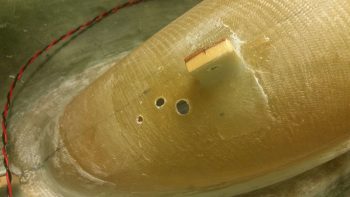
I then broke the wheel pants into its 2 pieces and used the front piece to determine left/right edges of the tire cutout (the one shown below is the left side wheel pant).  As you can see, with our gear struts and wheel assemblies taking up so much room inside the wheel pants, it really pushes the tire wheel pant exit far outboard.

Before making the final tire exit marks on the wheel pant, I verified clearances and dimensions by drawing the outline of the wheel pant onto the cutout template.  This really does help figure out all the wheel pant mounting, since in my case I had planned on using a 1/4″ wood spacer on the inboard side of the wheel pant as called out for in the installation instructions.  However, even though I widened my wheel pants I still felt the outboard wheel pant side was too close to the wheel/tire.  Thus, I changed the plan and went with a 1/8″ inboard spacer to drive the entire wheel pant outboard 1/8″.  Not a lot, but every bit helps in ensuring NO SMILES on the side of the wheel pant!

I then marked the location for the gear strut width-wise.

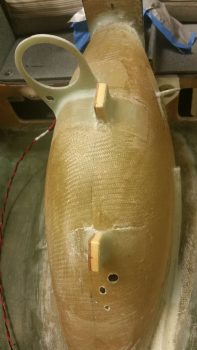
Here are the initial markings for the tire cutouts on the bottom of the wheel pants.  If you want to know what side is what, just imagine the plane flying upside down.

And here are the initial markings for the landing gear strut holes.

Since my inboard wheel pant mount is 1/2″ thick, and the new thickness for my inboard wheel pant spacer is 1/8″, I added a hair for flox and glass and made a foam spacer for each inboard side (R/L) at 0.65″ thick and taped them in place.

After determining and setting wheel pant jigs to match the CL of the aircraft, I then spent the next 4+ hours doing the iterative, trial-and-error: test fit-mark-cut-test fit-mark-cut loop.  But I eventually got both wheel pants dialed in and set in place.  It is truly amazing how much these wheel pants change the entire character of the airplane when mounted in place.

It was getting towards the end of the evening and I had a fair amount of noise to make, so I got to work setting some standard grade 1/4-28 bolts into a drill and then using the drill on the grinder to make some “whack-a-bolts”!  These little babies are threaded into the inboard and outboard wheel pant mounts, then when the time is right… BAM! You whack from the outside of the wheel pant and it makes a nice mark and/or indent (depending on how hard you whack it!) so you know right where your mounting screw hole needs to be drilled.

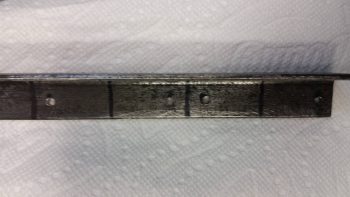
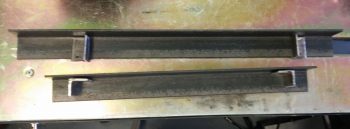
Here are my inboard mounting brackets that I made up a long time ago, using tried and true Neanderthal machining methods! . . . ha!  They need some TLC in the surface smoothing department, but I’ll wait until I have them cut to the specific size and shape for each wheel before I make them look all nice.

I then transferred the bolt hole pattern of the 4 right axle bolts and drilled those out on the right-side inboard wheel pant mounting bracket.  I then drilled and tapped a 1/4-28 hole in the center for the inboard wheel pant mounting screw.

I then threaded in the shorter of the two “whack-a-bolts” into the right wheel pant inboard mounting bracket.

I then transferred the bolt pattern and drilled the four 1/4″ axle bolt mounting holes into the left side wheel pant inboard mounting bracket.  I then drilled and tapped the center 1/4-28 inboard mounting screw hole, just as I did on the right side mounting bracket.

So you get an idea of just what I’m on about with these wheel pant inboard mounting brackets, I mocked them up quickly (just set over top of the axle bolts) to grab some pics of them “in action.”

The one on the right wheel still has the “whack-a-bolt” in it, and the one on the left side has a 1/4-28 mounting screw threaded into it.  Again, I’ll do a lot of cutting, shaping and cleaning on these inboard mounting brackets before their final installs.

Tomorrow will be Day 3 of the 3-DAY BLITZ.  I’m fairly confident I can get these wheel pants pretty much installed.  There may still be a few minor tasks left to do after tomorrow, but the overwhelming lion’s share of the install should definitely be finished!


Chapter 23 – Firewall Final Cleanup

I started out today researching and reacquainting myself with the wheel pant install tasks that I had undertaken about 2 years ago.  I then wrote out my wheel pants install task list.

When I went down to the shop to do some major rearranging before jumping into the start of the Wheel Pants 3-DAY BLITZ, I realized that there was quite a bit I had not yet finished on the firewall.

First off, I pulled the protective tape off the components of the CS123 control bearing floxed in place on the firewall.

Here’s a closeup of CS123 floxed into the firewall.  I realize (yes, after looking at my notes!) that there was a reason I was waiting to do this, and that the plans have you install the actual firewall Fiberfrax and metal sheet in Chapter 15.  Well, I was in Chapter 16 . . . oh, well.  There’s definitely a 6 and 1/2-dozen thing going on here because I really wasn’t ever keen on floxing this thing to a metal covered firewall.  So I’ll deal with the minor inconvenience of mounting the Fiberfrax and firewall sheeting over top and around my floxed-in CS123 bearing.

Here’s another shot with the aileron control tab slid into place. A couple things on the elevator control tab . . . if it looks closer than it should to the lower right engine extrusion, it is.  First off, that’s because the engine extrusion is 1.25″ wide vs. the plans’ 1″ wide.  Thus we’re clearly missing 1/4″ clearance that would normally be there.  That clearance will be attained from both sides giving a little: 1/8″ to be exact.  If you look at the extrusion, the majority of a 1/8″ trim on the edge would be primarily in the tapered edge area of the angled piece of aluminum.  On the aileron control it will just be a rounded little notch that is carefully made in the tab.

I then cleaned up the lower firewall by hacking off the lower longeron nubs that were sticking out of the firewall.

And then sanded them down so they looked like this:

I then sanded the edges of the interior Hell Hole BID tape layups, and worked on the bottom longeron to firewall corners a fair bit.  As you can see, the SD-8 Alternator relay and aileron control tube are looking ok.

I then did a quick test install of the engine mount on the firewall to ensure my efforts were all for a good cause!  Actually, the quick test fit came after a half hour of me chamfering all the engine mount bolt holes on the firewall extrusions, then taking a file to the engine mount to clean up the rough edges on the bolt holes.

The engine mount fit well, although I noticed that the lower right engine mount stub was gapped vertically with the lower right extrusion about 0.030″, and the left the same at about 0.020″.  I think there’s enough flex in all this that they can be cinched up fine without any undo stress, but it is interesting how these things appear after the fact.

Here’s a shot of the left and right side test-fitted engine mount.

Early evening I was finally able to initiate operation 3-DAY BLITZ on the wheel pants.  I got the wheel pants out and put the halves together on wheel pant #2.

I then rechecked the alignment using a laser crosshair on wheel pant #1.

After I got all the axes aligned, I then taped up wheel pant #1 to secure the sides from moving (the sides are so tight fitting that they aren’t going anywhere anyway).  After spending a good bit of time finalizing where I wanted the screw mounting holes situated, I drilled some 1/8″ holes where the screws/CAMLOCs will go and then Clecoed the holes.

Here’s a shot of the aft side of the left wheel pant.

I then aligned, drilled and Clecoed the second (aircraft right side) wheel pant and then snapped these shots:

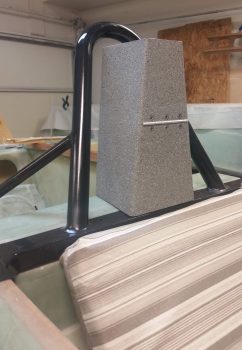
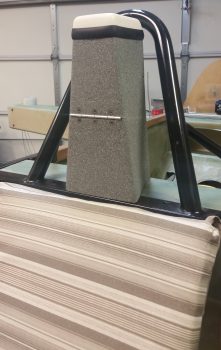
I then drilled a small hole in the CL front and aft of the wheel pants and placed 16 penny nails in the holes.  To ensure the nails stay aligned, I hit them with some hot glue.

I then finished making the mounting jigs for the wheel pants.  For the jigs I’m going with the Wayne Hicks’ style and have screwed-on adjustable elevation tabs both fore and aft on each installation jig.

After ensuring the main gear tires were full of air (70 PSI) I then taped up a 3/8″ foam piece on the top of each of the wheels to serve as a spacer to keep the wheel pant from rubbing on the tire after the pants are installed!

I also set the fuselage at a 1.4° nose up angle as you can tell by the right longeron (left)  and the left longeron (right).

Tomorrow I will continue forward with my 3-DAY WHEEL PANTS BLITZ!


Chapter 16 – Control System Bearing

Since I’ve been hitting the shop hard for the last few days, today was a light on shop work, heavy on research day.  I identified over 90% of my required components to roll my own fire-sleeved engine hoses (thanks Joe Coraggio for the tip on your website!).  In fact, I pulled the trigger on the first of 3 major orders that I’ll be placing for the engine hoses.

I then checked my interior CS Spar Clickbond installation that will serve as a hardpoint for the cable management Adel clamp.  Now, I don’t mean to brag, but clearly as decent as this layup turned out (90% of it in the blind), I need to start doing these things with my eyes closed!!! Ha!

Here’s a wider angle shot that provides a general idea of the entry and exit points for the wires in the cable bundle.

And one last closeup of the mounted Adel clamp.

I then did a bunch more research, but wanted to get something curing overnight.  I had already planned on installing the CS123 control system bearing into the firewall tonight…. so, that’s what I did.  I lined up the aft end control rod with the one that runs along the fuselage sidewall, mixed up some rather wet flox, and then floxed in the CS123 bearing (this is a Cozy Girrrls product btw).

Here’s a slightly lower angle shot.  I also got up into the hell hole and added a flox fillet around the front side as well.  I don’t this thing will be going anywhere with as much flox that’s holding it into place!

Tomorrow I have just a quick couple of sideline tasks to complete and then I’ll move right into my 3-DAY BLITZ on the wheel pants!


Chapter 6/16 – Post Firewall Tasks

I started off today making a paper template that will allow me to fill in the oval cutout of the firewall with 1 ply of Kevlar to add a bit physical and heat protection –as well as some noise dampening properties– to the bare shear web.  To be clear, the CS Spar will be bare during the build then covered with Fiberfrax and 6061 firewall covering (yes, regarding using aluminum as the firewall covering I’ll reiterate that I ascribe to Burt’s design that uses the aluminum as the structural covering for the firewall that also serves to protect the Fiberfrax… which is the REAL fire barrier in this configuration).

I then used my oval firewall template to mark and cut out the ply of Kevlar.

I prepregged the Kevlar ply then laid it up on the bare CS Spar shear web, peeking out of the oval cutout in the firewall.  I used fast hardener so that it would cure as quickly as possible.

I then peel plied the Kevlar ply layup and let it cure well into its green state.

With the Kevlar layup still slightly tacky but cured enough to let me carefully pull of the peel ply, I then created a fairly dry flocro fillet (about 70% micro/30% flox) around the edge to transition the 1/4″ plywood edge down to the surface of the CS Spar for a good glass flow.  I then laid up my prepregged 1-py 1.5″ wide BID tapes around the perimeter, covering the flocro fillet and overlapping onto both firewall face and the ply of Kevlar I had just laid up. [Note that in this pic and a couple below you can see where I flocro-filled the gaps in the “L”-shaped firewall openings around each engine mount extrusion].

Here’s a full firewall view shot of these layups.

To both prep the surface for better adhesion to the 3M high temp RTV that will secure the Fiberfrax in place to the firewall, and to remove the nasty, jagged sharks teeth of death that await unsuspecting fingers and forearms, I peel plied the perimeter BID layups.

A few hours later I pulled the peel and was somewhat pleased with the results.  I say “somewhat” because the actual layups are fine, but I think I allowed myself to fall a little prey to groupthink here in that I have seen this style firewall layup done on a number of Long-EZs.  However, with hindsight being 20/20, if I could go back and do it again, I think I would simple bevel the firewall plywood with a router to provide a simple transition from the firewall surface to the CS Spar.  Although I used somewhere between a paste to dry flocro, it still added more weight than I would have preferred, even though I tried to balance weight vs strength.   Oh, well. It’s done and I’ll press on!

I then set my focus on installing a Clickbond on the right inside edge of the oval opening of the CS Spar to be used as an Adel clamp hardpoint.  The Adel clamp will secure the wires transiting from above the CS Spar to the Hell Hole, keeping them both secure and out of the way of the opening to allow for placing stuff into the spar and removing it without getting hung up on loose wires.

As per normal, after I sanded the surface and 5-min glued the Clickbond in place, I then laid up 2-plies of BID over the Clickbond and peel plied it.

My final official build task of the evening was to finalize the install of the right side flight controls to the mini-bulkheads in the front and GIB side consoles (CS109 & CS118).  I gathered up all the hardware per plans and then bolted the bearings in place, again to the CS118 mini-bulkhead aft . . .

and to the CS109 mini-bulkhead up front.  I’m using the Cozy Girrrls control system hardware, so their bearing assemblies at each end of the control tubes may be less thick than stock, because the AN3-7A bolts called out for in the plans are a bit too long in my book.  But again, they work and the control system is installed, so a short thought to ponder.

I have a few more minor tasks to complete tomorrow and then I will be moving into –either tomorrow or Monday– what I’m going to call the “3-DAY BLITZ” (….key dramatic music!), whereupon I will be solely focused on FINISHING UP THE WHEEL PANTS INSTALL.  Yes, I just said THAT!  . . .  In short, I want to get some of these half-finished mini-projects off the list of things to do and on the finished column.


Chapter 6 – Finally Complete!

Only 7 years to get it done . . . not too bad!  Haha!

I started off finalizing the install of the remaining Hell Hole components before installing the firewall.

The first order of business was shaping the last bit of 3/8″ aluminum tubing for this airplane to finish up the fuel lines from tanks to firewall.  I had to shape and terminate 2 lengths of tubing with AN -6 fittings on each end.

I started on the backwards question mark looking piece that is the final run of tubing before getting attached to the firewall pass-thru fitting.  I try to avoid right angles on my fuel lines (not that it would matter that much here, honestly… I just didn’t have any fittings on hand) so I made this swooping loop with shallow right angle curves.  With this done, it would determine the length of tubing required for my cross connect between the FT-60 Red Cube fuel flow meter and the 30 micron filter (required by Silver Hawk fuel injection system).

The tube cutting, bending and flaring process went without event, and I must be getting decent at this stuff because these two lines are the only ones I made: as in no extra pieces of mangled tubing scattered on the floor . . . not that I haven’t done that before!

In the first piece below, you can see a black dot on the wood cross piece I clamped in place to simulate the inside surface of the firewall.  This dot was my target end point for the tubing and for placing the fuel line firewall pass-thru fitting.  I was fairly close on my final configuration.  BTW, as you probably surmised, the wood cross piece is to simulate the firewall not only for guesstimating the fuel line exit point, but also to ascertain the depth required to give me the proper tube length between FT-60 and filter so that the fuel filter Adel clamp would be positioned up against the forward side of the firewall for mounting.

With the fuel line and filter in place, I then verified that the SD-8 relay and fuel filter could coexist in the same area . . . which they can quite comfortably.

Speaking of the SD-8 B/U Alternator relay, as you can see I permanently mounted it in place under the CS Spar.  After I took this pic (and video) I then taped it up to protect it from any errant epoxy when I mounted the firewall in place with BID tapes just aft of the relay.

Since it was a quick kill, I terminated the big yellow ground cable with a ring terminal for eventual connection to the big brass bolt that goes through the firewall…. with the engine ground strap attached on the hot side of the firewall and the forest of tabs on the cold side.  [I can’t do this with the starter power lead since it will need to get run through the small stainless steel firewall fitting first before it gets terminated].

I slipped on an appropriate label and hit it with the heat gun, then a short length of black heat shrink to cover the crimp.  Then I clamped this baby up tight in the vice!

I then finished off the crimp with some heat shrink.

And Voila!  The final terminated big yellow ground cable that gets bolted to the forest of tabs post inside the Hell Hole.

Then, to cover all my recent lower engine mount extrusions, engine mount, Hell Hole wiring and components installs, I made up a short (kinda) video to provide an overview of what I’ve been up to.

I then snapped a couple final official shots of my bird sans permanently mounted firewall….

The pics above were actually taken after my initial task of cutting and micro’ing into place a small piece of foam filler on the lower aft end of the left fuselage sidewall.  Again, since my fuselage is much more football shaped than a stock Long-EZ, it really places each end sidewall mating surface –that would normally mount near-perpendicular to the front face of the firewall– at a more significantly oblique angle to the firewall face.  To account for these odd mounting angles, it requires some more judicious filling with foam, flox, and micro.

It took me yet still another hour+ to get the prep finished before I started mixing my first batch of epoxy.  I then set about mixing a boatload of flox to get all the interfacing surfaces covered before clamping the firewall into place.

It took a bit, but once I got the firewall set in position I then laid up my prepregged 2-ply 2″ wide BID tapes (boy, it’s been a while since I dealt with BID tapes!), starting on the top CS Spar to firewall junction across the spar in-between the top engine extrusions.  I peel plied this layup since I would be in the D-Deck/GIB headrest compartment a fair bit and decided to forgo having my hands ripped to shreds with wonderful invisible glass spikes.

I then laid up the 2-ply 2″ prepregged BID tapes on the bottom side CS Spar to firewall corner, and both the left and right corners.  As you can see, before I did any of the BID tape layups I added a flox fillet to each corner.

A bit wider angle shot of the lower CS Spar edge 2-ply BID tape to the front side firewall.

Here are the corner BID tapes.  After I reviewed these pics I went back in and cleared out a couple of those air bubbles.

I then spent well over an hour tweaking and cleaning up the flox gunk from all over the firewall.  All in all, a step that I thought would take 2-3 hours at most [I mean, com’n, we’re talking 4 BID tapes here… ] ended up taking about 6 hours!

As you can see, I used a cargo strap to pull the lower firewall in towards the fuselage to align the firewall top to bottom.  In actuality, the bottom is pulled closer to the fuselage by about 0.050″ to 0.060″ (<1/16″) to compress it tighter with the lower aft fuselage sides. This action squeezed out a decent amount more of flox so helped minimize weight just a tad more.  Plus, once all the lower cowling attach joggles are glassed in, it will be near impossible to tell that the lower firewall is set/angled forward less than 1/16″ of an inch more than the upper firewall.

And here she is: the attached firewall! Woo-hoo!

Tomorrow I’ll sand, flocro and glass the edges of the oval with 1.5″ 1 ply BID tapes to both secure the firewall more to the face of the spar and to help seal it up.


Chapter 9/22/23 – Hell Hole Final Prep

Final prep for installing the firewall that is . . .

I started out today by drilling a hole inside the CS Spar floor down at an angle from outboard to inboard so that the wiring coming up from the Hell Hole would better follow the contour of the side of the oval opening in the CS Spar.  My goal is to have the wires accessible and situated just inside the CS Spar oval opening.

I drilled only through the top layer of glass and then spent almost a half hour digging out as much foam as I could get to, which if you look at the circular empty cavity next to the hole as visible due to a light placed below, it’s roughly the same size as the AN970-4 washer next to it.  That’s quite a solid hardpoint considering this foam is 1″ thick [As a point of note I used Divinycell for the spar vs the Urethane called out for in the plans… so slightly heavier spar, but inherently stronger].

I filled this cavity up with about a 60/40 mix of flocro, slightly heavier on the flox, and let it cure before drilling out the hole all the way.  In addition, I concurrently laid up a 2-ply BID pad measuring 2″ x 4″ on the underside surface of the CS Spar in the Hell Hole that encircles this hole (I didn’t get a pic of that layup…)

While the stuff above cured, I then pulled the wing lights’ wiring harness back out to wire lace the wires.  Once finished I reran the wiring harness through the CS Spar.

I stopped the wire lacing just shy of each end of the CS Spar (cable lace shown by red arrow).

Here’s the right side wing wiring harness cable laced, draped over the left fuselage side.

I then cable laced the wing wiring inside the Hell Hole and secured it to the seat back via my plastic wire tie-down points.  The loose wire at the top apparently got away from me and at the angle I was working at I simply didn’t see it until I looked at this pic!  No worries, I’ll simple secure it as well.  I will say that where that loose wire is located is where I was aiming to put the wire tie-down points before the seat “reached out” and grabbed them! Still, the setup works fine and all the wires are nice and secure.

I then test fitted the big power wire runs through the Adel clamp on the bottom side of the gear leg pad.  This configuration works really well in keeping the wires from possibly getting pinched or damaged.

I really like this configuration as it looks like it will work really well in keeping the wires from getting gnawed through from any vibration…

especially at the transition from Hell Hole into the cockpit via the access hole in the GIB seat bulkhead.

I then did the final install on the FT-60 Red Cube fuel flow transducer.  After torquing both AN4 mounting bolts and the -6 tubing AN fitting nut, I applied orange torque seal to the -6 AN fitting.  In hindsight I should have applied torque seal to the AN4 bolt heads as well, so I noted that needs to be done.

Here’s a shot of the final mechanical install of the FT-60 Red Cube fuel flow transducer.

I then added cable management Adel clamp #2 to run the 3-wire cable from the Red Cube fuel flow meter upwards.  Again, I situated the Adel cable management clamps in their locations to not only keep all the wiring wrangled, but specifically to keep the wires off the aileron torque tube that traverses this part of the Hell Hole.

I then ran the 6-wire cable from the Instrument Panel along the fuselage sidewall, through the wire routing Adel clamps in the Hell Hole and up through the lower wire access hole in the CS Spar.

This 6-wire cable contains wires that interface between the EIS4000 in the D-Deck and panel avionics.  Here the 6-wire cable is heading up towards the D-Deck/GIB headrest. Note that this hole will serve as the sole remaining access hole on the lower CS spar plate for all wires heading to & from the D-Deck/GIB headrest-based components.

I also did a final install on the oil heat return line Adel clamp.

I then spent well over 2 hours shaping, cutting and installing the 3/16″ stainless steel brake line tubing that runs through the plastic tubing channel that I glassed into the gear fairing, situated on the TE of the original gear bow.

Shaping the right side brake line was a little trickier because I had to go up, over and around the big yellow power cables.  I had considered looping aft and below the cables, but I wanted as little brake line as possible hanging out unsecured in free space.  So I went up and over the big yellow cables.  I spent well over 2/3rds of my time working these brake lines on this right one.

The left was significantly easier, although bending stainless steel is not the easiest, daintiest of endeavors to undertake –especially when small bends or curves are required on a small length of tubing.  But through persistence I finally got both stainless steel brake lines routed through the gear legs and installed in the 3/16″ to 1/8″ Bi-Lock reducers (thanks to Dave B. for the gouge on those!).

All that is left now (although not a significantly EZ task) is to cut these lines near the wheels and cross connect them to the 9.25″ long -3 stainless steel hoses that are the final link in the brake line chain.

I then did the final install on the oil heat pump on the bottom centerline of the aircraft.  I like this pic below because it shows the oil heat pump, finished right brake line and secured big yellow power cables.

I had to spend a bit of time cleaning cured epoxy off the ends 2 of the 4 bolts hanging down from the oil heat pump, but after that I was able to bolt the pump in place EZ-PZ.

With all the Hell Hole prep work that I was able to finish today, I think I should be able to get the firewall mounted tomorrow…..  Inch by inch gettin ‘er done!


Chapter 22/23 – It’s the small things….

Today’s build efforts were marked by a lot of trial & error test fits, measuring and mock-ups in an effort to get all the Hell Hole components integrated and playing nicely together in a rather small area.  If you’ve ever seen the TV show, Monk, you can get sense of my emulating Tony Shalhoub “feeling” a crime scene in my efforts to figure out placing components in the Hell Hole. Ha!

My first required piece of information before I started mixing epoxy was to figure out how I was going to route the big power cables coming from the nose: either above or below the main gear bow.  My initial thought was above the gear bow but I just couldn’t get the bend right on the big power cables to miss the sharp edge on the forward gear mount extrusion.

My test run of the big power cables below the gear bow proved much more successful in regards to not having any sharks’ teeth in the way of hard edges at the ready to gnaw through one of these big (which means important! right?!) cables.

Moreover, having to remove and install the big power cables in an Adel clamp in the access hole at the base of the GIB seat bulkhead exposed yet another potential gnawing issue on the rather sharp outboard access hole edge.  Thus, I spent a good 20 min with some Perm-A-Grit tools and my mini German hack saw to create a nice round cable-shaped edge in the corner to alleviate any future pain & suffering to my outboard positioned big yellow cable.
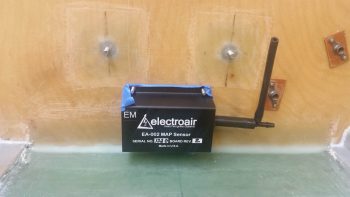
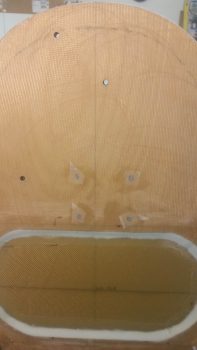
I also test routed the return line for my oil heat system a half dozen times to get the right position for the Adel clamp Clickbond hard point.  Not only does the Adel clamp secure the oil return line, but it will keep it pressed downward a hair to also avoid the left front mounting extrusion of the main gear.
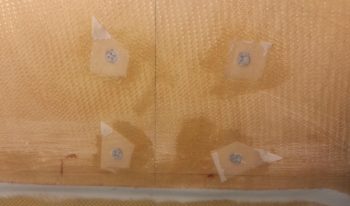
With my Adel clamp positions –and thus my Clickbond hardpoint positions– known, I pressed forward with setting them in place with 5 min glue.  Below is the left side oil heat return line Clickbond on the left aft side of the GIB seat bulkhead.
I then glassed it with a 2″ x 2″ 3-ply BID pad….. peel plying it of course.

Here we have the oddly positioned Adel clamp Clickbond hardpoint for the 2 big power cables.  I placed it on the corner like that to best angle the cables so that they are positioned well for mounting to or traversing through the firewall.  In addition, I wanted to minimize the added depth directly below the gear bow here to just the thickness of the cables, and not add the thickness of a bulky Adel clamp.

I cheat a bit when it comes to glassing on the gear pads or gear bow and add an extra ply or two, as well as making them oversized, just to take the opportunity to add a bit more oomph to main gear strength.  Here is a 4-ply BID pad for the Clickbond that covers about 3/4 of the existing gear mount pad.

With the leftover epoxy I whipped up some thick micro and filled in some open blemishes on my brake line loops… and then peel plied the micro.

I still had just a bit of epoxy left over (I always seem to make a bit too much when I just get back into glassing after a long hiatus) so I glassed in a 2-ply BID pad that I had planned to put in around the final wire access hole that I’ll drill into the inside floor of the CS Spar.

Here’s the 2-ply BID pad after I removed the peel ply a couple hours later.  Tomorrow I’ll glass a 2-ply BID pad on the underside of the CS Spar in the same area.  When the hole gets drilled I will be digging out the surrounding foam and creating a flox hardpoint around the hole to reinforce any strength that may be lost in creating the hole.

With my shop work done for the evening I headed upstairs to do the final -6 45° AN fitting install on the FT-60 “Red Cube” Fuel Flow Transducer.  I wanted the fitting clocked more aligned to the side marked with “FF” but it was just too loose in that position. I checked to see if I had any more -6 45° AN fittings on hand, but I didn’t. So, I took it down to the Hell Hole and checked to ensure there was enough clearance with the fitting situated as it is more up than slanted straight inboard.  The clearance is fine –I’m using a 45° fitting to more easily clear the aft main gear mount– but it will mandate that I get a little more creative with my bends on the 3/8″ aluminum fuel line run to the filter.  (I also constructed 2 of the 3 connecting wires for the fuel flow meter).

Also pictured is the brass fitting that I picked up from Airflow Performance when I ordered my Sniffle Valve.  It looked as if it had a lower profile than the 90° barbed brass fitting that I had on hand for the mechanical fuel pump overboard vent port.  In comparing the two fittings, this one looks like it will be a bit more shy and protrude out about 0.15″ less than the barbed brass fitting.  Yes, not much, but when we’re talking engine to firewall clearance, every bit helps.  Since I had the Loctite 567 out, I went ahead and installed an aluminum barbed fitting into the right angled brass fitting.

Lastly, I figured I would provide a glimpse inside my “evil lair” at what I call poor man’s CAD: paper, pencil, ruler and an eraser!

My final act of the evening was to update the external aircraft lights electrical diagram. Tomorrow I’ll continue my quest to wrap up the Hell Hole configuration so I can get the firewall installed.