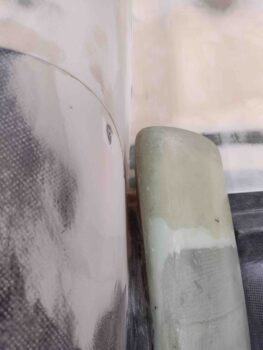
Chapter 25 – Left wing prep for micro

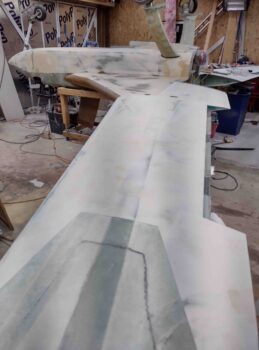
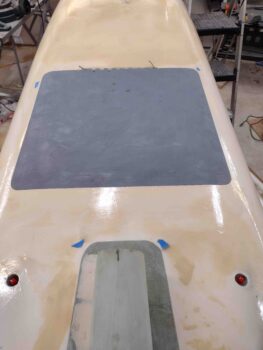
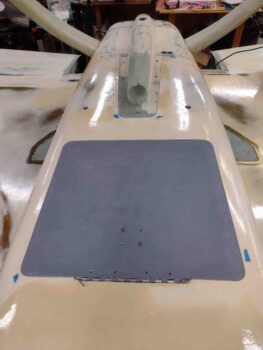
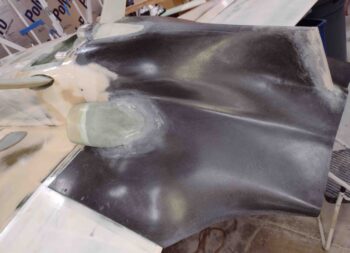
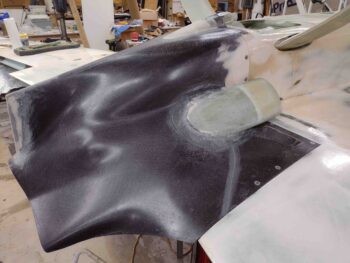
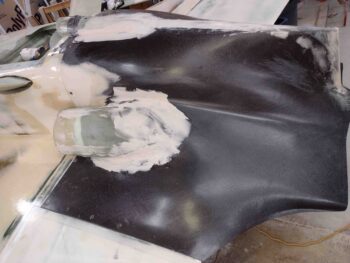
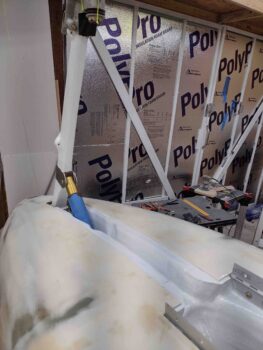
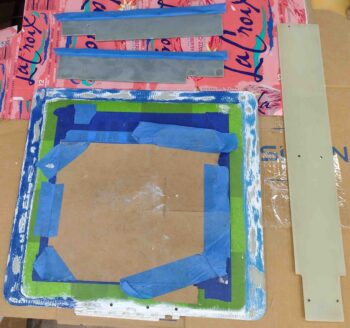
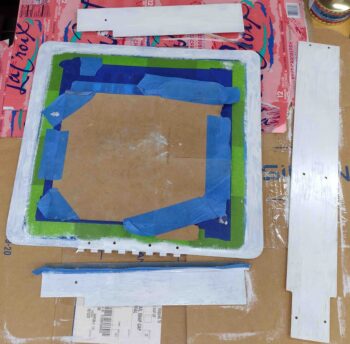
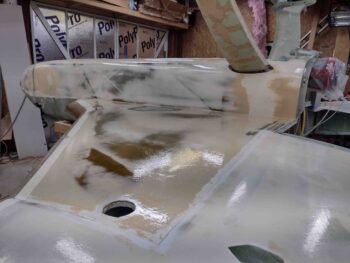
So today, all total, I did about 5 hours worth of sanding.

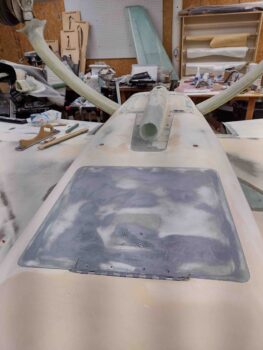
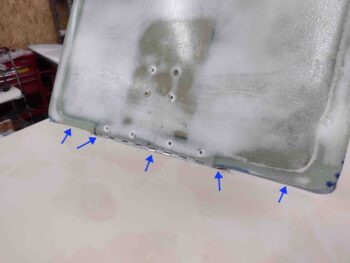
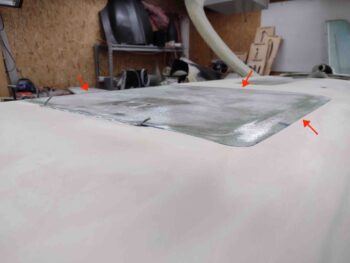
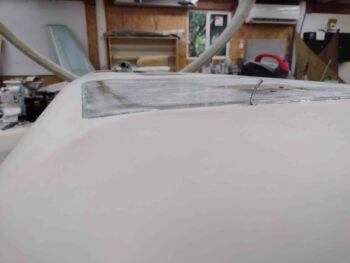
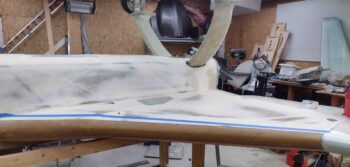
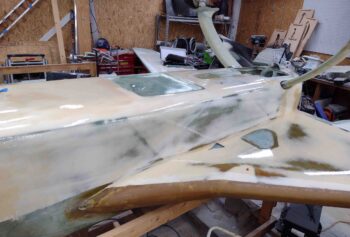
First off I sanded the bottom of the left wing, then cleaned and prepped it for “micro” (West 410/micro) finishing. That all took a bit over 3 hours.

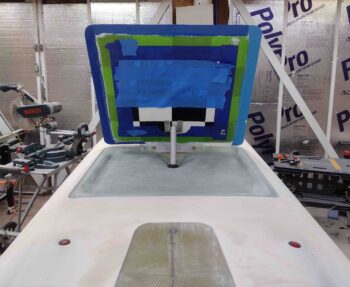
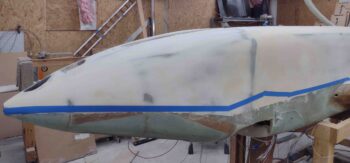
After spending nearly 2 hours (re)sanding the latest bottom/forward fuselage and nose “micro” finish refill, I then removed the tape around the edges of the landing brake and razor knifed the edge seams again.

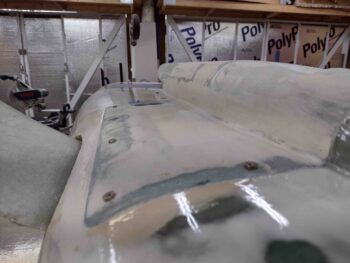
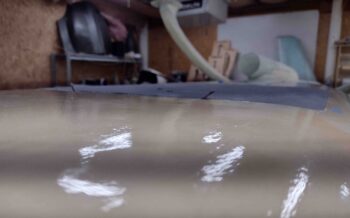
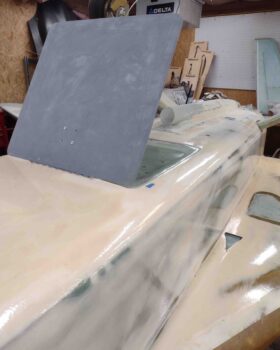
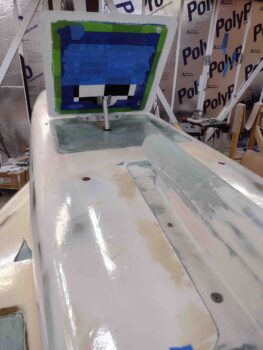
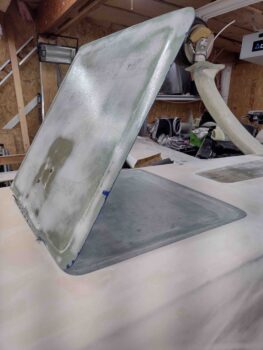
I then lowered (obviously “raised” as inverted) the landing brake and tested out the edge clearance with the micro fill by opening and closing it a few times.

I didn’t want to start the micro fill on the left wing since I knew it was going to take a minimum of 3 hours, and it was already later in the evening, so I plan on hitting that tomorrow.

Chapter 25 – Is this the end??

Admittedly it’s getting kind of hard for me to stay on track of my fill and sand iterations on the bottom/forward fuselage and nose “micro” fill.

Today I spent a few hours sanding the last big fill (#2) and dialed in the surface, shape and contour a lot closer to final.  I’m very happy with the shape, but again I have been failing in regards to the objective of the “fill once, sand once” method.  But as I’ve noted previously, the good news is that by using West 410 it forgives the sin of refilling and allows the “micro” finish to be nicely faired in and blended with the previous fill.

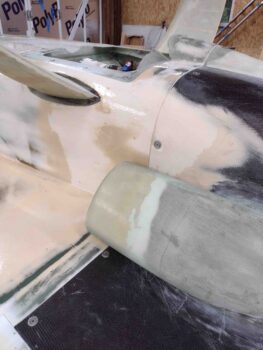
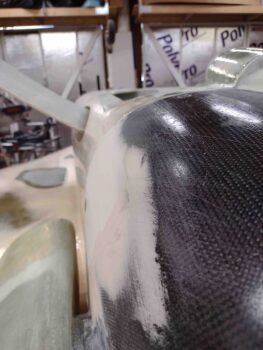
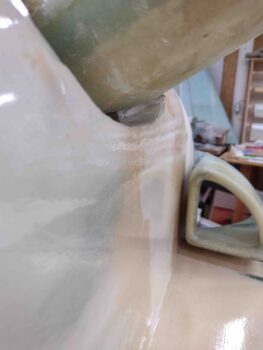
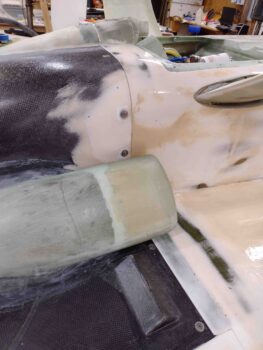
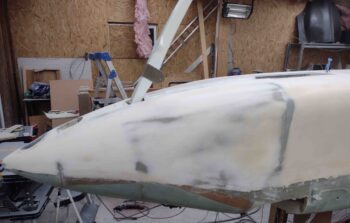
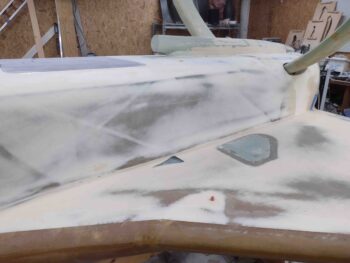
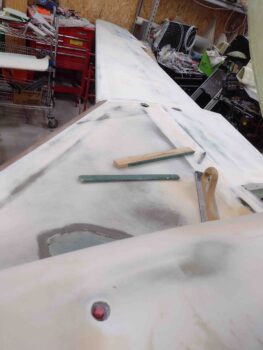
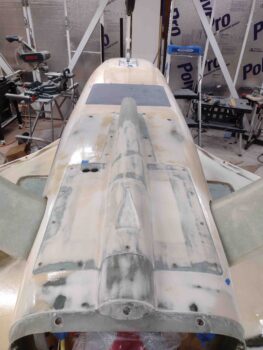
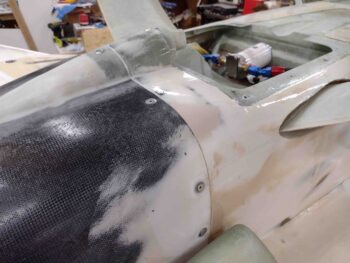
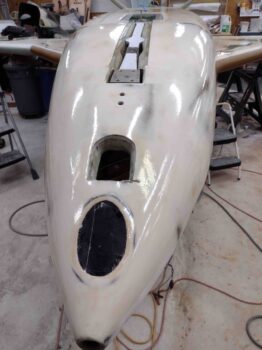
These pics are of the sanded and contoured bottom/forward fuselage and nose, with the next round of straight West 410 “micro” fill.  This last fill was much smaller, about 3 pumps of the West epoxy/hardener and only one batch.  Some of the patches you see aren’t even “required” but since I had a decent bit left over, I filled in some of the smaller holes and scratches.

I did have some decent-sized divots in the bottom center area of the fuselage between the nose gear doors and landing brake.  Clearly part of filing in some depression and divots in this area came with a skim coat to help ensure all the surfaces were covered adequately.

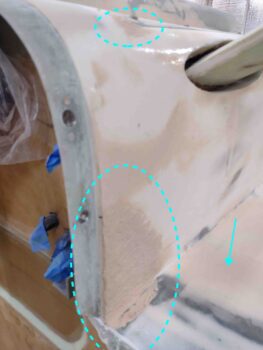
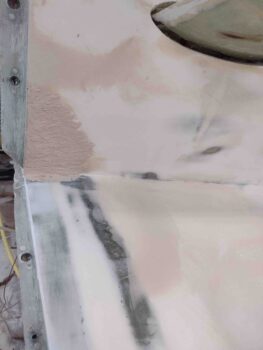
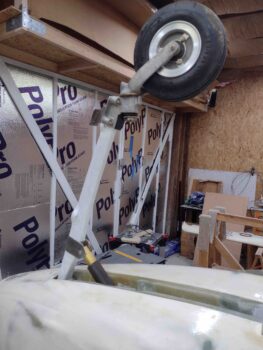
In addition to the forward area, I am very pleased with how my surface fill came out on the area forward of the left gear leg on this fuselage bottom “corner.”  This area was a bit low and depressed compared to the curve and flow of the bottom fuselage “corner” leading up to it.  As you can see, the dark splotch is fresh West 410 to fill in one small divot, which helps eliminate any extra epoxy required to fill it during the upcoming epoxy wipes.

With all these sanding sessions I haven’t been engaging in as long of build days that I would normally do. I’ll admit that multiple hours of sanding a day are enough for me and have been getting me good and tired.  So I’ve been trying to knock out some personal stuff on the side, especially to keep my shoulder from tiring out and aching…. slow and consistent is the mantra on this finishing!

Chapter 25 – Final fuselage refill

Today I was able to knock out the final forward/bottom fuselage and nose West 410 “micro” big refill.  Yes, that’s right sports fans, I used only West 410 “micro” on this round.

I suspect I’ll have one more round to fill in any minor divots or depressions, but that will not require mixing up multiple batches of this stuff to slather all over the place.

One significant area I’ll point out is the lower fuselage “corner” just immediately forward of the left main landing gear.  This corner was a bit thin with micro fill and was fairly noticeable with the naked eye, so I added a bit more micro fill to create a nice continuing curve along this lower “corner” of the fuselage from nose to firewall.

With that, I took the rest of the day and evening off to do some well-earned relaxing.

Chapter 25 – Fuselage finish, Round 2

Yesterday I actually knocked out the next major fill on the forward/bottom fuselage and nose area “micro” finish.  However, I failed to get pics of that fill in raw form… and didn’t realize this until after I sanded down the refill today.

Also, to be clear I still used a mixture of West 410 and standard micro for the refill.  I wanted to test this mix to see if it was viable to use for subsequent fills after the initial fill… it really seems to work fine and I didn’t have the problem of blending and fairing in softer new micro vs older harder cured micro.

I will note that it was NOT my intention to get into a traditional “sand and fill” finish process on any surface of this plane, but I was admittedly way low in my filling of some areas of the fuselage and nose…. again, mainly those areas on the sides around the F22 bulkhead, and the bottom area in-between the nose gear doors and the landing brake.  The rest of the areas requiring refill were just much smaller and manageable divots, troughs or depressions that simply didn’t get enough fill on the first pass.

Again, here are pics of the re-filled and re-sanded forward/bottom fuselage and nose areas.

I have to note that I failed yet again to get full coverage on this initial RE-fill of the “micro” finish and will need to do a final round of heavy refill to get the micro/410 to the level I need for a final smooth contour of the forward/bottom fuselage and nose.

But it’s late so I’ll do that refill tomorrow.

Chapter 25 – Sanding fuselage/nose

I started today by cleaning up the edge channels along each hinge on the nose gear doors.

You can get an idea what these edge channels will look like from an angle with the nose gear doors closed.  Keep in mind that they’re a bit higher than they will be after the micro gets sanded down to its appropriate surface level.

After razor trimming the aft and front edges fo the landing gear doors, as well as along the nose gear strut fairing, I then “dropped” the nose gear a little at a time to break the edge seals of the micro finish on these components.

Here we have the nose gear doors back in the open position, with the edge channels providing just the clearance required to allow that to happen.

I then got to work on the landing brake.  With the landing brake secured in the closed position, I took the opportunity to sand the majority of the external surface for micro finish application in the near future.

I then razor trimmed around the perimeter edge to free up the landing brake from the micro finish.

And slowly “lowered” the landing brake.  I had to work this aft corner a bit to get it clear so the brake could open, but after a few rounds it opened right up.

I then focused my attention on the forward hinge area of the landing brake and the clearance there with the micro finish.  I had to do a little bit of extra cleanup, but it all looked pretty good.

Here’s another couple of shots with the landing brake open, and the new pocket or depression created by the micro finish around the landing brake when it’s in the closed position.

And a closeup shot of the landing brake perimeter edge created by the newly applied micro finish.

I then spent over a couple hours sanding down the forward/bottom fuselage and nose micro finish.

I’ll note that where I applied the micro a bit too thick on the bottom right strake skin, here on the bottom/forward fuselage and nose I actually applied it a bit too thin in a number of spots.  By using the West 410 this is not nearly as dire of a situation as if I were using straight micro since the refills blend and fair in much more easily than re-applying straight micro.

Here’s another shot from the other side.  Forgive my messy shop… you see, I’m building an airplane and trying to keep that the true priority!

I’ll also note that the main areas needing refills on the “micro” finish are just forward and aft of the F22 junction on the side of the fuselage/nose junction; also the fuselage “corners” for a bit more meat for that bottom corner curve; and finally, the area forward of the landing brake and aft of the nose gear doors [since the raised nose gear doors and landing brake leave a slight depression on the bottom fuselage that needs to be addressed].

My schedule didn’t allow for me to get to the reapplication of micro this evening, so I’ll knock it out first thing tomorrow.


Chapter 25 – Fuselage cake frosting #2

Today I was finally able to finish the prep on the landing brake and the nose gear fairing and doors to start “frosting the cake” on the bottom/forward fuselage and nose.

I started out my adventure by leaving the nose gear down (up, as inverted here) just a bit so the taped gear doors would be in the open position.  Then I whipped up some flocro with some fast (West 205) hardener and laid it in along the edge of the open nose gear doors.

This of course was to create a hard edge and gap along the gear doors so that when they open the outboard edge of each gear door is resting on the original fuselage/nose bottom surface.

I then prepped the West 410/micro mix (rough 3-4:1 micro to 410) and started filling in from the aft section and around the landing brake going forward.  I did a number of rounds of fill before I got to the nose gear door area, at which point I simply “raised” the gear into the stowed position.  With the fast 205 hardener used on the flocro along the gear doors, by this point it was nearly fully cured.

I then continued the fill —for over 6 hours total— on the bottom/forward fuselage and nose.  As you can see I went fairly high up on the sides of the fuselage so I have a lot less work to do when I flip this bird back upright.

I also got a good fill around the very forward nose-positioned landing light and think it will turn out pretty darn nice when I sand this out.

With that, and a round of cheese-grating that I got no pics of, I left this “micro” application to cure overnight.

Chapter 25 – Fuselage finish prep

Today was all about prepping the forward lower fuselage and nose for micro finish.  I spent well over 3 hours sanding these areas in prep for micro-finishing.

Then, after taping up the outer edge, I re-installed the landing brake onto the bottom of the fuselage.

Another shot of the taped up landing brake.

My battery was quite low from having previously operated the landing brake and from running the gear up and down to dial in the nose gear doors, so I pulled it and put it on the charger overnight.  Tomorrow I’ll close the landing brake and have it in position to create a micro edge and transition around it.

My plan tomorrow is to get the micro finish complete on all the areas I prepped today.

Chapter 22/25 – Ancillary Finish Tasks

I started out today by applying primer to the outer perimeter of the inside of the landing brake. I then set the landing aside for the primer to cure.

I then took the nose gear doors and the nose gear strut fairing outside and sanded down the flocro to shape.

Once I was happy with the sanded flocro shape, I then hit these components with the first of 5 epoxy wipes.

I then knocked out another task I had on my pre-fuselage flip (back upright) list, and that was to actually finish the floxing and glassing of the armpit intake scoops on the bottom engine cowling.  There was about a 6″ strip of the scoop flange on each side that was secured to the cowling by flox, but not by any glass.

So I sanded down the area, added a bit more flox, laid up a ply on each, and then peel plied the layups.  Voila!  Here we are:

Another task I wanted to get knocked out was replacing the oil heat pump OUT hose attach fitting.  As you can see in the pics below, the straight fitting was causing the hose to pull towards the front side of the fitting.  Of course it’s not good to have this type of stress on a hose over time, so I ordered a 30° fitting and it came in today.

Here’s a closer up look of the oil heat pump OUT hose attach fitting.

I then dismantled the existing straight fitting.

With the resulting ragged looking hose end… usable, but not overly attractive.

I then test-fitted the new fitting to get an idea of how the hose would sit.

Since the hose is mounted inside the fuselage all nice and secure, I didn’t want to go through all the hassle of removing it just to add a fitting.  Thus I bought this neat little “Koul Tool” kit that is actually made to make it easier to add hose-ends to hoses still using a vise. However, I am using it here as a funnel (which is essentially what it is) to easily get the hose end fitting onto the hose.

And Voila!  Yes, the red piece looks the same as above when I dismantled the straight hose end, but this is actually part of the new 30° fitting (pic #2).

After installing the new 30° hose end fitting, I realized the hose was a tad too long and was bunching up a bit more than I wanted it to.

So I removed the fitting and trimmed about a half inch off the hose.

I then reinstalled the new hose end fitting, finagled the angle a bit and all was good.  No more stress on the hose!

As a bit of prep for clearing off the nose for the coming soon sanding for micro-finish, I removed the cool nose bumper that Marco made me many moons ago.

Also, every hour or two all day I knocked out epoxy wipes on the nose gear doors and the nose gear strut fairing.  Here is the last of 5 epoxy wipes, and my last task of the evening.

With the epoxy wipes done on these components, I called it a night!

Chapter 25 – Paint Prep, etc.

Today was yet another lackluster day on the build due to me helping a friend with getting their car fixed, which burned up a few hours.  That being said, I did still get a few significant things done.

First, I was able to flocro up the nose gear doors and the nose gear strut fairing.  I then set them aside to cure.

Next, I whipped up some straight West 410 “micro” fill to apply to the divots and deep scratches on the bottom right strake “micro” fill.

I then carefully pulled the protective tape from the perimeter of the interior landing brake and carefully taped up the inboard perimeter of the now painted area.  This obviously leaves the outer edge to be primed then painted.

Which leads me to the paint itself.  I spent well over an hour reviewing the painting process and procedures for the Epifanes 2-part polyurethane paint system that I will be using.  I specifically focused on getting the process dialed in for applying primer to the landing brake outer edge that I just exposed, before taping up the interior paint surface to protect it.

With that all in the bag, I called it a night.
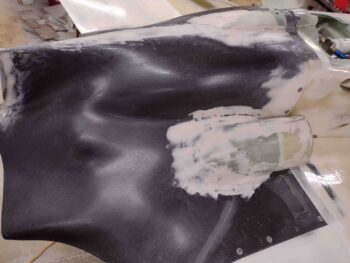
 

Chapter 25 – Bottom right strake sanded

I started off the work day today by cleaning up the checkerboard lines and touching up the red lettering on the landing brake, all with a very fine brush and by free-handing it.
I then let the touched-up/cleaned-up landing brake paint dry for about 20 minutes before taking it outside and spraying on 3-4 coats of clear… and yes, gloss clear coat.  I want this thing to be shiny, glossy and loud, kind of like the fixtures in a big city like New York or Paris that have been painted a million times with shiny, glossy paint.  BTW, I had taken both pics from different angles for the varying light reflection and just decided to add them both so you can see the “glare” variances… keep in mind this will be under the plane!
I then spent about a half hour final sanding the left bottom strake finish fill.  After the final sanding I whipped up some West 410 “micro” and applied it to the areas in need.

Here’s another shot of the left bottom strake West 410 “micro” fill.

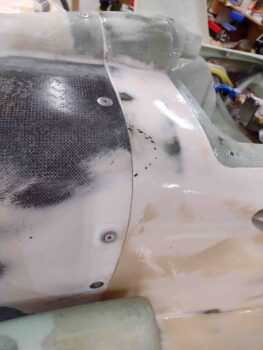
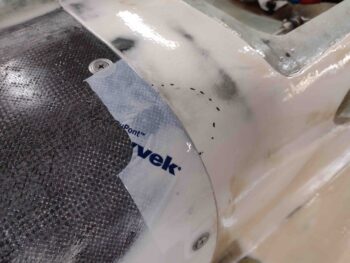
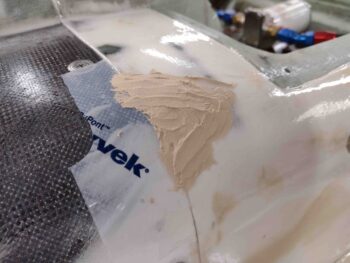
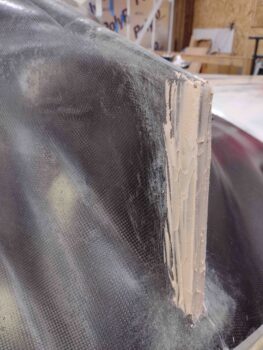
I had also taped up certain edges on the RAM air scoop/hell hole hatch cover to repair the bottom fuselage raised lip/edge in some areas.

I then got to work on sanding the straight West 410 “micro” fill I completed last night on the right bottom strake.  Remember, I slathered it on fairly thick, and it allowed me to learn an important lesson this evening: it doesn’t matter if it’s “EZ-to-sand” West 410, when there’s a lot of it piled high on the surface it’s going to take a lot longer to sand… about 2.5x longer than the left strake to be exact! (that equates to over 2.5 hours)

The good news is that it’s finished.  It looks and feels good, but will still require some subsequent straight West 410 “micro” fill tomorrow.

Here we have another shot of the sanded and contoured right bottom strake West 410 micro fill.

I was beat from all the sanding tonight, and it was getting late, so after I got the right bottom strake sanded I called it a night.