Chapter 23 – Induction shenanigans

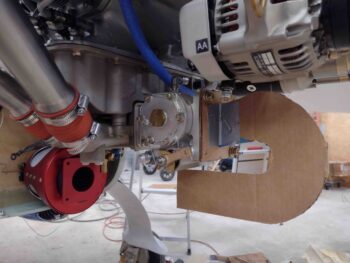
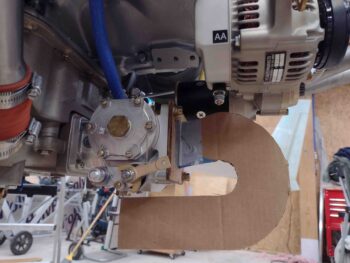
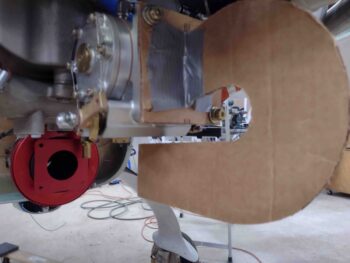
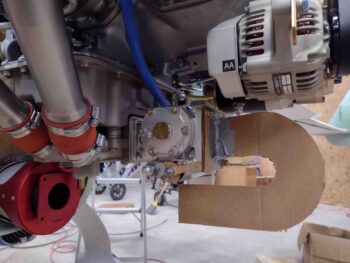
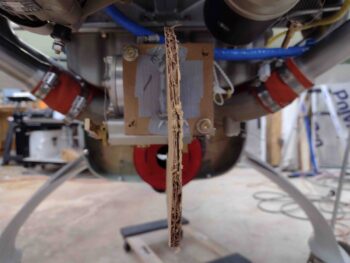
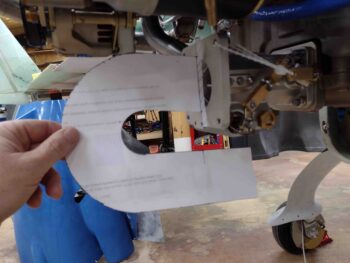
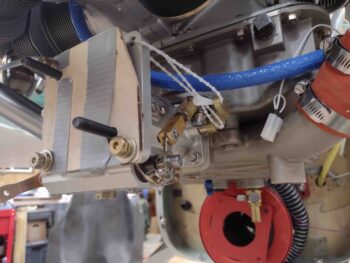
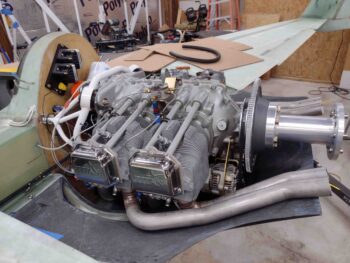
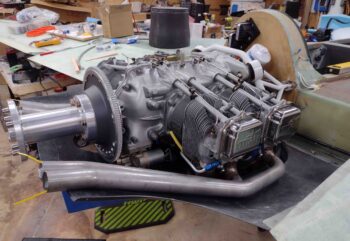
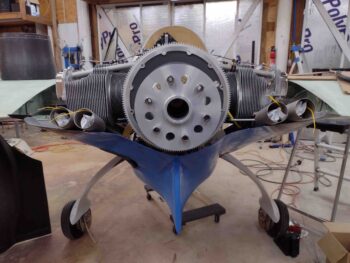
I started off today by re-mounting the trimmed cardboard air induction tube mockup in place on the aft cardboard plate already in place on the aft face of the fuel injection servo.  Note that pic #2 shows the targeted mounting flat for the probable move of the fuel injection flow divider to the underside of the engine.

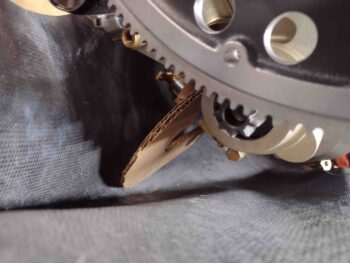
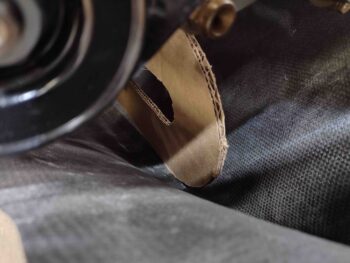
I then put the bottom cowling back on to check the clearance between my cardboard air induction tube mockup and the inside bottom of the cowling.

The good news is that there is actual clearance, the not so great news is that the clearance I got with cardboard tube mockup version #2 was just a hair over 1/8″.

Yep, a game of compromises . . . .

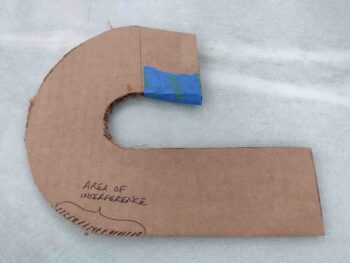
I completely redrew and made up another cardboard mockup for the cold air induction tube for my 180º turnaround into the fuel injection servo.  I cut another 3/16″ off the tube at the entrance into the FI servo, pushing the entire tube forward 3/16″.  Trimming here helps since the bottom of the cowling slopes downward as it goes forward.

In addition, I reduced the radius of the curve by 0.08″ to 1.92″ vs. my original 2″ radius, which I copied from the Airflow Performance elbows bolted together.  Again, compromises.

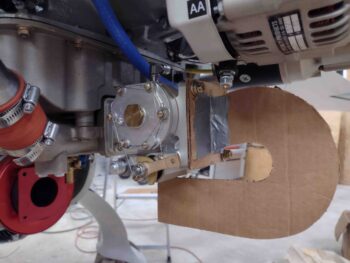
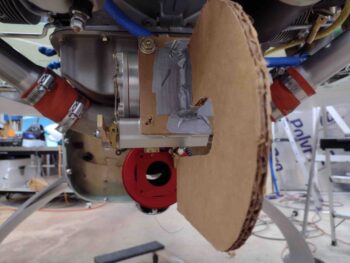
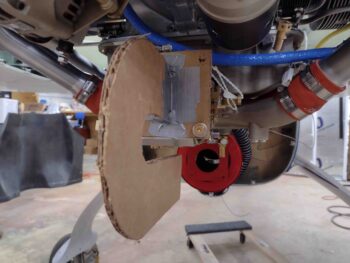
I then reattached my new Version 3 air induction tube to the aft face of the FI servo.

You can see that the clearance between the bottom of the servo and the forward tube of this duct has been greatly reduced, albeit still acceptable.  You may be able to see that now the forward pointing part of this tube is significantly higher than the top edge of the RAM air can opening if you drew a straight line from the aft tube.  More on this below.

I then re-mounted the bottom cowling and checked the clearance.  The cardboard I’m using is 0.269″ thick, so round up for an easier 0.27″.  Clearly over double from what I got from the Version 2 mockup, but still a bit too close for comfort… at least for me.

My plan is to trim another 1/4″ off the tube at the attach point/aft face of the fuel injection servo to move the entire tube/duct forward 1/4″ as well.  This should get me hopefully another 0.03″ to 0.05″ in clearance.  Maybe just a scant more with the bottom slope of the cowling in its diverging from the bottom edge of the tube.  Understandably not much, but it still gives me just over 1.5″ of straight air going into the servo air intake entrance —albeit at an angle— and at the risk of repeating myself: I’ll take what I can get!

Clearly the next version of the mockup will be #4.  Hopefully this gets me acceptable clearance results that I can live with, focusing of course on the lower aft curve area.  To then smooth out the transition between the RAM air can and this air induction tube, I will most likely make up a Version 5 that has the front forward point part of the tube angled down a bit to be as much in line with the RAM air can opening as possible, while maintaining a good clearance with the bottom cowling.

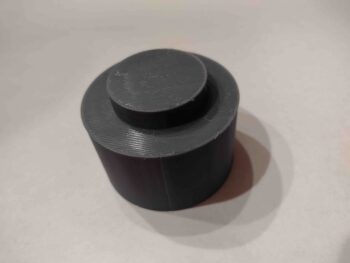
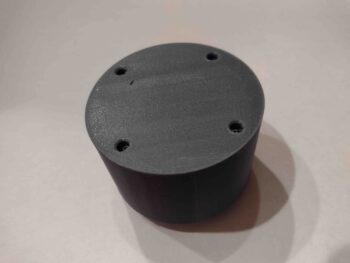
As I was involved with my fun-with-cardboard arts and crafts shenanigans above, my 3D printer was busy creating a basic mockup that I had modeled up in Fusion 360 of my fuel injection flow divider.  I put the spec’d threaded mounting screw holes in it so I can attach it to the mounting bracket that I’m also creating.

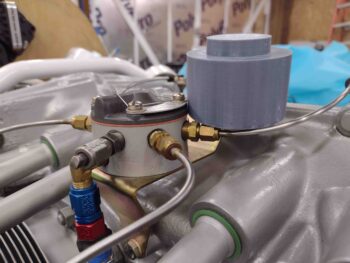
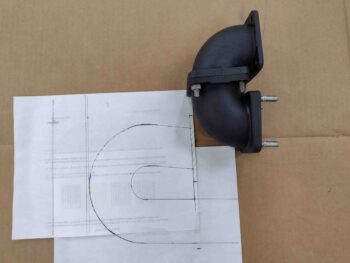
Here is the real fuel distro “spider” next to my 3D printed version, which looks a bit bigger since it’s one solid color, but they are the same size.  I didn’t take any extra time to create the intricate features on the top, I just threw a cylindrical cap on top to represent the overall height of the flow divider.

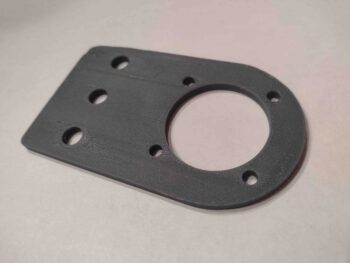
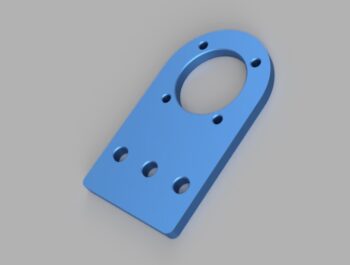
As soon as the fuel distro spider came off the 3D printer, I kicked off the 3D print of my fuel flow divider engine mounting bracket and let it run.  Here’s the result.

I called it a bit of an early night and enjoyed a nice dinner Jess cooked up for us.  I’ll get back on the build tomorrow.  I will note that I’ll be out of town next week for almost the entire week on vacation, then back to it again after that.  January will be a very busy month for this build!

Chapter 23 – FI servo duct fitting

I started off today by transferring my paper 180º air induction tube and bracket drawing to a more 3D version of it in cardboard.  The bracket portion is very close to what the flat bracket portion will be that attaches to the aft face of the FI servo, while the flat cardboard mockup of the tube is of course to check vertical clearance… although I did also check width as well (down below).

I tried as best possible in these shots to capture the almost perfect alignment between the cardboard “tube” and the RAM air can inlet… although clearly with this distance a perfect alignment is not an absolute necessity.

One more shot from the aft side… my camera lens is offset, as this was meant to show everything in excellent alignment on the centerline.

I then mounted the bottom cowling… which thankfully I was able to get completely installed.  You can see a very slight deformation of the bottom of the cardboard tube mockup, about 1/16″ I’d guess.  Since this is at the aft end of the engine and cowling, I’d like a bare bones minimum of 3/8″ clearance, while 1/2″ would be even better.

It may be hard to see, but before removing the cardboard tube mockup, I made a Sharpie mark at the aft end to denote where the tube turned upwards on the aft side.

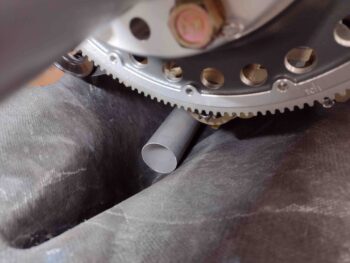
I then took a 2.5″ diameter tube I have on hand and placed it inside the bottom of the cowling with the edge resting on that Sharpie mark: to ensure I had clearance in all directions, but specifically left and right, for a 2.5″ diameter air duct tube.  As you can see, I do.

The mockup showed that some configuration tweaks were going to be needed, which means compromise on my requirements.  Reluctantly I trimmed a 1/2″ off the straight length portion of tube where it will attach to the aft face of the FI servo.  This now gives me only 2″ of straight air going into the servo vs 2.5″ … again, I have to take what I can get.

In addition, I also angled the tube at the entrance just a bit more to raise the entire duct up a bit.  This will be the last angle increase I do, and I probably should have stopped at just the 1/2″ trim in length.  But I’ll put this back on (tomorrow) and see how the clearance looks.

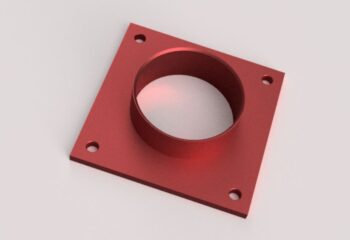
I then confirmed some dimensions on the aft face of my RAM air can where I’ll need an adapter to attach the 2.5″ SCEET tubing coming from the FI servo air duct tube above.  I modeled up the adapter in Fusion 360 CAD and grabbed a screen shot.  Now, I will point out that the final version will have chamfered corners, but that will be a subsequent milling operation so this is the first phase version of the SCEET tube mounting adapter.

Switching gears slightly . . .

I got a comment from Dave Adams, a very knowledgeable Canardian, on my last YouTube video build update where he advised me to consider mounting the fuel injection flow divider on the bottom (cold) side of the engine to ensure the fuel stays cool in the lines.  I get it.

But I had a some in-depth talks with Buly and my engine builder, who both had their spiders mounted up top, and neither had an issue with it up there over countless hours of operation. So now I really do want to know first hand what the difference is between running the fuel spider up top vs down below, but as I thought about remounting the fuel spider down below later on after the bird is flying, I pondered on what this would entail baffling-wise.

I don’t think the mechanics of moving the flow divider down below is all that crazy difficult, just time consuming (read: tedious) and a little pricey if different length stainless steel fuel injection lines are required.  However, again, the real issue I’m starting to see is maybe having to redo some baffling.  I’ll assess further.

Regardless, I went ahead and scoped out a good bit of the details of moving the fuel flow divider/spider down below.  I honestly don’t remember, and couldn’t find after a few minutes of Internet searches, what the 3-holed angled pad is on the aft underside of our engines (front side for tractor drivers), but that’s where I decided to mount the inverted fuel flow divider (ok to mount in this configuration per manual). And yes, my initial swag conveyed that at least 2 new fuel injection lines would need to be bought for relocating the spider down under, as well as some new hardware.

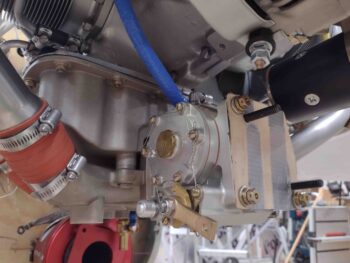
I mic’d up the dimensions of the this possible fuel spider new mounting pad as well as the fuel distro spider body and ginned up a mount in Fusion 360 CAD.

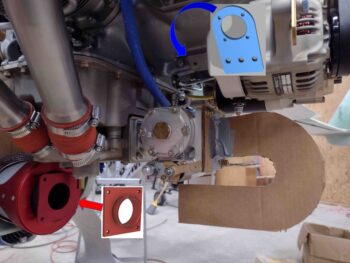
To be clear on where these CAD’d and machined adapters/brackets/mounts will go, I plopped them into the first pic from above.

Tomorrow will be round 2 of mocking up the 180º air induction tube to ensure that I’ve got the minimum clearance required.  Then I’ll start working on the best way to construct it to ensure a nice clean internal surface on the air duct tube.

Chapter 23 – Fuel Injection & More!

Merry Christmas and Happy Holidays everyone!

Over the last few days, besides getting ready for Christmas and truly enjoying this holiday (for what it really is!), I’ve been doing a lot of research on primarily my fuel injection system, but also a multitude of other engine components, including fuel system stuff too.  I’ve dropped a number of orders for fittings, more stainless steel hose, hardware, and aluminum and stainless steel for machining induction tube adapters, cable brackets, etc.

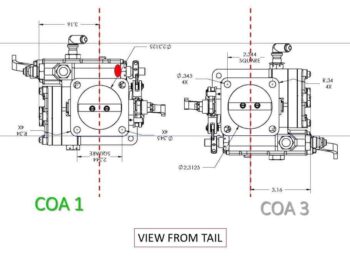
Today I finalized my Course Of Action (COA) assessment.  I found a critical error I made with labeling one of the Precision Airmotive diagrams in getting my throttle lever push-pull direction backwards.  Once caught and corrected, that pretty much nixed COA 3 —fuel injection servo facing forward as I had planned from very early on.

COA 1 has the FI servo facing forward as well, just inverted 180° from COA 3.  Since this puts most of the offset “mass” of the servo to the left and up high (clearly opposite of COA 3), it would require a spacer in between the two ~”90º” elbows to allow clearance for the topside -4 fitting (still no room for it on the bottom) and Sniffle Valve.

Using a spacer for COA 1 puts me right back as having a lot of the same issues as I was fighting with COA 3.  Worse, it really jacks up what little clearance I had —due to the contour of the bottom surface of the cold air plenum— for the top -4 fitting.  Moreover, the alignment between the fuel injection servo intake and the RAM air can exiting air is awful… off elevation-wise by over 2″ in a distance of about 5″ from face to face.

The bottom line is that both forward facing COA 1 and COA 3 are no-go’s.  That leaves me with only the aft-facing COA 2 as the last viable option.  Clearly I need to make this option work.

First up, my plan to buy my way out of work failed.  Unless I resort to some major surgery on the Air Performance air induction elbows, specifically the bottom one, then I’m once again left with no clearance with the bottom inside of the cowling.

To facilitate adding components and adapters, obviously the elbow mating flanges are square with threaded studs to attach to servos, filters, plenums, etc.  The squareness of the flange required for threaded studs and the area required to place a gasket for a nice airtight seal adds to a lot of the volume of these elbows.  Plus, let’s be honest in that they are a bit hefty at over 1.5 lbs. total… more than that once all the hardware is added.

By simply changing the shape of the bottom elbow to a comparatively thin-walled round tube, it would eliminate a lot of the lower clutter that cause the clearance issues with the inside bottom cowling.  Thus, using the same curve radius: 2″, I drew up a possible replacement for the combined elbow assembly.

I’ll note first that I wanted as much of a straight shot as possible entering the fuel injection servo to calm the air down and have it less turbulent as it enters the servo.  My limiting factor is going aft, where I will hit the wall —literally— since at 6.6″ aft of the servo face will be the aft lower baffle wall to seal off the hot vs cold side of the engine cooling air.

With a constant 2.5″ diameter duct and maintaining a 2″ minimum diameter curve, this gives me just a hair over 2.5″ of “straight” air prior to entering the servo… with one caveat: to get the entire ductwork up higher and off/away from the bottom cowling “floor,” I canted the straight segment up around 5º from the start.

I have to say that initially, this configuration looks fairly promising.  I dropped the bottom tubing going forward down from the servo plate 1″ to allow for clearance with the bottom port cover plug, but I do have wiggle room to scooch the entire duct up a bit if required.  Tomorrow I’ll make up a quasi-3D model of this duct, test it out on the servo and then check the clearance by mounting the bottom cowling.

Almost certainly more tweaks to follow …

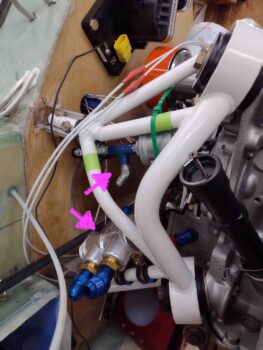
In other news: off and on all day I’ve been playing around with locations to mount the external oil Verrnatherm (more research on that required) and the engine sensors.  With so little space for these components, it’s really driving me to minimize the use of “traditional” manifold blocks and simply go with 1/8″ NPT 3-way T-fittings, as here with the oil pressure sensors that were in a manifold that I’m chucking out in lieu of employing a more diminutive T-fitting.

I also assessed installation locations and configurations for the manifold pressure sensors block and the fuel pressure sensor.  This exercise resulted in a slew of Adel clamps, fittings and hardware being added to the “to-buy” list.

The long slog continues!

Chapter 23 – Fuel Injection Servo COAs

Yesterday, as a retired military officer, I spent a few hours doing what I was best trained to do: build a PowerPoint slide deck that covered the possible COAs, or “Courses of Action” for the possible configurations for installing the fuel injection servo. Of course it was replete with pros and cons for each one, as well as specific install requirements for each configuration as well.  I also took a detailed look at the throttle quadrant control movement vs. servo throttle and mixture levers manipulation, and servo levers configuration and range of motion for each COA.

I ended up with 3 different possible install configurations, with the current way as COA 3.  COA 1 is to simply flip the fuel injection servo upside down as compared to how it’s currently installed.  Most of the mass of the servo is low and to the right (thus the current location of the cowling interference), which I would then of course transfer to higher and more to the left.  This would most likely result in having to actually put a spacer in the middle of the two elbows to allow clearance for the top -4 fuel line port.

COA 2 is to mount the fuel injection servo directly to the cold air intake plenum, facing aft.  The drawback to this configuration is possibly having 180º air —most likely more turbulent than if coming in straight— entering the servo intake.  I’ll need to call Allen at Precision Airmotive again and confirm whether or not that is an issue.

Today I flushed out all I could on the present configuration, COA 3, and then assessed COA 2 as well, since COA 1 requires physically moving fuel ports (read: snipping safety wire) on the servo.

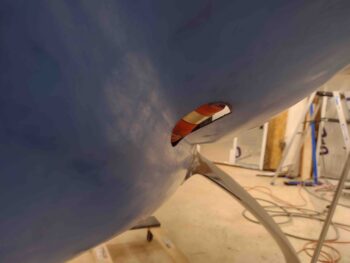
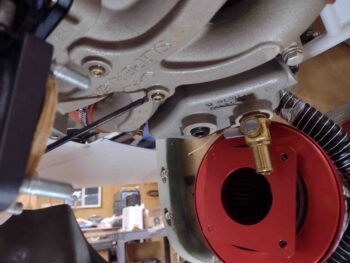
I determined that I wasn’t truly accounting for all my data points regarding the installation of the fuel injection servo unless I at least temporarily mount my Sniffle Valve… the install location on the bottom of the cold air induction plenum which I’m pointing out in this pic:
What is a Sniffle Valve?  Well, for those with a cold air plenum it is a safety valve to ensure that any type of liquid, be it fuel that drains back down from the intake manifolds or perhaps water entering into the system after a good rain is drained free and clear from the cold air intake plenum prior to engine start.  Specifically, it’s to ensure no fuel is pooled up in any quantity that when ingested at engine start would induce a backfire.  No muy bien!

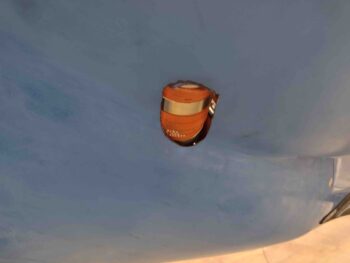
You can of course make a Sniffle Valve yourself, but it is just easier in my opinion to buy one from the good folks over at Airflow Performance.  Here’s what it looks like from the outside.
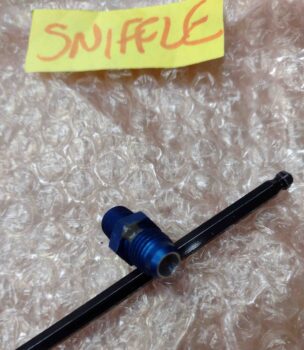
Inside is a ball bearing that falls down/open in its natural state when the engine is off, thus opening the port for all unwanted liquids to exit the plenum during the engine-off state.  Once the engine is started, the vacuum from the air induction system pulls the small ball bearing upwards and keeps it locked in the closed position until the engine is turned off.  Simply but very effective.
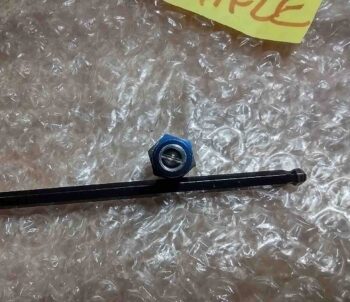
Since our Long-EZs are placed in the grazing positions after engine shutdown and prior to engine start, I am using the forward Sniffle Valve port to drain away any excess/unwanted fluids.  Since this engine is mounted “backwards” I’ll note that on a “normal” install most tricycle gear planes would use the other port, which would be the forward one.  Also in a tractor configuration, the Sniffle Valve port I’m using is what the taildragger bubbas would use.
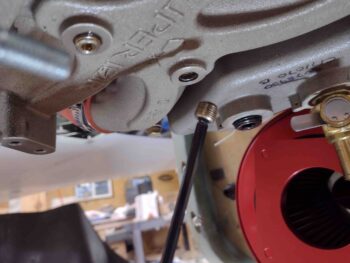
I installed the Sniffle Valve without any thread goop simply as a temp install to ensure clearance with the fuel injection servo, as we have here:
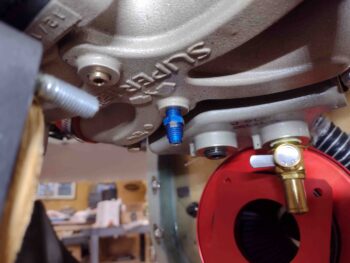
I didn’t grab any shots, but after some trial and error with the current FI servo configuration (COA 3) I determined that by adding washers again to make the bottom elbow 90º (versus actual 85º) and with a 0.090″ spacer in between the two “90º” elbows, I could get some actual clearance between the lower right side of the servo and the bottom of the cowling… maybe 0.08″.  The main fuel hose would still definitely have to be moved from the right side to the left, requiring more circuitous routing.

I then grabbed a fairly thick aircraft cable and tested the throttle and mixture cable loop back that would be required for those cables.  I even talked to a custom cable shop in California to inquire about how much I could bend these cables without inducing negative pressure on the cables or effect good operations.

You can just make out the red cable in areas of the lower cowling.
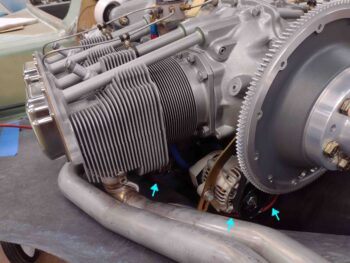
I then took the bottom cowling off to assess fuel injection servo install COA 2.

I should note that yesterday I also did an inventory and took a hard look at what options I had for installing an angled fitting into the mechanical fuel pump drain port that would allow acceptable clearance with the left aileron control tube.

I assessed a 90º aluminum barb fitting I had on hand (that I bought specifically for this), but it actually jutted out farther from the fuel pump body than did the brass 90º fitting (with female threads for a straight barb fitting).  The more I looked the more I realized that the brass fitting I had was about as low profile as I was going to get without rolling my own.

With the bottom cowling off and decent access the firewall area, I wanted to thoroughly flush out this brass 90º fitting to see if it could be used, or if I needed to keep looking for other options.  I had tried the fitting in place, and observed a couple of days ago that there was a scant bit of clearance until I went full right aileron.  Then the left forward corner of the brass fitting just kissed the aileron control tube.  Note that this is with the brass fitting hand tightened into place, so I’m fairly certain I can get one more full revolution of insertion here.
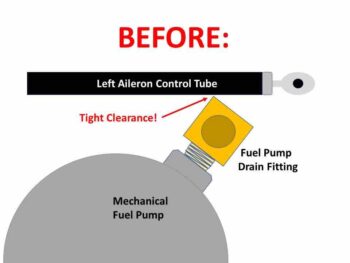
In looking harder at the brass fitting, I realized that it was a cube with the male threads protruding out one side, with the round threaded female port on the bottom to then thread in a barb fitting.  The round channel for the female threads left quite a bit of meat at the corners, which was exactly the area causing the interference issue with the left aileron control tube.

I took the Dremel and knocked down the corner edges a good bit, and after a couple of rounds had an acceptable amount of clearance with the aileron control tube.  Never as much clearance as I would like, but enough that I seriously don’t think under normal flight ops it would cause any interference issues.  Moreover, with now completely rounded edges of the fitting exposed to the control tube, any possible contact during, say, some high G maneuvers would only result in some momentary minor rubbing and possible paint blemishing vs any edges catching against each other.
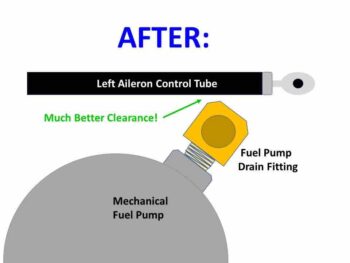
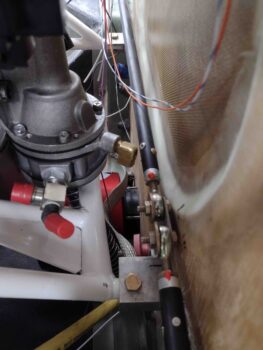
Here we have the mechanical fuel pump drain 90º brass fitting installed (remember! here it is only hand tight) after I rounded the sharp-edged corners.  Clearance is still tighter than I’d want, but this is about as good as it’s going to get unless I can find (or make) a lower profile fitting.  I’ll keep on the lookout, but I’m going to call this acceptably ok until that happens.
I then ginned up a thin plywood bracket to attach to the (now) aft face of the fuel injection servo as it is mounted facing aft directly onto the cold air intake plenum (COA 2).  I installed 2 CS 5/16″ screws to allow me to then mount the elbows onto the servo.

Which I did here.  Obviously the elbows aren’t installed in a perfectly tight and flush manner as they would be with a proper adapter bracket, but certainly good enough to give me an idea on cowling clearance.
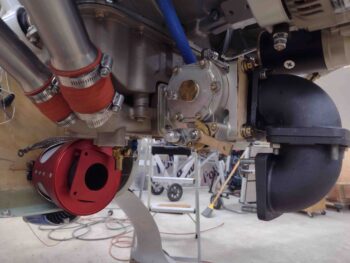
I have to say that the more I looked at COA 2, the more I really like this configuration.  It places both fuel lines in very optimal positions with about as zero interference or clearance issues you can get with this install.  It also places the throttle and mixture levers at good angles and distances from the bracket hard points on the bottom of the cold air plenum.  Moreover, although it requires much tighter length tolerances, it eliminates throttle and mixture cable U-turns in the cowling… with direct Point A to Point B cable runs from throttle quadrant to levers.  Again, so far the biggest drawback is the potential issue with turbulent air entering the servo from the directly attached 180º elbows.  Well, and clearly a slight hit on aft CG as well.

Well, my temporary plywood bracket with attached elbows exposed exactly what I had hoped it wouldn’t: interference between the ~180º elbows and the inside bottom of the cowling…. so much so that with all the CAMLOCs installed on the right side of the cowling, there was no way to get ANY CAMLOCs installed on the left side.
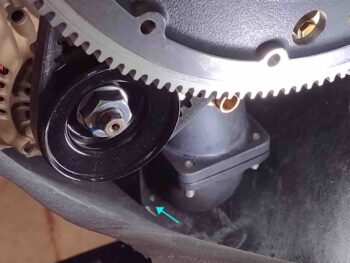
Here’s a shot from the right side of the aft-facing fuel injection servo and the ~180º elbows that are interfering with the bottom cowling fitting.
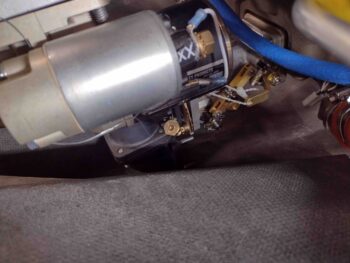
While not what I had hoped for, the data that I’m collecting from these various COA test installs is helping build a decision matrix for getting this fuel injection servo installed in the most optimized manner for this engine-cowling combo.  If I go with COA 2, it appears that I would pretty much have to fabricate my own air duct to get the air from the RAM air can into the fuel injection servo.  This might ultimately be a blessing in disguise given that I could most likely make it tighter and thus possibly add 2-4″ of a straight air intake just before it enters the fuel injection servo.  Not to mention that it would almost certainly be much, much lighter than these 2 bulky aluminum elbows.

Pressing forward!
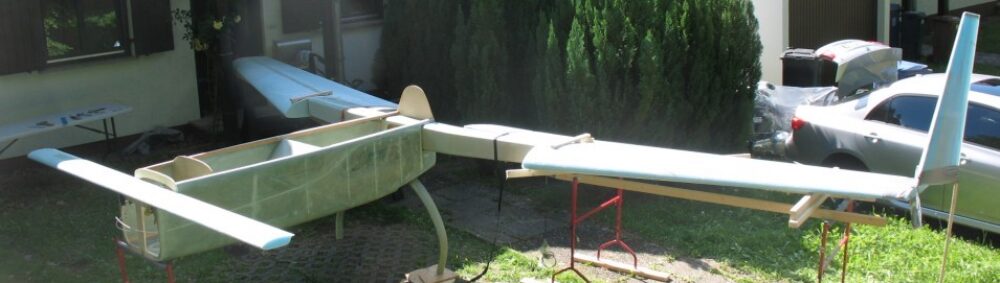
Chapter 23 – Engine mounts shimmed

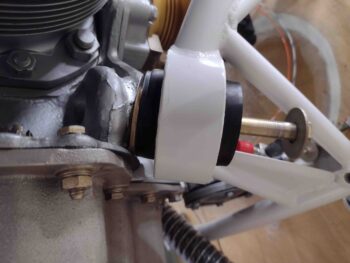
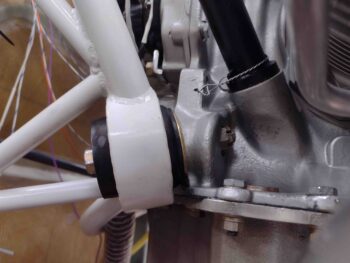
Today I finalized setting up the engine hoist which allowed me to remove the bottom engine mount bolts, lift the engine slightly and slip in an AN970-7 large area flat washer as a shim between the mount/engine flange interface on each side.

Here I’m installing the shim on the lower right engine mount.

And here I’ve shimmed the lower left engine mount using an AN970-7 washer.  Note that this is a test run on the shimming to see how well it works.  There is still a very good chance that I will pull the engine off the mount, work & tweak a number of things before then re-attaching the engine to the mount…. subject to further assessment.

I used my digital level and found that with the lower engine mounts shimmed that the engine was now sitting at 1.5° on the left side and 1.8° on the right side (vs plans 2°).  Remember, I haven’t leveled the fuselage so these are loose numbers and relative to the current longeron angles, and each other.  I know my shop floor is uneven, so I would not be surprised if there is a slight induced twist to the fuselage due to it sitting at an angle in the shop for the wings to fit on.

I then prepped the lower cowling and gathered up everything to put it back on the bird.  I’ll point out that I remounted the fuel injection servo on the 90°+85° elbows.

The lower cowling was a bit difficult to get on, more so than usual, and I found the main culprit being the fuel injection servo (see below).

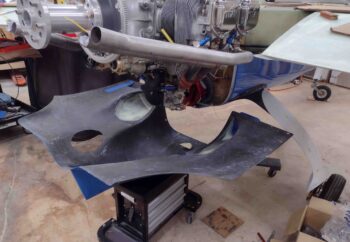
I will note that there is definitely more noticeable clearances with the right side exhaust pipes… very close to them not having to be reworked if push came to shove.  The left side exhaust pipes (above) though went from pressing hard into the bottom cowling to simply touching the bottom cowling… those still need some serious remedy.

My guess is that I probably gained somewhere around 3/16″ more clearance on the aft end between motor stuff and cowling.

The issue with the cowling being so difficult to get mounted back on is that I tried going with the 90° top and 85° bottom elbows to mount the fuel injection servo.  There is a safety wired port on the bottom of the fuel injection servo that is definitely protruding downward and pressing into the bottom cowling floor keeping it from sitting in its normal, higher position.

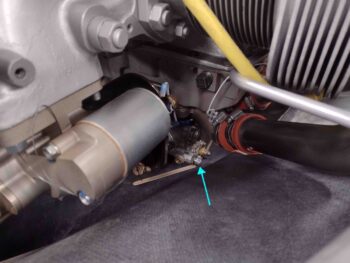
Moreover, with the 85° elbow in place the primary fuel line connection port has ZERO clearance with the bottom cowling (light blue arrow)… I can’t even slip a thin popsicle stir stick under the port cap, between it and the cowling.

Clearly, the fuel injection servo configuration will have to be reworked, and I have about 3-4 different options that I’ll entertain on just how to do that.  To be clear, the very LAST option is reworking the bottom of the bottom cowling to allow it to fit.

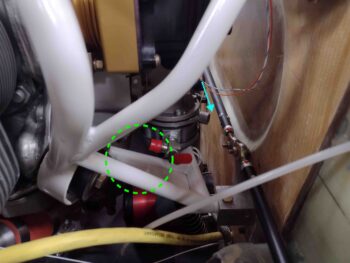
I also assessed the fuel feed hose exiting the mechanical fuel pump clearance with the frame of the engine mount (dashed green circle).  In 2018 I reported that I would be running this fuel hose on the inboard side of the engine mount frame tube, but I think that was before I added the fire sleeve.

It might be hard to tell in the pic below, but there are two angled engine mount tubes inside the dashed green circle.  The lower one in the background has a steel flange welded in place. At this point I’m certain that I have no choice and I’m going to have to grind off about 1.5″ inches of the aft edge of the flange to allow me to mount an Adel clamp and route the house OVER that lower engine mount tube and then down to the fuel injection servo that route.  There is simply almost no clearance on the inboard side with the fire sleeve installed on the primary fuel feed hose.

I also took a good look at the fuel pump drain fitting (not installed) clearance with the aileron control tubes (light blue arrow)  The engine mount shims of course had pretty much zero impact on the fuel hose routing above, but I would say with the shims in place the clearance here opened up by maybe 0.1″… still very tight, but there IS some clearance and the issue workable.  Again, where is there NOT tight clearances on these birds??

I’m thinking that simple up/down component-to-cowling clearances aren’t as noticeable as angular clearances.  Probably the most notable beneficiary of shimming the lower engine mounts is the right aft cold air induction manifold pipe. It clearly moved slightly aft and up and protrudes very noticeably less than before.

Here is a straight on shot of that.

And you can really see it here, with the cold air induction pipe protruding out way less than before.

My main priorities and concerns with the engine components-to-lower cowling clearances are 1) fuel injection servo – most likely remedied by re-configuring its position
2) exhaust pipes – my preferred remedy would to have them re-welded to fit better, before any possible/required bottom cowling skin rework.
3) Hershey Kiss spinner (specifically flow guide fit) – noting that Mike Melvill had no flow guide [not sure why?], I don’t see this spinner fitting at any point.  I will most likely send it back to Catto or sell it outright.  I think for this type of spinner to work it must have a non-lamp shade style flow guide… one that is more like what Klaus uses/sells (or used to anyway).

Chapter 20 – Winglets/Rudder complete

I started off today by pulling the peel ply off the single BID ply layup on the aft bottom corner of the right rudder.

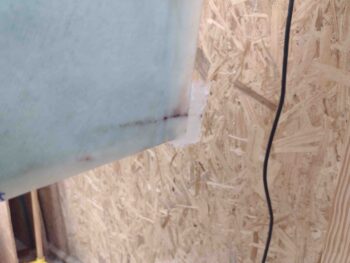
I then razor trimmed and lightly sanded the edges.  It definitely reinforced the tweaked corner and did exactly what I hoped it would do.

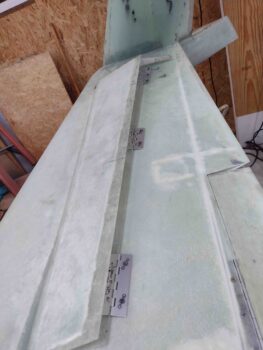
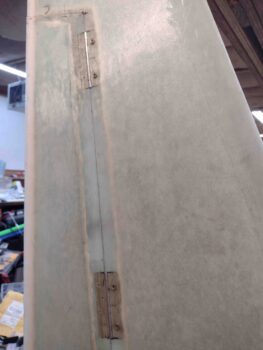
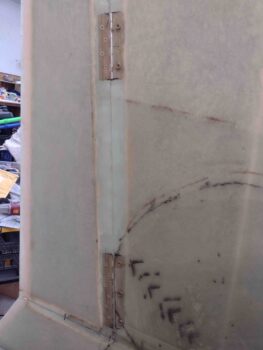
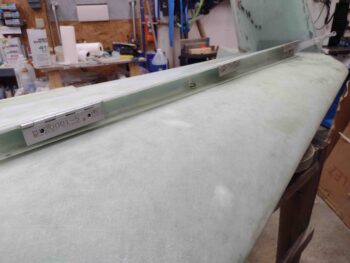
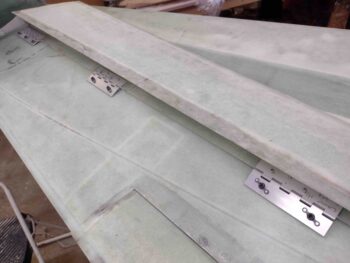
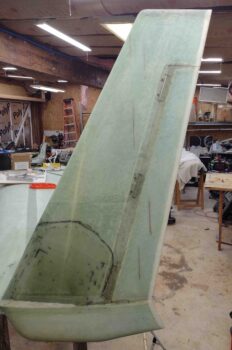
With my K1000-3s finally delivered, I removed the right rudder and installed 2x K1000-3s on the bottom hinge, and one each on the middle and top hinges, for a total of four (4) K1000-3s installed tonight (7 total installed overall).

I then reinstalled the right rudder with all the bolts in place.  I need to do a minor bit of tweaking on the right rudder alignment, as well as some judicious sanding, but overall everything looks really good.

I then repeated the process on the left side rudder.  First I installed the 4x K1000-3s.

And then reinstalled the left rudder, secured with all the required number of bolts.

The left rudder is a lot less of a troublemaker than the right, so I have no notable squawks to report.

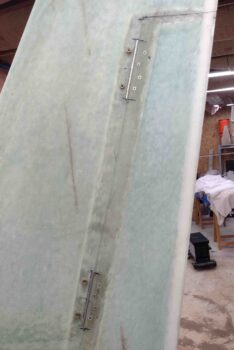
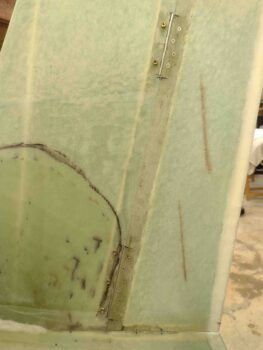
Here are closer up shots of the left rudder hinges with all the bolts installed.

Tomorrow will be a bit of a light build day, but I do plan on getting back to work on the engine and cowlings.

Chapter 23 – Engine & Cowling Plan

First off, I’ll let ya’ll know that I’ve had a cold for the last couple of days so I’ve been taking it easy as I assess my engine vs. cowling position issue.

Yes, over the last few days I’ve had a bit of an epiphany on my engine and I thought I would share it with you.

I have to face this issue down, and seriously determine and fix why I’m having any interference or just really tight clearances on my cold air induction pipe, my fuel injection servo, my exhaust pipes. my RAM air can, my mechanical fuel pump drain with my aileron control tubes, and now my prop spinner.

My initial assessment, again, is simple: something just ain’t right in Denmark…. the engine looks like it’s sitting in there fine, but all the indicators tell another story.

Ok, my troubleshooting skills may be slipping I guess.  But I think I’ve got at least two contributing factors.  My bad for not thinking this out better:

Here goes:  Mike Melvill had an O-235 and rigged his engine to be level at 2° nose high per plans… Or about 2° engine high at level longerons.

He then swapped his O-235 out for.an O-360, same mounts pretty much.  Cowling goes on the new engine which is still set at 2° high.

With a planned more powerful motor, I went with 1.4°… but am measuring even less.than that.  Probably not surprising since it’s been on the engine mount for 4 years now.

Now, my bird isn’t on a level floor, nor did I level it, so probably some slight variance.  But I’m measuring 1° on left, 1.2° on right as far as prop up in the back.  That equates to 0.2″ low on left and 0.16″ long on right if I were to bring it back up to 2°.  Significant when you’ve got close to zero clearance on the left exhaust pipes, and a lot of tight clearance issues with a myriad of other stuff.

When I was talking with Marco I wasn’t sure what angle I had set my motor at, but on my blog I noted that I set mine for 1.4º.  I used a .224″ spacer to get to 0.0º on the engine mount, while plans requires a 0.25″ spacer to get to 0º.

Looking at my buddy Dave Berenholtz’s blog, I noted he had a seemingly much tougher time getting the bottom cowl on than I did.  The major difference in our installs is that Dave had an O-320 motor installed on the plane to confirm that the bottom cowl needed to be angled back, or down on the back end.

In addition, Dave’s front top corners are about where mine are, which means the bottom of his cowl where it meets the bottom of the fuselage/firewall is most likely trimmed a good bit more than mine, angling his bottom cowl down on the aft end.  I would think that mounting the bottom cowl as he did caused issues on getting the sides lined up because the back end was actually where it needed to be.

I didn’t have the issues along the sides because I didn’t have my motor installed (huge error) and all seemed peachy keen installing it upside down.  Since, as I pointed out in my video, I only trimmed a max of 3/16″ off each side, most of it way less than that since it was a slight angle, I grossly underestimated how jacked up the cowling was in its design as far as NOT being anywhere close to plug ‘n play.

So…
1.  With my engine angled slightly down in the back more so than stock plans,
2.  Not confirming engine to bottom cowl fit with the engine in while installing lower cowling
3.  Resulting in engine sitting slightly low (some of that may be from 4 years on mounts) and cowling significantly higher compared to stock

I need to take some significant steps to mitigate my engine configuration issue.

#1 – I’ve been researching shims on engine mounts.  Apparently not that uncommon.  A number of reports of engines that start to sag or droop, and shims are used to get them back up to previous level.  I spoke with the Lord mounts folks and, with caveats and warnings to replace old mounts, I’m leaning seriously towards not replacing my mounts and shimming the bottom mounts to bring the engine back up to 2º.
#2 – After I shim the motor up, I’ll then assess its position.  I then need to be prepared for some possible major rework on the lower cowl to re-skin the aft area to open it up for exhaust pipes and spinner/flow guide.
#3 – I will work what I can on the exhaust pipes to possibly have them angled up just a scooch to add even more clearance.

I expect all this to add about a month to the build completion date.

Yep, mods can bite hard sometimes eh?

Chapter 20/23 – Odd & end tasks

As I was finishing up one of the final small tasks I had on my Chapter 20 to-do list, my buddy Brian Ashton called from Alaska… he’s the guy building a twin Long-EZ.  As we talked, I was making light of the fact that I had hauled these winglets around for 10 years after making them, and nary a scratch on them.  And then within the first hour of setting them in place for install the right one got away from me and of course crunched the lower aft corner… which is of course now the lower aft corner of the rudder.

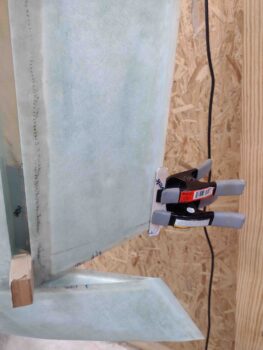
It was a slight crease, but one that needed some tending to.  I laid up a ply of BID on it, peel plied it and then clamped both sides of the layup and rudder to ensure it cured straight and aligned with the rest of the rudder TE.

Layup complete.

My K1000-3 order apparently was frustrated cargo with USPS and got sent back to CA.  Apparently Aircraft Spruce in GA doesn’t carry stock anymore because I seem to get a lot from CA.  They said that my zip code was incorrect, although I pulled my address off a list of maybe 30 same addresses in the shipping address block… oh, well. Weird, frustrating and the end result is no K1000-3s until I re-ordered.  BUT . . .

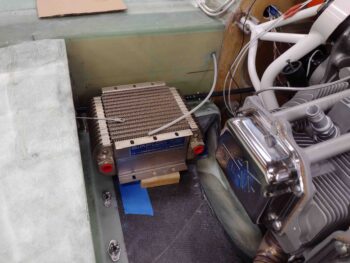
Knowing that I wanted to add a bracket to support the rather hefty oil cooler when I take off the bottom cowling, I ginned up a loose design to get an idea of even more hardware I would need.  Moreover, I wanted to ensure I accounted for all the oil line fittings and angles I would need to get the oil cooler installed.  All before re-pulling the trigger on another ACS order.

Now, Mike Melvill has his oil cooler installed with the rows going parallel to the CS spar.  So I started there.  I quickly realized that I would need 90° elbows, which A) I try to stay away from reported reduced flow (does it really matter? you got me…), but moreover, B) I have zero on hand.  Plus, the space would be tight between oil cooler lines and the aileron control tube, which I want to avoid.

I then tried setting the oil cooler in, with rows parallel to the CS spar, with the hose fittings facing aft.  This was not much better.  It would require a LOT more oil line hose and would still most likely require at least one 90° fitting.  Although I am keeping it as a viable option due to my inline external Vernatherm needing someplace to exist in this engine compartment area.

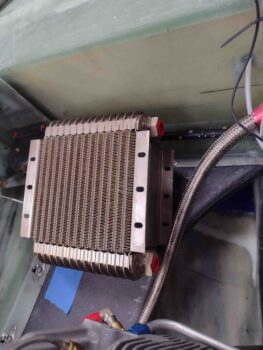
I concluded that the best option was turning the oil cooler 90° so the rows were perpendicular to the CS spar, with the connection fittings facing the inboard forward engine area. Again, I still have to account for my external Vernatherm mounting spot, but this looks like the best spot.  I will note because the extended curved side of the cooler, I may need to tilt it up bit at the front to ensure clearance with the left aileron control tube.

I decided to ask Marco if he had any pics of his oil cooler install?  What direction did his oil cooler fittings face?  I sat down on my step stool immediately aft of the engine to send him a text, and while awaiting his reply took a good look at the engine and bottom cowling.

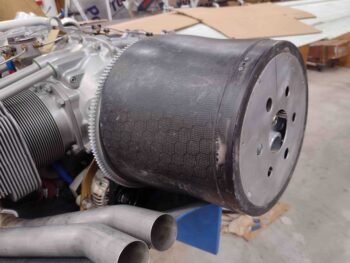
I noted to myself that it appeared with the current position of the engine along with the untrimmed aft lip of the bottom cowling, that there was no way my Catto Hershey Kiss spinner flow guide could be mounted in place.

I went into the house and quickly grabbed the flow guide and tried to put it on.  And I was right:

I determined that it would require trimming the bottom cowling aft lip forward at least to the edge of the top of the boat tail.  Very probably even more than that.

In doing a bit of snooping around online and in CSA I learned that Mike Melvill did in fact trim his bottom aft cowl lip back to just a small (maybe 1/4″) edge left over the top of the boat tail, and also that he had no flow guide installed on his bird.

Still, my gut feeling is that my engine is sitting (angled) just a tad low while my cowling is naturally just a tad high.  I’m going to do some more research tonight to get some more info on this and try to do a course correction before I proceed with any major cowling modifications.

BTW, Marco’s oil cooler fittings face inboard, like my last pic of the oil cooler shows.

Chapter 20 – Rudder springs installed

Today I installed the rudder return springs into each winglet and rudders. I didn’t get any pictures of that, but I did make a video that shows the result of installing these springs.

Tomorrow I’ll press forward with the upper and lower cowling installs, as well as engine component installs as well.  If the K1000-3 nutplates arrive tomorrow I’ll install those into the rudder hinges also.

Chapter 20 – Rudder return springs in

I’m going to start the blog off today by thanking and giving huge kudos to Ary Glantz for catching something that I think 99% of us builders miss.  You can read the detail here on his blog.   Moreover, since Ary did such a great job covering it, I will simply quote his words below, which is the lion’s share of the detail in his summation of what Jim Weir of RST engineering —the guy who designed the antennas and created the kit that I’d think over 90% of all canards use— had to say about our rudder return springs (indirectly):

Ary:
***** “Ok, so now to install [the rudder return spring] inside the winglet. The “high performance rudder plans” says to install the assembly at WL25. HOWEVER, the RST-2802 antenna manual (the Holy Grail manual that explains everything you ever wanted to know about canard airplane antennas) says “If there is a piece of metal more than an eighth of a wavelength long within a quarter wavelength of the plastic plane antenna design, the antenna performance will be degraded”. They go on to say “with the classic dipole ‘rabbit ears’ design, metal close to the center of the antenna where the ears come together has practically zero effect. Metal out at the tips of the ears has a tremendous effect.”

Hmmmmm… but the High Performance Rudder plans tell us to install a blob metal object at the tip of the antenna! Nooooooooo!!! Why!!!!?!?!!” *****
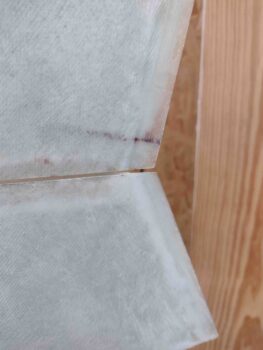
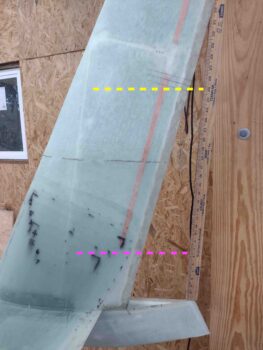
Here’s W.L. 25 on my bird, about an inch down from the bottom tip of the antenna.  So “why?” indeed.

My question was if essentially every builder and every Long-EZ that I know of —past, present and recent— installed the rudder return spring per plans, why are there no complaints on radio performance or range? l searched all the CSA articles and didn’t find any instances of issues or complaints.

I also read the RST-2802 manual firsthand and found the answer.  As Jim points out, and I”m paraphrasing, if you start out at a certain baseline capability, and it isn’t awful, with nothing to compare it to how could/would you possibly know or ascertain experience-wise how good it has the potential to be?  It’s simply a matter of optimization, not just if it works or not.

With Ary’s reminder of Jim’s words of warning, I decided to simply move my rudder return spring up much closer to the center of the comm antenna on each winglet.  I did want the rudder return spring near a “hard point” so I went a few inches above the center hinge position, which turned out to be about 2″ below the center of the antenna.  I think I’m safe in this location… obviously and comparatively much more optimized than putting it in the plans position.

The resulting final delta is 25″, moving the rudder return spring assembly up from W.L. 25 to around W.L. 43.

I’m guessing that the W.L. 25 position was based off the original plans squarish rudder, and with so many people at one point doing conversions to High Performance Rudders vs new builds they simply left the rudder spring in the original position. Also remember that these antenna configurations didn’t come into play until well after the first Long-EZs were built, so the W.L. 25 located rudder return spring assembly predates the Jim Weir winglet-located comm antennas. Just my thoughts, I could be wrong of course.

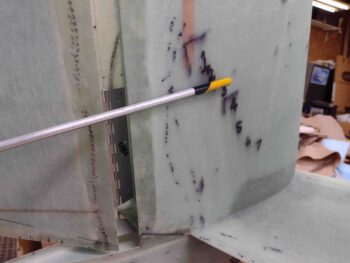
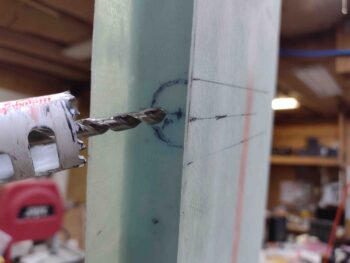
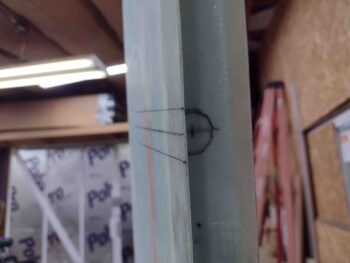
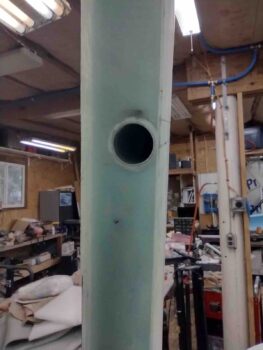
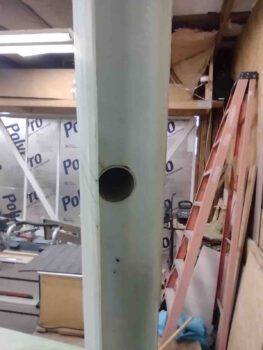
Once I had the positions marked, I took my 1″ hole saw and cut just the glass inside the winglet rudder hinge pocket.

I then found my old lopped off piece of 1″ OD 6061 tubing that had been the original plans length left elevator tubing.  It had some left over glass and epoxy on it that I scraped off, and I then notched the end with the Dremel to make some saw teeth.

I then carefully used my makeshift hole saw to make the pocket for the rudder return spring tube, being very careful to avoid damaging the antenna copper foil tape… as you can see here on the left winglet.

Again, on the left winglet, I cleaned out all the foam to ensure a nice 4.5″ deep pocket, also ensuring that the antenna was not damaged in the process.  I did the same on the right side.

I then whipped up some micro and slathered up the inside foam of each winglet cleared-out rudder return spring tube shaft.  After cleaning them with acetone, I then slathered up each rudder return spring tube with miicro and stuffed them into the winglets.  Although not shown, I also used a nice dap of flox on the wood plug at the front end of the tube before installing them.

Here we have the rudder return spring tubes micro’d and floxed in place in both the left and right winglets.

While the rudder return spring tubes cured in the winglet pockets, I then turned my sights on installing the rudder side rudder return spring hooks.

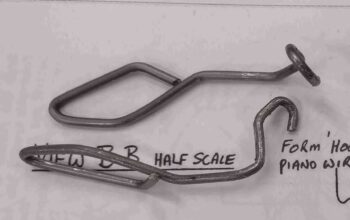
If you remember, I made my hooks so that they actually go into a hole on the face of the rudder hinge pocket, before then making essentially a 90° turn to lie somewhat flat against the interior side glass of the hinge pocket.  I also made them long enough and canted the hook at an angle that when I install them into the hole, I pivot them to lock the somewhat diamond shaped hook body up against the interior skin on the opposite side of the rudder.

Since the plans aren’t overly clear on how these are shaped, I got the idea for my hook design from how Dave Berenholtz made his (thanks!) after I pondered on their function a bit.

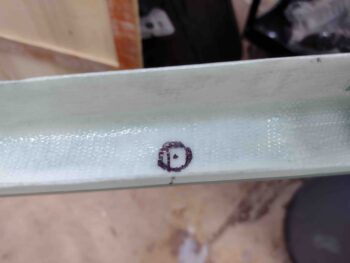
I then made a hole just a hair smaller than the widest part of the “diamond” part of the inside hook body.  For the left rudder this was a 1/2″ hole, for the right around 0.46″ diameter hole.

Given how my rudder-side rudder return springs physically lock into place inside the rudder hinge pocket, I wasn’t squeamish about using the decent amount of flox and micro I had left over from the winglet rudder return spring tube installs.

However, just to make sure all was secure, and cover the rather large hole I made on the face of each rudder hinge pocket, I did layup a small ply of BID around each hook.  I then peel plied each layup.

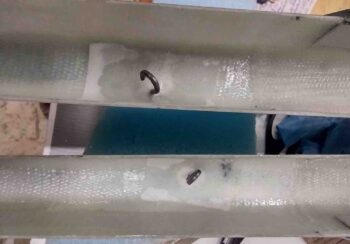
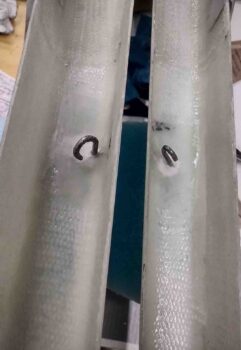
Very much later tonight I pulled the peel ply and grabbed this shot of the rudder-side rudder return spring hooks.

It was too late to install the rudders and test out my spring action, plus I wanted to give the micro, flox, and layups a good overnight cure before stressing them… so tomorrow I’ll test out the springs.

With the rudder return spring assemblies installs complete, I called it a night!