Chapter 22/24 – Armrest Shenanigans

I started off today accepting delivered packages from both Amazon and SteinAir.  My Amazon order contained this little gem right here:

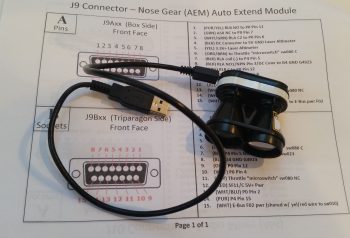
This 90° right angle USB adapter is perfect for allowing me to hook up my panel mounted USB jack to the HXr.  Since the HXr’s back panel is farther forward than the panel mounted USB jack and cable, then the USB plug at the end of the cable needed to do a 180° to get to/fit into the back of the HXr.  The cable’s USB plug could literally touch the USB jack on the HXr, but the geometry was such that it couldn’t go in since there just wasn’t enough length on the cable.  This 90° USB adapter solves the problem by essentially turning the HXr’s rear-facing (again, technically forward in the real world) USB jack into a side-facing USB jack.

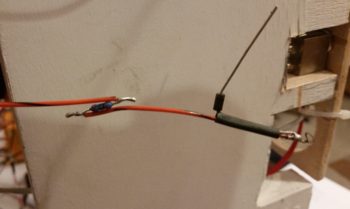
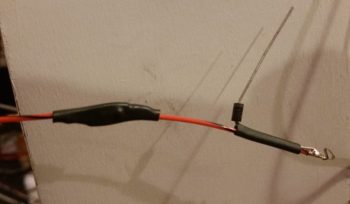
I secured the new 90° right angle USB adapter to the panel-mounted USB jack and cable with a piece of heat shrink.

I then mounted it into the back of the HXr.  I’m very happy that I now have a direct cable run and, moreover, that I don’t have to mess around with an extra foot of unneeded USB cable.

This view shows nearly the entire run of the panel-mounted USB jack and cable to the HXr, utilizing the new 90° USB adapter.  Again, I’m really happy with the minimal cable length required for this connection, yet still enough slack that it’s stress free.

I mounted the USB jack onto the aft side of the panel, and then plugged in the HXr’s thumb drive.

Since I’ll be updating the EFIS’s and adding some files to their respective thumb drives, I didn’t want to get them mixed up and wanted them easily identifiable.  So I took a few minutes to print off a snazzy label for each one.

Having just had separate discussions with both Dave B. and Marco on instrument panel and throttle/stick labeling, I decided since I had labeler in hand to make up a few test labels for the stick.

Not bad, but I see some modifications to these labels in the future . . .  I got plans!

I then got back to the build by drilling & prepping the 4 holes in the left fuselage sidewall for 4 RivNut hardpoints that will secure the cupholder to the sidewall.

I floxed the 4 RivNuts into the sidewall to create these 4 mounting hardpoints to allow for a removable cup holder.

A few hours later here are the 4 floxed-in and cured RivNut hardpoints for the cupholder.

I then rounded the cupholder’s mounting wings into a pleasing shape… although a friendly fire incident occurred when my Fein saw kicked back hard and took a small bite out of the lower mounting wing.  Minor fix, but annoying nonetheless.

I then test mounted the cupholder.

I then got to work cutting the cupholder access hole into the top of the left armrest.

Since the cupholder is a bit bigger in diameter than the armrest is wide, I needed a slot down the face of the armrest for the cupholder to peek out.
Here’s the left armrest in place over the cupholder after a few iterations of sanding and cutting away glass. It was almost midnight and my time for using the Fein saw was well past, so I called it good for the evening for any more work on the armrest.

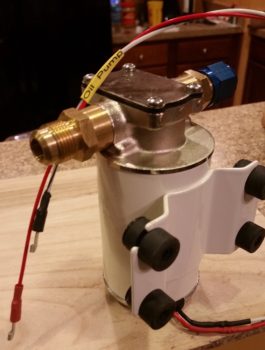
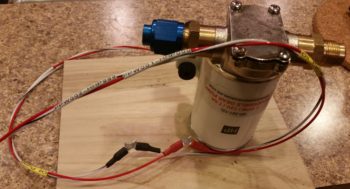
I then moved onto something a bit more quiet.  Earlier in the day I decided on the mounting location for my PWM (pulse width modulator) board for controlling the oil heat pump.  I drilled the 4 x 4-40 mounting holes into the front face of the lower instrument panel, left side under the armrest.

Now it was time to flox in the 4-40 nutplate assemblies to mount the PWM board, using the 4-40 nutplates that I ordered from Stein.  Of course I had to make them first . . .

I then floxed in the 4 x 4-40 nutplate assemblies on the lower front side of the left instrument panel, with the PWM board mounted –with standoffs– on the aft side so as to ensure I got the correct screw alignment into the nutplate assemblies as they cured in place.

Here are the four 4-40 nutplate assemblies floxed in place on the lower left instrument panel for mounting the PWM board.

With that, I called it a night.  Tomorrow I’ll continue to press forward with my left armrest build endeavors with the goal –again– being the install of the 3 cable levers for the heat/air ducts that will allow me to install the heating/air ductwork in the GIB area left sidewall.


Chapter 8/22/24 – Left Armrest Stuff

Today, again, was an unseasonably warm day . . . but I suspect that won’t last long. Yesterday was as well but I wasn’t mentally prepared to get something ‘on-the-block’ and painted.  Today I was.

I figure my current tasks are such that I can do them in the garage as long as I have heating of some sort.  Painting is a different animal however, and unless I want the entire shop filled with paint fumes for a good day or two, I like to get painting done outdoors.

So I started off today prepping my pilot seat headrest for paint.  I considered removing the hardware but that would be too much of a pain, so I simply covered it all with blue tape. I then gave it the once over and did some light sanding and hit it with a flat razor blade in some spots to get the surface smooth.  Then I gave it a good wash down with Simple Green, rinsed it well and then dried it off.

I took the headrest outside, hit it with 2 light coats of primer as you can see in the before & after pics below.

I suspected that I was going to run out of the darker Valspar Sand Stone top paint –which I did after 1.5 passes– so I picked up another can the other day while I was out.  But an odd thing occurred that I’m not sure if I’ve seen before.  The cans had different lids both in shape and color, yet the cans themselves were identical, with the same name, model number, etc.  Yet still, the paint was DIFFERENT, and did in fact match the color and texture on the lids which you can see are clearly different.  I tried shooting a test patch with the new paint, and sure enough it was different… how odd.  Good thing I noticed and didn’t dive right in and continue painting the headrest with a slightly different color!
A little later I brought the headrest inside.  Interesting how dark it looks under shop lights vs. out in the daylight.

I then spent quite a while determining the exact mounting location –specifically distance from the fuselage sidewall– of my throttle quadrant.  With this throttle handle, I have to be careful in how I route the throttle handle cable to prevent chaffing or rubbing.  I’ll be constructing a new, specifically designed throttle handle lever that will route the cable through the lever to ensure strain is minimized and keeps the cable from rubbing on the corner of the throttle quadrant plate.

After marking off the area for the throttle quadrant on the top of the left armrest, I then cut the area out using my trusty jig saw.

Below you can see the throttle quadrant mounted on the sidewall with the left armrest in place.  You may note also that I made a bit of a blunder in my up/down placement of the throttle handle IF I wanted the top of the throttle quadrant plate even with the top surface of the left armrest, which I did.

Ions ago I had drawn a line across the fuselage sidewall where the armrest would be located.  Unfortunately, this line was for the TOP of the armrest sidewall, but NOT the top of the armrest.  Essentially, I had drawn the intersection line of the armrest sidewall and the armrest top.  I kept this in mind when I mounted the throttle quadrant mounting hardpoints so the throttle quadrant base top was supposed to match the armrest top, but somewhere in the process I induced a slight mismatch.  Currently the throttle quadrant base sits about halfway down in the top of the armrest.  No big/uncorrectable deal, just another issue to work through.

This shot shows a bit more of the armrest fitted into the fuselage.

Today was kind of a lighter build day since I ended having my weekly outing with a buddy of mine.  We ended up seeing the new Thor movie so I didn’t get as much done as I had planned.  But tomorrow I should get a full day in on getting the left side pilot armrest components installed.


Chapter 22/24 – Cupholder Wings!

I actually started off today pulling peel ply and doing a rough cleanup on left armrest layup. I did a bit more thorough trimming later on in the pics below.

Then I started in on my cupholder.  I realize, without the plane being close to flying, that folks may wonder why I’m focusing on some things that seem rather insignificant in the grand scheme of things, especially in regards to getting this plane in the air.  I have to say that is quite often the mantra I hear either online or from other builders in person: “Just get ‘er in the air, all that other stuff will come later!”

Well, if you’ve been reading this blog for any amount of time you’ll know that I respectfully disagree, because in my mind what we’re building here is a system.  How often a $3 part is the one thing that keeps you from using a household appliance?  So, if I am to finish the left side armrest, I must know how ALL the pieces are going to fit inside it… you can really see how every new area becomes a puzzle with the goal to make all the pieces fit.

Having heard stories and seeing firsthand what a pain is to keep a bottle of water at the ready for some hydration during a 3 hour trip, and not tucked away in a spot where although you can feel the nice cold bottle pressed against you, alas, you know that you’re not going to drink anything until that plane is on the ground.  The bottom line is that Long-EZs are not Cessna 172s, and to get all the good out of them we must accept some of less than stellar characteristics of the design: as in NO space to put stuff.

Ok, off my soap box.

Here’s the cupholder with your typical soda bottle inside it.  Water bottles are most often narrower than this.

The cupholder will sit immediately in front of the throttle quadrant, which is really the only place I could place this nearly full armrest height component given that the throttle quadrant must have clearance aft of it for the throttle and mixture cables to head rearward into the engine compartment.

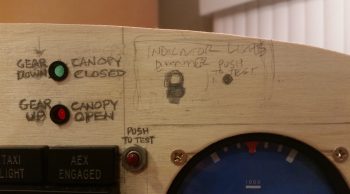
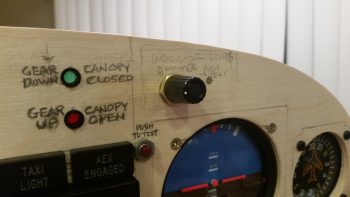
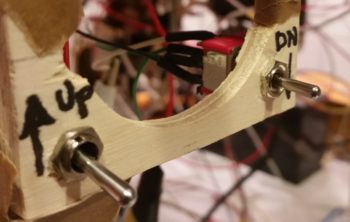
However, immediately forward of the cup holder for a good 1.7″, resides all the electronics for the aircraft’s 2 PAX heating systems: 1) Oil heat system, 2) Seat warmers.  These electronics include 3 individual relays, a PWM controller board and 4 switches (Oil heat/Seat warmer system select, PIC seat warmer OFF/ON, GIB seat warmer OFF/ON, PWM ON/speed control knob) on the surface of the very forward armrest at the base of the panel.  In other words, a lot of stuff that could require some type of maintenance, troubleshooting, definite mounting, and possible replacement.

It was clear then after some thought that the cupholder must be made removable, versus my original plan of slathering it up with flox and merely sticking it to the sidewall.

I made up some mounting wings out of some spare glass I had (the same stuff I used for the fuel select valve bracket mounting screw cover) and some G10, and 5-min glued them on each side of the flattest part of the cupholder . . .

I of course did this while it was laying horizontally, like this:

Before doing a final glassing of these mounting wings, I checked out the mounting fit of the cupholder in conjunction with the already test mounted throttle quadrant.  Since I dropped down the top mounting wings to clear the top forward throttle quadrant mounting reinforcement spacer, the cupholder looked like to integrate nicely.

I then whipped up some flocro, filled in the corner gaps between the cupholder body and the wings and glassed them with a ply of UNI and a top ply of BID.  I also laid up 1 small piece of BID to cover the last remaining inch-long gap on the bottom corner of the cup holder.  I peel plied all the layups and stuck the winged cupholder under the heat lamp.

BTW, that wood frame that the cupholder is surrounded by is the glassing stand I made for the left armrest.

Since I have so many pics in this post, I’m not covering my tasks chronologically, to keep from bouncing around topics with every new pic.  Thus, a few hours later, here was the result of my glassing on the cupholder.  I know it needs some cleaning up, a result of course of my initial screwup on not taping up the form!  Ahh, unintended consequences. But although being ever so slightly heavier, and much uglier, it will still do the job… and of course, except of the top opening, will be hidden away out of site like Quasimodo.

In the real world, while the glassed cupholder wings were curing, I grabbed my last little bit of 1/16″ thick G10 stock and got to work making a mount for the fuel vapor sensor.  I started off by making a cardboard template, then once I dialed that in, I transferred it to the G10.  In doing so I discovered that the mounting hole for the fuel vapor sensor is not 2-1/4″, nor 2″, but rather 2.034″ . . . some sanding required.

A quick discussion on the requirement for a fuel vapor sensor.  I got the idea of having a fuel vapor sensor, something that a lot of boaters have in their engine compartments, from some RV builders.  I had pulled it from the install line up, but with the GIB thigh support fuel sumps and a few fuel lines & connections in the cockpit, I decided since I had it on hand it was the prudent thing to do –at least initially– to install it.  I do realize that the grams start adding up into pounds, but this is really a lightweight, plastic housed instrument that it, combined with the wiring and aft-mounted sensor, weighs less than 4 oz.

I started by drilling a 2″ hole into the G10 plate.

After a few rounds of sanding I got the Fuel vapor sensor control head to slide into place.

Using my cardboard template I then finalized the shape of the mounting bracket.

I then used my trusty jig saw to cut out the fuel vapor sensor mounting bracket.

A quick test fit to confirm that the mount’s bottom profile was good.

And then, after sanding and cleaning the mounting site atop NB, I 5-min glued the fuel vapor bracket into place.

I then prepregged 2 plies of BID for the aft side, and 2 plies of BID sandwiching 1 ply of UNI for the front side.  I wet out the prepregged glass and laid it up on each side of the fuel vapor bracket.  I then peel plied the base of these layups.

Another look at the glassed fuel vapor sensor bracket.

While the fuel vapor sensor mounting bracket cured (under an added heat lamp as you can see in the pics below), I got to work finalizing the edge cleanup on the left armrest layup.

I then did a minor sanding on the front & aft outboard edge to get the left armrest to fit in place initially.  Although I still have a fair number of holes to punch into this thing, I have to tell you it was a great feeling knowing that my last armrest was glassed and that a task that I started over 5 years ago is finally complete!

After messing around with the left armrest for a while, I checked the layups on the fuel vapor sensor bracket.  The glass was barely pliable — I had let it go just a tad too long– so the razor trimming was a bit more of a workout than if I had caught it about 30 minutes earlier. Still, I got it rough trimmed to the point I could get the fuel vapor sensor control head installed.

To be honest, it felt as if I had mounted the fuel vapor sensor out from centerline a bit more than where I had originally set it in place.

I grabbed another shot looking straight ahead and it still seemed to be peeking out from the center panel strut just a tad more than it had in my original mockup.  Hmmm?

I finally decided that I couldn’t go to sleep tonight if I didn’t know exactly what the clearance would be between the fuel vapor sensor and my right leg . . . so I assembled all the dismantled pilot seat area stuff to allow me to climb in and check it out.  I have to say that it really presented no obstruction or clearance issues at all.  It IS CLOSE, but to touch it I have to force my knee unnaturally inward.  I still would have mounted it about 1/8″ to 3/16″ further inboard if I had a redo, but that’s more of a mental thing than it is a physical clearance issue.  Thus, this thing is pretty much in plain sight during my visual scan, being that I installed it about as far off CL as possible without having any leg clearance issues.
I may still sand down the outboard edge of the mounting bracket a hair just to keep it more in line with the instrument face, to keep any errant scrapes from happening during warm-weather flying in shorts.

This pic might provide a better visual as to the clearance I have between my leg and the fuel vapor sensor.  I’ll repeat that I had ZERO clearance issues, and that to actually touch the sensor to the point I really felt it, required in inward press on my knee that was not at all comfortable position-wise, and not from the pressure of the instrument mount.
Tomorrow I’ll continue to work on all this pilot area stuff, including populating the left sidewall with components. . . and getting the left armrest cut and shaped to both fit into its place on the left sidewall, but also to accept the throttle quadrant, cupholder, etc.
Chapter 24 – The Last Armrest

Today I started out by prepping the vertical wall and the narrow top piece of the left arm rest to micro & glass together.  I glassed one side of these these pieces, along with my other armrests, back in the 2012 timeframe.  I of course peel plied them and now it was time to remove the peel ply, which wasn’t too bad once I finally got a corner piece to grab ahold of.

I’m going to digress a bit from the armrest –which is really a basic micro together and secure with 2-ply BID tape deal– to do discuss a dire situation: my cup holder!  I have to tell you, I’m kicking myself for not grabbing a shot of the cured product before I pulled it off of its rather odd form: a kitchen fire extinguisher.  But I was looking for a 2.9″ diameter form and that was the only thing I could find.  Well, I didn’t follow protocol and take the time to tape up the very bottom with packing tape.  I did grease it down with a light coat of WD-40, but apparently that didn’t hold up to hours of cooking under a heat lamp.

Thus, I paid for my sin with quite a hassle getting the last 1/4″ of the bottom off the form… and man was it stuck! As you can see I had to resort to slicing the layup in half all the way around.  And I did NOT remove the bottom piece as you see in the pic below, it came off all on its own as a result of the brute force required to get these parts separated from the form.

Here’s the bottom of the fire extinguisher, replete with remnants of glass painfully extracted from my poor cup holder.  What’s a guy gotta do just to be able to have a cool beverage within reach while flying?!

Ok, so I micro’d and glassed the left side arm rest pieces together, and put it under the heat lamps.  Then after the initial repair layup on my sad cup holder, I put it under the heat lamps as well.

With my 2 layups curing under the heat lamps, I then got to work on the fire extinguisher.  I don’t plan on having the fire extinguisher sitting so deeply in its fiberglass mount (as I glassed it so high up), it’s just that since the fire extinguisher will be mounted on the same angle as the pilot seat, I’ll have to cut the mounting tube at an angle to be flush with the top of the armrest (see mockup below).  In short, I needed a longer mounting tube to allow for the mounting angle when I cut it.

As you can see, this layup extraction from its form –the actual fire extinguisher– went much, much easier (thank goodness!).

Here’s a peek into the inside of the fire extinguisher mounting tube.

Cleaned up extinguisher and its mounting tube.

Ahh, nice tight fit!

Here’s a basic idea where the fire extinguisher will get mounted.  Once the strake baggage area is cut out, I’ll turn the extinguisher 90° so that the gauge is facing forward and the handle overhangs just inside the baggage compartment.  This configuration may seem like it will get in the way of my elbow, but unless I push my arm back to a point that is uncomfortable, I won’t even feel it.  In addition and as I noted earlier, most importantly I’ll be able to reach it IN FLIGHT.

This may seem like the same shot as before, but this is showing the seam the I had to cut on the fire extinguisher mounting tube to remove it from its “form” resealed together by a cured 1-ply layer of BID.

By this point my 2 pieces of the left armrest were now just the left armrest. I then pulled the peel ply and cleaned up the glass overhanging on each end.

I then spent a few hours (yeah, it doesn’t seem like it should take that long!) first building a glassing stand, mounting the left armrest to the stand and then actually glassing the external surface of the left armrest.  Again, since I have a TON of spare UNI pieces I actually used 2 plies of UNI on this armrest vs the 1 ply of BID I used on the others to glass the top skin [Remember, since these armrests are now all removable, I’m not adding an extra layer of BID as per plans since the current structural strength is only for the armrest itself].

I wasn’t planning on peel plying the left armrest layup, but I accidentally poured way too much epoxy into the cup.  So, ended peel plying the layup and also glassing another couple of open areas on the seams of my now much happier cup holder.

Tomorrow I will continue working on getting the left side armrest installed, along with its ancillary components.


Chapter 23/24 – Throttle Quadrant & Armrest

Today I started out by removing the peel ply from the cured throttle quadrant mounting hardpoint layups and then cleaned it all up.  I then drilled the holes into each of the 4 hard points, removed the protective plastic wrap I had stuffed into each one to keep the nasty stuff out, and then cleaned up each hole to allow me to test mount the throttle quadrant.

I have to say it all looks good and I’m very pleased with the position of the throttle quadrant.

Today was more of an R&D day than it was a build day, as there was a lot of configuration stuff to figure out for not only the immediate throttle quadrant area, but the entire left armrest console. For example, when I placed the left armrest vertical wall in place, I immediately noticed that it “fanned” out in a way towards the aft end since the armrest wall was basically parallel with the centerline of the airplane.  This makes the side wall look as if it’s fanning out too, because in reality, well, it is since the fuselage gets wider at the pilot seat bulkhead.  This is probably even more pronounced on my plane since I have a more football shaped fuselage than do most Long-EZs.

I also needed to see how the seating space was affected in the pilot’s seat by this “fanned” out left armrest sidewall.  Interestingly enough, I had plenty of room either way as I wasn’t really pressed against either one.  I sat in the pilot’s seat a good 45 minutes simply taking notes and getting a good feel for how the ergonomics of possible configurations would work.  I will add though that the past few days, being able to actually sit in the cockpit and process ideas based on real dimensional data, have been invaluable.

Before I could decide to kick the aft end of the left armrest vertical wall outboard or not, I needed to know if the aft end would still allow me to mount the fire extinguisher in it since I really don’t see anywhere else to mount it . . . and keep it accessible in case of emergency [Side note: I’ve seen so many canard aircraft with fire extinguishers that are truly only accessible on the ground… not good in my book!]

So I drug out the fire extinguisher and low and behold, if I kicked the aft end of the left armrest wall outboard about a 0.25″ (e.g. narrowing) it will still allow me to slide the fire extinguisher in there . . . with a caveat: I’ll have to glass the aft end of the left armrest vertical upright with the inside glass laying up glass-to-glass with the glass on the exterior of the armrest console.  No big deal of course, just a bit more work.

With data in hand, I decided to go with the narrower, albeit straight, armrest configuration. So I was about ready to glass the top and side of the left armrest together and then the ancillary stuff, but honestly the armrest was the easier layup so I went ahead and knocked out the more difficult ones first: the glass sleeve (tube) that the fire extinguisher will get mounted into (on the left, pic below) since I won’t be using the included metal bracket; and the cup holder that I plan on installing just forward of the throttle quadrant.

Interestingly, I needed the ID of the cupholder to be 2.9″ and the only thing I could find that could be used as a mold (without making one from foam) was a small household fire extinguisher that I pulled out of my other house when I sold it (shown on right, pic below).

A point of note on these: due to the fact that I have a TON of leftover UNI from previous layups, I used it for the majority of glass in these 2 layups.

Tomorrow I plan to glass the left armrest top to the left armrest sidewall as the first thing on the build agenda.  Then while that is curing, I’ll pull the peel ply and clean & shape these 2 layups I did tonight.  I also plan on continuing in my quest to finish the left pilot armrest console so that I can press forward with the few GIB area and nose area items, including finalizing the install of the heat & air system.  This of course will be facilitated by my being able to install the 3 heat/air control cables into the left armrest.


Chapter 23/24 – Throttle Quadrant Install

I started out today actually redoing yet another round of updates on some wiring diagrams, since I had switched around some remote functions on the GNS480 handled by the 5-way castle switch.  I wanted to get the diagrams updated ASAP to reflect the changes before heading into the shop.

The weather was unexpectedly sunny & nice, so I took the opportunity to cut 4 beveled plywood hard points to reinforce the aluminum threaded inserts that the throttle quadrant will mount to.  I then rounded the corners with my sanding block.

A bit later I drilled the appropriate size holes and then trimmed the top 2 plywood hard points… this throttle quadrant is marketed more towards RV bubbas so it mounts a bit odd going into a Long-EZ with the top mounting bolts almost even (but maybe 0.050″ low) with the top of the throttle quadrant plate.  Not a huge issue, I just either had to trim down my top hard points or have to deal with them sticking above the top of the armrest.

To be clear, I had sat in the pilot’s for quite a while in an attempt to ascertain the right spot (for me) to mount the throttle quadrant.  Since I’ll have to redo the actual lever for the throttle handle I have some flexibility on the height and left/right position of the handle, thus the main issue to determine today was forward/aft positioning and did I want it sunken a bit below the surface of the armrest or not [I chose not].

This pic below jumps ahead a bit after I had decided where I wanted the throttle quadrant mounted and subsequently after the holes in the left fuselage sidewall were drilled.  I set the throttle quadrant threaded aluminum mounting posts into the holes, climbed in and ensured that this is where I wanted it before I finalized the install.  I did move it forward 0.4″ from my originally planned mounting position. As you’ll note by the pics below, obviously I liked this spot so I pulled the pressed forward with the install.

I prepped each threaded aluminum insert by taping up the outboard (open) ends of each one, and then bolting a tape-covered washer to the inboard open hole.  I then mixed up some flox and started by floxing the threaded aluminum inserts into each plywood hardpoint.  I then floxed the threaded insert/plywood hardpoint assemblies into their respective holes.  Of course the back (outboard) side of each plywood hardpoint was slathered with flox as well, providing a fair amount of surface contact area for added strength.

[In hindsight, if I had really taken note on how close the bottom 2 hardpoints were together, I might have just made one longer plywood hardpoint.  No worries though since what I used below worked fine too.]

While the floxed-in threaded insert/plywood hardpoint throttle quadrant mounting assemblies cured, I then prepped the layups by cutting and prepregging 2-plies of BID for each hardpoint.

After the flox cured the majority of the way, I then mixed up some more epoxy, wet out the prepregged 2-ply BID layups and went to work.  Here you can see all the threaded insert/plywood hard points glassed and peel plied.  I then set a heat lamp on them (….my shop was a balmy 66° F).

It was getting late so I left the threaded insert & plywood hardpoint throttle quadrant mounting assemblies alone to cure in peace while I went upstairs to get a bit of research in.  Tomorrow I’ll mount the throttle quadrant and dial in its exact, final location (left to right) in the left armrest console.  Then I’ll start the process of building out the left armrest as I install the console internals as well.  Again, this is still all part of the quest to get the lion’s share of the internal fuselage/cockpit components installed so that I can then install/construct/glass the firewall, nose & canopy.


Chapter 21/24 – Pilot thigh support done

I started off this morning, which was surprisingly rain free unlike the forecast had called for, by quickly getting the thigh support cover outside.  I set it up and then shot it with 2 coats of clear.

While the thigh support cover clear coat was drying, I took the opportunity to reinstall the fuel valve bracket and the actual Andair fuel valve.

A couple of hours later I installed the dry clear-coated thigh support cover.  Not surprisingly, I’m super happy with how it came out, both structurally and paint-wise.

Here’s a close-up shot of the support screw that secures the fuel selector valve bracket to the thigh support fuel valve pedestal base.

I made an honest attempt to finish installing the Dynon Intercom but was quickly reminded that I’m completely out of D-Sub connector pins and a host of other electrical supplies.  I put together an order on SteinAir and will pull the trigger either later tonight or first thing tomorrow after I do a bit more inventorying to ascertain my current benchstock levels.

Since I couldn’t wire up the intercom, I decided to make the forward pilot seat area fuel system video that I said I would a few months back when I made the GIB thigh support sump tank video.  So here it is:

After I messed around for a few hours filming, editing and uploading the video, I then spent well over an hour finalizing all the electrical diagram updates from the recent panel mock-up wiring.

Tomorrow I plan on sitting in the pilot’s seat (I wanted to give the clear coat a good 24 hours to dry before sitting on it) and figuring out the locations for the left armrest console components.  Also, I also plan to start the final installation of the Parking Brake pull T-handle and start on the nose hatch pull-to-open T-handle as well.  In short, I have a number of build tasks I can now start with the knowledge of my exact sitting ergonomics in hand.


Chapter 21/24 – Finishing fuel valve base

Today I started out by pulling the peel ply and cleaning up the side layups on the inside of the fuel valve pedestal base.  I was going to layup the entire rest of it, but then determined that since I had decided to use thin-walled 1/4″ aluminum tubing to make up the top rounded edge that I needed an inside wall to create the “U” shaped channel, or rounded groove, along the top edge of the pedestal base.

So I glassed the aft inside wall and just as I did with the side walls, dug the foam out of the edge of the thigh support plate below and filled with dry micro.  I then laid up 1 ply of BID overlapping slightly onto each of the previous interior sidewall layups.

I then put the layup under a heat lamp so that it would cure even more quickly, which it did.  A little over an hour later I pulled the peel ply and cleaned up the layup.

I then sanded the top of the pedestal base to ensure the top edge was even all the way around.  I then double checked the fit of the thigh support with its newly attached fuel valve pedestal in place around the fuel valve bracket.

I then spent a good half hour bending and shaping a piece of 1/4″ 3003-0 Versatube to create the top edge of the fuel valve pedestal base.  I considered using Nylaflow, but it’s really hard to get it to straighten out.  I also considered just shaping the foam by hand, but I changed my mind in having a bit higher edge around the fuel valve bracket, so I figured the aluminum tubing was very light and would fit the requirement nicely.

I failed to get any pics of the my ensuing tasks, but after I ensured the fit of the 1/4″ tubing was correct I then set it in place and filled in the gaps with micro and then glassed over the entire pedestal base with 1 ply of BID.  I overlapped the BID ply onto the thigh support cover top about a half inch.  When the layup was done I then peel plied it.

One question I had to answer was what to do on the front side of the fuel selector valve bracket, where its 6 attach screws reside.  Since this area will be the floor to my little impromptu bin –when required– I figured I would simply take some spare glass I had kept around for just such purposes, make a small insert plate, and then simply use a few dabs of RTV Silicon to keep it in place until such time as I may need to remove the fuel valve bracket.

I found just such a piece of glass in my spare parts bin that looked to be about 3 plies thick.  I marked out (amazing how clear this stuff is btw!) the dimensions of the cover plate on the glass piece.

And then sanded it, painted it with 2 coats of darker granite paint, then hit it with a couple coats of clear (not all in one shot, I’m jumping ahead with the pic below).

While the pedestal base layup was curing under the heat lamp, I then cut a piece of 1/16″ thick angled aluminum to create a support bracket tab that I’ll attach a nutplate to in order to allow me to secure the aft end of the cantilevered fuel valve bracket to the aft wall of the fuel valve pedestal base on the thigh support.

Here’s a closer up view of the fuel valve bracket screw support tab.

By this point the pedestal base layup was cured, so I pulled the peel ply and cleaned it up. I then spent a good half hour fitting the thigh support with its newly attached fuel valve pedestal in place around the fuel valve bracket.  With the extra ply or 2 of BID on the inside of the pedestal base wall, I had to do some aggressive sanding in spots and even resorted to filing a bit of the edges of the fuel valve bracket in some spots to get things to fit!  I underestimated how much clearance I would have so the fit was TIGHT!  But I eventually proved myself smarter than these inanimate objects and won! ha!

I then drilled a small pilot hole for the fuel valve bracket screw support tab.  I was off just a hair so I ended up making the hole bigger to use a #8 screw versus my originally planned #6 screw.  With my hole drilled, I then drilled and riveted the #8 nutplate into place on the front side of the fuel valve bracket screw support tab.

After beveling the hole with a countersink, I then tested out a screw to see how it fit.  I think this should do the trick nicely!  Also, while the pedestal base layup was curing I primed & painted the fuel valve bracket, as you can see in this pic.

Here’s a shot of the painted fuel valve bracket in its thigh support pedestal.

I quickly mocked up the fuel valve top assemblies (no actual valve here) as well as the forward screw cover plate to see how it was all looking so far.  I’m liking it!

I then sanded down and prepped the thigh support cover for a couple of lighter coats of primer.  Here’s the results after the primer dried.

Then, for the grand finale of the evening, I hit the thigh support cover with a couple coats of the dark granite paint.  I have to say, I really like my interior paint scheme so far.

Tomorrow it’s supposed to rain, but if I can I’ll sneak in a few coats of clear on the thigh support cover.  I’ll finish getting the fuel selector valve and pedestal squared away, then move on to figuring out the left armrest console.  I will also try to sneak in finishing the wiring on the Dynon intercom on the instrument panel mockup.


Chapter 24 – Fuel Valve Pedestal

I started off today doing a fair amount of updates to my electrical connector pinout diagrams for a bunch of the work I did on the panel last night.

I then got down into the shop to figure out the fuel valve skirt, pedestal, base . . . whatever it is that you’d call one of things!  Since the fuel valve sits higher than the thigh support cover, then I clearly need something to keep things from falling down under the thigh support, but also I want it all to look finished as well.  Another important function of this piece is that it will keep the seat cushion in place and from sliding forward.

I started by assessing and brainstorming what I needed and what I wanted.  I had a general idea –obviously– but the particulars have been germinating in my mind since the day I decided to place the fuel selector valve in the location I did.  After taking some measurements and playing around with the top few ideas on my list, I decided to keep the top level all the way around, so it’s basically a giant “U”, just flipped forward away from you.

I measured the depth at the back at about 1.7″, although it ended up being a bit taller on the very back part. The front was about 1.3″ high.  The bottom line is that I knew that I could use some of my 2″ thick urethane foam for this task.  I then made a quick thin cardboard template to figure out the lengths and slope on the bottom of the pedestal.  I then used the actual thigh support cover turned upside down to get the interior shape and dimensions transferred to the foam.  I then measured 0.25″ from the inside edge to give my sides, with a bit thicker area on the aft end for room to shape it around the actual fuel valve.  I then used my jig saw and on VERY slow speed cut this out in a very cautious manner.

Once I got the pedestal rough top view cut out, I then marked the sides using my template.  I then cut the lines to give me a straight top and angled bottomed pedestal piece.

I then tried it out on the thigh support by wrapping it around the fuel selector valve.  Of course it took about 15 minutes of the trial and error fitting-sanding-fitting cycle to do this, but I fairly quickly dialed it in.  A bit ironically (or stupidly!) I had the sides reaching forward where I needed them on the rough cutout and then ended up lopping them off too short!  I then had to make a little extension piece for each side and use needles to keep them in place.

You may be wondering, looking at the pic below, why I’m extending the sides all the way forward . . . well, I want an area that is a little sort of a tray, or bin, if you will, to hold small bits either in flight or especially on the ground.

I then mixed up some epoxy with fast hardener and whipped up some micro.  When I set the fuel valve pedestal foam piece in place I did cheat a little and used a spot of 5 minute glue about mid-point on each side.  After about 5 minutes of ensuring it wasn’t moving anywhere then I finished adding the micro fillets all the way around as you see below.

I then laid up 1 ply of BID all the way up the pedestal walls overlapping down onto the seat thigh support about an inch.  After ensuring the layup was all good I peel plied it since I’m going to add another ply of BID over top of it tomorrow.

I then went for pizza & beer with a buddy of mine and we decided to go see a movie. After I returned I decided to glass the straight sections on the inside of the fuel selector pedestal so that I would have glass curing overnight.  Since I used urethane foam on this, the walls are a bit flimsy and I wanted to beefen them up a bit.  So I laid up 1 ply of BID on each inside straight wall of the fuel selector pedestal, peel plied them and called it a night.  For now I stayed clear of the aft curved wall.

As you can see I also added some micro on the inside aft curved foam edge… actually with a little bit of cheater alcohol in it to make it much easier to sand (I learned this trick from Randi of Cozy Girrrls fame).

Here’s a shot of the interior right side glassed with 1 ply of BID (and the alcohol micro).

And shot of the right side as well.

Tomorrow I plan on getting the fuel selector valve pedestal base completed and move on to figuring out and building the pilot left side arm support & console.  If I get a chance, because I didn’t today, I’ll try to work on wiring up the intercom on the instrument panel mockup as well.


Chapter 22/24 – Coming together…

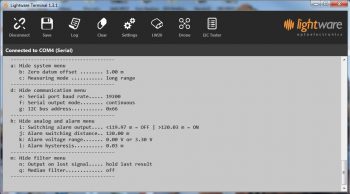
I started out today by doing a bit of electrical system administrivia until I could call GRT Avionics.  I then called them and left a voicemail detailing my tale of woe regarding the AHRS not talking to the HXr EFIS.  Within 15 minutes Mark from GRT called me back and within a minute I had the AHRS online.  It was simply a matter of setting the baud rate to 19200 (which I couldn’t find in the documentation) and it was off to the races from there.

While I had Mark on the phone we also worked through how to set & label some of the analog ports for my specific inputs such as the GIB thigh support fuel sump low fuel alarm. He had to do some digging around but he found the info that allowed me to set all my unique analog port inputs.

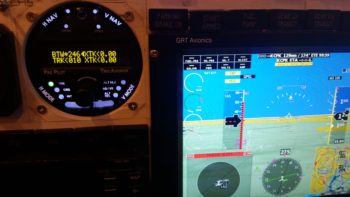
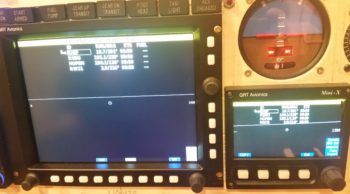
Here’s another shot with some slightly different screen views than above.

Upon checking my mail I found that I had received the 4″ USB dongle I ordered to connect the HXr EFIS display to the 4-port USB hub.  The USB hub connects items such as the Radenna SkyRadar ADS-B IN Receiver and by adding a little nub of a USB device also provides Bluetooth capability for the GRT EFIS system.  Specifically, with a small Android tablet the GIB will be able to see essentially the same info on the PFD as I do up front.

I then installed the USB dongle . . . this is the HXr EFIS side

And here is the 4-port USB hub side.  You can see there is not a lot space behind (again, technically “in front of”) the EFIS display unit.

I also received the parts from ACS that I was remiss in ordering in a timely fashion.  With the #2 CAMLOC receptacle in hand I then pressed forward with the pilot thigh support cover CAMLOC locking tabs installation.  Two items worthy of note on these CAMLOC tabs is that, first, I realized I did not have countersunk rivets large enough to mount the CAMLOC receptacles to the tabs…. hmmm?  I quickly determined that a #6 countersunk screw would do the trick so I rounded up some of those (I only had the fancy SS hex drive #6 screws that would work) and some locknuts and got to work.

The second issue was that the left tab would not sit flush with the lower instrument panel cross piece and that it really required some force to get the thigh support cover to seat down in its proper position.  Of course I didn’t notice this until the receptacles were mounted in place and the CAMLOCs were installed tightly.  I fiddled around with it for a bit and realized it just wouldn’t work with the bracket at a 90° angle since it was obvious the angle must be more acute.  I don’t really like bending composite components with heat because things can go south quickly, but I bit the bullet and did just that.  I used a scrap piece of wood to mount the bracket to and then judiciously applied heat and was able to bend the bracket into a more acute angle and . . . Voila! . . . worked like a champ!

Here’s another shot with the thigh support CAMLOC brackets ready to be floxed into place into the fuselage at the base of the instrument panel bulkhead.

Ahhh, this familiar site!  What could it be??  Well, this time around of course it’s the thigh support CAMLOC brackets floxed into place and curing.

While the thigh support CAMLOC brackets cured, I prepped the Trio autopilot pitch servo for removal.  I needed to remove it for a twofold purpose: 1) I needed to repair 2 of its P3 connector pins that were NOT toning out, and 2) I needed to hook it up to the panel-mounted Trio autopilot control head for testing.

I forgot about the cool looking base floxed into place inside the right side of the nose, so I figured I would grab a currently rare shot of no pitch servo mounted on the side wall.

A bit later, after I confirmed the flox had cured, I pulled the weights off of the pilot thigh support cover and checked the fit of the now CAMLOC-secured cover.  Bottom line, as my buddy Dave B. from OZ would say, “It works a treat!”

Here are the left and right CAMLOC receptacle brackets now permanently floxed in place at the base of the instrument panel.

And here’s a shot of both thigh support CAMLOC receptacle brackets.

As I finished wiring up the Trio Pro Pilot autopilot into the instrument panel mockup, I first repaired the 2 errant connector pins on the pitch servo and then connected both servos to the Trio autopilot control head.

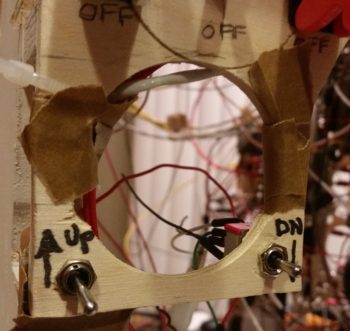
I also ginned up a quick little mount for a temporary autopilot disconnect switch just in front of the intercom.  I picked this spot since my actual autopilot disconnect switch is on the control stick.

BTW, the connector you see in the Adel clamp attached to the outside upright of the instrument panel mockup base is the P5 connector, which attaches to the control stick cable connector.

Although I temp-mounted the GNS480 GPS antenna puck last night, I thought I’d get a shot of that and the newly connected Radenna SkyRadar-DX ADS-B IN receiver sitting down low in front of the instrument panel mockup base.  You can see that I zip-tied its own GPS antenna puck to the top of it, this making GPS antenna puck number 5 that is currently connected to this panel mockup!  If you’re curios, here’s the list:

      1—GNS480 GPS Receiver
      2—HXr AHRS
      3—Mini-X EFIS
      4—TruTrak ADI
      5—Radenna SkyRadar-DX ADS-B Receiver

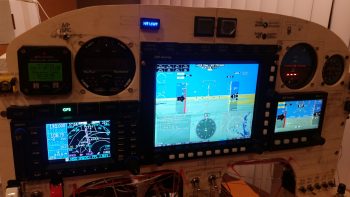
Ok, so here’s the latest shot of the mocked up instrument panel, ready for official power-on test #2 . . . which means that I am really just checking out my Trio autopilot wiring installation.

And here’s the panel with power fired up again.  A quick note that not only did I resolve my AHRS connection issue, but I was able to tweak my GNS480 external annunciator lights and rewire the OAT probe on the MGL clock, so all of my 3 issues from yesterday are resolved.

My last act of the evening, as I was doing some minor configuration inputs on the Trio autopilot, was to personalize that sucker to make it MINE!  [Note the blue GPSS LED light lit up as the Trio AP is talking to the GNS480 GPS receiver…]

Alrighty then my friends, tomorrow I plan to work on both the thigh support cover piece that will wrap around the fuel selector valve to finish off the thigh support install, and also work on finalizing the Dynon intercom wiring connections as much as possible.