Chapter 3 – Getting old & tooling up!

Around the time of my last post, my old age (and previous injury) showed up as I threw my back out, majorly.  I figured it would last just a few days but it was fairly severe for well over a week, and I’m just now getting comfortable doing some stuff without crazy pain.
As I was researching a new 3D printer to replace Bob, I found a couple of things that intrigued me greatly.  First, was the new plethora of high-end carbon fiber filaments that can be 3D printed (on a higher end 3D printer) to create some phenomenally strong parts.

Next, was a 3D printer that could print those carbon fiber filaments in not only an enclosed unit, but way faster than what I’ve ever been able to print and with a build volume that is quite impressive.  The only catch is that you have to either spend well over $10K for one of these 3D printers …. or, you can use one of the many published open source design machines that are out there.  Uh, just one catch on the latter: you may be able to find one second-hand, otherwise these have to be built versus just shelling out a large chunk of cash.

One such 3D printer that I seriously had my eye on was the Voron 2.4.  Although you can self source the materials to build one, there are a few different companies that sell kits with just about everything you need… except one major thing is not included: 3D printed parts.

If you’re interested, here’s a pretty good overview of the Voron 2.4:

You see, the major components (brackets, connectors, housings, etc.) of these 3D printers are ABS plastic, that you can either buy outright or print yourself.  This is one reason I went with the Sovol SV-06 3D printer, because at some point IN THE FUTURE I planned on definitely building one of these beasts.  And since I’m a) cheap, and b) wanted the experience, I would do my own 3D printing of the ABS parts.

The future is now!

Then I threw my back out.  In between stretching and back exercises, I spent a good bit of time on the computer researching both Long-EZ build stuff and 3D printing stuff.  I think boredom got the best of me and during my research I ran across an open box Voron 2.4 kit on Ebay selling for hundreds less than currently available elsewhere… yep, I pulled the trigger.

Here’s the unboxing and inventorying of the kit.

Once I pulled the trigger on the kit, I started 3D printing the ABS parts in earnest.  I had “Sally” (the new printer) working just about 24/7 printing out the parts.  I had a box of unopened black ABS on hand for over 6 months that I was going to test out with Bob, but never got to it.  So I used it as my main color for the Voron 2.4.

My plan was to work on the Voron 2.4 3D printer until my back was better, just another few days I guessed.  But this was one bugger of an injury, and I was still pretty tender for another week plus.

Since Sally was doing the major work at this point, it allowed me to recover in a decently leisurely fashion while still getting something accomplished.  It really didn’t take long to assembly the parts once I had the 3D printed parts created.  I would construct the parts for a bit, then take a break, do my back stretches, do more prints, more back exercises, more assembly, etc.

Here’s some more parts of the Voron 2.4 being assembled.  I decided to use blue as my accent color and ordered a roll of ABS from Amazon, which I had in hand a few days later.

The Voron 2.4 uses linear rails for all the axes so it is very stable, which is obviously a requirement to allow printing at high speeds.

Just some examples of a few more black and blue 3D printed ABS parts.  I have to say, although somewhat slow, Sally did a great job of printing out these parts and the enclosure on the Sovol worked a treat.

I do plan on getting back on the plane build as soon as possible, and have been doing some good research on that as well (I’ll report on all that as I come to those components during the build).  In the meantime, I’ll continue to putter around like an old man and at least get this Voron 3D printer as far along as possible until I jump back on the plane.

Chapter 3 – Bob is dead :(

Or shall we say Bob (my 3D printer) is currently in a coma and non-responsive.  Alas, it was a good run Bob!

Here’s the story.  After I printed out the oil dipstick/filler tube extension, I not surprisingly had a number of other parts in the queue to 3D print.  I got a number of those items printed over the next couple of days and was doing a fair bit of CAD work as well.

Then out of nowhere Bob up and died.

I spent a good couple of days troubleshooting Bob’s ailment, but much like today’s doctors I couldn’t figure it out, so I left him to die… alone… in the corner. (ha)  [I’ll fix him later when I have time to troubleshoot EVERYTHING].

If you’ve read more than just a couple of my blog posts or have watched any of my videos, you know that 3D printing has become indispensable to me for modeling up or making Long-EZ parts.  Especially checking out fit, function and design before machining parts.

I spent a couple of days researching a replacement 3D printer that wasn’t going to break the bank, and also wanted to ensure the printer was configured such that would allow me to somewhat easily relocate the major components (power supply, electronics, and control screen) off the frame to enclose it for 3D printing ABS.

The answer was this machine: the Sovol SV-06.

With a pretty good idea of what my plan would be to enclose this 3D printer, I started collecting/buying materials and slapping stuff together immediately after I pulled the trigger to buy it.

A few days later I received the new 3D printer and had it unboxed and together in 20 minutes.  Within the next couple of days I had it dialed in and printing well.  And also enclosed in my hack, makeshift enclosure (I have front doors for the enclosure but got so busy printing that I resorted to merely shoving an insulated foam board against the front to keep the heat in . . .  combat 3D printing!)

So I’m back up and running with a working 3D printer, and am loving my new capability of printing ABS!

Moving on!

Chapter 23 – Oil dipstick tube

Over the last few days I’ve been involved in trying to figure out a solution for my oil dipstick/filler tube.  As you can see, the wide area at the top of the oil filler tube is uncomfortably close to the engine motor mount tube.  In fact, it’s so close that since the engine has been installed to the motor mount, I have NEVER had the dipstick in place… it just won’t thread in with the wider dipstick handle preventing it from being installed.

I know in the past builders have manipulated the length of this oil tube (usually shorter) with cutting it and then wrapping it with fiberglass.  Due to the position of the top cowling oil dipstick access door —to check the oil level pre-flight— I certainly don’t want this oil tube shorter… I want it readily available just inside the cowling access door to avoid any mandatory crazy gymnastics (on my part) to simply check the oil (e.g. such as having to climb into the back seat, etc.).

In lieu of my previous post on this subject, I modeled up an extension in Fusion 360 CAD and after too many attempts was finally able to get my 3D printer (AKA “Bob”) to print it out.  Note in the pic below the lower right was the bottom of the print, the upper left was the top and final portion to be printed out.  I point this out since in Fusion 360 when creating threads, there’s a little tick box that is used when you want to physically model threads vs simply have them show up on screen.  I (apparently!) forget to tick that block and was unpleasantly surprised to find that my part printed out sans threads (male) on one side.

The inside threads, for the dipstick, did print out.  Although the tolerance is a bit too tight and I had to really use some force to get the dipstick threaded in to the point it is in the pic.

This 3D printed extension is still just part of the info and data collection phase, R&D if you will, and I’m still looking at all available options.  That being said, the primary downside of this adding-an-extension method to fix this issue is that the widest part of the oil tube is still very close to engine mount tube.  Should I leave the small gap or simply pad it and secure the oil tube to the engine mount tube somehow that avoids vibratory chaffing but still allows movement betwixt motor and mount?  Moreover, if I did make the extension would it be some type of heat resistant plastic or machined out of aluminum?

Clearly one of the best options would to simply get a taller oil dipstick/filler tube where the actual tube part is narrowest as it crosses the area of the engine mount tube.  I’ve done a very initial look at those, but am hesitant to plop down nearly $200 for a new tube just yet!  Clearly I’ll flush out all available options first.

Finally, I will note that I did buy a length of solid 3/16″ 6061 aluminum rod that I will replace the current dipstick rod with once & however the oil dipstick tube has been increased in height.

Chapter 23 – Exhaust pipes trimmed

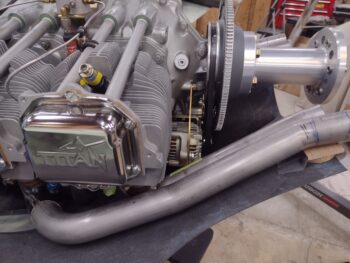
Today was all about completing the long-overdue exhaust pipe surgery to better allow the exhaust pipes to fit inside the lower cowling.

I spent a good couple of hours going over my notes and finalizing the no-kidding plan on how to proceed with getting the engine set and the bottom cowling fitted into place.  Step 1 was to trim the exhaust pipes at the top flange on both male and female sides of the slip joint to then assess if the trimming resolved the clearance issue between exhaust pipes and lower cowling.

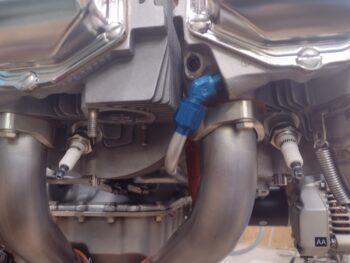
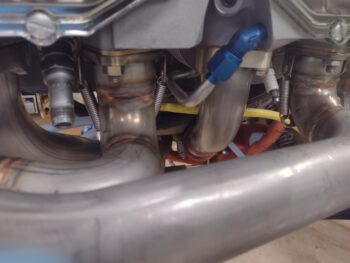
I grabbed these shots of cylinder #1 and #3 exhaust pipes to ensure I captured exactly how the springs needed to go back on.  Speaking of the springs, I had whole-heartedly expected to have needed to replace the springs, but due to the comparatively scant amount of trim material (more on that below) and the twist of the pipes stretching the springs when mounted on the cylinder, I don’t see that new springs will be required.

After speaking with Clinton from Custom Aircraft Parts in early February about my exhaust pipe vs cowling clearance issues, he told me that they couldn’t custom re-weld my exhaust pipes without my bird physically there… and I get that.  If one or two welds or angles needed to be tweaked, as would have invariably been the case, then sending the pipes back and forth for the mods would have been a few hundred dollars just in shipping alone.

Clinton told me about the option of trimming the inner and outer slip joint tubes to lessen the overall height of the pipes, but cautioned that I should leave at least 3/4″ of mating tube between the flange side and the pipe side to ensure no exhaust leaks.

While I was talking to Clinton on the phone, and what I reported in my 3 Feb blog post was that I had 1.2″ of slip joint tube between the underside of the flange to the end of the weld where the outer slip joint tube was clearly visible.  Thus I planned on removing a 1/2″ and leaving 0.7″ for the slip joint.  EZ-PZ.

However, when I actually disassembled the exhaust pipes and measured the slip joint from the INSIDE, I found a slightly different story.  I didn’t have 1.2″ worth of slip joint tubing, but rather just under an inch: about 0.97″ on average.   To maintain 3/4″ material between inner and outer (male and female) mating tubes of the slip joints, this only gave me 0.23″ to trim off.

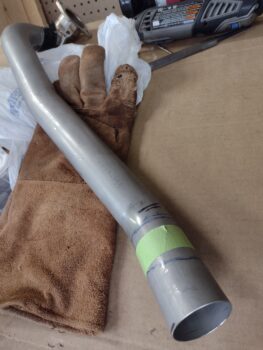
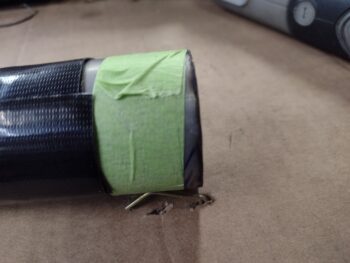
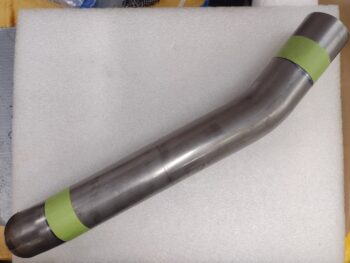
Well, a 1/4″ is better than nothing in the tight, confined spaces of my cowling situation, so I got to work.  I marked 0.23″ from the edge of the slip joint tube and then taped around my marks.  I used my Dremel Tool with a cutoff wheel and carefully cut up close to the line.  I then used a file and finalized the trim before cleaning it up with emory cloth.

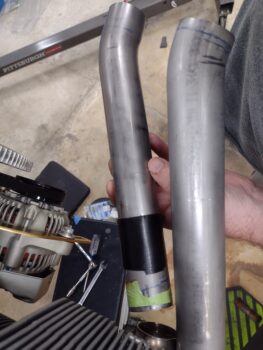
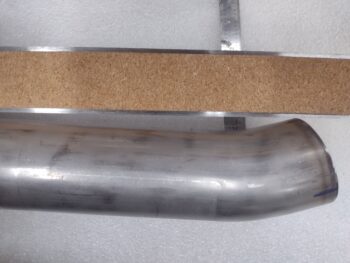
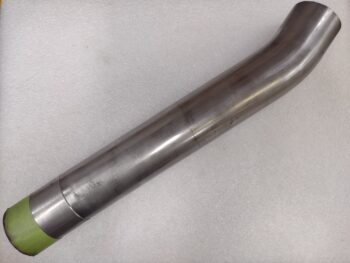
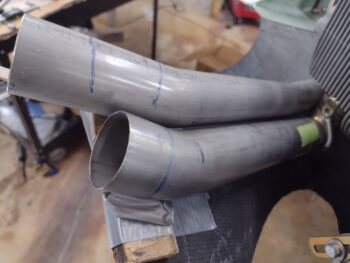
Here we have cylinder #1’s (on the right) exhaust pipe flange side of the slip joint trimmed by 0.23″ and cleaned up.  Cylinder #3’s untrimmed flange-side slip joint is on the left.

I then repeated the same process on the actual exhaust tube side: marking 0.23″ from the edge and then carefully cutting the tube with my Dremel tool.

I then test fit the trimmed cylinder #1 exhaust pipe.  The springs were still somewhat of a PITA to get back into place, which told me they had at least some decent spring holding action.  With the slip joint design, the pipes have to be turned at an angle from the mounting flange which stretches out the springs even more… so even though I removed 1/4″ out of the distance that the springs were holding, I don’t see any noticeable difference between the trimmed exhaust pipe’s spring holding power vs cylinders 2 and 4 on the other side (clearly I compared them).

After declaring cylinder #1’s exhaust pipe trim successful, I proceeded with trimming the height of cylinder #3.

I’ll note that the slip joint on cylinder #3 couldn’t really be classified as such since it was too tight of a fit and I had to use considerable force to get the flange side out of the tube side.  After I trimmed off 0.23″ from the flange side, I spent a good 10 minutes wet sanding the interfacing surface of the slip joint tube.  I then did the same on the inside of the exhaust tube side of the slip joint after I trimmed it, and also worked it back and forth a bit as well to ensure it was in fact a true “slip joint” in operation as well name.  All the slip joint fits on the other cylinders’ exhaust pipes were fine.

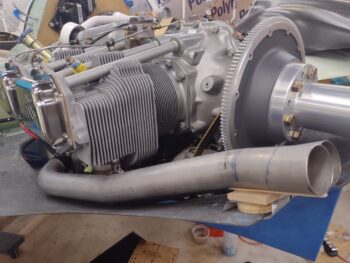
I then trimmed the exhaust pipes for cylinders #2 and #4 as well (right pic).  Here we also have both exhaust pipes on cylinders #1 and #3 in place too (left pic).

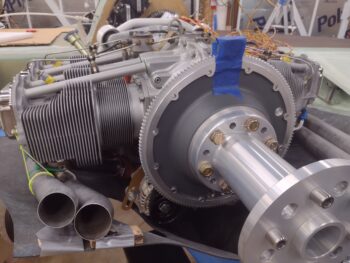
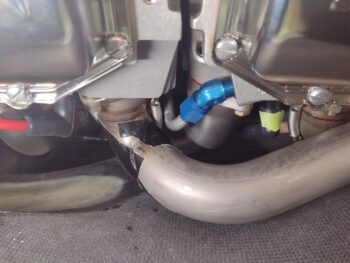
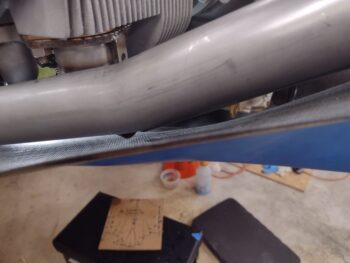
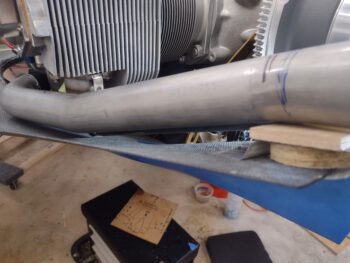
Some wider angle views of the trimmed exhaust pipes mounted onto the engine.

And a shot of all the trimmed 0.23″ rings I removed from the pipes.  I of course had to weigh them out of curiosity: 1.6 oz of weight savings!

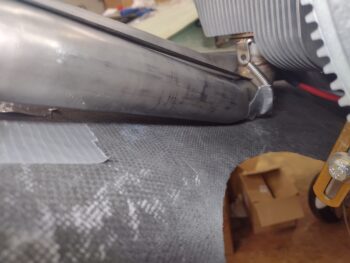
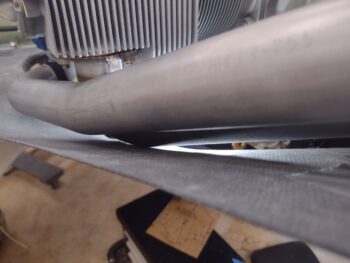
Then came the real test: would the lower cowling fit with the exhaust pipes mounted in place?

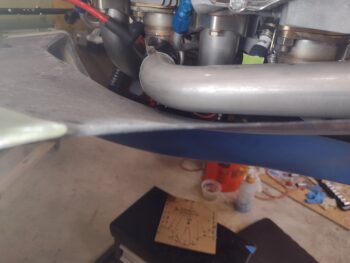
The good news is that I was able to easily mount the lower cowling with the exhaust pipes in place, which I wasn’t before if the left exhaust pipes were mounted.

The bad news is that the left exhaust pipes are still too low and too close to the cowling to simply press forward with the engine and upper cowling install.  The bottom line is that I’m going to have to do a considerable amount of bottom cowling rework, about the aft 25% I’d guesstimate.  Since I will now have to engage in significant cowling rework anyway, part of my rework will be to open up the lower cowling center aft area to allow me to fit the flow guide of the bumble bee/Hershey kiss spinner in place.

I still have the lower engine mount bolts that need final torque and cotter pin (left side) replaced, which I will do tomorrow as well as start the initial sanding of the cowling and planning for just how I will modify the cowling to provide the proper clearance for the exhaust pipes and spinner flow guide.

Chapter 23 – Video Update

Today I spent a few hours filming, editing and finishing up a video that I’ve been working on the past few days that I wanted to get out before throwing myself headlong into working on the engine install.

This video covers the Fuel Injection Servo configuration and install, the air induction system and the RAM air can ops, including some footage of the new lever and actuator in action as they manipulate the RAM air can butterfly valve open and closed.

Tomorrow I have a bunch of errands to run, but I do plan on starting back to full time work on the engine install Saturday.

Pressing forward!

Chapter 22/23 – Some quick tidbits

Today I spent good little bit finishing up taping some content for the next video in the queue, which I should have out tomorrow.  I also spent well over an hour editing the new content before getting a bit of work done in the shop.

The bolts for the engine plenum-mounted throttle cable bracket have the drilled heads for safety wiring, but like the bolts on the mixture cable bracket, these too are short-threaded with the threads only going up halfway on the bolt shank.  I mounted them in the lathe chuck and added a good 3/16″ more threads with a die and then cleaned them up for mounting to secure the throttle cable bracket.  I also used blue Loctite and then wired them after I torqued them to around 100 in-lbs.

Not a perfect safety wire job, but it will do for now.

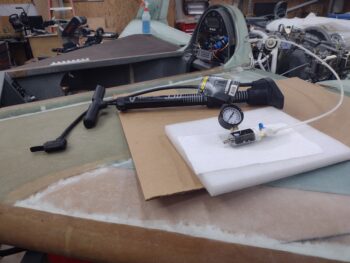
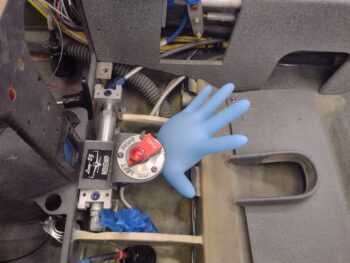
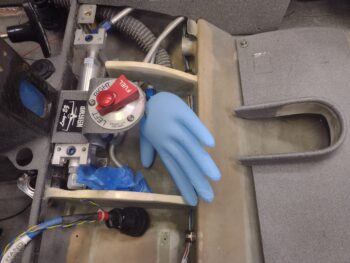
I also wired up the RAM air lever actuator in the hell hole.  I tried to use simple crimp-on butt splice connectors, but the actuator wires are too small… even with the wire tripled up it pulled out of the first connector when I did the pull test.

So I carefully soldered spliced the wires together and then covered the splice with heat shrink.

The test from the wires behind the panel to manipulate the RAM can butterfly valve open/closed worked a treat… so one more task complete and in the books!

I have at least a good hour of editing left on my next video that I want to get posted before I move onto working full bore on the engine install.

Chapter 23 – Throttle/mixture final steps

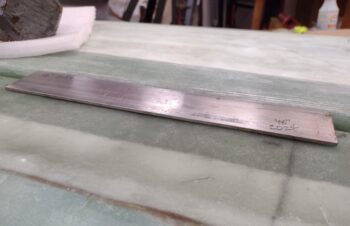
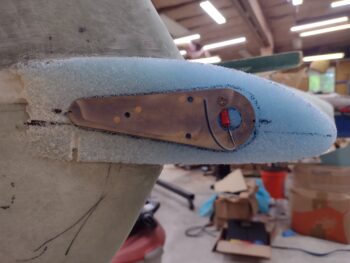
I started off first thing this morning by Dremeling, sanding and cleaning up the back (outboard) wall of the throttle friction lock pocket in the armrest.  Although the stainless steel plate I then floxed into place is only 0.02″ thick, I tried to make it so that it had zero intrusion into the vertical plane of the slot that the lever pivots in.

I did expose a few areas of foam as I prepped the back wall area, so I used wet micro on those, and on the other areas I used flox before clamping the stainless steel backplate into place.  I then left it to cure.

A task that I’ve had on my to-do list for awhile was using a die to add more threads to the cold air plenum mounted throttle and mixture cable bracket bolts.  These bolts have drilled heads for safety wire, and are pretty much the correct length (with an extra washer or two) but the threads only go up about half way on the bolt shaft as you can see below in the comparison to a fully threaded bolt.

I secured the die in the chuck jaws on my lathe and used a wrench to turn the bolt to add more threads to the 2 mixture cable bracket bolts.

Here’s the first of the pair of mixture cable bracket bolts.  After I installed these I did another short segment for my video.

And since the flox was cured by this point on the stainless steel back plate on the armrest, I pulled it and redid that segment as well.  I then threw those into the video, did a quick edit and posted the video online.

Here it is.

I have another video in the works on the Fuel Injection Servo, the air induction tube and RAM air can that I’ll be working on/finishing up over the next couple of days, along with a bunch of smaller tasks on my to-do list.  I expect within the next 2-3 days I’ll be back on the engine full bore, beginning with trimming and dialing in the exhaust pipes vs lower cowling.

Chapter 16/23 – Friction lock backplate

I spent a good portion of the day off and on editing a bunch of video footage I took yesterday on the installation of the throttle and mixture cables, quadrants and levers in my attempt to get it finished and uploaded.

However, I wasn’t happy with the video segment that I started to shoot with the front left armrest in place.  The outboard back wall of the throttle friction lock pocket was all torn to hell from the screw of the knob rubbing on the paint, so I decided to finalize the configuration for the throttle friction lock pocket back plate and get it in place before finishing up the video.  I was half-heartedly thinking I would just leave it until after first flight since it was just a cosmetic issue although I was prepping to work it in between other tasks as time permitted, but it just looked too nasty to wait.

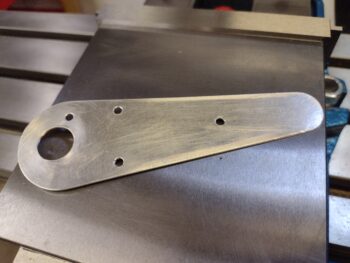
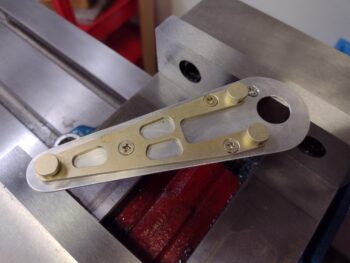
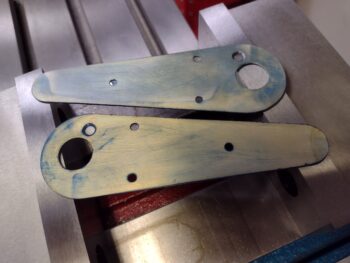
So It took another half-dozen iterations to get it right —testing the fit with 3D printed mockups— before I was happy with the final fit.

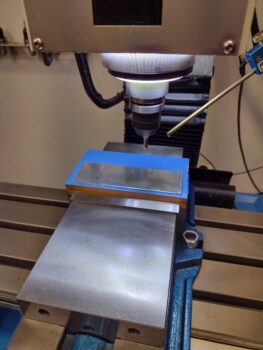
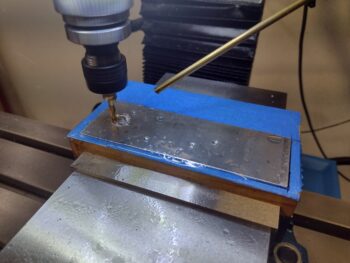
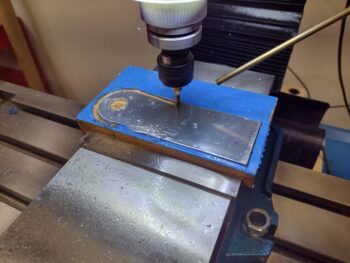
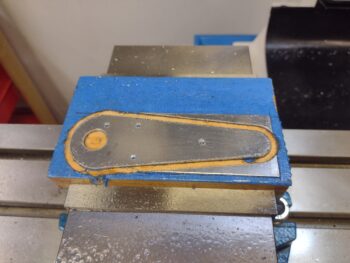
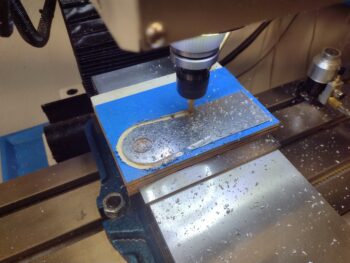
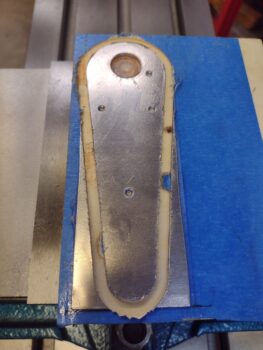
I then spent a good little bit of time researching machining stainless steel and prepping the thick plywood machining base to machine this piece.

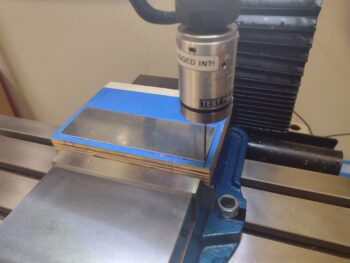
I actually machined just the plywood base to clear out any wood that would cause resistance to the end mill.  In addition, I wanted to cut up high on the end mill so that if this 0.020″ thick piece of stainless steel wrecked my end mill, it would be high up on an area that I don’t normally cut with.

That being said, I should have re-probed my end mill #2 because the tool holder just kissed the top edge of the stainless steel plate and made some nasty marks on it.  Thus I had to do the whole process twice (ugh!).

I had planned on prepping the armrest and getting this back plate floxed in place, but it was getting later into the evening and Jess was over cooking dinner… so I just called it a night and will re-attack this tomorrow.

Chapter 23 – GIB throttle final install

I started off this morning with trimming the GIB throttle cover for a final time as well as sanding the edges.

I then mounted the GIB throttle cover back in place to check that the final fit was good before pressing forward with my paint antics.

Which I did next.  I taped up the carbon fiber bottom area on the cover in prep for paint. I then shot a couple coats of primer and the gray granite paint (see below) and set the cover aside to dry.

While the primered and painted GIB throttle cover cured, I then pulled the tape and peel ply from the 2-ply BID layup over the pair of clickbonds mounted inside the hell hole high up on the front side of the firewall.

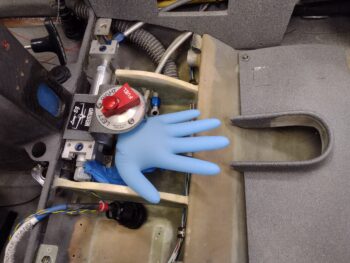
I then mounted the RAM air can butterfly valve actuator onto the 2 clickbonds and tested out the functioning of the actuator in manipulating the butterfly valve open and closed. The actuator opening and closing the valve worked like a champ.

I then mounted the GIB throttle lever to machine it to shorten its length.

Here are some action shots of the GIB throttle lever being machined to shorten the overall length of the lever.

Here is the shortened GIB throttle lever, ready for install.

Which I did here.  I will note that after dialing in the final configuration and pivot action between the front throttle quadrant lever and the GIB throttle lever, that I had to drill another hole closer to the bottom edge of the lever to get the pivot just right.

This was the final task on the GIB throttle install and I’m calling it officially complete.

A number of hours later I put the painted and clear coated GIB throttle cover back in to check to see how it looked… I have to say I’m very happy with how the rear seat throttle installation came out.

Still working the GIB throttle, I then did the final attach of the slaved GIB throttle cable to the pilot throttle lever with a clevis pin secured by a cotter pin.

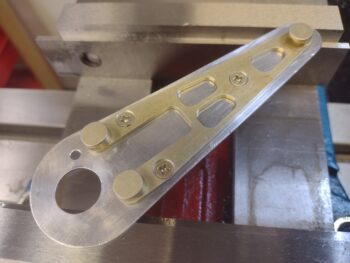
Back in the house for the evening, I modeled up a few versions of what will be the protective back plate that I’ll attach inside the throttle friction lock pocket to keep the actuation of the throttle friction lever from scraping the paint off.

Here we have a shot of where the throttle friction lock pocket protective back plate will go… I’m going to attempt to make it out of thin stainless steel to withstand the upcoming years of scraping it will receive from the screw securing the throttle friction lock knob to the lever.

With that, I called it a night and will continue to press forward tomorrow!


Chapter 23 – GIB throttle + RAM can

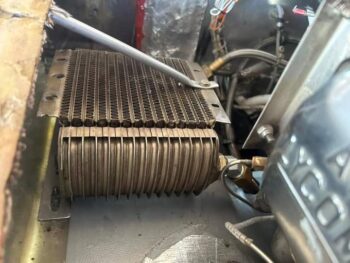
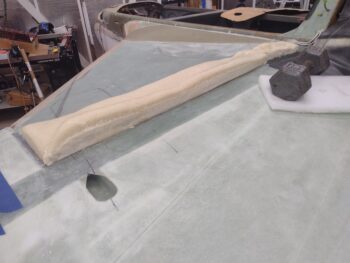
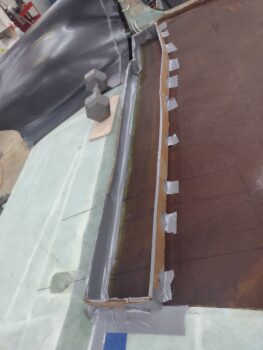
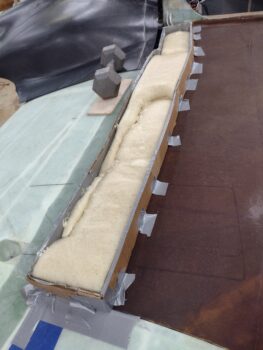
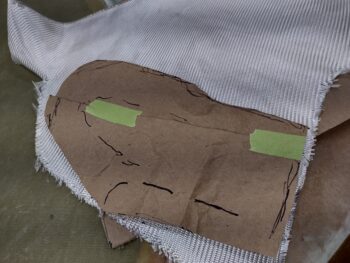
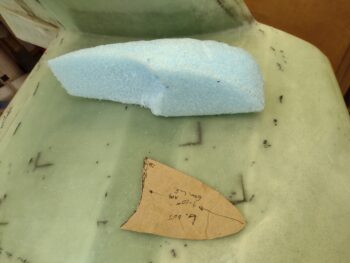
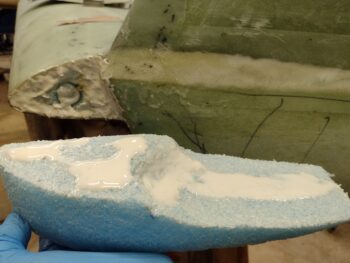
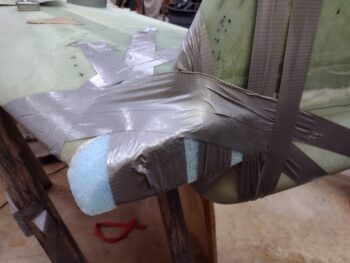
I started off this morning spending a good 45 minutes creating a form out of cardboard and duct tape for the remaining portion of the cover for the GIB throttle quadrant, cable rod end and 3 transiting throttle and mixture cables across the face of the oil heat exchanger.  In my mind I figured I would have to do 3 different rounds (or phases) of layups to construct the cover, but I was able to knock out both my planned Phase II and III in one fell swoop here.

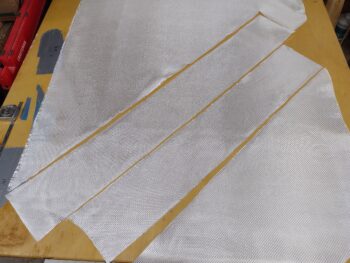
I then laid up 2 plies of BID, a partial ply of Kevlar —where you can imagine a foot stepping onto or scraping against the inboard “horn/long funnel” shaped area— and then a single ply of Carbon Fiber nearly full size.

Note how the cover is laid up around the aft edge & inboard face of the initially glassed cover piece.  Also note how it is anchored on the forward end by resting on (or very closely) to the Adel clamp that secures the 3 transiting throttle mixture cables heading towards the pilot throttle quadrant (though not visible… trust me, it does).  On the aft side the cover rests upon the top front edge of the GIB thigh support.

About 6 hours later I pulled the GIB throttle cover off the mold, pulled and discarded all the tape, cardboard and peel ply.  I then did a quick trim of all the un-wetted out glass/CF.

Speaking of peel ply, see the seam between the carbon fiber and the 2 plies of BID (which aren’t clearly visible) that I peel plied?  This is essentially the paint line where everything above that will get shot with primer and the gray rock/granite paint, and everything below that simply left as bare —probably clear coated— carbon fiber.

I then cleaned up the edge with the Fein saw for a secondary trim…

before remounting the cover back into place around the GIB throttle quadrant.  Admittedly, I am getting just a hair bit of interference with the lower headset jack when putting the plug in or taking it out.  If I pop off the screw at the RivNut I can press the cover down to give me that 1/8″ I need to get the lower jack in and out…. yes, I was trying to have full unabated clearance for both jacks, but space is so darn limited I’ll take what I can get here.

It was mid-evening by this point, with rain off and on all day… so I simply left the cover in place to get a solid overnight cure before I start sanding and painting it tomorrow.

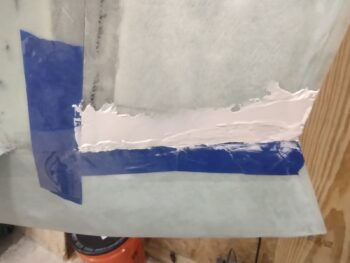
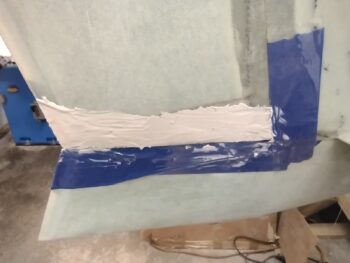
After testing out the RAM air can lever actuator to ensure it functioned as designed (pics of it installed coming tomorrow) in opening and closing the RAM air can butterfly valve, I then taped up the actuator mounting bracket and floxed 2 Clickbonds to the face of the firewall inside the hell hole.  A few hours later I cleaned up the Clickbonds and laid up 2 plies of BID over them, peel plied the layup and then left it to cure overnight.

Tomorrow I’ll finalize the trimming and shaping of the GIB throttle cover before commencing its painting and clear-coating.  I also plan on trimming (machining) the original GIB throttle quadrant lever to install that for a final time… once I verify the lever & cable pivot is dialed in between pilot and GIB throttles I’ll install the clevis and cotter pin on the GIB throttle cable on the pilot throttle quadrant.  Once all these parts are back in place, I will officially be complete with the throttle and mixture cable install from engine-mounted fuel servo, to front seat throttle quadrant with slaved GIB throttle.  I should also have the RAM air can butterfly valve lever, actuator, switch and wiring all installed and complete tomorrow as well.

Pushing forward!