Chapter 23 – Fuel pump cooling shroud

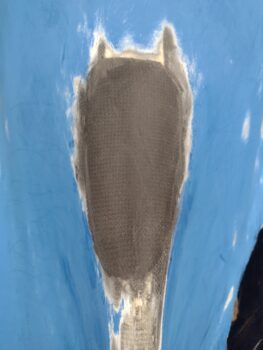
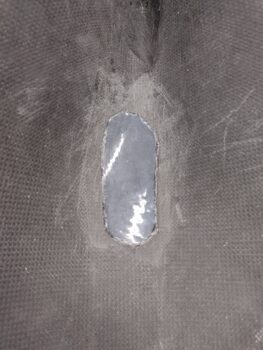
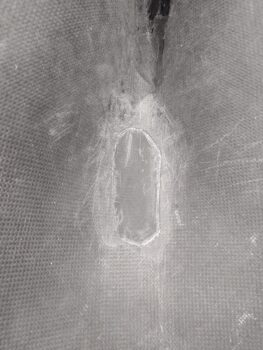
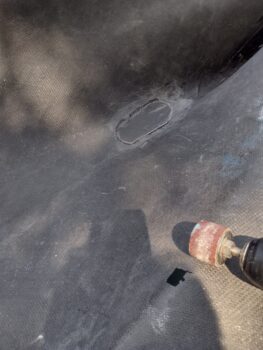
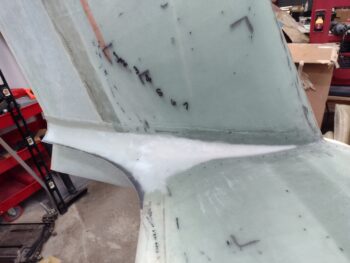
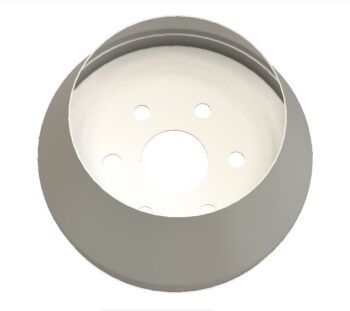
My primary goal today was to produce a usable plug to use in glassing (mainly carbon fiber) a cooling shroud for the engine mechanical fuel pump.

As with many of my self-designed parts, this was definitely an iterative process.

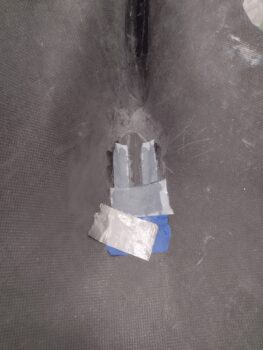
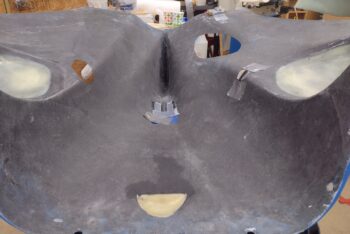
This is the point I got to late last night as I kicked off the 3D print for this guy below.  That print took nearly 3 hours and it was still whirring away as I went to bed.

This morning I test fitted it.  Although I clearly thought I had nailed the side protrusion that allows the fuel pump overflow fitting boss to fit under the cooling shroud, I was off by about 0.12″ each side.

It took about 3 more prints to dial this in and then pretty much a remodel in CAD to get the final product.  I kicked this nearly 5-hour 3D print off early evening and made some much overdue phone calls (as well as dinner) while it printed out.

In all actuality, I designed, CAD modeled and printed the small top cap piece first since it only took about 30 minutes to print and then verify fit.  Then I kicked off the big mo-jamma plug.

The reason for the separate pieces is simply for ease of 3D printing.  The big plug is much easier to print with the flat top down and then simply have the sides build up.  The same too in the inverse for the top cap with the tabs that are sticking up.

I had wanted to get this piece glassed up tonight, but with the multiple versions and the long print time, it is what is.  My plan is to glass this first thing tomorrow and get on with other engine tasks.


Chapter 23 – More Accessorizing

Today I met my goal of getting all the hoses installed on the front of the engine (oil cooler connections will be the last no-kidding 2 hoses).

I started off by adding fire sleeves to the oil hoses I made up yesterday.  Here they are mounted on the front engine area (along with all the other hoses as well!).

To stack the deck in my favor in avoiding any leaks, I employed a little trick that I picked up from Nate Mullins: using DEL fitting seals —soft thin aluminum “caps”— in all the AN connections.

Rewinding the build tape just a bit, here’s a shot of the crankcase vent hose installed and secured… obviously with the oil filter off again to assist in both this task and the final install of the oil hose to the upper oil port.

I then took the old oil level tube (aka dipstick tube) off and spent a good little bit of time cleaning off the edge around the hole before then installing the new oil level tube.  I have to say, not only does that anodized aluminum look great, but I also gain an acceptable 1/4″ clearance between the tube and the engine mount.  I’d like just a skooch more, but even with a rowdy engine during startup I don’t see any damage going on here.

For my daily arts and crafts project, today I’m slowly designing what will be the plug for glassing up a cooling shroud for the engine mechanical fuel pump.  The plan thus far is to have one ply BID on the inside (since carbon fiber doesn’t play as well with aluminum) with 2 plies of CF on the exterior.

Again, this will have a port that is fed via SCAT tubing from the NACA scoop on the aft end of the RAM air scoop… that serves split duty specifically for cooling this fuel pump and the PMag ignition.

That being said, I’ll dial in this design over the next few days most likely before glassing it up… this below being the 3rd iteration of the design so far.  I also plan on adding to it and 3D printing a larger test piece overnight.

I’ll leave with you with a final pic of today’s work.

But first, to be specific, I’ll point out that I installed the 2 accessory oil lines from yesterday (IN/OUT), the crankcase vent hose, the oil heat oil return hose, the main fuel line on the OUT side of the fuel pump (feeds the fuel injection servo), the fuel feed line on the IN side of the fuel pump, the fuel pressure gauge hose, and the oil pressure gauge hose.  In addition, last night I terminated both ends of the -8 stainless steel hose with AN fittings in prep for connecting up the oil cooler (temp connected on the outboard side of the external vernatherm).  Besides the new oil level tube, I also installed the overflow port fitting on the front of the mechanical fuel pump.

This is the lion’s share of the work for the front side of the engine.  Tomorrow I’ll safety wire the oil filter and the oil level tube.  Besides the cooling shroud for the fuel pump, I also need to make one up (if I have the spec sheet) for the PMag.  In addition, I also need to work the install and configuration of the oil heat standpipe, which I plan to do concurrently with verifying and marking the new dipstick rod.

Chapter 23 – Engine Accessory Stuff

I started off this morning (in part) with a quick phone call to Brad at E-Mag Air Ignitions with a question on optimized PMag spark plug configuration (top, bottom, mixed… he said it really doesn’t matter: user preference) and to confirm I was cleared hot in sending in my PMag.  With clearance to land I finished packing up the box and sent out the ignition back to them.

Back in the shop I referred to my list of around a dozen major tasks that I need to knock out on the accessory case side… obviously the removal and sending back the PMag being the first one.

Next up was a very slight trim of the lower right engine mount arm to provide just a skooch more space for the titanium firewall cover with 1/16″ thick FiberFrax backing,

“I don’t normally highlight unfinished, free-handed cuts on an unsecured engine hanging from a hoist, but when I do I’m damn sure going to brag about it with a pic!” Ha!

I’ll note that before and during my phone call with E-Mag Air I kicked off a series of short 3D prints to test & confirm the thread pitch on the inside top (female) of the new oil level tube.  With the final one printing while I ran into town to send off the PMag.

Upon returning home, I spent about 15 minutes finalizing the design for my dipstick cap and fired that up while I did my Dremel Tool work above.  Here is the result: A low profile threaded oil level tube cap and dipstick rod holder (note the inside center hole in the subsequent pics).

I incorporated the little roundish side nubs in a star pattern to of course allow for better gripping of the cap.  I also designed a half-moon (side profile view) groove for a rubber O-ring to get a good seal.

I printed this in ABS plastic, which is good against heat but isn’t the best on details (in my experience) so the threads needed to be worked a bit to “cut” them in… almost as if I was using the oil level tube as a sort of tap.  But once I worked the cap threaded on a good half dozen times it seated well.  Here it is fully threaded in and sealed.

Again, this is just a prototype/proof-of-concept cap, but so far it looks very promising.  I’ll see how it fits under the top cowling and may make up a metal version of it.

Moving on in my engine “cleanup” tasks, one item high on my list was the top oil fitting on the accessory case that was clocked almost exactly 180° out in the wrong position. I need it facing in the general direction that I’m pointing using the red zip tie.

Note the lower fitting at the end of the zip tie that is facing in the direction I want for the upper fitting…. which would allow the oil hose to snake between the oil filter and the PMag.

I’m again pointing with a red zip tie to the lower oil port fitting on the engine accessory case.  In my initial assessment I had planned on swapping this out with a straight fitting, and since this one is clocked naturally with its final torque in about the same direction I need for the top port fitting, I’m going to swap this out and use it up top (plus it looks better!).

I’ll note that at this point one issue I had was that the engine was so full of oil that when I removed the red cap from this lower fitting, oil immediately began gushing out of the fitting… time to do some engine oil draining!

Which I did next.  I don’t really have a good airplane worthy oil drain container yet so in my rush to get this done I simply used two clean plastic gallon jugs to drain the oil.  And I needed 2 full gallon jugs because I had about 8 quarts of oil in this beast.  The quick oil drain fitting worked as advertised and started flowing oil with just the flip of the lever.

In addition to draining the oil, to get the top oil port fitting off I needed to remove the oil filter… which is probably good practice anyway for me to do it at least once while I have decent access to it before I do it when the engine is mounted on the plane.

I got the top oil port fitting off with minimal drama, and with the oil drained I could then move on to removing the bottom oil port fitting.

I then got the new top oil port fitting (the previous bottom fitting) installed. To finalize its clocked position I temporarily re-installed the oil filler.  Yes, it’s a tight fit… but again, what isn’t a tight fit on these birds??

And yes, my hoses and fittings were in my back rec room and the end of this hose was peaking out from the box and got sun-faded a bit.  This pink/formerly red part of the fitting will be 90% covered with fire-sleeve and I’m not chucking a $20 fitting simply because it has a little sun fade… cuz “I am not a rich man” (Forrest Gump voice).

I then finalized the hose flow and configuration assessment before terminating the other end with a straight fitting into the external vernatherm.

Since it has been awhile in discussing this: the external vernatherm is currently being used by Nick Ugolini to eliminate the need for any type of airflow control device on or around the oil cooler, to include taping off or covering part of it when flying during the cold winter months (for us “normal” people in the northern hemisphere <wink!>).  The external vernatherm is a “set it and forget it” component that simple keeps your oil temp at 180° all the time, all year round, with no further fuss or shenanigans.

Also in this pic below note my pre-staged/uninstalled straight fitting that I had planned on installing in the lower oil port.

Ahhh, but the best laid plans of mice and men!  Nope, after spending a good 45 minutes working the tight and odd configuration that is the norm on this bird: creative geometric machinations… and ready to have to pull the trigger on yet another esoteric 127.18473° fitting —or whatever!— component to make this thing work, ironically I circled right back around to…?  Yep, you guessed it!  The top 45° fitting (LOL as I write this).  You can’t make this stuff up.

The last bit of effort apparently was merely for aesthetics sake to swap out the top 45° fitting for the better looking bottom 45° fitting… ha!  At least their naturally clocking positions seemed better suited for hitting much closer to the torque specs.

Regardless, here is the end result.

The geometric gymnastics I was involved in was how to get the clearance between the crossing hoses while still simply just being able to make a minimal-stress hose connection between the engine accessory case lower oil port fitting and the lower external vernatherm fitting.  Apparently a 45° fitting combined with a 90° did the trick… and with NO sharp 90° fittings to boot! (let it be known however that if that had been the answer, I would have slapped a sharp 90° fitting onto this thing in a nanosecond if that would have solved this 5D chess problem… which I’ll note always looks simple enough after it’s successfully configured/installed!).

Here’s a slightly lower angle shot to better show the clearance between the 2 accessory case oil hoses.

With my oil hose configurations good to go, I then took them off the accessory case to pressure test each hose at 140 psi.  Thankfully they both passed the pressure test.

Here is the shorter oil OUT hose that connects to the lower oil port fitting.

And both ends of the oil IN fitting that goes to the upper oil port fitting.

And with that, I called it a night on this very long build day.  Tomorrow I plan to continue working the forward engine tasks to include hooking up all the hoses to the engine sensors.  I’ll also fire sleeve these 2 oil hoses after they’ve air dried overnight.

Chapter 13/23/25 – Engine off the bird

Today I received the new oil level tube.  It’s a beautiful piece of machining, but right out of the gate I found an issue: my dipstick threads don’t fit this tube!  Ugh… two steps forward, one step back.  So there may very well be some machining in my future because I’m not paying a small fortune for a dipstick!

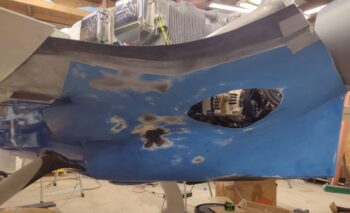
Although I didn’t mention it in yesterday’s blog post, I had a good conversation with Clinton from Custom Aircraft Parts.  I had sent him a bunch of pics and he requested even more specific pics, which I sent out this morning.  He sounded very amenable in our discussion to tweaking the left exhaust pipes given how close they are to the cowling.

Part of our plan is to mimic what is in my cowling and on my engine when he connects up my pipes to an -320 motor he has.  To do this I needed to lock in the configuration of the two left exhaust pipes and essentially immobilize them… as you can see I did this with zip ties, hot glue and pieces of wood glued in place.

Moreover, I received an email back from Clinton late this afternoon stating we would plan on me shipping these out to him next week, so fingers crossed!

To take these pipes off —and the right side too— I took the bottom cowling off.

I then pulled the 90° sniffle valve and replaced it with the original design I tried out which keeps it off the SCEET tubing beneath it.

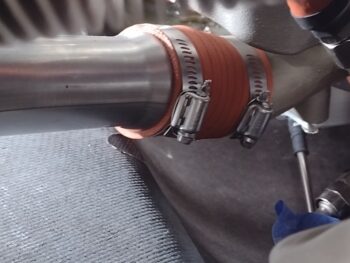
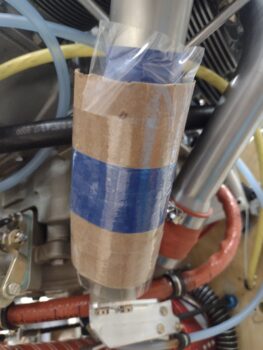
I also assessed the SCAT tubing coming up from the NACA scoop on the bottom side of the RAM air scoop.  This tube feeds cooling air that splits off to the 1) PMag and 2) the mechanical fuel pump.  I decided that for future engine removals I would have the tube disconnect between firewall and engine at about the spot where I’m pointing at with the screwdriver.

I also wanted to ensure that I had enough clearance between the PMag spark plug wire connectors (going into the main unit) and the firewall.  I taped a piece of the 1/4″ thick Birch plywood that is actually used for the firewall onto the firewall to check the clearance… as you can see there is plenty of room (tight, but in this bird that is PLENTY of room!).

I then cleared out a bunch of stuff on the bottom of the engine in prep for removing it.

I then connected up the engine hoist and removed all the engine mount bolts.

After a good 10 minutes of slowly and carefully easing the engine off the firewall, it came off without much hoopla (good!).

I then grabbed this shot of the accessory case, which was hard to see when the engine was on the floor stand.

I had already cracked the mounting bolts slightly loose on the PMag while the engine was secured on the firewall, which then allowed me to quickly remove the PMag in short order.  I plan on sending it back to EMag Air tomorrow for them to give it a firmware update and thorough check-over before I mount it back onto the engine.

Here’s the rather large hole remaining on the right side of the accessory case (the right “mag” hole) where the PMag was extracted from . . .

I looked around the shop and found the cap to the large cylindrical zip tie container and grabbed that to temporarily seal up the hole… it fit perfectly!

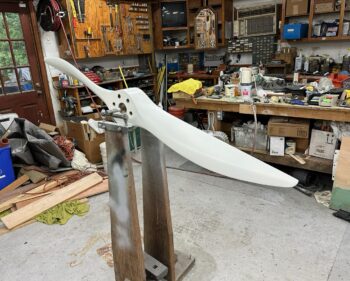
I grabbed one more shot of the engine off the bird.  Pardon the mess, I’m building an airplane!

And another shot showing the front side of the engine as well.

Although I sanded down and repainted red the aft nose/avionics cover “window” area prior to prepping and pulling the engine, I finally grabbed a shot of it before closing up the shop.  As you can see it turned out much, much nicer this go around.

The last noteworthy item to report is that I spoke with the ever-knowledgeable Mike Toomey yesterday about my hershey kiss spinner woes.  I got a lot of good info from him which enabled me to figure out a plan to modify the Catto “lamp shade” flow guide that will allow me to mount the original spinner I got from them. In short I’ll be turning my lamp shade flow guide into a flow guide much closer to what Klaus Xavier designed.

I even called Catto and will be getting the same carbon fiber they used on the spinner setup so that my mod will match the original.

Ok, very, very late here so I’m calling it a night!

Chapter 13/23/25 – Cowl Sculpting

I started off today with a final sanding of the inside of aft nose/avionics cover.  After cleaning up the dust I then epoxy wiped the micro/West 410 filled area with 3 rounds.

As I let the epoxy wipes cure on the aft nose/avionics cover, I then did a quick check on the charging status of my TCW Technologies Integrated Backup Battery System (IBBS). As this now is a little long in the tooth (I can relate!) anything between 13.5 and 14.5 volts is good, so I’ve very happy that the unit is reading 13.78 volts.  After taking this picture, I then put it back on the charger and will continue to monitor it to see if this voltage value goes up any.

After another visual review of Mike Melvill’s cowling configuration, I then marked the top cowling for a bit of a trim on the aft sides.  The flare out that you see is persona non gratis on Mike’s bird, so it will be on mine as well.  This area is actually just a sort of a rounded rectangle that makes up the aft opening of the cowling on Mike M’s Long-EZ.

I then also marked up the aft lower cowling for trimming as well . . .

Here’s one final look at the stock aft cowling sides before I trim them.

And here are the aft lower cowling sides trimmed up.  The sharp “trailing edge” of the cowling actually is on the upper cowling as it rests on the lower cowling and gets secured with a series of CAMLOCs.

And here is the upper cowling with its hind quarters trimmed a bit as well.  I’ll note that the top cowling looks a bit cleaner here since I spent a good bit of time hitting it with Simple Green, water, a 3M pad and even a wire brush to remove the PVA (mold release agent) from the surface.

Here’s a look at the aft hind quarters of the upper cowling and its current interface with the lower cowling.  I’ll of course continue to work this and dial it in, but a good amount of glasswork will most definitely be required and ensue in these areas.

I then got back to working the inside of the aft nose/avionics cover.  I sanded the cured epoxy wipes and cleaned up the area (there are some areas outside the immediate “window” that I wasn’t as thorough with currently).

I then taped and covered the surrounding surfaces around the immediate “window” area and then primed it with a few light coats.

Today –and tonight– was very hot and humid, and I’m guessing that it had something to do with my red paint turning out so blotchy and nasty.  I’ll sand it down and hit it with another couple coats tomorrow.

And with that folks, I called it a night!

Chapter 13/23/25 – Bottom cowl trimmed

I started out today by giving the inside of the aft nose/avionics cover “window” looking area a quick sanding to rough it up in prep for micro finish.

I then applied a decent layer of micro/West 410 on the “window” looking area of the inside surface of the aft nose/avionics cover.  I used fast hardener so that it would be cured by this evening, and then set it off to the side.

I then called the folks at Jet-Hot to discuss ceramic coatings for the exhaust pipes.  I had a very informative discussion with their sales rep Debbie for a good half hour while she went through the different types of coatings they offer.  I got off the call with a little bit of homework (research) to do, while they actually had some to do on their end as well.  Clinton from Custom Aircraft Parts (who I also emailed about the exhaust pipes) recommended these folks, and I have to say my initial impression of them is excellent.

After reviewing my notes on Mike Melvill’s engine, cowling, prop and exhaust pipe configurations, I then got back into the shop to figure out where the aft edge of the top and bottom cowlings needed to be.  After a number of machinations, checks and rechecks, a bit more research here and there, I finally got my numbers dialed in and a straight line drawn across the aft edge of the bottom cowling (note I’m using the screw- driver to point out the line).

Here’s a genera idea of what is coming off the aft edge of the cowling… I marked this line a few days ago on a swag of what this would look like.

I then removed the lower cowling, took it outside and prepped to trim it with my trusty Fein saw… which you can see I did in pic #2.  I then sanded the aft edge to ensure it was straight.

Back in the shop I remounted the lower cowling and then double-checked the aft edge with a yardstick to ensure it was straight… it is.  Looking pretty good!

Here’s a shot of the freshly trimmed aft edge of the lower cowling.

Alas… sadly the “lamp shade” flow guide on my Catto prop spinner assembly still doesn’t fit with the cowl set as it is.  This means I’m either going to have to modify the flow guide or simple sell the spinner assembly outright.  I’m leaning towards the former since I like the spinner and they’re hard to come by these days… and I seriously don’t want to take the time to make one myself.

I then went to dinner with Jess and after returning back home, I grabbed the aft nose/ avionics cover to sand down the now cured micro/West 410 finish.  Although it took a bit of elbow grease (doesn’t it always), it sanded out nicely.

Although I got most of it done, this was just the initial sanding to knock down all the high spots before it cured rock solid.  Tomorrow I’ll fine tune it and either do a few West 410 touchups, or just jump right into a couple rounds of epoxy wipes.

And with that, I called it a night!


Chapter 23 – Engine mount bolts

I spent the first part of today catching up on my blog posts.  I basically cut and pasted the early ones off my MacBook which is having issues and am now working off a Windows laptop.

I then spent a good hour torqueing the lower engine bolts to specs.  If you look closely you’ll see the AN970 wide area washer shim that I added on the bottom mounts to get the engine angle closer to where it should be 1-2°.   I’ll remind you that this was done in consultation with the folks at Lord engine mounts, not just willy-nilly.

I have castellated nuts with cotter pins on the 2 top engine mounts, and I did the same for the lower left engine mount… but what a ginormous PITA!

Here’s a wider shot of the torqued-to-spec-after-adding-shim lower left engine mount.

As far as a castellated nut with cotter pin on the lower right engine mount? … uh, no way!  I called no joy on this bubba right out of the gate since there is about zero clearance to get any of MY tools in there to get a cotter pin installed.  I simply went with the original AN363-720 nut called out in the Long-EZ IIL plans.

I then had a good conversation with Clinton at Custom Aircraft Parts.  He asked me to send him some pics of the left exhaust pipes to coordinate possibly sending them back to him to have the outboard rebent and the inboard pipe cut and rewelded to get them angled up at the aft end and off the bottom cowling.

Here are a few of the pics that I sent to Clinton.

With the exhaust pipes being so close to the cowling (Dave Anderson’s are as well with his Melvill cowlings so he applied heat shields to the inside surfaces of his cowling) Clinton highly recommended getting them ceramic coated to reduce the emissive heat impact on the cowling surfaces.  At this point I’m very much leaning towards BOTH ceramic coating and heat shields… and of course will be doing much more research and fact finding on those.

Chapter 8/14/23 – Forward engine bolts

Over the last week, save going out on the boat and fireworks watching for July 4th, I’ve been scurrying about cleaning up the shop and getting my build priorities in order.  That being said, this blog post covers the last few days of my build shenanigans.

One task, that in part led me down the 3D printing rabbit hole for a good month plus (combined with throwing my back out!) was the issue with the too-short oil dipstick/filler tube.  Well, after some height confirmation and testing with the upper cowling on —and a bunch of research— I’m happy to report that I pulled the trigger on a new oil dipstick & filler tube from Aircraft Specialties Services.

You may note from the pics below that this doesn’t look like Grandpa’s ol’ plastic Lycoming oil tube, and that’s because it is most definitely not.  The 10.57″ Lycoming oil level tube is p/n 75767, whereas this (again, after a good bit of research) is the Superior Air Parts anodized aluminum oil tube, p/n SL75767.   Note the lack of protrusions in the middle area that lends this tube the ability to stay as far off as possible from the engine mount tube.  Hopefully, this tube will put this issue to bed!

With the oil dipstick/filler/level tube ordered and on its way, I then started back on the engine to get its position situated and finalized.  Yes, in my fast and loose style of living dangerously, I didn’t have the very forward bolts of my engine mount extrusions installed yet (shown below) to accommodate working all the engine electrical components in the GIB headrest.

Thus, to ensure full clamping pressure of the forward engine extrusion bolts, I lifted the engine up slightly to relieve any downward pressure on the engine extrusions (aft) that might lift the engine extrusions upward on forward side.

A quick aside before I continue on with the forward engine extrusion bolts.
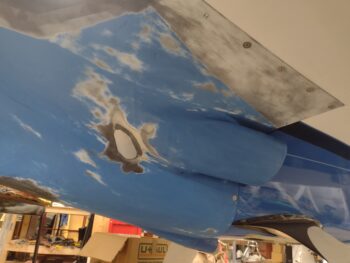
** Note the two left exhaust pipes showing in the above pic.  Although I trimmed them to minimize their overall height, they still need to be tilted up at the aft end to eliminate their closeness to the inside surface of the bottom cowling.  Once I get the engine bottom mounts finalized (they’re currently tight but not torqued fully to spec), I’ll assess and query Clinton at Custom Aircraft Parts about bending the outboard/forward exhaust pipe and cutting rewelding the inboard/aft exhaust pipe.  This should eliminate/greatly minimize any cowling rework. Note that the left side exhaust pipes are close, but acceptable enough that they don’t need any rework (bottom line: this is a tight cowling!) **

Now, back to the forward engine extrusion bolts.  First, in the pic below note immediately above the seatbelt strap on the right side of the pic is a red electrical FastOn terminal. Immediately behind that is the 90° aluminum extrusion that traverses the bottom of the GIB headrest engine electronics bay from one side to the other, and secures the bottom sides of the respective components… I installed this first since after the seatbelt bar was installed it would have been much more difficult to install this extrusion.

As you can see, the forward engine extrusion bolts secure the outboard ends of the strap bar for the GIB upper seatbelts.  Why this bar versus the plans method of attaching the upper seatbelt straps for the GIB?  Have you ever ridden a hairy roller coaster at an amusement park?  They pull the padded bar down over your shoulders so that your head barely fits through it, not out on edges of your shoulders.  Because not only does is not hold as well on the edges of your shoulders, it’s uncomfortable!

If you look a bit closer you can see two screws, each about an inch inboard of each strap.  These inboard stops essentially provides a “slot” on each side to move the straps back and forth, with the furthest outboard position still about inch inboard from the plans position.  These screw points also secure the bar from flexing or bending in the middle for better rigidity.

I’ll note for clarity’s sake that although I’ve been using the term “bar” here, that it is actually a 6061 square tube.  Moreover, there is an alodined 2024 insert with a 0.25″ thru-hole mounted inside each end of the tube to ensure the AN4 bolt clamping pressure doesn’t collapse the square tube.

After installing the forward engine extrusion bolts and GIB upper seatbelt strap bar, I then lowered the engine hoist to let the engine settle back into its normal resting state. I then rolled the engine hoist out of the way and removed the bottom cowling.

Looking over everything on the bottom of the engine, I realized that I hadn’t yet gotten around to tapping the bolt threads for 2 of the bolts that need to go into the carbon fiber air induction tube flange to secure it to the fuel injection servo’s inlet face.  The issue is that the unthreaded shank of each bolt doesn’t allow it to be threaded in all the way.  With these bolt threads tapped, all the hardware is ready to go to secure the air induction tube to the fuel injection servo.

Finally, I took another hard look at the sniffle valve.  I discuss this in one of my latest videos where after I tweaked the SCEET tubing to remove any internal bumps and wrinkles, the end result is that it also removed the slight downward curve (dip) of the SCEET tubing.  With the SCEET tubing now a straighter line from point a (RAM air can) to point b (air induction tube) the 90° sniffle valve fitting is a bit too close for comfort to the SCEET tubing [this older pic shows the sniffle valve I’m talking about with the SCEET in the previous “dipped” configuration].

To remedy this, I’m going back to my original sniffle valve configuration where I first have a 45° street elbow installed in the bottom of the cold air plenum followed by the actual sniffle valve (see pic below).  This 45° angle should provide immediate clearance between the sniffle valve and the SCEET tubing below it.

Since I stole the only 45° street elbow I had on hand for the MAP block install, I fired off an order for another couple elbows.

Pressing forward!

Chapter 18/25 – Canopy tape removed

Yes, getting back on the plane build has been a lot longer in coming than I had planned.  Between getting some much needed house repairs knocked out, prepping the boat/initial boating season shake down cruise (a must here!), some family drama (not mine!) and a final summer mini-vacay down to Florida before hopping back into things, it’s been a busy spring/summer thus far . . .  to say the least!

My first task back in the shop was to get something knocked out that’s been nagging me in the back of my brain for a good bit . . .

I wanted to get the painting edge tape removed from the canopy to ensure it didn’t get too emotionally —moreover physically!— attached to the canopy.  Also I wanted to ensure no major paint blobs had decided to take up residency on the edge of the canopy.

Thankfully with a little coaxing the tape came right off.

I then spent about 20 minutes cleaning up the small bits of tape left on the edge and any minor paint seepages that wicked up onto the canopy (maybe 3/16″ high at the most) with the very careful use of a razor blade.

I’m very happy that I had no unpleasant surprises regarding the canopy.  I’ll point out that this paint job on the canopy is not the final one… actually most of it will be sanded off and I’ll be shooting paint for the final topside paint (including all the white paint on the bird).

Next I’ll focus on some more maintenance items such as battery and IBBS charging, as well as swapping out the desiccant plugs in the engine.

Chapter 3 – Tooling up: Mistress Build

Happy Cinco De Mayo everyone!

Just wanted to do a quick post showing the new Voron 2.4 3D printer is operationally complete and kicking out parts.  Moreover, my back is back and I am operational as well!

Here is the first print (in PLA) on the Voron 2.4:

I then did a few other torture test prints before kicking this one off.  Normally this would have been nearly a 2-day print on Bob or Sally, but on the Voron it took about 11 hours.

A few days later I had the new Voron 2.4 dialed in even more and started printing no kidding ABS parts… as advertised, this thing is a BEAST!

Just one final shot of my newly built and operational Voron 2.4 3D printer.  I’ll stop boring you guys with non-airplane building stuff (although very related & critical for my plane build).  Also wanted to let you all know what I was up to while down for the count with my back being thrown out!

That being said, with Mother’s Day and Jess’s birthday coming up over the next couple of weeks, I’ll again be offline from the plane build (I have some house repairs that really need to get done as well) for a good 2-3 weeks.

But I’ll be back to it ASAP!