Chapter 25 – Bottom cowl micro

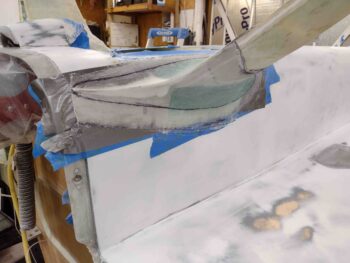
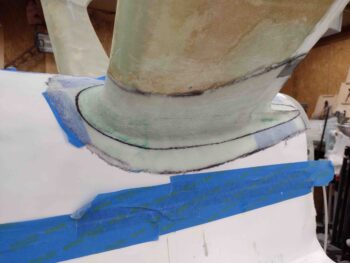
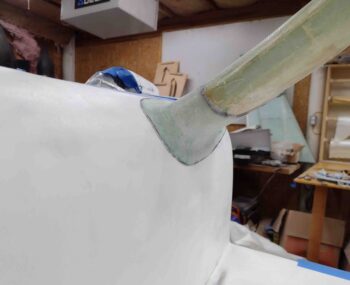
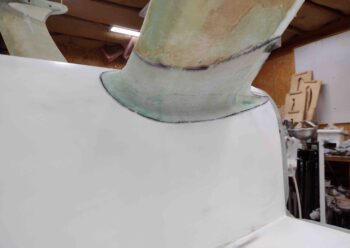
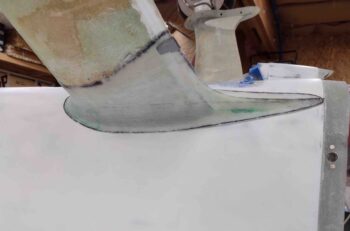
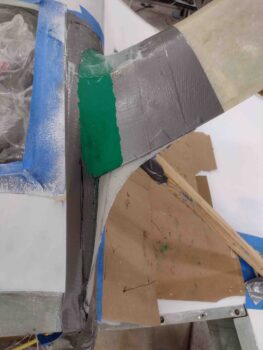
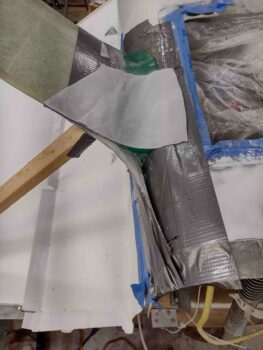
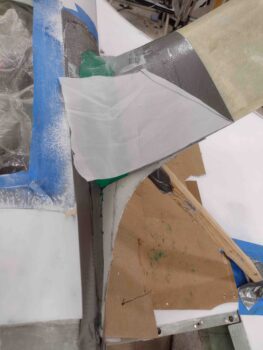
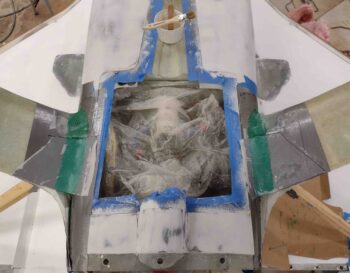
I started out today by sanding, shaping and leveling the added West 410 filler at the lower left aft corner of the fuselage for a smooth transition with the bottom cowling.

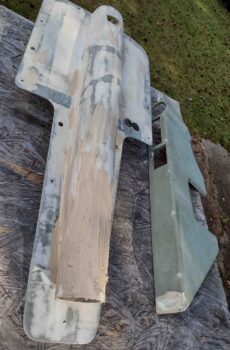
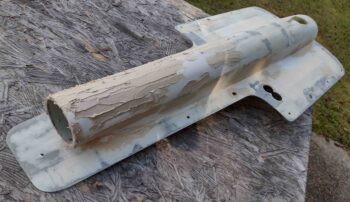
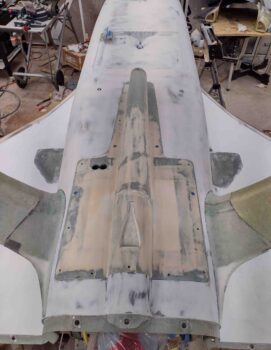
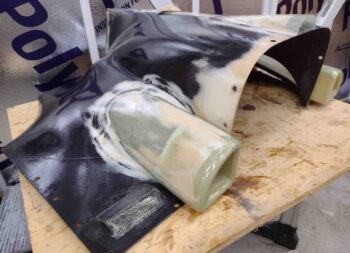
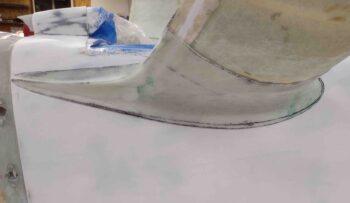
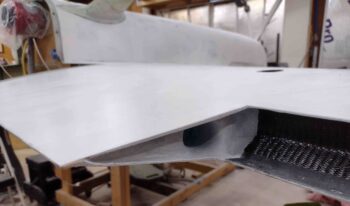
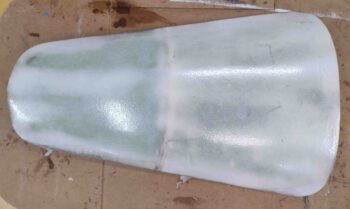
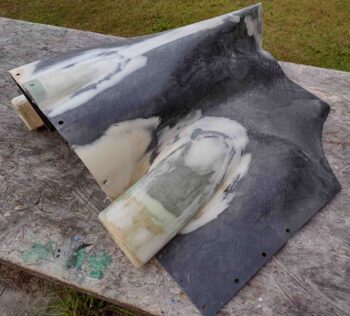
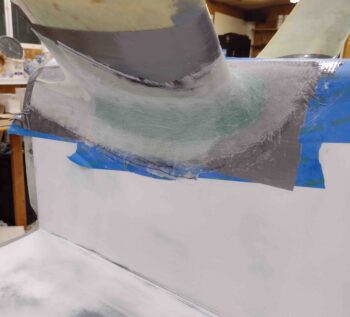
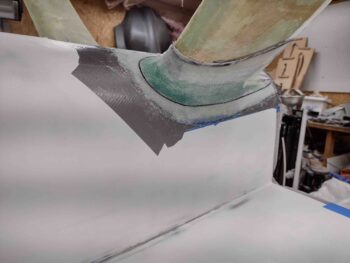
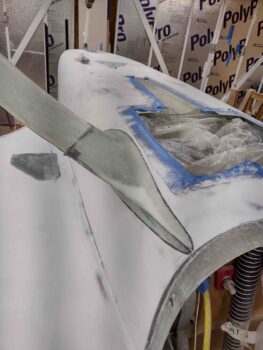
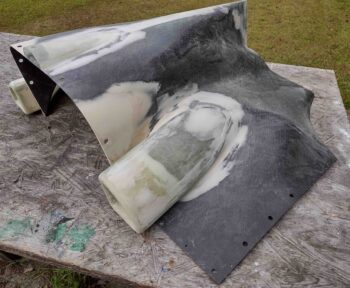
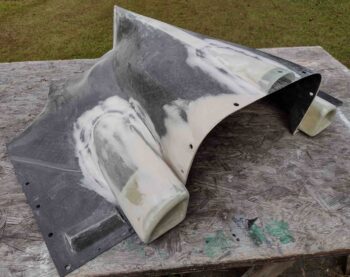
I then pulled the bottom cowling off to wash off any mold release agent and then sanded the areas that would be getting “micro” fill.  Here’s the right side cowling ready for “micro”.

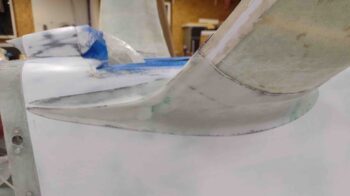
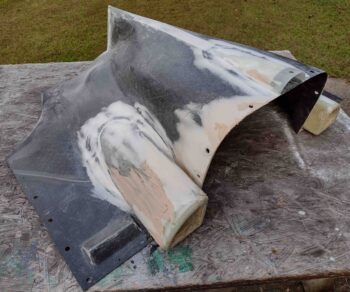
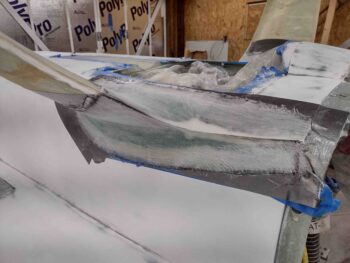
And the left.

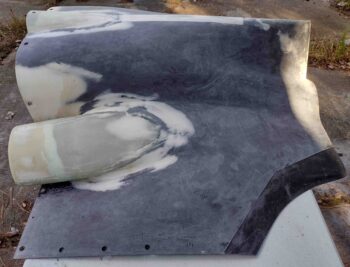
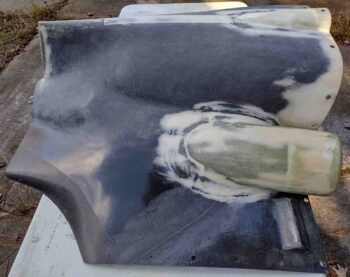
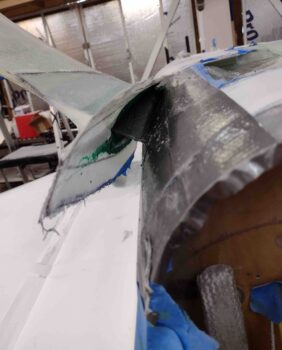
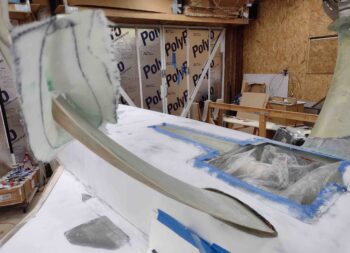
I then mixed up some “micro” fill (micro + West 410) and applied it to the areas that needed it.

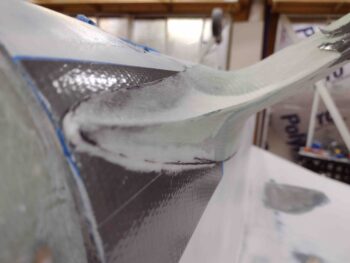
The black carbon fiber areas showing are somewhat porous, but more along the lines of what I would consider pin holes… so I won’t be using micro to fill them, but rather 2-3 epoxy wipes along with the micro-filled areas of the cowling.

A bit later, after the micro fill on the bottom cowling, I then made up a batch of white paint and painted the nose gear strut, strut channel and nose wheel well.

I also painted the inside surfaces of the nose gear strut fairing and the nose wheel well doors.

One reason I wanted to start painting the inside surfaces and the nose gear strut (as well as the general bottom surfaces of the aircraft) was so that I could dial in the painting process.  You might be able to notice a fair bit of dust in the air that has conveniently settled on my white painted surfaces.  I’ll address this dust issue and also see how well it buffs out, if at all.

I’ll reiterate that a significant reason I started the finishing, priming and painting process on the bottom surfaces of the plane was to test out and dial in my finishing and painting methodologies.  Obviously on the bottom of the plane, which is exponentially less visible and/or viewed while the bird is sitting on the ramp, is a better place to repair or redo any finishing, priming or painting actions that don’t work out as originally planned.

One such area is high build primer.  The primer that is used in the Epifanes 2-part polyurethane system seams to have really good adhesion, but isn’t what I would consider a high build primer.  In my research in preparing for finishing the airplane to paint, I noted a number of builders that reported whipping up their own version of high build primer by simply adding a bit of micro to their respective primer.  Again, many builders, using a variety of different paint systems, reported on this method in the Central States Association newsletter.

So, what the heck?! I might as well give it a try eh?  And that’s exactly what I did on the exterior side of the landing brake surface… which still had some minor imperfections that needed filling before final primer/paint.  I used a cheap brush to apply it, and it was a bit wonky going on, but definitely not bad enough to try again.  I think I’ll try using a roller next time to see if it goes on a bit more uniformly.  Still, it appears to have filled the imperfections, and I’m excited to see how it looks after block sanding it out.

I then left the painted/primed items to cure overnight.

Chapter 25 – Bottom cowl final fit

I started out today sanding down the primer I applied yesterday on the nose gear strut.

I also cleaned up the wheel well a bit more, including some primer applied in there as well. In addition I sanded the nose gear strut well… all except the area covered by the nose gear actuator.

I then finished priming the nose gear wheel and strut wells.

I then slathered on another round of white primer on the nose gear strut with its first coat of white paint.

I also applied another round of white primer to the inside surface of the nose gear doors and strut fairing as well, but didn’t grab a pic of those components.

I then spent a good 45 minutes cleaning up the interface between the aft/bottom fuselage and bottom cowling to allow me to re-install the bottom cowling.

I also took a few minutes to annotate the stud lengths of all the CAMLOCs that secure the cowling in place.

Note the bottom cowling side CAMLOC in place with its new reinforced floxed hole edge.

The right side looked good, although I had to do some slight sanding on the bottom right corner of the cowling to get the elevation dialed in with that and the lower right fuselage corner.

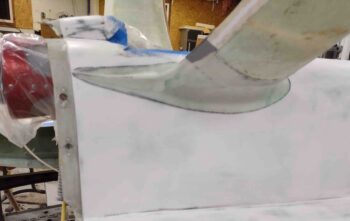
Here’s a shot from the front… note the indentation at the side fuselage and cowling is pretty much gone. Mission complete!

Although with that said, sadly I have a couple of minor tweaks I need to do on the left side cowling and aft fuselage…. with a couple of West 410 filler added fills on the aft fuselage. One at the corner since there is a slight elevation mismatch with the fuselage corner low, causing the cowling corner to jut out into the wind slightly (about 30-40 thou of an inch).

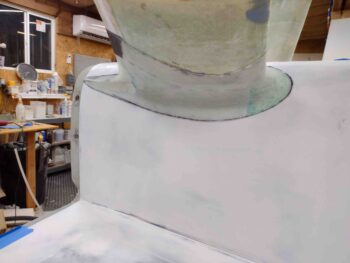
The other area is behind the armpit air intake scoop… as pictured below, from about even with the lower CAMLOC down to the corner with the strake.  About a 1/16″ thickness needs to be added in to match the bottom cowling sidewall.  Again, all to help eliminate the indentation at this point.

Note the bottom cowling side CAMLOCs in place with their new reinforced floxed hole edges.

The lower (“upper” as situated here) refill was a fairly quick kill, so I marked the slightly depressed area on the bottom lower left corner of the fuselage.

Then sanded the epoxy wiped aft lower fuselage corner to provide a nice textured surface for the West 410 to grip to.  I also taped up the front edge on the bottom cowling.

I then whipped up some West 410 and applied it to the lower aft left corner of the fuselage.

After I sand and contour this to the correct shape tomorrow, I’ll then remove the bottom cowling and work the other area requiring attention on this side.

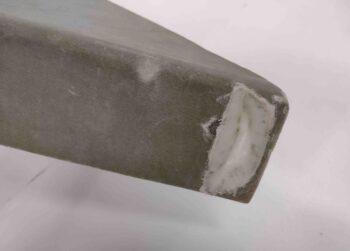
Of course you can never mix up just what you need (at least I can’t!), so I had some West 410 filler left over.  Not wanting to waste it I applied it to the back tip of the bottom cowling boat tail, which definitely needed some love.

I then left this West 410 refill to cure overnight, closed up the shop and spent another good hour+ doing research on my Epifanes 2-part polyurethane paint application process before calling it a night.

Chapter 23/25 – Flox & Primer!

Today I started off by sanding down the flox “plugs” (if you will) around the CAMLOC holes on the sides of the bottom cowling.  I’m hoping and expecting that the straight flox will prove much more durable than the flocro I had employed before around these holes.

I then got busy with applying white primer on the inside surfaces of the nose gear strut fairing and nose gear doors, as well as the sanded perimeter of the inside landing brake.

Here are these components with the primer applied.  Since these are the inside surfaces and will get sanded before paint is applied, I went ahead and brushed the primer on with a narrow brush.

In addition to the items above, I also primed the remaining unprimed surfaces of the nose gear strut.

With that, I left the primer to cure overnight.

Chapter 23/25 – Cowl CAMLOC holes

Today I focused on fixing the CAMLOC holes on the vertical sides of the bottom cowling.  I had originally filled the immediate area surrounding these holes with flocro, but quickly discovered that it wasn’t up to the task of the constant inserting and removing of the securing CAMLOCs… so I decided to switch to pure flox to provide much more strength around the perimeter of each hole.

Here are the before pics, left side bottom cowl and right side.

And the after pics… after I Dremeled out a good edge around each hole, pretty much back down to the original carbon fiber.

I didn’t get any pics of it, but I then slathered some flox around the edges of each of these CAMLOC holes.

The main reason I didn’t get any pics is that I got sidetracked with the delivery of my Mountain High supplemental O2 system.  As you can see below the kit includes a 9 cf bottle, regulator, mounting bracket and two Oxymizer cannulas.  I needed my supplemental oxygen system in hand to allow me to install the mounting brackets onto the original sidewall of the fuselage —inside of the right strake baggage area— before I close out the tops of strakes… after I flip the bird back upright (hopefully within the next week or two).

Yes, it was a light build day, but I did get some stuff knocked out.


Chapter 25 – Bottom plane epoxy wipes

Today I started off by knocking out the final fitting of the landing brake on the bottom of the fuselage, in the depression I created with the micro around the perimeter of the landing brake.

I first temporarily mounted the landing brake.

Here’s a gratuitous shot from the aft side.

My initial main focus was on the front edge, where the landing brake interfaces with the bottom of the fuselage.  I worked on this interface for nearly an hour.

After getting the front edge of the landing brake interface with the bottom fuselage micro fill or sorted out, I then dialed in the left, right and aft sides of the landing brake.  There was a good little bit of a ridge on the fuselage on all sides, so it took another good 45 minutes to sand it down and fair it all in with the existing micro fill.

Here’s a shot looking aft after I dialed in the seam elevation of the micro fill around the perimeter of the landing brake.

The landing brake interface with the bottom fuselage micro fill was the last item on the list that required finishing before I was cleared hot to epoxy wipe the bottom of the fuselage, nose and strakes.

After vacuuming and blowing off all the dust with filtered high compressed air, I then taped off the front edge of the strakes . . .

and the top edge of the fuselage and nose, to allow for a bit of bare micro fill for transition with the new micro fill when the plane is back upright and I finish all the topside surfaces.

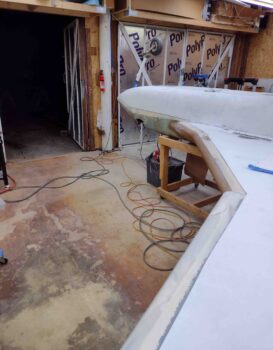
I then started the fairly lengthy process of the epoxy wiping the bottom of the fuselage, nose and strakes.  The following pics are after round 2 of wiping on a thin coat of pure West epoxy (with 206 hardener) ala the Corey Bird finishing method.

And this shot is many hours later, after I finished later in the evening.  Normally surfaces would get 5 coats, or wipes, of epoxy, but once the scratches and holes are filled in, there is nothing for the epoxy to really “grab” onto on the vertical side surfaces.  Since the surface was looking nice and filled, and a lot of epoxy was ending up on the strake and/or floor, this was one of the main contributing factors for me stopping at 4 wipes total.

Here’s a shot from the firewall, looking forward at the bottom of the fuselage.

And a good shot of the nose.  These last 2 shots were taken many hours later, when the epoxy was virtually cured.

I’ll give these epoxy wipes a couple good days to cure, then start sanding it all down, including the wings.  Tomorrow I plan on working on the bottom cowling, and the nose gear fairing and doors.

Chapter 24/25 – Aft fuselage junction

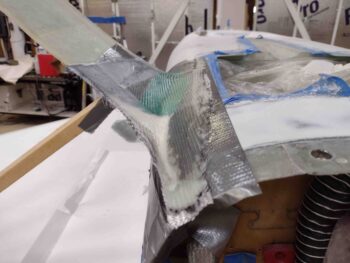
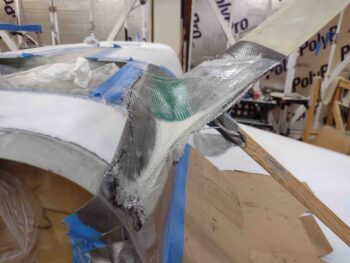
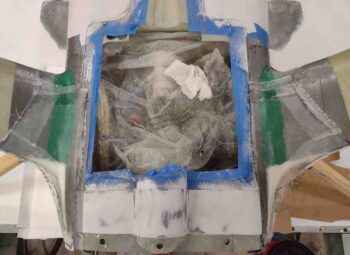
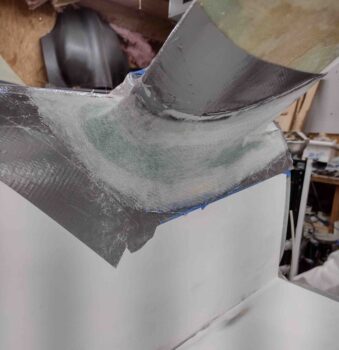
As I mentioned before, I’m kicking myself that I didn’t grab some before shots of the indentation at the junction between the aft fuselage sides —right at the firewall— and the bottom cowling vertical front edges.

Again, the issue was my rounder (more football shaped) fuselage vs an original stock fuselage and then mounting Mike Melvill’s carbon fiber cowlings to it.

A little reminder of what I’m talking about with this diagram I’ve used a couple of times previously.

I’ve been slowly going through the machinations of getting this seam filled, on both sides. Not a hugely difficult task, but definitely a bit of a time bust considering all the back and forth iterations of filling the aft fuselage side, then matching that to a degree by filling the bottom cowling vertical front edges… then repeat.
If I had to do it over, I would probably do 2 things:
A) Work this area pre-armpit cooling intakes install, and
B) Use pour foam, shape and then glass with a ply of BID before finishing.

You can see on the right side (left pic) that the indentation has been pretty much filled and the sidewall is straight.  On the left side (right pic) —which definitely had a more significant indentation at the seam— there is still as slight depression, but it has been minimized greatly.
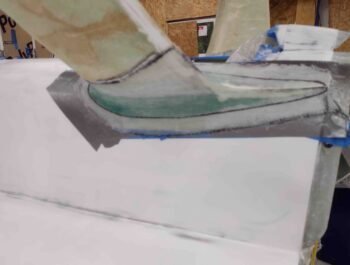
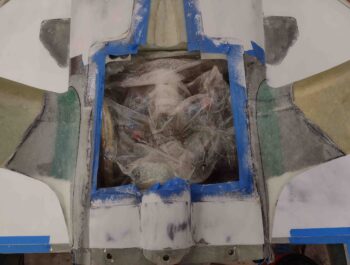
Also I’ve noted, the filler adds about 1/8″ to 3/16″ on each side, so my gap between the inside edge of the armpit scoops to the fuselage sidewall are now around 7/16″ vs the 3/4″ called for in the Melvill cowling install instructions.  I’ll reiterate that I don’t foresee any issue with these new narrower gaps between intake and sidewall.

I’m heading out of town for a break to visit friends for the next 5 days, and will get back to work full bore when I return.

Chapter 25 – Wing bottom epoxy wipes

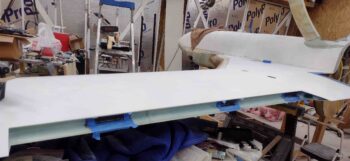
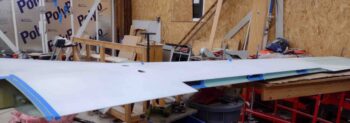
Today was all about getting the bottom of the wings epoxy wiped with pure West epoxy. I did do some minor tasks in between like remove the nose gear wheel well doors and strut in prep for sanding, priming and painting, but for the most part the entire day was focused on these epoxy wipes.

The first pair of pics of below are after the second of 5 wipes total.  The average cure time in between the wipes was 1.5 to 2 hours.  Albeit between the second and third wipe was over 3 hours.

It is quite interesting (IMO) that the first wipe took 3 pumps of West epoxy per wing for a total of 6 across both wings.  The second wipe took almost exactly half that with 1.5 pumps per wing, 3 total.  For wipes 3-5 we (Jessica helped me on the last few) used 1 pump of epoxy per wing.

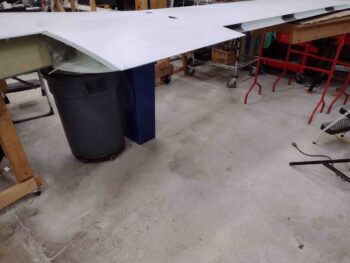
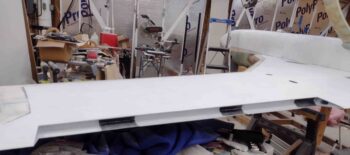
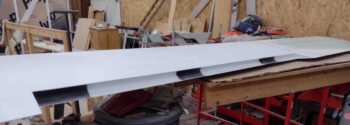
These last 2 shots are of the wings with the 5 total wipes after they cured.

I have to say it’s pretty cool to see the wings looking shiny with epoxy and feel fairly slick and smooth when you run your hands across them.  Even the sound is a bit different if you tap the surface since these are now “hard shelled.”

With the wings epoxy wiped, tomorrow I plan on jumping back on to the aft fuselage and bottom cowling junction to finish that up as best possible.

Chapter 24/25 – Aft fuselage seam

Today was all about dialing in the shape on the aft fuselage at the junction with the bottom cowling, with almost the entire focal point being on the vertical sidewall.

I spent about 45 minutes per side sanding down and contouring the West 410 filler that I applied last night.

As I continuously note, this is definitely an iterative process.  I then sanded down the other side as well.

I also sanded down the interfacing areas on the side front edges of the bottom cowling as well.  I then worked both the bottom cowling “micro” fill and the aft fuselage “micro” fill together.

As I then did on the other side as well.

A point of note I’ll make about filling in the depression at this side wall area on each side, is that I wish I had had the foresight to recognize the real need for it and do it earlier (i.e. pre- armpit intake install) as it is clearly closing the gap between the fuselage/cowling sidewall and the armpit intake vertical side.  Where Mike Melvill’s cowling installation instructions say to mount the armpit intakes 3/4″ from the bottom of the strake on the horizontal side, and 3/4″ from the sidewall on the vertical edge, my gap now will be just over 1/2″ on the sidewall side… more like 9/16″ really.

However, do I think this will lessen the effectiveness or hamper the air entering smoothly into the armpit intake scoop?  No.  Especially since I don’t have external fuel sump blisters to disturb the air in any way before the air enters the armpit intakes.  This is  just a symmetrical, cosmetic issue really, but one I wanted to address.

There is still some filling and matching left to do… as there always seems to be.  I’d say I’m about 90% done on this filling task.  I did do another round of minor straight West 410 fill… which I didn’t grab any pics of.  I then left that to cure overnight.

I then got busy sanding down the inside bottom surfaces of the main gear.  The left gear leg is shown here.  I did the same on the right side.

I had pondered about slathering up these bottom surfaces with micro, but then decided to wait until the gear fairing at the intersection between the top of the gear and fuselage are completed and installed… then I’ll finish the inside bottom surface of the gear legs all in one fell swoop.

Tomorrow I plan on epoxy-wiping the bottom of the wings with 5 coats of raw West epoxy (“raw” as in only epoxy + hardener…. to be clear, not just resin) among other tasks, if possible.

Chapter 24/25 – All about the paint!

Starting out today was all about getting this silly paint stuff figured out.  Unless some real egregiousness rears its ugly head, I’ve got the paint system figured out: 2-part polyurethane yacht paint from Epifanes.  I went with the 2-part because unlike single part polyurethane the 2-part coats can be sanded and re-applied, pretty much like a standard type paint… not one coat and done like single part.  This means if you need to rework a composite area on the plane, touch-up, recoating and maintainability is not an issue.

The only real issue is availability…. the color on the left below is Capri Blue, the color on the right is Bright Blue.  Although I actually originally planned on a darker blue such as the Bright Blue on the right, which I love, I kept hearing the voice of Burt (and a few other builders!) cautioning me against going with a darker paint…. which I eventually relented to and set aside my rebel, rogue ways on this task.

The problem is that there is another blue, Bold Blue, that Epifanes makes (in theory) that is in between these colors in shade.  It’s just been unavailable for over 3 months!  To get some paint in hand I pulled the trigger on the darker blue, but over time realized it was just too dark in reality.  Then I got the light blue to test, and upon receiving it’s just too light for my taste.

What to do?

Well, I did a taste test of sorts with these colors. I still really love the dark blue, but again, I’m trying to be responsible here and mitigate as best possible any heat issues cropping up on the bird’s finish.

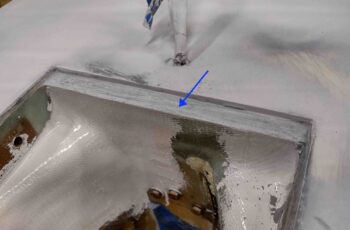
As you can see, I used the inside edge of the landing brake as a real world test canvas and applied the light blue along the left edge, the dark blue along the right edge, and a 50/50 mix of both (more along the lines of the Bold Blue that I wanted!) along the bottom edge.  Keep in mind this pic is right after I painted the edges . . .

Since the cured paint looks a tad bit darker as you can see on this test swatch I made with the excess paint from each application. I used a piece of black project cardboard to assess how each color would contrast with the black, which is one concern I had with the darker blue in that it might be so dark the black trim would be harder to see.

I want to keep my color scheme simple in the amount of colors I use. White flying surfaces and white base with a good bit of blue bordered by a black accent stripe.  No other colors involved.

My original color scheme was this… clearly I really like it.  But admittedly the blue is pretty dark.  I wouldn’t have any real concerns with using this darker blue except one main area: the canopy frame.  Since it is carved and constructed out of blue wing foam, I clearly don’t want it getting too hot and having the glass delam.

Thus I’m lightening up the blue paint in my scheme a couple of shades to avoid poking the bear… keep in mind I snagged a color match from the original test pic of the landing brake to create this pic below.  The actual blue color will probably be just a very tad bit darker than what we have here, once fully cured (see color swatch above).

One reason I started out the work day focusing on paint was that I new the folks I deal with have a few cans of Capri Blue on hand.  Almost literally nothing else is in stock.  So after I assessed the paint colors and decided to go with the 50/50 mix, later in the afternoon I pulled the trigger on another can of the Capri Blue… giving me 2 cans each of the light and dark blue paint.

Also, being Friday and a business day, it allowed me to get on the horn with the Epifanes folks and ask a bunch of questions before pressing forward in my upcoming paint adventures.

Back on the build… I then pulled the peel ply from the RAM air scoop EZ Point layups, used a small drill bit to remove the protective plastic inside the threads, and then carefully trimmed the glass away to expose the screw holes.  I then tested out a couple screws to ensure that the EZ Points were still fully operational… which they were.

I then spent a few hours sanding, tweaking and dialing in the aft fuselage sidewall interface with the bottom cowling.  So far the results look promising in removing a rather notable indentation at this junction.

Again I failed to get any pics (thought I had) of the results of the original sanding, but here is the subsequent round of “micro” fill that I applied to the aft fuselage.  I used straight West 410 filler here since I wanted to be able to sand down the edges —especially along the very front edge of the fill— to blend and fair in this fill with the previous fuselage fill.

I also added some of this straight West 410 to some spots on the front side edges of the bottom cowling as well.

With my latest round of “micro” finish applied to both the aft fuselage and the bottom cowling, I left it to cure overnight.

Chapter 24/25 – RAM scoop mounted

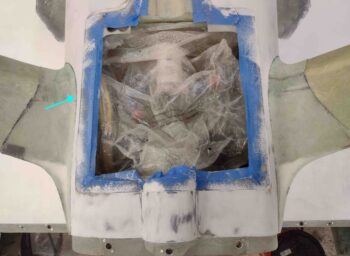
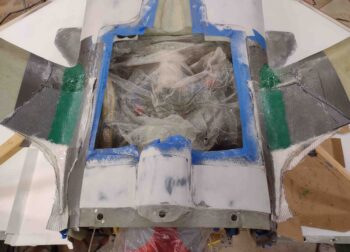
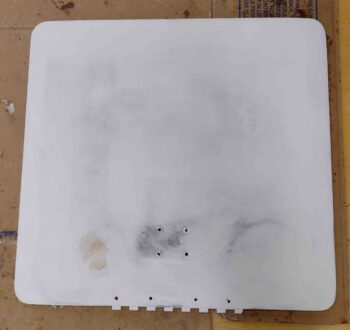
I started out this morning pulling all the weights off the RAM air scoop mounting flanges. The resulting pics show you the screws securing the flange to the bottom of the fuselage.

Grant it there is a longer section between these screws to the front center screw than I’d like there to be, but with the available real estate to mount into between these points being virtually non-existent, beggars can’t be choosers.

I then unscrewed the screws from the newly floxed-in EZ Points and all the other attaching screws and CAMLOCs from the RAM air scoop/hell hole hatch cover.

As a point of note I’ll again simply highlight the acceptable —but not the most desired— gap between this pair of EZ Point hardpoints and the center screw up front. But clearly I feel that the configuration and positioning of these attach points will hold this RAM air scoop in place on the bottom of the aircraft just fine…. lest I would not have proceeded in the fashion which I did!

I then got busy sanding down the area around the installed EZ Points, and a bit of the surface of the EZ Point locking nuts themselves to level it all out in prep for a ply of BID, to add yet another bit of strength to these RAM air scoop attach hardpoints.

After stuffing the threads with plastic Saran wrap, I then laid up a ply of BID over each EZ Point, and then peel plied the layups.

While the EZ Point layups cured, I then got busy on what I currently consider the long pole in the tent as far what is the priority to get knocked out on this build: the aft fuselage to bottom cowl interface surface leveling on each side.

I taped up the front edge of the bottom cowling on the vertical sides and a bit on the bottom right side to protect it from the “micro” finish that I was about to apply to the aft fuselage side of this intersection.

Which I did here.  I mixed up some West 410/micro fill and slathered it on both sides.

The “micro” wasn’t too dry, but it was dry enough that I needed to use my heated blades to get a good application.

I then left the latest addition of “micro” fill to cure overnight.