Chapter 23 – Starter installed

I started off today with a phone call to B&C Specialty Products to get some final intel on mounting both the starter and the alternator, clearly both B&C units.  I had the install manuals in my hands and had reviewed them, but one thing I was curious about was the ground path.

You see, they both use the engine case for ground, but I saw a slight issue.  Both the alternator and starter boss pads on my engine case were painted.  I did a continuity test to see if I was missing something with this specific paint, but there was no electrical connectivity to the paint.

Thus the phone call with B&C, who confirmed that it’s a good idea to have a majority of the paint off of those bosses to allow optimal contact for ground path.  I grabbed a shot of the starter boss paint removed (I left an edge right at the corner) but it not surprisingly came out blurry.

I then applied a thin coat of dielectric grease on the face of the boss before mounting the starter and torqueing the nuts and bolt to spec.  I then applied orange torque seal to the nuts and bolt.

Here’s a shot of the mounted starter from the inboard side.  I had determined earlier that it would be easier to mount the starter first than the alternator, since it allowed access to these inboard mounting nuts.

If you look on the engine alternator mounting boss, you can see I removed a decent sized patch of paint there to get good metal-to-metal contact for the ground.  To be clear, I specifically asked B&C if the mounting bolts alone provided enough of a ground path to the engine for starter and alternator ops.  Again, they highly recommended removing a decent amount of paint for optimized electrical ground conductive-ness.

As with the starter boss, I applied dielectric grease to the boss and alternator bracket before mounting it and torqueing the bolts to spec.  Then, as per the manual, I safety wired the bolts and bent the metal tabs down over each bolt.

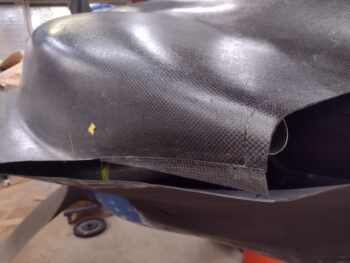
I then spent well over an hour prepping the left side of the bottom cowling for pour foam.  I taped up the large hole where I removed the alternator clearance bump and then put all the perimeter dam walls in place.

Here’s another shot from the side.

I then spent the next hour laying in different batches of pour foam.  The first batch was the last of X-30, and all the rest was a different brand, but the same exact stuff.

I then took the rest of the night off for a later dinner with Jess.  I needed some time and space to ponder exactly my plan for the lower cowling.

My thought is that if I’m going to modify the lower cowling, why not do all that I will probably do in the future now and get it over with.  My concern as I’ve been looking at the bottom cowling is how tight the curves are, in both vertical and horizontal references, in regards to the air flowing around it.  As per usual, I’m sure it works well enough as is, but with another day’s worth of work could I really optimize that airflow and have it flow nice and smoothly right into the awaiting prop?

Here’s a pic of Klaus Savier’s bottom cowling.  Note how smooth the surfaces are, even the respective protrusions for internal component clearances.  This design, which Dave Adams adopted on his bird, actually presents the air to the prop in an excellent flow.

This pic above is actually a screen shot from the video of Dave and Klaus discussing their respective Long-EZs at Oshkosh.  Here’s the video link if you’re interested.

I’ll note that Klaus mentions that due to all the mods he has made to both the top and bottom carbon fiber cowlings, that they now weigh about 10 lbs. a piece.  I weighed my bottom cowl just before I started the work above.  Now granted, I’ve sanded most of the paint off, but it weights 5.2 lbs.

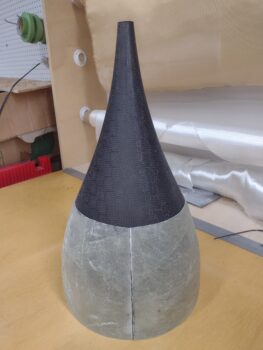
I’ll reiterate that I would rather take an extra day or two to plan out a much better performing bottom cowl, with acceptable internal clearances, allowing me to NOT have to modify my spinner “lampshade” flow guide, and be as light as possible when finished with minimal, if any, future mods… where is the downside?

And yet I’m still pondering!

More to come . . .

Chapter 23 – Starter mounting pad

Today was a hodgepodge of tasks, both build-oriented and personal, that I was attempting to knock out.

First up, I’m coordinating and prepping for both my Class III flight physical and upcoming Biennial Flight Review that will allow me to get back into the air.

I also worked and submitted an order to Summit Racing for the -8 AN hose end fittings for both the second oil cooler hose and also the oil heat oil feed hose.

I then sent a quick email to Dale Martin regarding some info he said he had regarding lower cowl aerodynamics.  Any good tidbits of info regarding lower cowling design would of course be good to have at this point in time.

After running downtown for yet another round of personal errands, I then finally got out to the shop.  I started off with the final sanding of the bottom cowling… sanding for well over an hour.

I then washed off the bottom cowling and while it dried I got to work on the starter mounting.

I first removed the starter and assessed which one of the threaded studs needed to be removed and swapped over into a new position.  Why?  Out of the 4 possible positions to use a bolt, 2 of them —the aft left and front right— simply won’t work because a bolt 1″ or longer just can’t be mounted into the hole with the way the starter is designed.

Ahhh, so the aft left position is exactly the one that was left open for a bolt to mount my starter.  Again, this is just a non-starter (puns actually not intended!).

At this point I needed to make a decision at which corner —of the 2 viable ones— I would place the mounting bolt.  I decided to make it easy on myself and also to allow quick visual verification of the installed mounting bolt by targeting the aft right position.

Thankfully threaded studs are much more easily removed from the steel engine case than they are from the aluminum cold air induction plenum… by far!  I was pleasantly surprised that —while not super EZ & requiring a good bit of effort, WD-40, and heat— the stud actually came out without having to destroy it.

I then cleaned up the stud and reinstalled it in the aft left corner of the starter mounting pad using blue Loctite.

I then temporarily re-installed the starter to check out both the configuration and fit of the aft left stud and mounting nut . . .

as well as the aft right mounting bolt.

I have a fairly early appointment tomorrow and didn’t want to get wrapped up in working on the bottom cowling, so I decided to call it an early evening (for me anyway!).  Tomorrow I do plan on starting full bore on the lower cowling re-configuration and re-construction.

Chapter 22/23 – Miscellaneous, etc, et al

Yep, I took yesterday off and spent the majority of the day out on the boat and anchored off of the outer bank islands with Jess.  Then an evening out… no plane building at all.

And today, although I wrote out my task list fairly early in the day, I then spent a good bit of time researching my rudder/brake pedal installs, specifically the requirement for an inline spring with my configuration.  I even called Dale Martin, the maker of my rudder pedals, to do a final cross check with him.

After finally getting out into the shop late/mid afternoon, I started by marking my oil cooler scoop and then trimming the aft edge a good 1/8+”.

This trim was just simply to get the scoop aft edge aligned with the upper cross “bridge” wall.  I may actually trim more off as I’m discussing some of Dave Berenholtz’s findings with him of his oil scoop install on his flying bird.

I’ll note that when I took the bottom cowling outside to trim the aft edge of the air scoop (above) and to prep the original micro application for more micro (below) I also used the Dremel tool to countersink the forward inboard screw hole for the oil cooler.

I then prepped both the front and aft oil cooler wall/seals for finalizing the micro install that I had done days ago when I taped up the bottom of the oil cooler edges and plopped it down on a good bead of micro.  I cleaned up the spots that needed it and then on the aft side used taped popsicle sticks to build dams to contain the micro.

On the front side I simply added a ply of BID to both the front and aft edge of the wall that also served to contain the micro that I added to fill in the voids from the original application.

Jumping ahead a few hours later, with the dams pulled from the aft side oil cooler wall/seal and the peel ply pulled from the front oil cooler wall/seal layups.  I then knocked down the micro a good bit on each side and will sand it to depth after it cures overnight.

In actuality, while the additional micro application above cured, I spent a good bit of time figuring out just how the oil cooler hoses were going to connect between oil cooler and the external Vernatherm.  I had posited the idea in my head a few days ago that I may very well have to cross the hoses simply to create more space to actually have any actual hose involved for each side.

And yep, that is exactly what happened.  The aft oil cooler port could have easily been attached to the aft Vernatherm port, but the forward side was just way too close to add the 2 hose end fittings and have any space for any hose between them.

In fact, while the oil cooler aft-port hose shown here looks somewhat normal, I’ll need to buy some more hose end fittings to create the rather interesting front-side oil cooler fitting to aft-side external Vernatherm fitting.  It will most likely end up seriously looking like half of the McDonald’s golden arches just to clear both the rudder cable “shark tube” and the MAP hose coming off of cylinder #3.  Honestly, it was the only way I could see to do it… and while I will try to use the 45° AN fitting on the forward oil cooler port along with a 45° hose end fitting to then arch over to a 90° (curved) hose end fitting to attach to the Vernatherm’s aft 45°, if I have to I will employ the 90° steel fitting shown in the upper left corner… only as a measure of last resort.

Note that in both the pic above and below you can see the forward and aft rudder cables attached.  I think the angle/geometry will work well, and I’m calling the “shark tube/fin” assemblies complete.

As promised, I did do a bit of weighing on the CF rudder tube/brackets.  Ok, so the left shark tube & right shark fin, 2x Clickbonds with 2x BID/epoxy, 2x washer, 2x nut and 1x Adel clamp = 2.3 oz (66 g).  Compare that to weighing ONLY the original stock rudder setup SS pulley brackets at 8.9 oz (253 g)… to reiterate, that’s no hardware, no pulleys, and about 3′ more cable that did NOT get weighed in that per-plans/stock total.  Quite a difference and a significant weight savings (between 1/2 to about 3/4 of a pound).

After swapping out the desiccant in the engine plugs for some fresh stuff, my final task of the evening was pulling off the round CPC connector that was installed on the Trio autopilot roll servo and replacing it with a Deutsch connector that I ordered a few days ago.

The original connector from Trio was a 4-pin connector, so I replaced it with a 4-pin CPC connector.  However, if you dig into the Trio Pro-Pilot wiring diagrams you’ll find that one of the wires is not used.  Thus to save weight and add simplicity, I ordered just a 3-pin plug.

Here we have the Trio AP roll servo Deutsch connector installed and connected.

Yep, I’m calling the Trio AP roll servo electrical install complete.  I do still need to finish building and installing the actuating arm by connecting it up to the aileron control rod.

And with that, I called it a night.  Either tomorrow or the next day I do plan on starting back on the lower cowling to get it re-whickered for final flight ops.

Chapter 15/16/23 – A real “shark fin”

I started off today by pulling the right side rudder cable CF sleeve and freshly laid up mounting flange off the CS spar.  I then pulled the peel ply and cleaned up the mounting flange just enough to drill a hole to use in mounting the Clickbond with flox (no pic).

A bit later I pulled the CF rudder cable sleeve/mounting flange and prepped the Clickbond for glassing (pic #1).  I then laid up 3 plies of BID over the Clickbond and peel plied them (pic #2).

Here’s the right rudder cable CF sleeve with the new mounting tab.  Pic #1 is the initial trim I did whereas pic #2 is the final trim.  Sorry for the pics, I was in a rush and my phone camera apparently had a hard time focusing on the center item in the pic!

I had been pondering about how our rudder & brake system works over the last couple of days, so a bit later I decided that I needed the CF sleeve to be be a tad more immune to flex… since when we get to the end of the rudder throw as we press our pedal we then get into the brake portion of our pedal operation.  If the rudder segment of this throw is squishy it very well may not give me as good of an “anchor” for the brake portion.

Thus I decided that since the right rudder cable CF sleeve is in open space, then I would do my originally planned “shark fin” design.  I’ll note that on the left side I can simply mount an Adel Clamp to secure the CF rudder sleeve at the inboard oil cooler mount and resolve this flex issue that way.

I grabbed a curved piece of CF scrap from a previous cowl trimming and after a few rounds of marking it up, cutting it with the Fein saw and sanding it I had a nice shark fin shaped insert.  I then essentially adding just enough dry micro to the mating edge to provide a filleted transition and then wrapped the CF sleeved tube and the shark fin insert with a ply of CF.  In addition, the remaining part of the tube not covered by the shark fin CF got another 3rd addition of CF sleeving. I then wet out the CF shark fin and sleeving and then peel plied it (aka “an adventure in using clothespins for securing peel ply”… ha!).

While the new CF “shark fin” mod was curing, I then pulled the peel ply and razor trimmed the oil cooler scoop singly ply BID layup from yesterday.  The layup looked good with no issues.

A good many hours later I pulled the peel ply on the “shark fin” mod and did a good little bit of sanding to clean it up.

I then pulled the tape and the peel ply from the right CS spar Clickbond . . .

and test mounted the new right rudder CF sleeve “shark fin” . . . it really looks like it is going to work a treat!  I’m very happy with how both of these rudder cable sleeve assemblies came out, and tomorrow I’ll get a final weight on them.

And with that, I called it a night!

Chapter 15/16/23- Layups & more layups

Today was all about continuing on with the myriad of layups to get the rudder cable conduit sleeves (aka “shark tubes”) and some of the final oil cooler tasks completed.

I started off by pulling the cured right “shark tube” off the 3/16″ Nyla-flow rudder conduit.

I then pulled the peel ply (pic #1) and then cleaned up the right “shark tube” (pic #2).

I then added the second CF sleeve (pic #1) and then wetted it out and peel plied this final CF sleeve for the right rudder cable conduit (pic #2).

On the left rudder cable conduit, I pulled the cured “shark tube” with the initially trimmed mounting flange.

I found an interesting characteristic of using the Fein saw outside: flies, bees and pretty much any flying creature go crazy over the sound of the Fein saw buzzing away.  The main unwanted trespassers during my cutting ops have been flies, but towards the last of my cuts on the left “shark fin” mounting flange was this little leaf bug guy… so I grabbed a shot of this friendly little critter.

After drilling a #10 mounting hole in the left “shark tube” mounting flange, l then test fitted the left “shark tube” with a Clickbond set in place (pic #1).

I then prepped and affixed the left “shark tube” Clickbond onto the CS spar with flox and secured it in place with duct tape (pic #2).

I then switched gears a bit and laid up a ply of BID across the bottom face of the front oil cooler “bridge” wall, overlapping onto the front scoop cover and down onto the inside scoop surface.  I then peel plied the layup.

Not too long after I finished the above layup, I then pulled the left “shark tube” and cleaned up the floxed-in-place Clickbond (pic #1).  I then laid up 3 plies of BID over the Clickbond to secure it. I then peel plied the layup (pic #2).

Back over on the right side I pulled the peel ply and cleaned up the “shark tube” with its cured second CF sleeve.

I then remounted the right “shark tube” and laid up its BID and CF mounting flange.  I then peel plied the mounting flange.

To be clear, these completed shark tubes provide the final piece of the puzzle in what holes need to be made on the Titanium CS spar outriggers (or “wings”) that will be part of the firewall covering.  Underneath the Titanium sheeting I’ll affix Fiberfrax to the composite/wood surfaces.  In addition, with the ability to no-kidding run the entire rudder cables to the nose of the bird I will then be able to install the rudder/brake pedals.

Finally, after many hours I pulled the peel ply on the right side Clickbond and test mounted the “shark tube.”  I have to say that so far I’m happy with how these “shark tubes” are turning out.

Now, that being said, I do reserve the right to either add a third CF sleeve or even an inside-curve wedge (dare I say: “shark fin”) to ensure that the “shark tubes” don’t flex too much during rudder actuation.  I’ll test out any flex when I run the fuselage-side rudder cables and also during initial flight ops.

On a final note I’ll add that I weighed the “shark tube” above at a whopping 17 grams, or a fine hair under 0.6 oz.  With the right shark tube just a bit shorter, we’re looking at total weight (at this point) for the rudder cable conduit sleeves at just a tad over 1 oz.

Ok, a lot of layups going on here.  Also, tomorrow is the start of a holiday weekend and I will be spending some time both on the beach and on the boat before kicking it into high gear on the bottom cowling reconfiguration next week.

Pressing forward!

Chapter 15/16/23 – “Shark tubes”

I titled this blog post “Shark Tubes” as a tribute to the original design I had for the method I was going to employ to secure & position the Nyla-flow rudder cable conduit exiting the CS spar adjacent to the firewall edge on each side.  My first real design was a thin aluminum “shark fin” mounted 90° to a thin aluminum mounting plate.  I would then simply zip-tie the 3/16″ Nyla-flow rudder cable conduit to the edge of the shark fin shaped plate and that would be the end of it.

At some point I saw somebody with a similar setup that had used aluminum tubing to cover the Nyla-flow and then they simply secured the aluminum tube with an Adel clamp.  That seemed like a nice simple design, but then the exit of my rudder cable Nyla-flow conduits out of the CS spar has no nearby structure or hardware to mount an Adel clamp at 90° to the conduit.

Hmmm?  What if I melded their tube design with my shark fin design I pondered…  instead of aluminum I would simply use the next larger size Nyla-flow (1/4″) and cover it with carbon fiber.  That would allow me to make a small mounting plate at the CS spar to then secure the tube structure with a single Clickbond.  Voila!

And that, my friends, is the history of my “Shark Tubes.”

With that little tale conveyed, I started off this morning by pulling the left side “shark tube” assembly off the 3/16″ Nyla-flow conduit.  I only had to firmly twist to break the minor bit of excess epoxy grabbing at the CS spar and pull firmly as well and it came right off.

I then pulled the peel ply and removed the overlap boogers (pic #1) and then sanded down the surface and cleaned it with Acetone in prep for the second CF sleeve (pic #2).

I then slowly added the second CF sleeve, secured it at each end with a zip-tie so the CF weave wouldn’t unravel, and then pushed it back into place over the 3/16″ Nyla-flow rudder conduit (pic #1).

I then slathered it up with epoxy to wet it out and peel plied it.  The peel ply wrapping is a bit of pain and is akin to catching a greased pig (my guessing), but I persisted and won out (pic #2).

Before I got to work on the right rudder conduit, I went ahead and decided where my wire access hole in the CS spar was going to be located for the Trio AP roll servo cable.  I then drilled the hole and climbed into the back seat to run the cable through the CS spar.

I didn’t want too big of a hole in the CS spar, and I actually drilled the hole ensuring it was in the overlapping 5-ply layup of the top cowling flange to provide extra glass support to the CS spar at the spot where the hole was getting drilled into it.

However, while I was running the cable through the hole one of the CPC connector sockets got caught in the hole and it actually broke the small wire as I wrangled it through.  I was actually thinking the CPC connector on these cables is a bit big and bulky, and maybe just a bit of extra weight (they’re plastic so they aren’t overly heavy)… so maybe I broke the wire subconsciously?  ha!  Bottom line is I’m leaning heavily to converting this connection to using a Deutsch connector.

I then did the iterative 3-4 rounds of running the right rudder cable to the front of the bird and measuring the required cable distance when the rudder was deployed.  If you look closely near the inboard/left side of the green clamp you can see my initial cut line.  I then ended up making another small trim of the conduit after this first one.

With the conduit the proper length, and the associated covering 1/4″ Nyla-flow conduit piece cut, I then needed a way to secure the position of the Nyla-flow rudder cable conduit in free space as I laid up the “shark tube” CF sleeves.

Using a nail and a piece of plywood, I constructed a stand to secure the rudder cable conduit with the nail simply stuck into the end of the original rudder cable conduit.  It’s hard to tell, but I have a 1/4″ shim between the plywood and base 2×4 to create an angle between the 2 pieces of wood since the floor of the bottom cowling angles down going inward and I wanted the plywood about vertical.

After sanding and cleaning the 1/4″ outer Nyla-flow conduit with Acetone, I then added the CF sleeve over it.  Again, I had to zip-tie the ends to keep the CF sleeve from unraveling.  I then slipped the CF conduit assembly into place and secured it on the nail of my makeshift stand (pic #1).

I then wetted out the CF sleeve and peel plied it.

Over on the left side, the second CF sleeve had cured.  I grabbed this shot to show how it pretty much maintained both its position and elevation without anything propping it up or pushing it into place.

I removed the left side shark tube, pulled the peel and spent a good bit of time cleaning off the peel ply boogers.  I then sanded the shark tube before setting up the layup to create the mounting flange that would allow me to secure the shark tube setup to the CS spar via a single Clickbond.

I added more protective/mold release tape to the CS spar and then a ply of peel ply.  Not knowing how well CF gets along with Titanium (I suspect no issues, but just in case) I started with a ply of BID followed by a ply of CF.  This was before I slid the shark tube in place, which I did next.  I then proceeded to add about 3 plies of CF around the front of the shark tube to secure it to the base plies and create a flange overall when it cures.

If you’ve worked with small pieces of carbon fiber then you know it’s not overly user friendly as is fiberglass BID, so you kind of force it in place as the plies are unweaving and slather it up with epoxy (pre-pregging certainly would have taken care of 90% of this issue, but where’s the fun in that?!).  This flange certainly will not be an award-winning thing of beauty, but I have no doubt that it will be pretty darn strong and comparatively pretty darn light.  I then peel plied the vertical face of the flange and the initial inch plus of CF overlapping onto the CF sleeve.

I then left it cure and called it a night.


Chapter 22/23 – Oil cooler mounted

I started out first thing this morning by redoing the 1/8″ G10 tab insert layup —with 2 plies of BID above it and below it— before then applying thicker micro on top of the aft half of the right, and also the front and aft oil cooler walls… to both fill the gaps and get a good idea of how thick those gaps are.  I then set the taped-up oil cooler in place and weighed it down a bit to ensure the cooler was as far down as it could physically sit.

A few hours later, I cleaned up the G10 tab layup and redrilled the #10 hole to clean it out.

Here’s a shot of the 1/8″ thick phenolic reinforcement tab on the bottom edge of the left wing’s top cowling mounting flange.  It was hard to get a good shot of this tab due to the glare of the shop lights.

I then drilled, countersunk and installed the aft screw on the inboard side of the oil cooler.  This aft screw secures the oil cooler to the lower cowling (or vice versa?).  I also installed a K1000-3 platenut to the oil cooler flange that this aft screw threads into.

I then assembled all the hardware and installed the oil cooler.  Last night I had made up the 1/16″ angled aluminum bracket that not only underlies the securing brace attachment to the oil cooler top flange, but ties the entire top flange to the bottom flange . . .

via the center position long bolt and an aluminum spacer (that Marco and I made up years ago on his lathe).  Also note the front & aft platenuts on the oil cooler’s inboard bottom flange that secures the oil cooler to the bottom cowling.

Here we have the oil cooler pretty much installed.  At this point I did not have the 3x platenuts installed along the outboard/left oil cooler flange (see below), but the remaining hardware and oil cooler configuration in the bottom cowling is set.

I then removed the bottom cowling.  Note that this configuration was exactly what my goal was: to have the oil cooler remain in position whenever the bottom cowling needs to be removed.  Again, I got the idea from Burrall Sanders in a post he made on FB.  Nifty!

Curiosity led me down an unplanned path to undertake a task that was not on my to-do list for the day.  I gathered up all my parts for installing the Trio Avionics Autopilot Roll Servo and was ensuring I knew my plan for the upcoming install on the right CS spar face.

I had a 3″ x 5/16″ aluminum rod in the kit and called Chuck Busch at Trio to inquire if I should use it for connecting the roll servo arm to the aileron control tube.  He gave me some really good Long-EZ specific info and informed me that the longer the connecting tube, the better/smoother response I’d get with the roll servo inputs.  He advised that I place the servo as outboard as possible on the CS spar to allow for as much connecting tube length as possible (they provide a 9″ length of tube in the kit).

My entire reason for going down the road of the AP roll servo install on the CS spar at this time is that I’ll be prepping the firewall covering material here in the near future.  I decided what the hey, with this all fresh in my mind let’s just knock this out now.
[A couple of items of note: While my Pro-Set hardener was delivered today, it wasn’t until early evening.  Also, we have the aftermath of Hurricane Idalia coming through with a lot of wind and rain, so no final sanding on the bottom cowling just yet to work it].

I had considered making a 0.04″ plate to secure the 6 Clickbonds (I’m using 6 because they’re the smaller diameter base Clickbonds) but then just decided to simply go with “bare” Clickbonds.  After drilling out the servo mounting holes to #10 size (vs #8) I then transferred the outline of the servo and screw hole positions to a taped Cardboard template… the tape acting as a mold release against flox or 5-min glue.

I whipped up some MGS flox with fast hardener and made a ring on the face of each prepped Clickbond.  In the center I added a drop of 5-min glue and then placed and secured the Clickbond template to the CS spar (which I had spent a good half hour prepping as well).

Over a half hour later, I carefully pulled the cardboard template away (I was making up 3-ply BID prepreg setups during this time) and taped up the threads of each Clickbond with electrical tape.  I then laid up the prepregged 3 plies of BID over each vertical row of 3 Clickbonds and peel plied the layups.

To be clear (this will come into play later) I used the physical AP roll servo to check that the Clickbond spacing was spot-on before applying the black protective tape to the threads.

While the AP roll servo Clickbond layups cured, I then installed the 3 platenuts on the outboard bottom mounting flange of the oil cooler.

This allowed me to no-kidding actually install the oil cooler to the inside of the left wing with the 3 countersunk screws.

I put an order in with McMaster-Carr late last week, and one thing I was looking for was carbon fiber sleeving to use in my proposed design to create very lightweight, yet strong, sleeves to secure the 3/16″ Nyla-flow rudder conduit exiting out the CS spar on each side of the firewall.  I looked around online at a number of vendors, but thankfully McMaster-Carr had the CF sleeving in stock since I needed some other stuff from them as well (a lot of stuff for the oil check door “hidden” latch).

I did a number of iterations of slipping the left fuselage/rudder pedal side cable into the existing 3/16″ Nyla-flow conduit and slowly trimmed it to length (kinda weird that this Nyla-flow has been dangling out the back of the fuselage since 2012!).  I then added a very slightly shorter piece of 1/4″ Nyla-flow over the existing 3/16″ Nyla-flow coming out of the CS spar.

After ensuring fit of the 1/4″ Nyla-flow was good, I then removed it to rough it up with sandpaper and clean it with Acetone.  I then slowly covered it with the 1/4″–5/16″ CF sleeve (what a major PITA!).  There really is nothing holding the weave of the CF together and I learned you have to be very careful and very patient as you slowly expand and slide it onto the Nyla-flow… kind of like an inch worm in movement.

To keep the ends from fraying on the CF sleeve, I zip-tied them into place.  The overarching issue here is that the natural curve of the Nyla-flow is too shallow (note in pic #1) and I needed it to be just a bit tighter (pic #2), which also put the opening of the Nyla-flow closer to the AC CL/inboard.

To do this I set up a clamp, taped an aluminum spacer to the clamp, and then once the CF sleeve was wetted out and peel plied (yes, I’m crazy and am actually going to try to get 2 plies of this sleeve on here!) I zip-tied (red) the laid up/peel plied CF sleeved Nyla-flow to the clamp setup.  Fingers crossed!

My plan here is to have a removable CF sleeve that will mount to the CS spar/firewall with a flange that is secured to a single Clickbond.  This will keep the angle and curve of the Nyla-flow rudder cable conduit exiting the CS spar aimed and pointed right at the rudder cable exiting the wing root.  Plus the elevation will be maintained as well.

That’s the plan anyway and my initial step is to get 2 plies of CF on the 1/4″ Nyla-flow sleeve. Once the cured CF sleeve is constructed, I’ll add the CS spar flange.  Then once I see the flange and sleeve secures the 3/16″ Nyla-flow in position, I’ll attach the Clickbond to the CS spar.

By the time I got the left rudder CS spar-side 1/4″ Nyla-flow plus CF sleeve laid up and peel plied, the AP roll servo Clickbond layups on the right CS spar were cured.  It took me a good little bit to get the tape off and the peel plied removed.

Once I went through all the hassle and effort of getting the tape off the threads and everything cleaned up, I was looking forward to just simply sliding the roll servo right onto the Clickbonds… I mean, I had set up the taped cardboard template and double checked the spacing before I taped up the Clickbond threads, so this thing should just slip right on… right?!

Wrong!

There was clearly some slight mismatches between the Clickbonds and the mounting holes on the AP roll servo.  My best guess is that when I laid up the prepregged glassed and squeegeed all the air out of the layups around each Clickbond, that the fresh epoxy somehow softened the 5-min glue underneath and allowed slight movements of the Clickbonds, because I had to widen or directionally expand 4 of the 6 mounting holes to get the roll servo unit onto the Clickbonds.

Still, as you can see it’s on the CS spar… in ungraceful, ugly fashion, but mission accomplished.

I’ll tell ya, I know minor issues go awry here and there during these builds, but my patience is wearing thin on all these niggling issues that just seam to be popping up from left field constantly, lately.

Anyway… STILL PRESSING FORWARD!!

Chapter 23 – Playing Blacksmith

I started out today with grabbing a pic of the glassed plug for the oil cooler forward air scoop.

I then set the oil cooler in place (not shown) and marked the front wall/seal for trimming.

Here’s the first round of trimming.  Not surprisingly, there was another couple of rounds of trimming and sanding to dial in the oil cooler front wall/seal height.

Once I had the height for the oil cooler front wall/seal set, I then made a “flox” corner trough on both the front aft side of the top edge of the front wall/seal, before filling those troughs with micro and glassing the top of it with 2 plies of BID.  I then peel plied the layup.

While the above glass cured, I then cleaned up the majority of the dead glass off the firewall from the previous flange layups.  There’s a bit more cleanup to do, but for now I pressed forward with checking fit and clearance…

of both the Electroair CDI and the oil filter.  I’m happy to report that not only did both fit fine, but that getting the torque wrench onto the oil filter to install was not an issue at all.

I then safety wired the oil cooler.

Next up (after a bit of online research) was creating the oil cooler securing brace out 1/2″ x 0.035″ wall 4130 steel tubing.  To do this I picked up a Bernzomatic 8000 torch.

In pic #2 you can see that I was able to both flatten the end (after turning cherry red hot) and then bend it about 20°.

I confirmed the fit of the oil cooler side of the brace first, then marked the remainder of the tube for trimming (not shown is that I pulled the peel ply and razor trimmed the oil cooler front wall layup).

I then trimmed the oil cooler steel brace to length.

It took me about 3 iterations to get both the major angle and minor angle dialed in (remember, the wing curves so I needed a side angle to the major angle).

Once I got the angles set, I clamped the wing side of the oil cooler brace and then drilled a 1/8″ pilot hole.

I then drilled the #10 hole in the wing side of the oil cooler brace… also I trimmed the end so that it was curved.

Finally, here is the 4130 steel oil cooler brace set in place.

I will note that I laid up 2 plies of BID on each side of a 1/8″ phenolic plate on the inside of the top wing flange to secure the top wing-side screw… however, the glass was drooping a bit on the underside of the plate and when I tried to tweak it with a tape-covered wide-area washer and bolt it pretty much shredded the layup pretty good.

That was the last of a few things that had gone askew on the layup, so I pulled it and dumped it in the trash, cleaned off all the surfaces of epoxy and will do it over first thing in the morning.  Don’t press a bad position, eh?!

Pressing forward… sometimes haltingly!

Chapter 23 – Just blinging around

Today was a light build day given I had a bunch of errands to run and a social event with Jess this evening.

After getting a late start with prepping for other non-build stuff for the day, I finally got into the shop mid-afternoon to pull the peel ply and clean up yesterday’s oil cooler mount layups.  They all looked good, and I guess you’ll have to trust me on that since I didn’t realize this pic was fuzzy until I uploaded it.

I ran back out to get some other stuff done, and upon my return home I knew I would be heading out to pick up Jess as soon as she was done playing chauffeur for her grandmother.  I had more layups to do of course but didn’t want to have to try rush those or be in the middle of one when I needed to leave.

Instead I started a small project that I could drop and leave out on immediately if need be: I would add some Hi-Vis tape bling to the oil check door hinge.  Since my hinge is spring loaded I want to ensure that I know that it’s open any time that it is, so I figured this would be some cheap, albeit flashy, insurance to help with that.

Since the original width of the red and white stripes on the tape were almost twice as wide as what I have on the hinge, I had to do some rather detailed (and straight!) cutting to get the visual that I was looking for… essentially red & white “down arrows” (chevrons) for CLOSE THIS!

I will note that as I was out I was able to pick up a number of items I need to set up a test rig for the eventual cable latch setup I plan to install for the oil door.

In addition, my Pro-Set epoxy and some carbon fiber was delivered today (but no hardener, yet).

And with my light build day in the books, I’m calling it a night!

Chapter 23 – A little this, a little that

Yes, a myriad more small layups in the construction of the bottom cowl oil cooler mounting/sealing frame.  The end of the layups for the oil cooler mounting is on the horizon, and then I’ll move into the actual hardware install to get this oil cooler mounted (let’s not forget the oil lines either!).  Who knew so much went into just getting an oil cooler mounted into this bird…  do the RV guys go through all this?!

I started off this morning by pulling the peel ply, razor trimming and sanding the respective left and right inside channel layups.  The layups came out well, and no complaints.

I then pulled the peel ply from around the edges and cleaned up the install of the oil check door top cowl-side hinge.  Again, no complaints on how this guy turned out either.

It took some Fein saw trimming and a few rounds of aggressive sanding with the sanding board to get the outboard oil cooler channel wall/seal to fit and play nicely with the left wing extended oil cooler mounting flange.  I had to trim/sand about 0.05″ off the extended wing flange and aggressively sand the outboard side of the bottom cowl outboard oil cooler channel wall/seal to allow EZ, interference-free install of the bottom cowling.

I then set the oil cooler in place.  As I expected, the aft wall was just a tad high and needed to be trimmed.  I measured the left and right bottom mounting tabs of the oil cooler to check how high it was sitting off the side walls… grant it, I know there’s also a bit of extra gap I have to fill on the aft side of the right sidewall.

I marked the aft wall to trim off about 0.1″ inch, and started by using the Fein saw.  I then finished up with a couple sanding blocks.

I did a few rounds of putting the oil cooler back in, checking height, pulling the oil cooler with a bit more trimming and sanding before I got it to an acceptable point.  I will be adding a couple of plies of BID to close off the top, and also plan to have a thin rubber seal all the way around the oil cooler support base.

Although I have the tape holding on the protective plastic on the oil cooler in these shots, here’s the fit of the oil cooler with the channel side walls, outboard/left and inboard/right.

I peeled back the plastic to get a better shot of the first cooling row in relation to the inboard sidewall.  Not an exact perfectly aligned line, but definitely 99.9% operational. Note that I also have the forward screw in place.  Aft screw coming soon.

Pic #2 shows the aft inboard corner —which will get a small corner plug— and the aft wall of the oil cooler channel.

A more direct shot of the aft wall of the oil cooler channel on the bottom cowling.  Overall I’m very happy with the fit and sealing of the oil cooler on its bottom cowl mounting base so far.

Now it was time to create the front wall/seal for the oil cooler.  To allow for the length of foam with a ply of BID on each side, I had to turn to one of the leftover scrap pieces from the original fuel tank baffle stock that came with the Feather Light Strake Leading Edge kit.

I marked up my dimensions on my scrap piece and took it outside with my Fein saw.

Here’s the foam/glass bridge piece micro’d in place to the inside surface of the bottom cowling with a little dollop of micro on each end. To get the interface just right, I taped up the bottom leading edge of the oil cooler and used it to weigh down the foam/glass bridge while it cured.

I actually misjudged (go figure!) the placement of the front wall bridge, so there is a gap between it and the sidewall on each side of about 0.1″… sounds like an opportunity to allow some micro to shine in its performance! (…sigh)

While the micro’d-in-place oil cooler channel front support bridge cured, I then mounted the actual oil check door to the other half of the hinge.  I then assembled the hinge halves together and mounted the door in the best spot on the flange and taped the crap out of it to set it in place while it cured.

A few hours later I pulled all the tape off (I used fast hardener).  And yes, just like the other hinge half I have BID plies, a small amount of flox, and rivets holding the hinge to the oil check door.  To be clear, the BID and flox is primarily for spacing and gap control, while of course it does work quite well in its secondary role of securing the door to the hinge.

Also, while the small bit of flox may add a skooch of weight, I want this door affixed on here SECURELY!

And Voila!  We have an operational oil check door!

To get the door sitting as flat as possible on the top cowl flange, the resulting position had the front edge of the door just grabbing the top cowl edge at the flange.  I had to sand about 0.04″ off the front edge and front top corner of the door to get rid of the interference.

Another wider angle shot of the operational oil check door.

Since my planned Hartwell latch simply will not fit on the lower compound curve of this oil check door configuration, I’m going to send it out to replace the heavier Hartwell latch on the right strake storage hatch.  I’m simply not going to use a CAMLOC on this door, and have been designing a simple internal wire pull mechanism (ala Bill James) to open/secure the door.  This will make it a very clean install in the end since no hinges or latches will be visible on the oil check door.

At this point my oil cooler forward foam/glass bridge was securely micro’d in place. I clearly needed a way to fill in or cover the exposed forward portion of the bottom cowl oil cooler air scoop.  I considered using pour foam and simply filling in the scoop entirely, but I didn’t want to deal with the sanding mess nor do I like the look of a filled in scoop (maybe I’m too ‘ol skool?).

I’ll remind everyone that this oil cooler air scoop is baked into the design and mold of this Mike Melvill cowling.  Further, I’ll remind ya’ll that Mike had his 17-row oil cooler nested into the forward part of the scoop.  My 13-row oil cooler is positioned just even with the aft edge of the scoop.

I decided to use a scrap piece of the original cowling CF and simply make a plate to cover up the forward scoop opening.  I looked at all my CF scrap pieces, and the most viable candidate for the job ironically came from the original trimmed front edge of the lower cowling itself.  I then marked up my scoop cover dimensions on the scrap CF.

And cut ‘er out.  Here’s my CF cover… after I aggressively sanded both sides.

I prepped the scoop area by taking a taped popsicle stir stick and clamping it to the bottom edge of the bridge.  This would make the bottom of the CF scoop cover even with the bottom of the bridge, at which point later I will simply slap a ply of BID across the two for support and to even up the scoop innards for a pleasing shape… uh, view.

Here’s the front scoop opening CF cover in place.

I then ran protective tape across the strake and wing side flanges to protect them during the layup.

I was more focused on the scoop cover so I only laid up a single ply of BID to cover it up.  I know that a single ply of BID on each side of 3/8″ PVC is pretty darn strong, but I’ll probable add one more ply mainly on the front face of the bridge just overlapping onto the cover plate and sides to beef it up just a hair…. don’t want any issues supporting this hefty oil cooler during high speed turns <grin>.

Finally, the CF cover was just barely curved and the cowling actually slopes very slightly down going inboard… so to keep all the edges pressed tightly together I added a bit of weight to the scoop CF cover plate while it cured.

I also made some small “flox” corner channels on the top of the aft wall and laid up a couple plies of BID on that… the second ply not so much for strength, but for padding and to also allow me to sand the surface very straight and smooth without breaking through the glass if just a single ply was on there.

It may not be overly visible, but I added a small piece of foam in the right aft corner to seal that corner gap visible in the pics above.

Finally, with plenty of leftover epoxy (never fails) I whipped up some more micro and slathered it into those 0.1″ forward gaps and sealed the corners with a single ply of BID, peel plied of course.

And with all these oil check door and especially oil cooler mounting base layup shenanigans in the bag, I called it a night!