Chapter 23 – More oil door & cooler

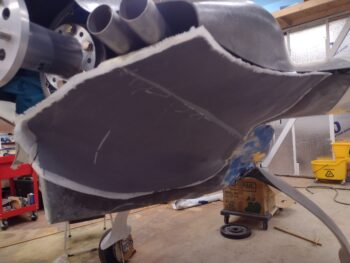
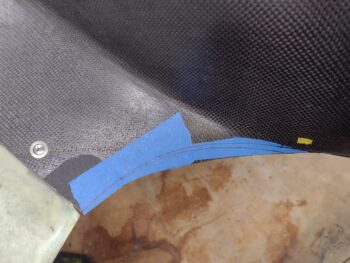
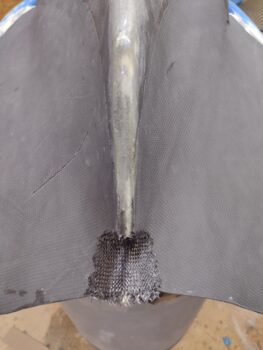
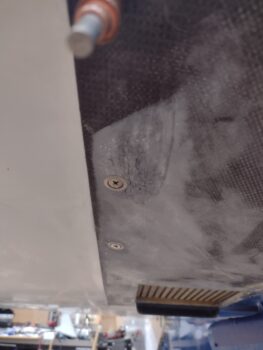
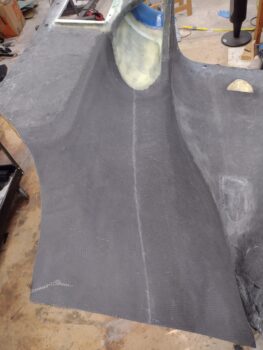
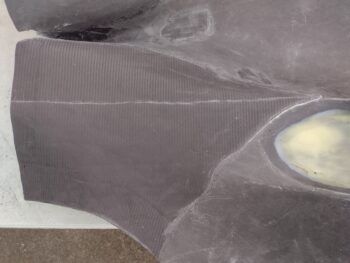
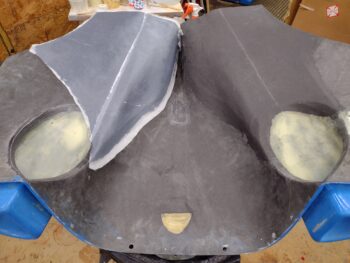
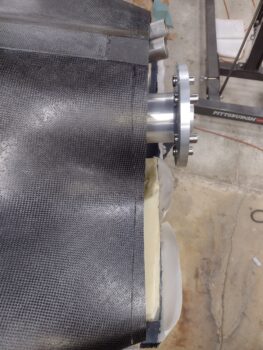
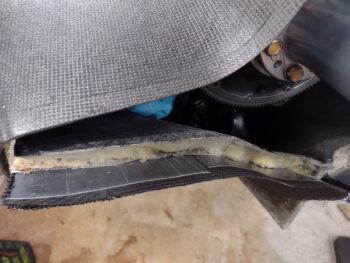
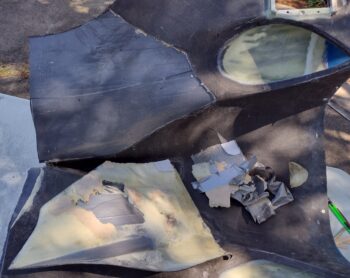
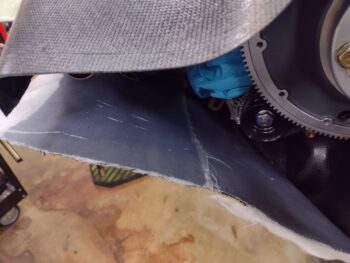
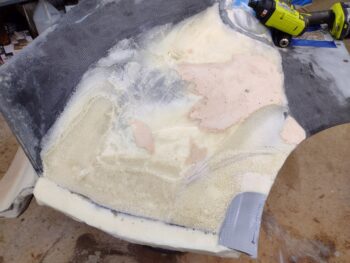
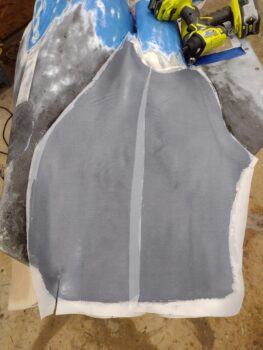
I started the day off by pulling the peel ply and razor trimming the inboard lip for the oil cooler.  I had made a divot in the underlying foam at the center oil cooler mounting bolt position to provide clearance for the head of the long mounting bolt —which will not only secure the oil cooler to the upcoming steel brace coming off the left wing top flange, but also will secure the bottom flange to the top flange via an aluminum spacer.

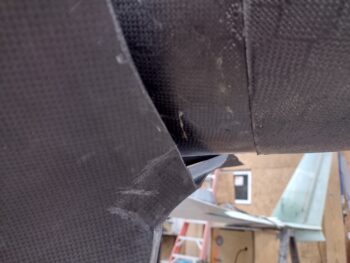
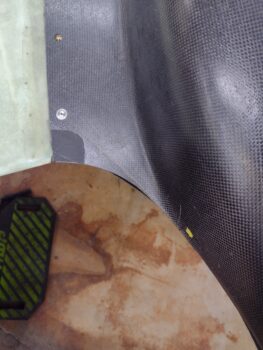
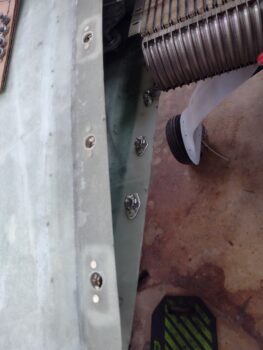
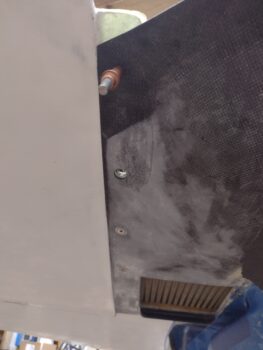
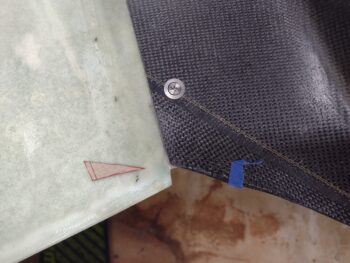
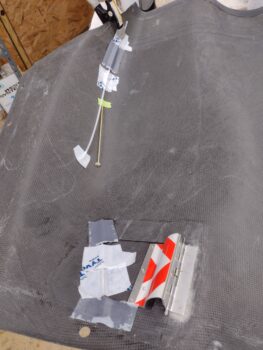
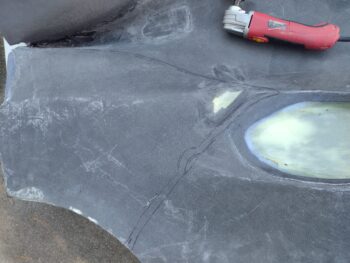
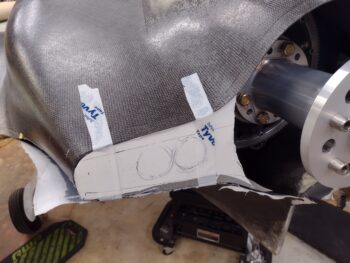
I also drilled out the forward #10 screw bolt hole on the inboard/right side of the oil cooler (note mechanical pencil pointer) to allow for the bottom cowling at the inboard side of the oil cooler to be pulled up tight to the cooler to best eliminate any air leaking.

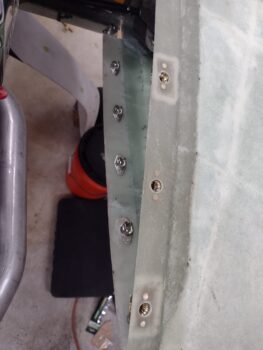
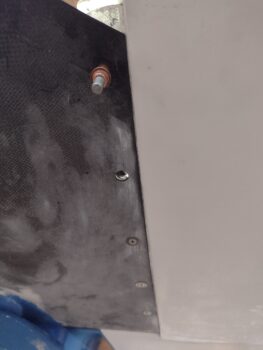
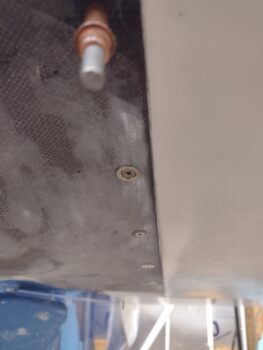
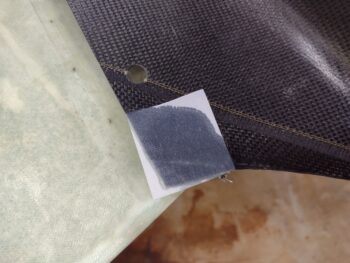
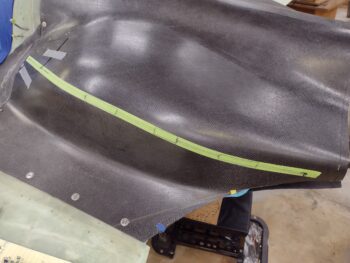
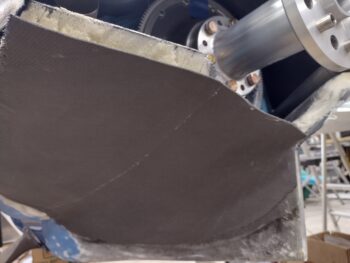
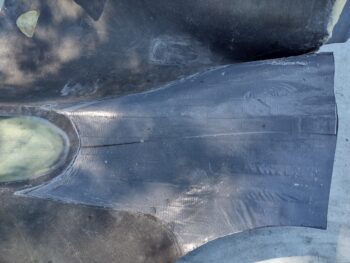
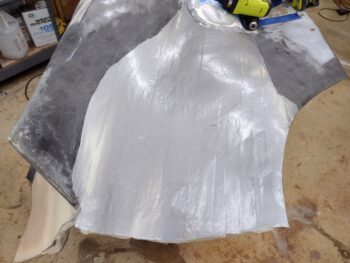
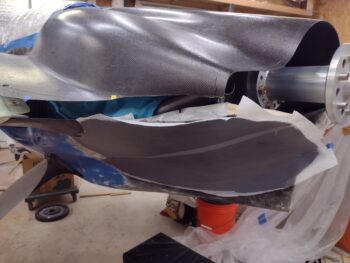
Pic #2 is the exterior shot of this screw.  I’ll note that since I can’t even get the counter sink bit in there by itself to countersink the screw hole (I’ll do it manually with a razor blade), I know that I’ll have to change course a bit in how I mount the aft screw.

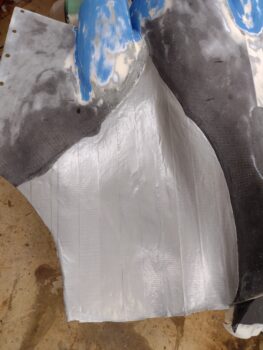
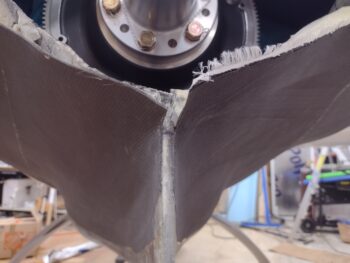
For the aft wall of the oil cooler sealing channel I wanted to create a bridge of sorts to help suck up the “drooping” lower cowling in this spot.  There’s just a slight dip, or downward curve, at the cowling here that I wanted to bring up close to straight.

To do that I wanted to use pre-glassed foam so that each side will support being clamped as I micro the foam on the bottom of the “bridge” to the inside of the bottom cowling.

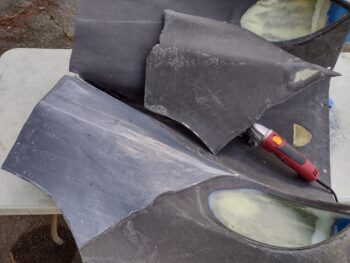
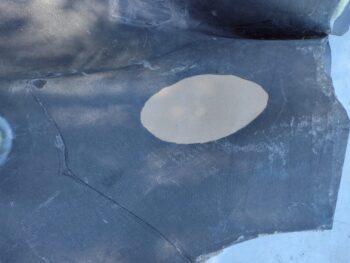
I rummaged through my scrap pile and found this: the section of the front right armrest that I cut out for the control stick.  Perfect.

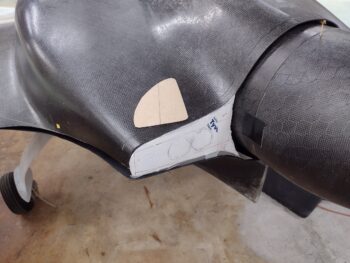
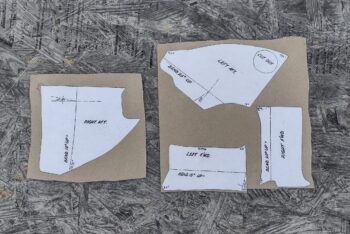
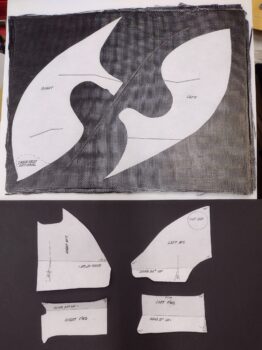
I then marked up and cut out my 0.6″ high “bridge” for the aft wall of the oil cooler support/air channel.

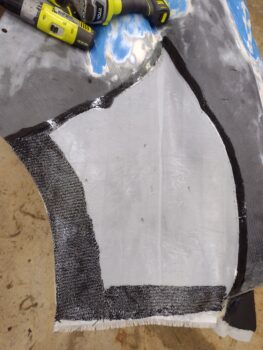
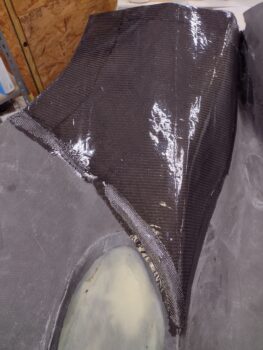
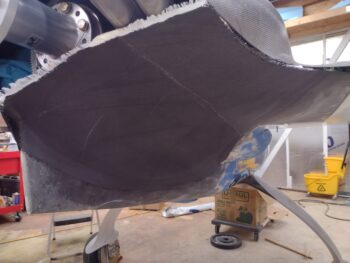
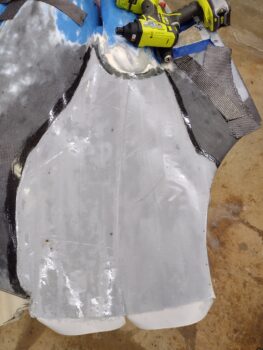
I decided to kill 2 birds with one stone, so after I micro’d the “bridge” in place along the aft edge of the oil cooler opening, I also laid up 2 plies of BID on the ouside/aft wall, overlapping onto the inside of the bottom cowling.

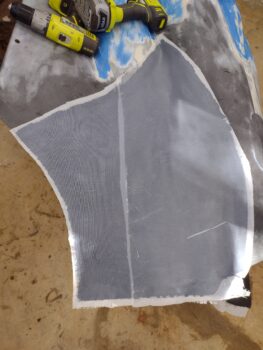
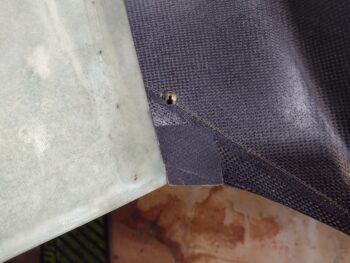
In addition, I laid up a ply of BID over the outboard/left mini-support wall/seal for the oil cooler.  To keep the top straight and the glass attached, I placed an inverted taped L-bracket onto the peel plied layup.

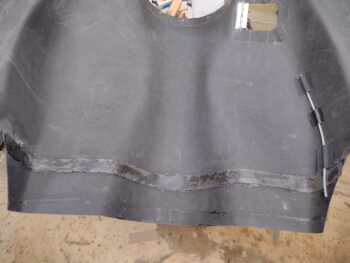
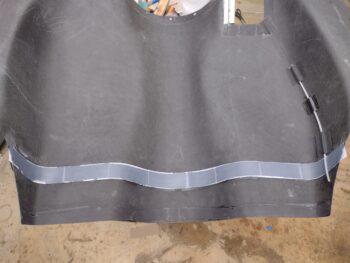
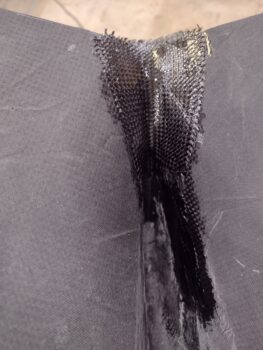
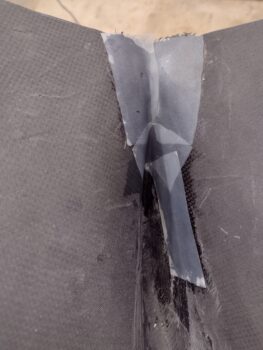
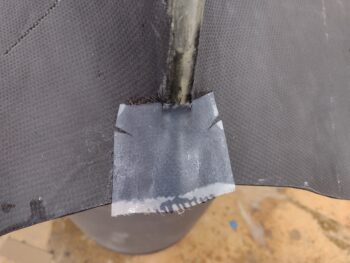
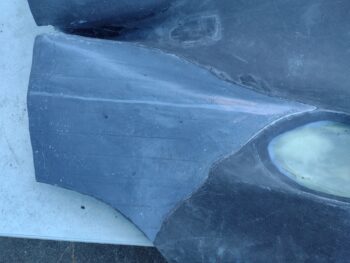
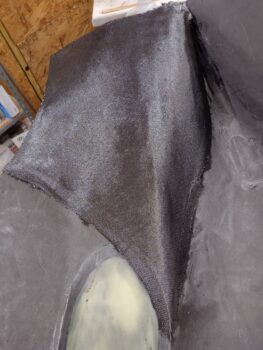
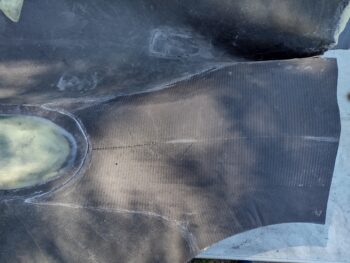
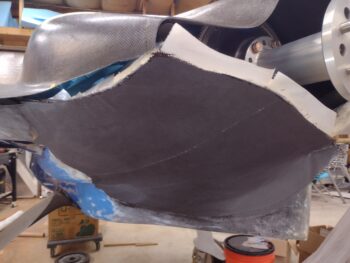
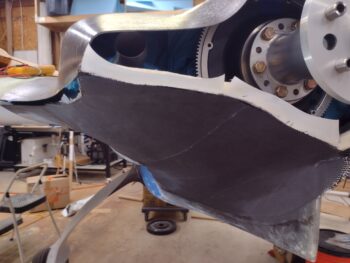
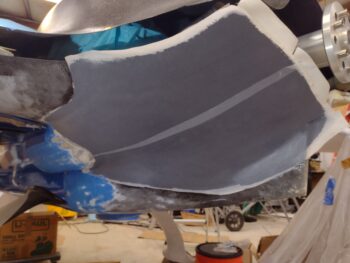
Pic #2 is of these layups a few hours later after I pulled the peel ply, razor trimmed, and cleaned them all up.

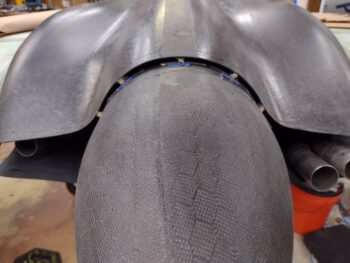
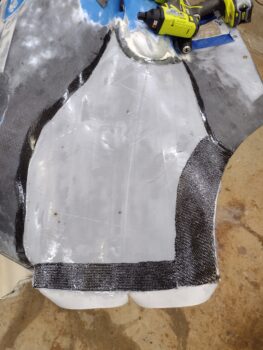
Here’s another shot of the oil cooler aft channel lip/seal micro’d and glassed in place.

I then tried to make “flox” corners on both the top and bottom edges of the inside walls of the oil cooler exit channel, but essentially just dug out about 0.1″ of foam and filled it with micro.

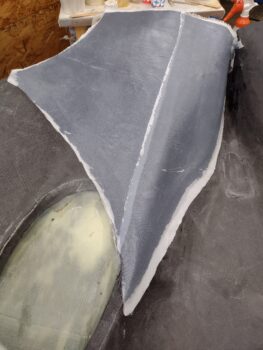
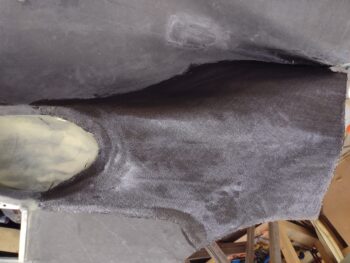
I then laid up a ply of BID on the inside of each channel, overlapping a bit onto the aft vertical lip.

After peel plying, I then left those inside layups to cure.

Moving on to the oil check door, here’s the cleaned up 1-ply BID layup on the oil check door hinge.

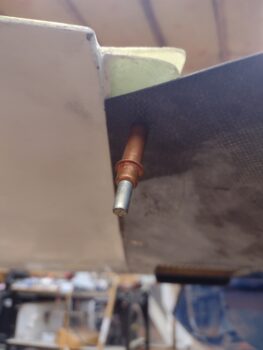
I then mocked up the oil check door hinge on the top cowling using Gorilla duct tape, and after a number test open/close iterations I drilled a rivet hole on the outboard edge of each hinge tab.

After another bunch of rounds of testing out the hinge geometry —and realizing there is a minor change just about every time I tested it out— I pulled the trigger on installing the top cowling-side hinge piece.

Since the cowl curves out where this hinge is mounted, there is a considerable dip at the middle of the hinge (Oh yeah, there’s also a good bit of twist as well!).  To compensate for the curved cowl I used 4 small 0.6″ wide plies of BID: 3″, 2″, 2″ and 1″, that start from 1″ aft of the front edge of the hinge piece and end at the aft edge of the hinge.

To account for the twist, I mounted a narrower piece of 1/32″ x 1″ G10 on the inboard (lower right in pic below) front side of the hinge.

I also applied a thin row of flox to the top center of the layup to fill up any gaps or air pockets.

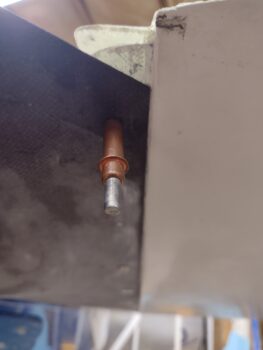
After glass and flox were applied, and the hinge in place, I then installed the rivet on each end.

Here’s how that looks from the outside of the top cowling.

I used MGS with fast hardener to mount the oil check door top cowl-side hinge piece, and after about 1.5 hours, when my test flox was beyond the gummy stage, I drilled 2 more holes (pre-marked) and mounted 2 more rivets.

Again, here’s how that looked from the exterior side of the top cowling.

I then mounted the top cowling on the bird to allow the installed hinge to cure in the cowling’s mounted state.

And with that folks, I called it yet another late night!

Chapter 23 – Slow, constant roll . . .

Today was one of those build days that consisted of a lot of small seemingly disparate tasks… although they all centered on either the top cowling’s oil check door or the oil cooler install.

Although I jumped back and forth between the 2 tasks all day long, I’ll begin with focusing just on the oil check door to make this post easier to follow.

I started by pulling the tape and popping off the hot glued popsicle stick tabs before cleaning up the leftover blobs of glue, and a bit of epoxy that had seeped through the gap and affixed itself to the top surface of the upper cowling.

Of course I realized immediately that I had forgotten an initial application of peel ply with the shiny carbon fiber staring me in the face.  If I’m lucky I may be able to leave this as the flange and claim that I ‘meant to do that’ all along… ha!

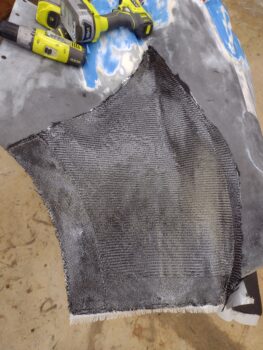
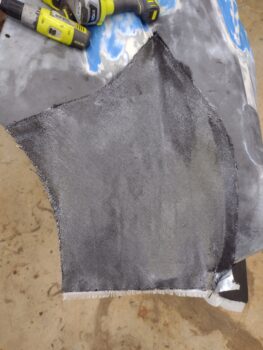
In my haste to get stuff done I guess I skipped over a few steps in my picture taking, as I laid up 2 plies of CF on the interior of the oil check door to reinforce it… as it was a bit flimsier than I preferred.  I’ll note while the door was still in place I applied 2 layers of Gorilla duct tape to ensure its form was maintained.

The second pic is with the oil check door back in place… as you can see there is no real appreciable difference in the elevation between door and top cowl surface.  This will of course minimize having to pile on more micro for any height mismatches.

Again, this is not the exact order in which I accomplished my tasks throughout the day, but next up on the oil check door was taping up the perimeter of the opening on the top cowling and then trimming the excess carbon fiber flange down to 0.4″.  I actually thought I was going significantly more than the plans recommended 0.25″, but even the 0.4″ flange seems just barely enough IMO… although it should work just fine.

I then pulled the tape off.  Here we have the 0.4″ wide perimeter flange for the oil check access port.

I then set the cowling back in place to check clearance with me reaching my hand in to manipulate the dipstick cap.  The clearance seemed plenty and I wasn’t dinging or slicing my hand along the flange, so again, all seems good.

And yes, out of curiosity I again placed the oil check door back in place.  All is looking pretty darn good here as far as I’m concerned.

On the oil cooler install side of things, I clamped a piece of scrap wood to minimize the glass blowout on the underside of my drilling the holes for the #10 screws that would be occupying them.

Here are the holes drilled out and then countersunk in the pic on the left.  I then put the screws in place and secured them with standard nuts on the top side.

To be clear, I needed to use CS screws here since they are set in the flange that mate with the inside surface of the bottom cowling.  Obviously any type of fastener that was proud of this surface would cause issues.

I then set the oil cooler back in place.  Previously I drilled new holes in the lower oil cooler flange for these mounting screws and to keep any bits of metal out of the cooling fins I wrapped the oil cooler in Saran/plastic wrap.

Also note that where the temporary standard nut(s) are securing the oil cooler here, those will be platenuts in the final configuration.

After a good bit of figuring out the desired height/elevation of the oil cooler, I fashioned the inboard slightly elevated edge out of PVC foam… maybe 1/4″ high.  I then micro’d the inboard foam elevation piece in place, and weighed it down just a hair while it cured.

Here’s a shot of the inboard foam elevation piece from the outside of the bottom cowling.  Note how I trimmed the front scoop just a bit from the original configuration.  I don’t know if this was a good idea or not, but I wanted the angled line to intersect the bottom cowling at the front cross edge of the oil cooler.

A couple/few hours later I laid up 2 plies of BID on the inboard foam elevation piece, and then peel plied the layup.  The vertical edge/inside exit opening of this foam piece is not glassed at this point, which I’ll most likely do tomorrow.  And when I do glass it I’ll create “flox” corners to better secure the glass and reinforce the edge.

Also note that I micro’d a thin strip of foam on the outboard edge of the oil cooler opening.  Which brings me to another point: you may have noted that the spacing of the oil cooler-securing screws may seem a bit uneven.  That’s due to my planning to secure the bottom cowling to the outboard edge of the oil cooler with 2 screws —as is commonly seen on these birds.

However, with the outboard edge of the oil cooler so darn close to the row of CAMLOCs AND the 3 mounting screws, I realized that there is very little added value in adding 2 more screws to keep this thing pinned to the cowling… especially with 3 screws and 3 CAMLOCs right along that edge.  I was going to put the 2 screws in the forward and aft original holes on the oil cooler flange, thus why the mounting screws are on slightly different centers to avoid those original mounting holes, CAMLOCs, etc.

My last official task of the evening was to simply lay up a ply of BID, with peel ply, on the face of the hinge arm that will mount to the inside of the oil check door.  Since the oil check door is CF and the hinge assembly aluminum, I just added a BID ply here to avoid any weird reaction between CF and aluminum… in prep for mounting this hinge in the next day or so.

Ok, a lot of nitnoy tasks today to get these installs moving along.  I half expected my Pro-Set epoxy to be delivered today, but alas, it was not.  So I’ll work these installs and knock them out before jumping full bore onto the bottom cowling rework.

Pressing forward!

Chapter 23 – Oil check door

Today’s focus was primarily on creating the oil check door in the top cowling.

I’ve been doing as much research on this seemingly benign topic, specifically in regards to pusher canard aircraft, but honestly didn’t find a whole lot of info.  I think a lot of this apparent lack of chatter on this topic has to do with so many of the early Long-EZs simply used Task cowlings, et al, that seemed to have an oil check door baked into the mold.  There wasn’t a lot of thought required in producing an oil door.

As a quick aside, one interesting school of thought not surprisingly coming from Klaus Savier is to simply NOT have an oil door.  Clearly that saves weight and minimizes any pressure loss from air escaping through the door.  I attempt to consider things without just passing judgment on them and seriously thought this through.  Perhaps it’s my old school mentality showing through, but I saw myself out at say Rough River or just flying around visiting friends… do I really want to take the cowl off every time I want check the oil?   The answer is a resounding no.

In fact, I don’t want to have a tool (e.g. screwdriver) at all required to open the oil check door to gain access to the oil dipstick.  I realize that a CAMLOC or two is one of the easier solutions to crack open the oil door, but besides a quick round of fuel checking in the mini-cup (I hate the old school “test tube” that invariably puts as much fuel on your hands as in the tube) I just want to be checking stuff and pulling “Remove Before Flight” pins.  Moreover, a slip of your finger on a latch doesn’t scratch the paint quite like a good slip of the ‘ol screwdriver!

As I’ve mentioned previously, in my former job as a communications project manager, the focus was always on requirements.  And that’s where the rub occurred for me in this endeavor of picking how this oil door was going to get created.  I have a spring loaded hinge on hand (more on that in a bit) and lightweight Hartwell 2-button latch that I would like to incorporate into this design.  BTW, the latch is less than an ounce heavier than a single CAMLOC setup (you can’t forget the receptacle weight).

Thus, the ensuing conflict became one of EASE OF INSTALL vs OPTIMIZED OPERATION.  You can throw safety in there too.

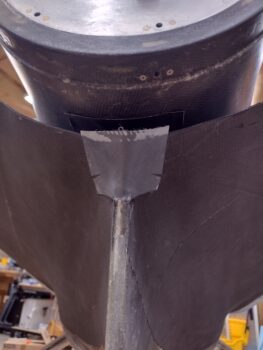
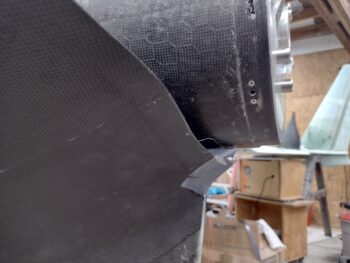
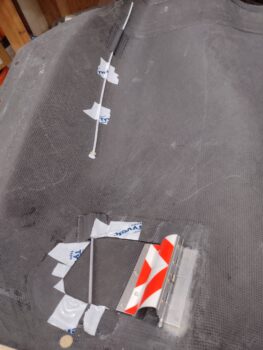
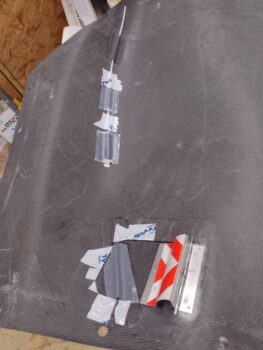
With the contour of the top cowling over the fuel level dipstick, the clear winner for ease of install was to have the oil check door open up aft, at an angle to A/C CL, as in the 2 pics above.  The aft edge is straight and allows for an EZ install of a hinge.  The forward edge of the door is fairly straight and would allow for an EZ install of the latch.  Ok, done right?

Uh, no.

First, in any endeavor that involves a breathing tank (SCUBA, Firefighting, Chem/Bio Ops, etc.) you’re always taught to have the tank fully open or fully closed.  No guessing from your buddy as to what state the breathing tank is in.  The same goes for any valve: have it fully opened or fully closed.  And thus hatches on aircraft, IMO, should be fully open or fully closed.  In the most obvious state.  Although I prefer an oil door that just pops up a little, if it’s open I want it known that it is not locked and secured and not rely just on my memory.  We all know about accident cases where someone gets interrupted and then fails to complete the task.  Thus my decision to go with a spring loaded door: safety.

Sorry for the diatribe, but that explains my primary issue with have the door open aft.  With the spring loaded door, if the latch were to ever fail, the door would spring up straight into the wind —as a mini-sail or speed brake— and could conceivably be ripped off and sent into the prop.  The PRO is that with some high-vis tape or paint, I would clearly see that it was open from the front of the plane.  Accessibility and reach wasn’t really an issue, until you counted that our birds are typically in the grazing attitude with tail higher than as it sits in my shop right now.  So reach with the aft opening oil hatch is more in the con category as well.

Sorry for my tome on the oil door.  Almost done.

I notice a lot of builders made their oil doors open forward.  Personally I consider this great for checking the oil and for safety of flight if the latch fails.  However, unless the door swings all the way over, which mine won’t be, it’s not a good configuration for putting oil into the filler neck.  So front is a no-go.

Clearly the oil door swinging outboard is the worst of all cases: visibility hampered, dipstick removal hampered, oil filling hampered…. just not good.

Which leads us to the optimized oil door opening position: inboard.  This gets us the best of all worlds in regards to this diminutive little hatch: best visibility, best dipstick access, best oil filling access (both physically and due to visibility too).

So what’s the downside of this latter position?  Well, the hinge side is on a slight curve. Not horrible, but significant enough it will have to be contended with.  Worse than that is the latch side… it sits on a compound curve —not surprisingly with the obvious curves of the top cowling— and putting any type latch here, even just a CAMLOC, will to any degree and in a word: suck.

But after literally a few hours of testing every configuration, reading whatever I could find, and spending way too much time pondering future ops… I chose the operationally optimized configuration, and the one that would not present any significant potential risk to safety of flight.

Here it is… all 5.1″ wide x 5.2″ tall of it.

After making my decision and deciding to just deal with the mounting of it when that time came, I grabbed my trusty Fein saw and carefully freed the oil door from the top cowling.  Obviously seeing the gray dipstick cap staring me in the face when I removed the oil door piece was super swell as well.

I then cleaned up the edges of both the oil door opening and the oil door itself.

I could definitely tell I was cutting in the center 3-ply area of the cowling because as far as cutting it with the Fein saw it felt almost paper thin.  I knew I would need to add a ply or 2 of carbon fiber to the oil door itself to stiffen it up a bit more, so I added a ply of thick Gorilla duct tape to the inside of the door before then adding the Tyvek “mold release” tape for laying up the oil door opening perimeter flange.

I recycled the pieces of popsicle sticks I had used for mounting the top cowling by hot gluing them to the external face of the oil check door.  Here I’m simply doing a test fit with it back into place on the top cowling.

I then added a small dab of hot glue on each wood piece before setting the oil check door back into place into the top cowling.  I then taped the wood tabs to ensure they were pressed firmly against the surface.

Here’s how that looked from the inside of the top cowling.

I placed scrap pieces of the Tyvek tape around the edge to show my glassing “boundaries” and then proceeded to use up all my CF scraps in creating the oil check door flange on the top cowling.  I grabbed my roll of CF and cut out one nice “top” piece and laid that up as well… in actuality I wanted 3 plies to ensure good flange strength to ensure as tight a seal I can get to thwart the air pressure coming in from the armpit scoops trying to blow this door off the cowling.

I then peel plied the oil check door CF flange layup.

I let the layup cure for well over an hour to set up a bit before remounting the top cowling onto the plane.  I didn’t use fast hardener here but rather MGS 285 with a 60/40 mix of slow/fast hardener to give me a medium cure time.

With the decent size of the flange layup I didn’t want it curing with the cowling off and upside down with the sides splayed out a bit… I wanted it to final cure with the cowl set in position.

Here’s how that looked from the inside.

I had run out of epoxy about half way through laying up that last ply of CF on the flange, so I mixed up a bit more for that and the subsequent peel ply.  Well, I overshot my target by a few grams so had some epoxy left over.

As to not waste the epoxy, I went into hyperdrive in prepping the next phase of my oil cooler left wing mounting flange.  I trimmed the topside layup, and then removed any flox that had seeped out from under the G10 flange on the bottom side.

I then measured the thickness of the left wing bottom flange and it came out to 0.066″.

I needed to continue my flange extension inboard and with a flange thickness of 0.066″ it allowed me to simply add in another strip of 1/16″ thick G10 on the inboard EDGE of the wing flange, just below the G10 I had added yesterday.  I found a scrap piece of G10 about 3/16″ wide and trimmed it to length, sanded it up and then used my epoxy from the Oil check door flange layup to attach the G10 strip in place with flox.

Before adding the G10 strip above, I used my sanding board to aggressively sand the area on the bottom wing flange that would receive glass.  I then added a nearly 1″ wide by 5.5″ ply of BID on the bottom inboard face of the wing flange, overlapping onto the narrow strip of G10 that I had just floxed to both the inside edge of the wing flange and also to the G10 above it.

Again, this is all to create a strong mounting lip, 0.2″ inboard than previously, to allow mounting the oil cooler to the buttressed left wing flange with 3x CS SS #10 screws.

Here’s a shot from above, which really doesn’t show much other than the ply of BID peeking out from underneath.  It does show that I pulled the peel ply and the previous layup is looking healthy.

We’re due to get a good bit of rain all next week, and it was starting to get dark… and with the past couple days slightly cooler than the crazy heat we’ve been having lately, I wanted to get a good sanding session in on the bottom cowling.

I sanded the bottom cowling outside the shop for a good 25 minutes straight, focusing mainly on the lower aft fin portion of the cowling.  After the fin was paint free, I moved forward and out in my sanding to continue to remove as much of the old blue paint as possible in prep for future painting, and obviously upcoming glassing.

As I mentioned last Friday, I ordered a gallon of Pro-Set epoxy with medium hardener and will use that for the bottom cowling reconstructive surgery.  While I wait for that order to be delivered I obviously wanted to get both the oil cooler and oil check door installed and off the to-do list.  That being said, I expect to start working on the bottom cowling full stop in another 2-3 days.

Chapter 23 – Oil cooler install

Today was mainly about deciding the final install configuration for the oil cooler.  On the outboard side of the oil cooler I will be mounting the lower flange to the bottom cowling mounting flange on the left wing.

Since there’s only about 1/2″ of visible cowling between the inboard edge of the left wing’s bottom flange for the lower cowling and the outboard opening for the oil cooler, I am adding about a 0.2″ flange to drive the 3x #10 CS screws up through the reinforced flange to attach the outboard lip of the oil cooler.  Yes, you may need to read that twice (if you’re that interested).

The bottom line is that both in bulk and width I need to reinforce the lower flange of the left wing (the lower cowling mounting flange that is) to provide enough meat to drive 3x CS screws UP into the flange of the oil cooler, where awaiting these 3 screws will be three K1000-3 platenuts, or variants thereof.

After making a cardboard template, I then transferred the shape onto a piece of 1/16″ thick G10 Garolite phenolic.  I then drilled holes into the G10 extension for flox grips, and also dulled the entire piece with sandpaper for a good epoxy grip.  Finally, I cleaned up the piece with Acetone.

I then prepped the left wing’s lower flange with tape and cleaning for both floxing on the extension and for glassing.

I then floxed on the G10 extension and wetted out the area for a 3-ply BID layup.

Here’s BID ply #2 getting laid up to secure the G10 extension.

Here we have all 3 plies of BID laid up over and on the G10 extension.  I then peel plied the layup.

I’ll remind you that this is pretty much the configuration I’m looking for in my oil cooler install… and that I serendipitously found this in a FaceBook post from Burrall Sanders.

I then spent a good hour both pinpointing the exact center of my top cowling oil check door —based on the position and angle of the oil level tube— and brainstorming different variations of possible oil check door sizes and opening configurations.

Jess had been down in Florida for a number of days, and I hadn’t seen her in almost a week, so I called it an early evening on the build and went out with her for a night out.

Tomorrow I’ll be back onto both the oil cooler install and the top cowling oil check door install as well.

Chapter 23 – Oil cooler fitment

Today was a carry over of sorts from last night’s assessment phase.

First, off I had marked the aft sides of the top cowling for trimming so each would flow better into the trailing edge of each respective wing.

Today I started off with trimming those aft sides of the top cowling and then proceeded to take the top cowling off without grabbing pics first.  So here’s the top cowling just set back in place for the pics.

The yellow tape on each side is about the same distance forward from the very aft opening of the top cowling.  This tape represents the transition from vertical to horizontal and will come into play when I create the actual cowling trailing edge.  Everything outboard of the yellow tape will be a sharp trailing edge with an underside lip that extends forward about 1.5″ (like the plans cowling), and everything inboard/aft of the tape will just be a vertical wall that wraps around the aft cowl opening.

I then spent a good half hour creating a hardware card for the top cowling.  These of course are very handy and keep the CAMLOCs organized.

Here’s a shot of the left wing floating CAMLOC/SkyBolt receptacles, as best as I could get it with the bottom cowling in place.

And here we have a couple shots of the CAMLOC/SkyBolt lightweight SS receptacles along the top cowling front edge mounting flanges.  Yes, I still need to clean up the dead glass off the firewall from the flange layup.

I then spent a good amount of time mocking up and figuring out exactly the install position of the oil cooler.

That of course required some decisions to be made so I spent some time doing a bit of research as well before taking the scalpel to the lower cowling.

Here’s where and how my oil cooler will get installed.  I’ll note that I have 13-row oil cooler whereas Mike Melvill had a 17-row cooler.  You can’t go aft very much before the cooler is too close to the #3 cylinder, so Mike had to go forward into the little drop down scoop… about an inch into it.

I’ll remind everybody what that scoop does, which was employed by Dick Rutan on his historic round-the-world Voyager flight.  Yes, it may create a little drag, but it greatly increases the flow of air through the oil cooler by essentially sucking/drawing the air out of the cooler.  Again, with a slightly smaller oil cooler and moving it about an inch aft I can get just about every bit of Delta ‘P’ action as shown in the bottom diagram.

Here’s how that looks close up.  I actually trimmed off about the aft third of the side triangular piece from each side as well (no pic).

And here’s a general idea of how the oil cooler will look.  Over the years I’ve had about 3-4 plans on how to install it, and then this year alone I’ve had 2-3 different thoughts on how to install it.  I’ve confirmed (to myself) that I’m going to install it primarily to the left wing root, at both the top and bottom cowling mounting flanges, but even that actual how-to and configuration plan has changed about 3 times just today.

Tomorrow I’ll start glassing the mounting tabs, etc. to get the oil cooler installed, while I also intend to knock out the cutting out and glassing of the top cowling oil check/dipstick access door.


Chapter 23 – Top cowling installed!

Apparently these huge grasshoppers showed up on my kitchen window to help me celebrate yet another significant milestone on the plane build: I’m declaring the top cowling is officially installed!

I decided to plow forward with getting all the CAMLOCs and screws knocked out in one fell swoop today and get it over with.

I started on the front edge and got the last 2 CAMLOCs and the screw platenut on each side installed.

Again, these screws here are just easy to get in and out screw/bolts that will be replaced with SS CS screws.  However, since this is a regularly accessed area I will NOT be using the “Melvill” SS hex head screws here.  Those are reserved for components that are rarely removed like ailerons and rudders, and in areas that I want to look particularly sexy! <grin>

A couple more shots of the top cowling in place with ALL the CAMLOCs and screws installed.

I know I promised a pic of the inside of the flanges to get a look at the top cowling CAMLOC receptacles, but that will have to come in the next day or two.

Here’s a good look at the right side of the top cowling replete with installed CAMLOCs.

And now that I’ve convinced you that the top cowl is in fact secured to the aircraft, a couple of CnC (Cowl and Canopy) shots!

Let’s check the canopy/D-deck/top cowl angle knowing that it’s secured in place… not bad!

I then dimmed the lights and broke out the laser level to start down the machinations road of getting the aft edge of the top cowling trimmed.  This is one of those take-a-deep-breath-and-dive-right-in events that seem to happen at too many intervals on this build!

Note that I dropped a plumb line on the aft opening of the lower cowling (oh, I installed the bottom cowl btw) as both a reference to the lower cowl opening edge and also to verify that my laser was shooting level vertically.

I transcribed the bottom cowl outer edge line to the bottom outboard edge of the top cowling, and used that and the inboard plumb line to mark my cut line.

I then did the same thing on the right side, dropping yet another plumb line.  It was then that I realized I had a slight offset issue with my laser shots since my lines met at the top cowl centerline about 1/4″ off from each other.

I realized one reference wasn’t good enough to really get 90° so I lined up my laser shot to hit both plumb lines and the outboard reference mark, on both right and left sides.

Bingo!  That did the trick.

Since my marking tape was all marked up, and it was a bit dark and I was wearing the red protective “Bono” glasses, I just went ahead and marked the laser line with the forward EDGE of the tape.

Again, I grabbed my TRUSTY Fein saw, took a deep breath, and trimmed the aft edge of the top cowling.

The only minor issue I encountered was cutting the top cowling joggle near top centerline resulted in a bit of a slight line movement forward… of course this can be remedied at finishing but may take a ply or two to reestablish that very faint indent forward.

To show you the tightness of the outboard gap between top and bottom cowling, I grabbed these shots with a ruler.  Now grant it I could have alleviated some of this narrowness by cheating on the top cowl angle a bit, but I wanted to maintain that angle as near-perfect as I could make it out to be.

The current vertical gap is about 1.3″ on the outboard sides.  I’m actually not going to increase it a whole lot… probably just a hair under an inch more (bottom cowl lip lower) since I’ll be shifting the exhaust pipes a bit more inboard; again as per Mike Melvill’s write-up in CP83.

From the outboard part of the aft cowling opening moving inboard —right where it starts to really expand/open up around the spinner— is currently about 3″ high.  I only plan to open that up to less than 4″, just enough to ensure good vertical clearance on each side of the exhaust pipes.

Here’s some afterthought “Oh yeah, I installed the bottom cowling btw” pics…

Moreover, after a few more minor shenanigans with the top cowling over the next couple of days, I then plan on throwing myself headlong back onto the bottom cowling for major rework & reconfiguration that needs to happen for both exhaust pipe clearance and to tie in the top/bottom cowling interfaces.

Yup… more good stuff.  Pressing forward!

Chapter 23 – 7 CAMLOCs

My goal by the end of this evening was to have all the flanges glassed for the top cowling and to have a minimum of 7 CAMLOCs installed to secure the top cowling.

Well, I’m happy to report that I met my goal.  Not in the timeline I was looking for (I busted that by about 1.5 hours), but I got ‘er done!

I started off by pulling the peel ply on the left wing flange that secures the top cowling on the left side.  Again, I used 5 complete plies (as per plans) since I wanted it as robust as possible since I’ll be using this flange —in part— to secure the oil cooler to.  The main mounting of the oil cooler will be on the bottom left wing flange that secures the bottom cowling.  Both flanges will be beefed up in those localized areas for use in oil cooler mounting.

On the exterior side I drilled the holes for and installed Clecos to secure the top cowling to the newly glassed flanges.

I then removed the weights and the tape as the initial cleanup phase.

And then spent a bit of time knocking off all the hot-glued on popsicle sticks.

Here we have the entire top cowling secured to its mounting flanges via Clecos.

Although having all the flanges glassed in and the top cowling completely secured with Clecos to those flanges is cause for celebration, I do have a very minor casualty in my top cowing install: my centering tick marks show that I’m off to the right about 1/16″.  I again included 2 pics so that my camera alignment would have only one set of tick marks centered.

I’m fairly certain this happened when I had to wrangle in the right trailing edge of the cowling to get it to even up with the wing.  You can see the 2 O’ Clock position of the cowling aft center is slightly lower and the 10 O’ Clock position, which is hair higher.  Interestingly if you push down on the aft flat portion on the left side of the cowling about 0.1″ it straightens it right up.

There’s a lot more steps between now and final top (and bottom) cowl configuration, so I’m sure I’ll be able to tweak this back to symmetrical… just an interesting tidbit I thought I’d share.

I then removed the cowling and pulled the tape from the inside front right edge BUT kept the inside edge tape along the left side cowl in place for the next and final cowl flange layup.

First I pulled the peel ply, marked and trimmed the left wing top cowl flange.  I am loath to point this out, but yes I have another few air blemishes that popped up (again: annoying!).

On the right front I pulled the topside peel ply and then marked the flange for trimming.

Here’s a pic of all the top cowling perimeter mounting flanges in a Π shape around the engine.

But wait! There’s more!

I added another strip of tape down the inside right edge of the cowling in prep for the final top cowling flange layup: the top 1-ply BID strip that overlaps the top of the wing onto the top of the top cowling wing flange.

Actually, before I laid up any glass I drilled tiny holes and injected nearly a dozen total little air pockets, blemishes, etc.  I would say I was successful on a little over 2/3rds of those.  BTW, with the G10 inserts being flat, I get their tendency to have hard time with not having a bit of air on the face of them.  I should have added a bit of wet flox on the top side to allow them to conform better on the curves.  I did hit the tops of those as well.  All in all I would say this sideline task was a success, and got rid of quite a few of these uncommon air gaps.

In the first pic the strip of BID is in place and wetted out, while in pic #2 I’ve added the peel ply that you see beside the layup in pic #1.

I laid up and peel plied the right wing edge flange the same as I did the left above.

I also added a 1+ ply (some small filler BID pieces as well) layup in the corner on each side where the shoulder flange meets the D-deck flange.  This should clean up that transition nicely.

I then set the cowling back in place and installed all the Clecos along the front edge.

Clearly I couldn’t install the Clecos along the cowling wing interfaces since I had just laid up a ply of BID on each side, so I resorted to weights once again to ensure the top cowling was in position on the wing flanges.

Here’s a pic of that on the right side.  Again, that pesky trailing edge piped up and was just a hair proud.

The center weight was already in place, so I grabbed 2x 2.5# weights and slung them onto a tie-down strap and hung the weights over the right side trailing edge.  It worked a treat in keeping that aft edge in place.  In fact, when I went to hang the weights down below, they just barely rested on the step stool I had below… literally the perfect amount of pressure and completely unintended with the step stool!

A few hours later I pulled the weights and removed the Clecos.  I knew the MGS with fast hardener was about 90% cure… to the point you could remove the peel ply without it giving any hassle or being stubborn.

I then spent well over the next 2 hours installing 7 CAMLOCs along the front edge of the top cowling.

I didn’t mess with the corner just above the shoulder on each side since this had just been glassed and I wanted to let it get a full cure overnight before installing those CAMLOCs.

The final unfinished outboard position on each side (#2 in from corner) actually gets a K1000-3 platenut since I’ll be using a stainless steel CS screw in these spots.

As for the CAMLOC (technically SkyBolt) receptacles, I’m using the non-floating lightweight stainless steel receptacles all across the front edge of the cowling (except the 2 screw points, obviously).  However, along the wing flanges I’ll be using the aluminum floating self-adjusting CAMLOC/SkyBolt receptacles… which is good because I have a good number of -2 CAMLOC studs that are too short to use elsewhere and need a good home!

I’ll get some pics of the receptacles tomorrow.  It’s well past midnight and I’m beat, so time to call it a night!

Chapter 23 – Top cowl mirror layups

I started off today by drilling the fastener center holes for Clecos in the top cowling right wing lip that I laid up last night.  I then pulled the Gorilla duct tape that was helping secure the cowling in place.

I then did the same thing on the left side for the front edge of the cowling, with holes drilled and Clecos in the new cured lip along the strake and shoulder.  I also removed the duct tape here as well.

I then removed all the hot glued popsicle sticks along the left front edge of the top cowling, although I left the wood tabs along the left wing edge.

I then removed the top cowling and pulled all the tape off the inside edges of the cowling.  I then pulled the peel ply off the new lips, both along the right wing top . . .

And off the top of the newly glassed left side strake and shoulder lip.  I also pulled the peel ply from the underside of the new left-side lip and the face of the CS spar and shoulder aft foam wall.

Again, despite my best efforts of fighting them as best possible, I found a few more void spots that I am not happy with… I’ll correct these in the near future.  I’m thinking MGS has a new number for their hardener and it may not age as well as the good ‘ol stuff because I’ve obviously been doing this for a good bit and haven’t seen this type of issue in all my years of building.

Regardless, I’m just about to the end of both jugs of MGS (285 and 335) and just ordered a gallon of Pro-Set to use in finishing out out all the upcoming layups. [Regarding MGS: 1) It’s nearly $300 a gallon for the 285, and 2) I’m not liking the new hardener as I just mentioned].

I failed to get pics of my trimming both new sets of top cowling mounting lips/flanges, as well as my marking and cutting the cowling front right and left side wing-interface for the ensuing top cowl mounting flange layups.

Thankfully my pattern for the left side strake and shoulder BID plies was about 95% good for the right side, with only some very minor tweaking required.  With that, I cut out the initial 2 plies (that covers the entire shoulder foam aft wall —overlapping onto the CS spar below) and then the remaining 3 BID plies that is mainly for the flange portion of the layup, which I used my traditional plastic prepreg.

After taping up the cowling edge and adding peel ply to that edge, I then installed the cowling with the Clecos and secured the right front edge position with hot-glued popsicle sticks, Gorilla duct tape and a weight on the corner.

Here’s the 5-ply BID layup.  I took 2 pics to show the entire layup since the light beam only hit one side or the other.  Also note that I only peel plied the lower side of this layup since admittedly it was late and I didn’t see a ton of value added in all the effort of peel plying the upper side of it.

As you can see in the pics above I used the toothpick trick again for the added G10 phenolic hardpoints, and below you can see them peeking out from the upper left of the pic down to the lower right.

For the left side wing flange I used 5 plies of BID (vs primarily 4 on the right) since I’ll be adding another fastener mounting hardpoint (1/16″ G10 phenolic) for a screw to secure the oil cooler mounting arm (I’ll actually be mounting the oil cooler to the left wing root, including an additional 4 screws to secure it to the lower cowling, or rather the lower cowling to the oil cooler… clearly these 4 screws will need to be removed from the underside of the bottom cowling to remove it from the plane, while the oil cooler will stay attached to the left wing top and bottom flanges).

After cutting the BID for the left side top cowling-securing flange, I prepregged 2 plies in one setup while the other 3 plies went in a second prepreg setup.

And as I did on the right side, I secured the top cowl left side even with the wing with popsicle sticks, Gorilla duct tape and weights (no trailing edge clamp required here).

I laid up the first 2 plies in standard fashion, then embedded the 2x G10 hardpoints into the 3-ply BID prepreg setup to then lay that up… again using my toothpick trick.

Here we have the 2 toothpicks peaking through the surface of the upper cowling, again one in the very upper left corner and the other in the very lower right.

And with the layups looking good (and hopefully air free… so annoying!) I called it a night.


Chapter 23 – Cowl CAMLOC flanges

I started off today by drilling holes in the CAMLOC positions for Clecos before pulling the top cowling off.  I then pulled off all the tape and cleaned up the inside of the top cowling.

My next task was to investigate how my aft vertical “shoulder” pour foam dams held up on each side.  I’d say there’s room for improvement, but since I doubt I’ll ever being dong this again I’ll just have to deal with all the pour foam that leaked down the inboard side of the strakes . . . of course this was one of the few times I was not cautious of protecting stuff below with painters tape!

Here we have a bit of a mess… you can see some of the temp quick disconnect hardware was engulfed in pour foam!

All in all it wasn’t horrible, and it took me a good 10 minutes per side to clean up the mess and then I got to shaping the shoulder pour foam on each side.

Also note the bottom edge of the D-deck flange where I’ve marked it for trimming, so I can connect the strake and shoulder flange to the D-deck flange with overlapping glass.

Although I hadn’t yet completely cleaned up the right side shoulder foam, here you can again see the lower edge of the D-deck flange marked for trimming.

After both shoulder foam cores were shaped for glassing and the lower edge on each side of the D-deck flange trimmed, I grabbed this pic:

I then remounted the top cowling and spent some time assessing and marking up the cut lines to trim the front left edge of the top cowling, as well as the right side that mates with the right wing.

I was originally considering glassing the flange along both front cowling edges, but then decided against it in order to limit my variables and better control the mating surface elevations.

I spent a good couple of hours getting everything planned out and prepped for glassing the left side strake and shoulder flange, which I did with one layup.  I laid up 5 plies of BID total, with the first 2 plies completely covering the aft foam core of the shoulder.

This initial 2-ply layup overlapped onto the CS spar adjacent to the firewall (below the foam).  Since I didn’t overlap the layup onto the actual firewall, I made a “flox” corner (although I used dry micro to save weight) at the junction of the foam and the firewall.  Also note I tried out using aluminum foil for “prepreg” vs the plastic I almost always use.

After my not-so-stellar emplacement of the embedded G10 hardpoints on the D-deck flange, I decided to employ a little bit different technique.  I still made up the 1/32″ G10 phenolic tabs as I did before, but this time I predetermined where my fastener positions were going to be in the top cowling and drilled a small hole at each one.

Before embedding the G10 hardpoints I drilled a small hole in the center of those as well.

I then ran half a toothpick through each hole in the G10, and obviously through the BID as well, before laying up the 3 ply prepregged BID layup.

Then I used the pre-drilled holes in the top cowling as a position guide and simply pushed the toothpicks that were in the G10 tabs into the holes of the cowling.  It worked a treat and quite EZ-PZ!

Here I’m pointing at the toothpick peeking through the top cowling on the shoulder.  If you look closely over on the left of the pic —next to the glued-on popsicle stick— you can see the center toothpick also peeking out.

Here we have tape, popsicle sticks and weights holding the left “free floating” cowling (since there is no more front cowling flange) in the correct position as the underside layup cured.

In my attempt to be as efficient as possible and to get the top cowling installed in the least amount of time, I also laid up the top cowl right wing flange as well.  Since I have the G10 hardpoints in 2 of the 4 positions —with still one more upcoming ply of BID on the top side that overlaps onto the wing— I decided to go with 4 plies overall, with a reinforcement ply at the bare (no G10) positions.

As on the left side, I used tape, hot-glued popsicle sticks and weights to keep the top cowl in position as the underside layup cured.  However, to keep the cowl trailing edge wrangled in position I needed to add a clamp into the mix.

Tomorrow I plan on doing the opposite of what I just finished tonight, by glassing in the front right of the top cowling flange and the left wing flange as well.

And with that, I called it a night!

Chapter 23 – Cowl shoulder surgery

Today was all about ‘shoulder addition surgery’ . . . yeah, yeah, so it sounds like something “Doctor” Mengele would be involved with.  Well, I can assure it is not! This is all about the glorious Long-EZ, not some debased science experiment! <wink>

I digress . . .

First off, after glassing the strake “stock” flange I naturally had a decision (or 5) to make: Do I add the follow-on Melvill CAMLOC lip as I did with the D-deck? Or do I do something else?

I chose something else.

I decided I would layup the “Melvill CAMLOC lip” all in one go from the strake flange that I had just laid up, around the “shoulder” and tie it into the D-deck flange.

To do that I would need to venture off without having “gear adrift” (Navy term), as in I wanted to secure the outboard front edge of the top cowl.  To do this I simply drilled a couple of holes in the now cured “stock” flange for a pair of temporary Clecos (these holes will be filled in during finishing).

I then marked each side top cowl “shoulder” flange for trimming.

I removed the top cowling, cleaned off the tape, and pulled the peel ply from the strake flange underside before trimming the flange at the cowl “shoulder” flanges (marked above).

I then grabbed some cardboard and duct tape to make up some aft pour foam dam walls for the top cowl “shoulders”.

Here’s a test fit of the aft pour foam dam walls with top cowling in place.

I then finished constructing the remaining part of the pour foam dams for both left and right top cowling “shoulders.”

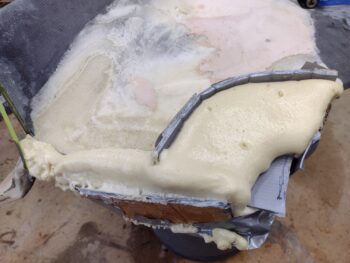
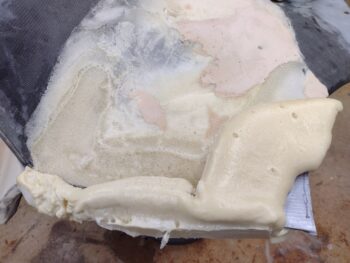
I then whipped up some pour foam and dumped it into the right “shoulder” dam… I was probably 1/8″ too shy in my inside cup marking to make a complete fill.  As you can see by that top dollop I needed just a hair more pour foam juice to complete my mission on the right side . . .

The way to solve this problem is to of course completely over-compensate!  The dollop to finish off the right side was from the left side pour foam application, which itself turned into a seemingly living creature… as it oozed out of the dam on the left side it decided to do a nose dive into my strake, which I thwarted.  Thus why it looks so ugly because I ‘uprighted’ the foam overflow and stretched the curing glue component.
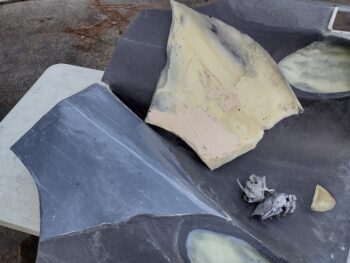
On the right side I judiciously lopped off the exposed foam and then ripped off the pour foam dam (feel free to picture Conan the Barbarian in this scenario… ).

After a number of rounds of sanding, shaping and vacuuming [it’s an iterative process!] I got the right “shoulder” ready for glass/CF.

I followed pretty much the same process on the left side… slowly sanding and shaping the top cowling “shoulder.”

And finally getting it prepped for glass/CF.

My layup schedule for the “shoulders” was 2 plies of BID followed by 2 plies of carbon fiber.  One reason I’m using CF is that it is amazingly resistant to heat, and I plan on having a black accent line/swoosh —as I do on the bottom of the plane— that goes just a skooch onto the inside corner of the strake.  Notice I stretched the top CF ply out to cover this corner just a bit to allow for that black paint.

I of course did the same thing on the right side.

And here they are many hours later after I pulled the peel ply.

I guess with these shoulder fairings in place and their being black carbon fiber, and thus a bit harder to make out, it’s not so much what you do see but what you don’t: unfinished corners with bare fuel vent lines showing.

Here’s a couple longer view shots of the “shoulders.”

And I guess we can call these medium view shots.  I have to say I’m really happy with how these top cowling shoulders came out.

Tomorrow I’ll continue on with the top cowling install.