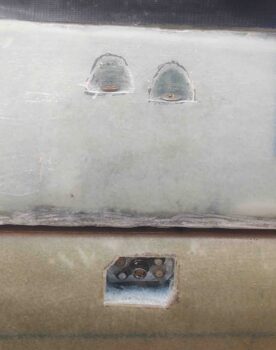
Chapter 9/22/23 – Still preppy

er, ah . . . prepping!

Today I started out by taking a 1.5 hour flight to get my sea legs back. I did a little pattern work before heading up the coast a ways to check out the sites that the Outer Banks has to offer. It really is a beautiful area to fly around. Here’s just a few of the many pics I took:

Beaufort town waterfront
Intercoastal waterway
180º over the Atlantic Ocean
Heading back to base….

On the way back home I stopped off at Harbor Freight to see if they had a metal brake in stock, which I’ll eventually need for making/installing some of the engine baffles. I’ve been checking for months at the stores in the area and they never have any in stock, which again the Morehead City store did not. However, they were nice enough to check around and the store in New Bern had one, so I detoured a half hour to go get it. Then returned home. I’ll detail the specifics on it in a post once I have it put together.

Late afternoon I finally got back into the shop.

To best describe what I’m doing here on this first task, I’ll go in reverse chronological order starting with the glassed bracket, and show you what it’s for before I show you how I ginned it up.

First, the P-Mag Electronic Ignition has the option to select an “A” or “B” timing curve. In reality this will probably never get used, but I’d rather have it wired up and at the ready than needing it and not having it available (or worse, doing a field mod to wire it up).

Next, the P-Mag also has a serial interface to the unit via a DB-9 connector for selecting variable timing, data I/O, etc. Again, better to have it ready to go (IMO) than needing it and not having it installed.
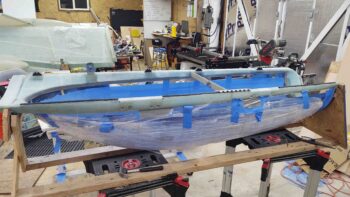
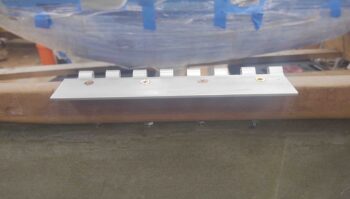
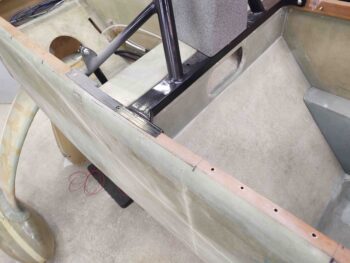
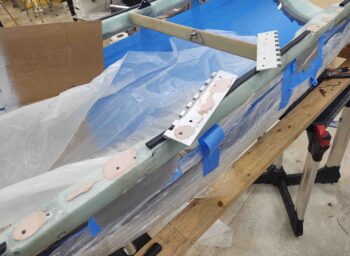
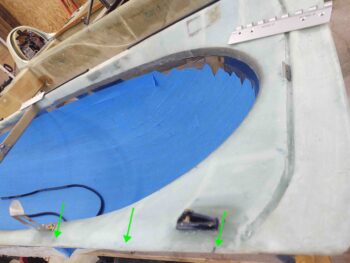
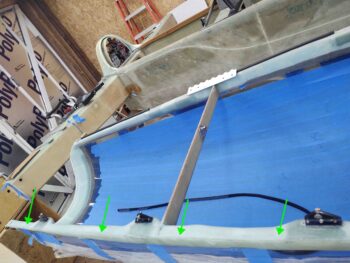
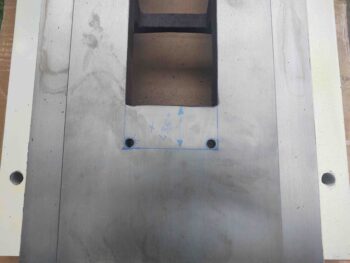
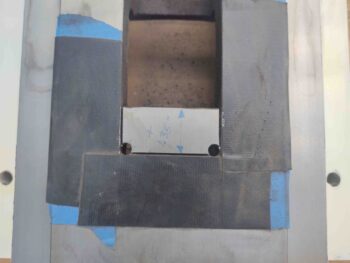
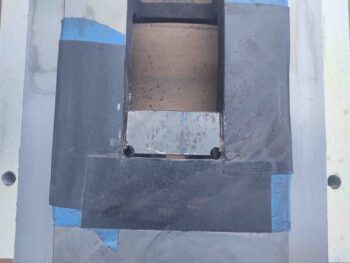
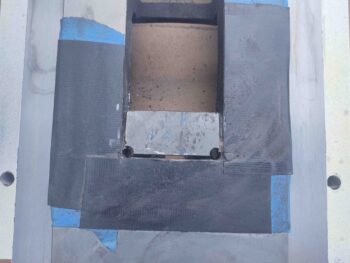
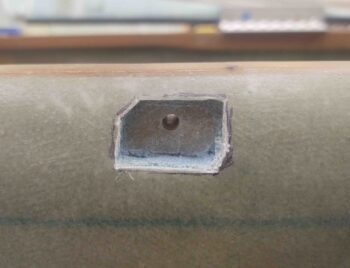
So my current task is all about making a bracket to mount the P-Mag switch and DB-9 connector. In my idealized world all these would have been on the D-Deck’s upper interior faceplate (that I just painted black) but alas, putting them up there space-wise and difficulty-wise is too much hassle for these things. So I decided to put them down in the lower RH corner (left if facing aft).

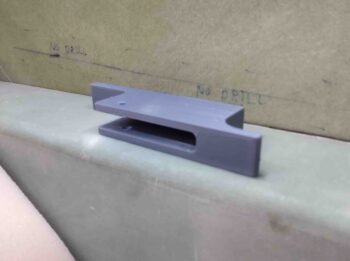
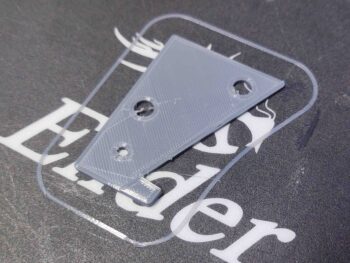
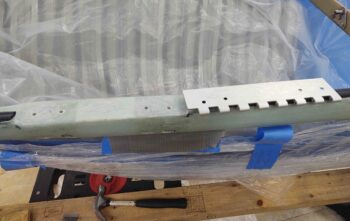
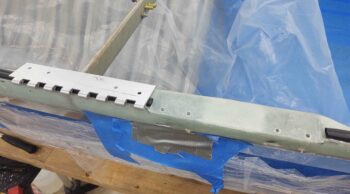
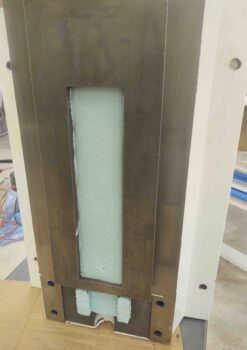
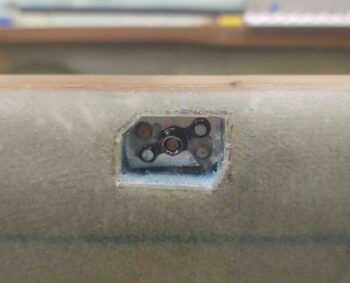
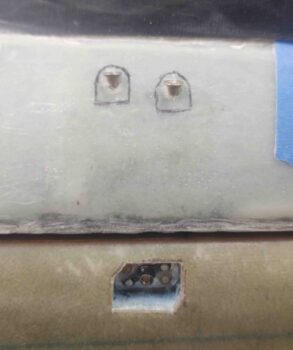
This is the end result of my glassing effort, still to be trimmed to final shape/configuration.

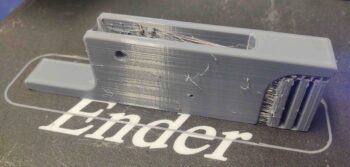
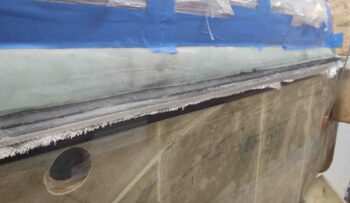
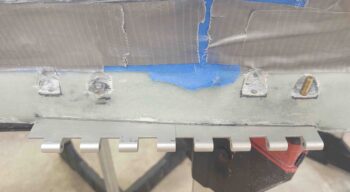
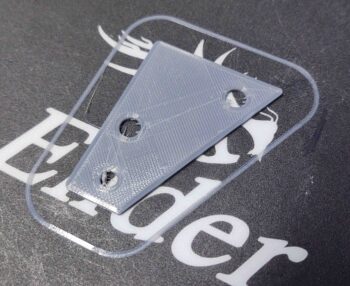
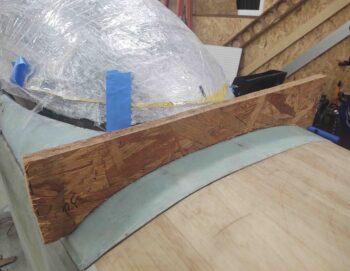
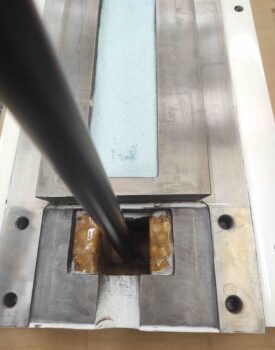
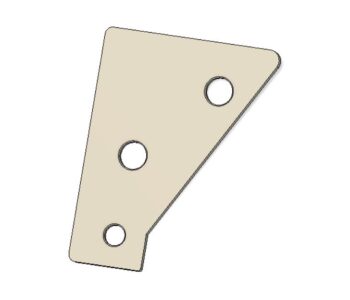
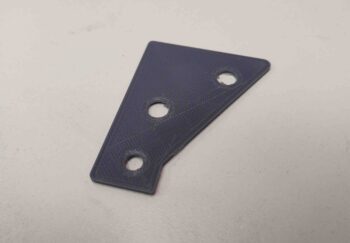
Here’s how the bracket looked in raw form after I pulled it off the mold. Note the curved “top” edge which matches the curve of the interior side of the D-Deck/Turtledeck/GIB headrest.
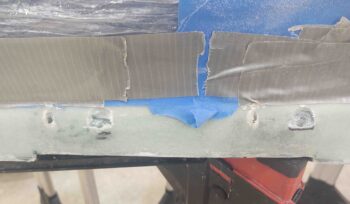
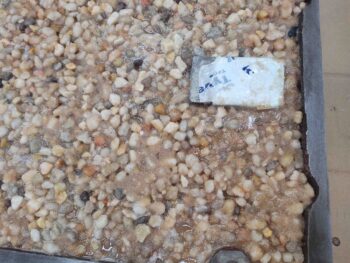
And here we have the bracket just after I glassed it, with 3 plies of scrap BID. I peel plied the front face (top here) and the curved mating face (side here) to get a jump on cleaning it up for mounting in the D-Deck.

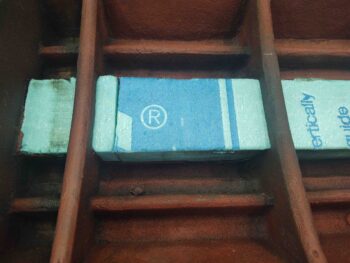
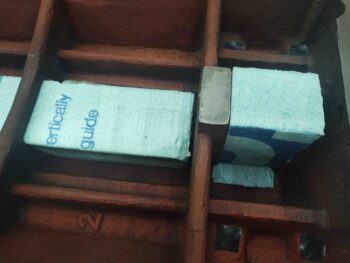
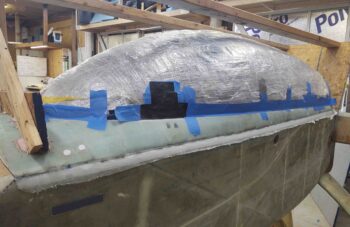
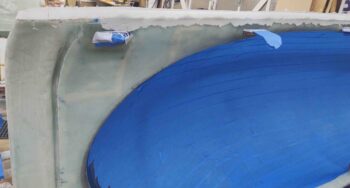
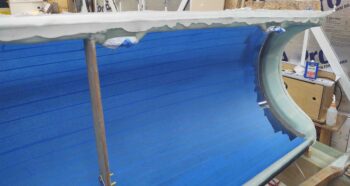
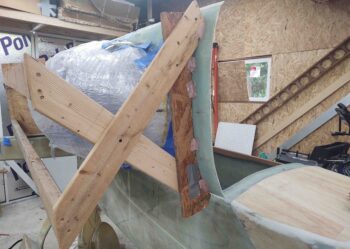
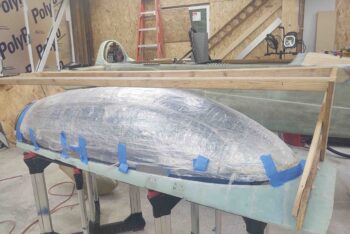
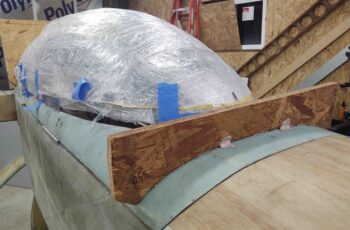
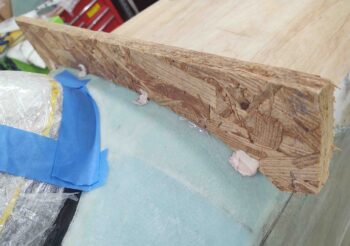
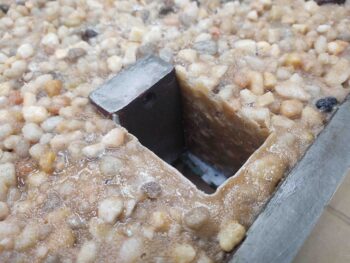
Here’s the form I made with scrap cardboard: flat on top for the front face and curved on the side to somewhat match the interior curve of the D-Deck/Turtledeck/GIB headrest.

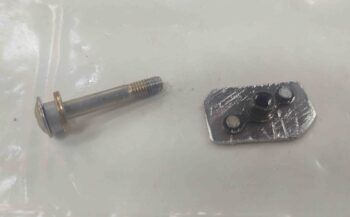
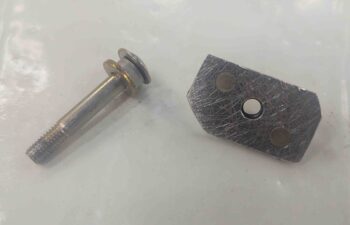
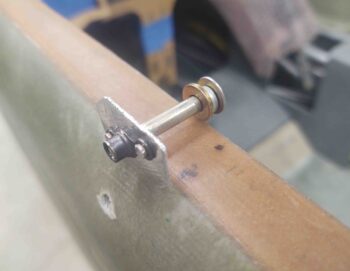
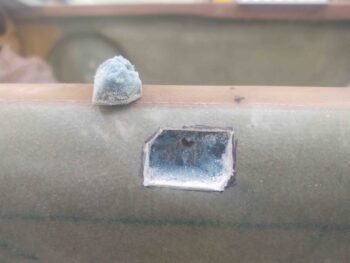
Since I had a bit of epoxy left over from the layup above, I went ahead and knocked out re-floxing the right wing aileron bearing aft (upper in pic) clickbond. The glass around it didn’t look so great when I pried off the bearing assembly, thus I had planned on remounting the clickbond anyway. Not wanting to waste any expensive MGS epoxy, I put it to good use here.

I then got back to work on the right wheel pant. This gap at the inboard bottom edge might as well have been the wheel pant shrieking: “I’m not done yet!!” . . . so I decided to knock out the right side tonight.

Here’s an idea of about how off the front and aft sections of the wheel pant are at this point. Not sure why since the rest of the pant seems in good shape, but the gap is considerable.

About 0.162″ inches… pretty decent-sized anyway, I’d say.

So I took the right wheel pant off the gear leg, with hardware going onto the card… which worked a treat!

I drilled and then mounted the bottom CAMLOC assembly to tighten up the gap. Much better!

I then retraced my tire clearance marks to provide a minimum of 1/4″ on the sides.

I then trimmed the wheel cutout with the Fein saw and cleaned up the edge.

Here’s how it all looked when I mounted the pant back in place. It took a bit of finagling to align the bottom inboard edge of the wheel pant while getting the CAMLOC installed under there. After a few times I’m sure I’ll get the hang of it.

Here’s another shot of the inboard lower junction on the right wheel pant. There’s still a bit of an offset, but not nearly as much as before. Now that the bottom edge is secure I feel good about filling and forming this lower area with micro to clean it up before paint.

The bottom line is that besides finishing with micro and painting, there is nothing left to do on the right wheel pant. I’ll finish off the the left side wheel pant with an added lower CAMLOC within the next few days and be completely finished with the wheel pants, sans finishing.

As I mentioned before, as I’m moving closer to knocking out the bigger airframe build tasks on this project, and getting some of smaller items off the list first, I’m trying to get at least one glassing task (P-Mag switch/connector bracket) and one electrical component install done per day.

Well, my electrical install task for the day was soldering the 3 wires for the D-deck exhaust cooling fan connector. Thankfully I remembered to slide the heatshrink pieces in place to finish off the task expletive free!

The fan’s connector then plugs into the fan thermostat controller which ensures that the internal D-Deck area stays reasonably cool by kicking off the cooling and exhaust fan at around 80º F. I still need to solder the 3 wires into place on the intake cooling fan, but will do that with the fan installed on the actual plane.

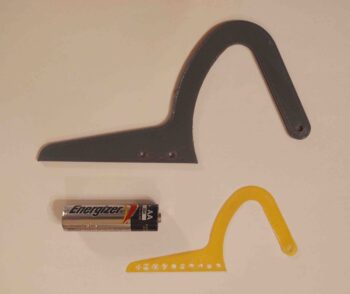
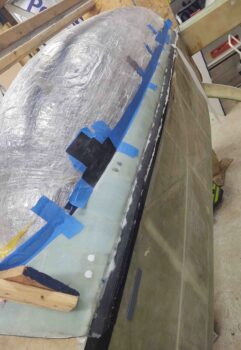
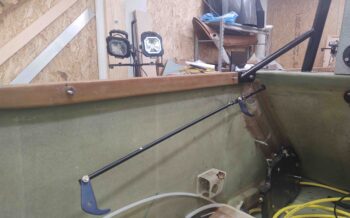
I realized I didn’t show any of the “mechanics” of the panel RAM ball mount for the iPad cradle when I discussed it yesterday. Although the ball mount is covered in blue tape and clamps, you can see the actual ball at the bottom of the RAM arm. This gives you an idea where I’ll be mounting it on the center panel strut.

An important lesson I’ve learned in the past when doing electrical system work, is that following the planned wiring diagram is key. It’s like a well-oiled engine with all the parts working in sync. However, if something changes –as things often do– and if I fail to update the plan/wiring diagram and/or forget…. Let’s just say that I have ended up wiring things incorrectly, and spending time un-screwing up what I just did, because I eventually realize something is not right.

That being said, I spent about 1-1/2 hours updating the wiring diagrams denoting the fuel probe electronics modules’ move from the D-Deck down to the Hell Hole. I then reprinted the associated wiring labels and got those all sorted out on the fuel probe wires.

I would also like to note I have been doing a fair amount of work on the canopy latching hardware, but I am going to wait to post about it until I can discuss it in a more coherent fashion with some actual hard info… vs the myriad of mundane –and seemingly unending– tweaks that is currently underway right now.

Chapter 22 – Closin’ in…

On working canopy details in earnest. I did do quite a bit of planning, measuring and note taking on the canopy latch system tonight… no real actionable intel though with pics.

Today I did a refi closing on my house, in Jacksonville, so I was out until early afternoon.

I then was on the phone a bit talking to vendors about various LEZ topics (MGS hardener, Oxygen systems, etc.)

I got to work in the shop late afternoon. First order of business was to check out how the freshly painted PIC headset jack cover looked in place. Not too objectionable in my book!

So, the following is on my task list… and curiousity drove me to check out the placement of the RAM ball mount –for my iPad– install somewhere on the center panel strut. I had a decently long discussion with Marco on his configuration, so I used the info he gave me to get a head start.

First, I need to know where I’m going to mount the ball mount because it plays into panel design before I plasma cut it for real.

Also note that in this configuration I can see the fuel selector valve and a good bit of the nose gear window. It may look like the iPad is resting on my legs, but it is well off of them. Also note the visibility I have of all my main power avionics on the panel… none of them blocked.
Part of the discussion that I had with Marco was the possibility that I may have to move some switches. Specifically my 2 big light switches. However, with this configuration I simply move my head forward a bit and I can see right over the iPad to both see and manipulate those light switches.

When I get a chance, I’ll update my instrument panel CAD file to reflect these changes.

A curious point of note, at least for me, is that the iPad Mini actually fits completely inside my right armrest map/document pocket… pretty nifty!

I then checked, trimmed and cleaned up the layups on the fuel probe electronic module mounts. They looked great.

I quickly test fitted them one last time to ensure all was good.
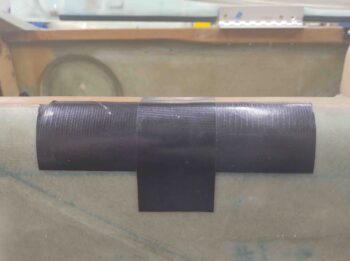
I then flocro’d and glassed them in place on the top of the gear inside the Hell Hole. I used 2 plies of BID to secure them to the gear leg and then left them to cure.
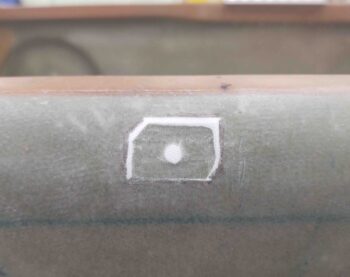
Another item on my list was to remove the aileron bearing assemblies from the wing roots and soak them in PB Blaster for a few days.

They suffered from a bit of corrosion while in storage. You can see some rust in the pic below.

Here they are getting a bath in PB Blaster for a few days. I’ll clean up and assess after that.

Again we have the fuel probe electronic module mounts nearly 100% cured. So I pulled the peel ply off the front edge . . .

And attached the fuel probe electronic modules on the mounts. I left the cover off the left fuel probe electronics module to show the visibility this configuration provides during calibration.

Pressing forward.

Chapter 9/18/22 – What a relief…

… tube?

Locating and installing the relief tube exit out of the left wheel pant was just one of many of a myriad of tasks I got done today.

As a reminder, in case I haven’t been perfectly clear! I’m working tasks that would be much more difficult later on in the build. Specifically those that would be a royal pain when the strakes are installed.

Case in point: the wheel pants. Speaking of which, I installed the last “required” CAMLOC on the lower outboard side of the left wheel pant. Again, I’m most likely going to install one more CAMLOC on each pant on the inboard bottom side… got a tad bit of separation going on there, especially on the right pant.

Also note my hardware cards for the CAMLOC and screw storage when the wheel pants are disassembled… I stole this great idea from Marco!

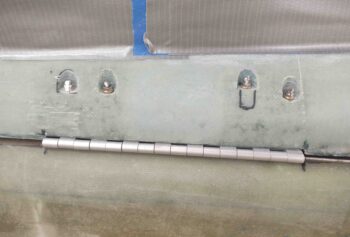
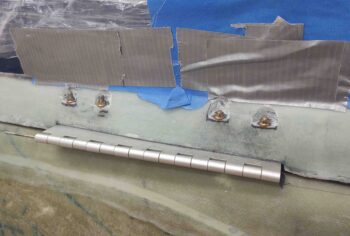
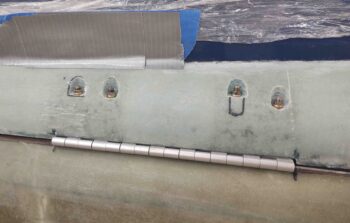
Here’s a pic I took of the front hinge for my canopy notes, but figured I would share it. See the gap caused by the bondo? That needs to go…

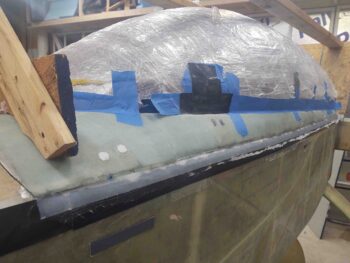
Also on the canopy… the other day I used some left over flox to fill in the current front canopy latch hook bolt hole.

Well, today I moved the hole by checking it on the upper latch and then drilling a new hole about 0.2″ aft of the original one.

Of course I had to widen the exterior hole in the glass and foam to get the new bolt installed.

Since I’m working all things that would be a royal PITA when the strakes are installed, that would of course include the D-deck/Turtledeck/GIB headrest.

I have 2 slide switches and one D-Sub connector to install, to allow me somewhat easy access to them. One of the slide switches and the D-Sub connector are for the P-Mag EI.

The other slide switch I’ve installed here (actually just the switch bracket at this point), which controls the on/off for the Electroair electronic ignition manifold pressure (MAP) signal. Having this switch can be very useful for troubleshooting potential EIS issues, so I installed it onto the upper D-deck faceplate.

Here’s a final shote of the upper D-deck faceplate before it goes in for paint . . .

Which just happened. I followed Nate Mullins’ paint protocol here and baked this sucker at 175º F for about an hour.

I then installed the actual Electroair electronic ignition manifold pressure (MAP) signal switch [sw090] onto its bracket.

And here’s the new look, with functioning switch in place.

Also note that with some left over micro I dug out the foam on the lower front edges of the GIB headrest housing and filled it in… looks much better IMO than bare foam.

If you’re curious about Nate’s paint choice for panels, assemblies, etc., here it is. SEM Trim Black… which is a flat/matte black.

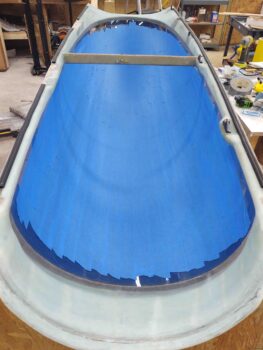
Also, if you’re curious about what I used to clean the canopy, here it is as well.

Next!

I’ve been trying to stuff these fuel tank probe electronics modules into the D-deck –at least mentally– for years! Well, tonight I finally gave up. After one last final assessment, I threw in the towel and decided that they will be going into the Hell Hole.

Note in the pic below they are actually set up on the mounts they’ll be attached to in the Hell Hole… technically just off to each side of the center line of the main gear.

I cut a couple of strips of 1/16″ thick G10 approximately 1″ x 3.6″ wide. I then drilled holes for the mounting click bonds. I’m using click bonds in lieu of nutplates here because these mounting brackets have to sit “flat” on the surface of the gear leg… and when they get floxed into place I didn’t want any of it gumming up any internal holes of the nutplates.

Here’s a shot of the fuel probe electronic’s module G10/clickbond mount both on and off the module.

Yes, a little unconventional, but I then floxed the click bonds to the G10 plates and glassed over the backside of the click bonds with 4 plies of BID.

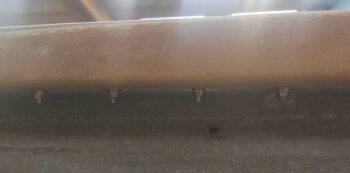
Here you can see the click bonds peaking out on the bottom side of the fuel probe electronics’ modules mount assemblies.

I then peel plied them and left them to cure overnight.

One final item of note tonight: the PIC headset jack cover.

Well, I wasn’t too concerned about this small module stuffed in the corner having a pristine finish, so I simply hit it with a couple of coats of gray primer.

Nope… too ugly. The weave wasn’t too bad, but there was some holes and scars that were a bit glaring. So I gave it well over 24 hours and then hit with some micro (yes, a bit backwards in the process I know).

Then, just as with the D-deck upper face plate, I painted this guy black and baked it. Admittedly, I was curious to see how this composite piece would handle the heat.

Well, after about 45 min I noted that it had some off-gassing bubbles going on.

But interestingly enough, once removed from the heat for not even 2 minutes, the bubbles went away . . . looks fine!

Here’s another shot.

Yep, this dawg will hunt!

More adventures tomorrow!

BTW, tasks will soon start converging on fine tweaking the canopy and getting Chapter 18 closed out and off the books.

Chapter 9/18/22/23 – Ubiquitous tasks!

Today started out as engine flip and desiccant baking day. I didn’t post any pics because I have so many times before, but I figure it’s a noteworthy task regarding the build. I also added another quart of oil before flipping the engine upside down. All told, I baked 3 different batches of desiccant today.

As I’m knocking out some of these seemingly disparate tasks, I’m actually resolving some of the riddles of the plane before I head into territory that is more of route “follow-the-book” work. Relief tube routing & exiting out of the wheel pant is not in the plans, nor is my version of the PIC headset jack module. In short, things I’ve been thinking about for literally years, and now have a solution for, are what I’m checking off the proverbial list as I get back into the build.

Moving on . . .

I then drilled the holes for the traditional headset jack plugs and the Bose LEMO jack. Admittedly, since the LEMO jack has flats on the side I needed an oval hole… and I got a bit overzealous in my making the hole a bit oblong. So I’ll be filling in the slightly oversized hole with a bit of RTV, etc. My bad for rushing . . .

Here’s an inside look at the jacks.

And the initial placement on the right armrest. My goal was to actually trim more off of this housing, which I did eventually with another 0.6″ off the open/bottom end.

Again, this its the initial cut line. I went through a half dozen iterations before ending up with my final configuration.

. . . which is this one.

Driving the headset jack cover further down into the aft armrest not only gives me a lower profile overall on the headset jack cover assembly, but with the angle of the cover it also allows me to remove the armrest with enough clearance around the headset jack cover to leave it in place.

Again, it also allowed me to remove a bit more material on the cover, albeit lightweight, for a skoach of weight savings.

About midday the UPS guy delivered a box from Aircraft Spruce. In that order was the lightweight stainless steel CAMLOC receptacle for the last “official” CAMLOC needing installed… which I did so here.

I say official since I’m heavily leaning on adding a CAMLOC on the wider inboard section of the wheel pant bottom side to keep it secure and vibration free. The left wheel pant is better aligned than the right, and since the right really needs it I figure I’ll go symmetrical with my pant attach hardware.

While the aft wheel pant was off I took the opportunity with some spare BID and West epoxy to layup what will be 2-3 relief tube interior retaining tabs for the left aft wheel pant half.

Here’s a closer view.

I’m going to use the tabs to route the relief tube so that it mounts quickly in a semi-circular configuration to exit the wheel pant 90º to bottom edge, a little aft of the wheel opening.

My friend had an unexpected last minute work engagement so I ended up babysitting for a few hours, which really knocked me off my schedule today. My own daughter just gave birth to yet another granddaughter, so I spent a good couple hours with her and my son on the phone.

While talking on the phone I decided to finish getting the last remaining duct tape gunk off of the fuselage still left from transporting, which I did.

As I was assessing the canopy, I realized it was just absolutely filthy. Since I’ll be finishing up the canopy build here soon, I decided it was a good time to clean it. Again, which I did. For over 2 hours.

I have to say I was quite surprised at the number of fine scratches it had all around, and especially the crap around the edges still remaining from the canopy build.

There were even a good number of spots where apparently a bit of epoxy had weaseled its way in under all the tape that I had put on the inside of the canopy during the frame construction… leaving a number of various lines of epoxy on the interior canopy surface.

I have to say a lot of these blemishes were much more difficult to see with the thick protective plastic in place. Needless to say, it took A LOT of elbow grease to work out the blemishes and dead epoxy spots.

The canopy clearly is functional, and looks great from 3 feet away or further. But closer inspection leads me to think there is still a considerable amount of cleanup work to do on it.

I then spent well over an hour cleaning up the intersection between canopy and frame.

I also took that time cleaning the canopy to ascertain and refine next steps for the canopy, including how I’ll add glass to fill in the slight gap on each side.

For example, on the left side (non-hinge) I can simply add a slight lip to overlap the longeron a bit. Since my hinges stick out a good bit, I can actually do that for a good portion on the right side, just not as pronounced as on the left.

Chapter 22 – Butterfly Effect

Today was a bit of an admin day on the build. Admittedly, I’m not used to this build pace and I’m dragging a bit.

I took an hour or so to consolidate and update my build notes and build chapter to-do task lists and get fresh copies printed out.

I also compiled 2 different hardware orders, at Wicks and ACS, for some needed supplies for upcoming build pushes.

In my attempt at getting a “quick kill” in today with reassembling the Triparagon, I of course ran full face into some unintended consequences of my actions. The 2nd and 3rd order effect thing… or, as I titled this post: the butterfly effect. Yep, change one thing!

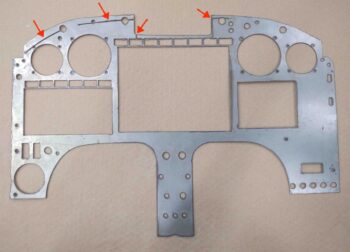
My issue that I failed to account for was static tubing access to my #1 airspeed switch. It was situated on the inside far right end of the front lip {red arrow, below} of the Triparagon top shelf, but I then covered that entire end with a makeshift cap called the Trig TT22 Transponder.

Thus began my 45 min journey of discovery of just how I was going to fix this predicament. Should I make a new bracket and move the transponder aft? (good thing I didn’t because space is tight with the panel-mounted GRT Mini-X, just aft of the transponder)… should I move it outboard? Or should I move Airspeed Switch #1?

Well, I chose the latter, it being the easiest of all options (some call it laziness, I call it efficiency… ha!).

Below shows where I ended up moving the airspeed switch to {yellow arrow}.

The one advantage of having the airspeed switches (there are 3) along the front edge of the Triparagon top shelf, is that they are accessible to fine tune the settings with a quick open of the aft nose/avionics cover.

Well, Airspeed Switch #1 will now not be AS accessible as the other two, but still not horrible. You see, I positioned it so that by simply popping the Trig TT22 transponder out of its bracket for a bit I can gain access to Airspeed Switch #1’s adjustment screw via the center lightening hole. Then pop the transponder back in place, close & secure the aft nose/avionics cover and it’s back to business.

Here are airspeed switches #2 and #3 mounted on the front lip of the Triparagon top shelf.

Not shown is the reinstalled JBWilco Gear/Canopy Warning module and the warning buzzer.

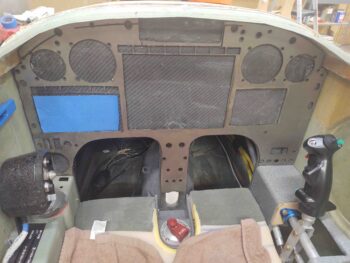
And although not a great pic, here is the Triparagon top shelf –with installed avionics– reattached to the rest of the assembly in the instrument panel mockup. At top center of the pic is the opening for the GRT HXr EFIS.

Tomorrow I plan on jumping back on the build full tilt.

Chapter 22 – More niggling stuff

Today I started out doing some more searches for some parts and organizing even more LEZ parts and consumables…. almost 2 hours total. The good news is that I found every part I was looking for today. The bad news is the stuff I was originally looking for is still MIA.

I then got to work on the PIC headset jack cover. Here it is after I removed the blue tape.

And again after I trimmed up the glass edges… not too shabby.

I cleaned out the thin sliver of shaping foam and the duct tape, sanded up the inside and small gap along the front and then attacked it again with micro and a ply of glass on the inside. Just enough to cover the front face with the existing hole indentions (to be clear, which I filled with micro).

As the PIC headset jack cover cured, I went ahead and made up a power cable {yellow} for the feed between the battery contactor (on right) and the starter contactor (on left). I also reused the old 8 AWG wire feed to connect the battery contactor to the IF009 ANL40 current limiter (actually, I also lopped off about 1/4″ off the bolt studs on the IF009 to allow me to better get the white boot in place).

A few hours later I measured the angle between the front right armrest and the pilot’s seatback. I then transcribed that angle onto the mostly cured PIC headset jack cover.

I then cut off about a third of the PIC headset jack cover.

Although the peel ply is still covering the micro on the bottom, here’s what it looked like at this point.

And a shot of the very nearly cured interior 1-ply BID layup.

Here we have what she looks like in place.

And an even closer shot. Now, the final look will have it actually sitting just a bit lower as I’ll most likely notch the back edge of the armrest to fit around the bottom edge of the PIC headset jack cover. Besides giving the PIC headset jack cover a bit lower profile, it will provide a path for the headset jack wires.

Yet another shot.

I then got to work on the last component to get mounted onto the Triparagon top shelf: the Trig TT22 transponder.

Here’s the bracket I cut late last year for mounting the Trig TT22 on the right side of the Triparagon top shelf. Again, due to clearance issues I can’t install it on the top of the shelf where I had originally designed it to go.

Here’s the initial bracket weight.

And after I drilled some lightening holes. I would say with all holes drilled it was fairly close to an ounce lighter in its mounted configuration.

Here’s the bracket complete and mounted to the Triparagon top shelf. Note the actual Trig TT22 bracket on the side, and the actual bracket bolt hole pattern used on the top shelf… in case the opportunity allows for moving it back up top.

Here we have the underside, showing all the nuts and bolts, in their natural habitat.

Finally a shot with the actual Trig TT22 unit installed.

Another angle.

A final shot…

As I’ve noted previously, if any noise should arise in the headset or comms I’ll be prepared to move the transponder out to the end of the right strake. That being said, I have a number of canard buddies who are flying Trig TT22s mounting behind the panel with the antenna in the nose, with zero noise issues. So I figured I would try that route first.

Chapter 13/18/22 – More Glass!

I started off today in good fashion by going flying for an hour. I needed a quick checkout in the local FBO’s C172 SP to allow me to rent it. Beautiful day and fun was had by all!

Then the day got a bit darker build-wise…. I have been looking in earnest for a few LEZ components –specifically my wing bolt interior U-channel bracket pieces and my hard aluminum brake line assemblies for the nose– and just can’t seem to find them anywhere. My house is still enough in disarray that I won’t write them off just yet, but so far it doesn’t look good. It’s as if one box, or even big plastic moving baggy, is simply missing….

The bright side to looking around for stuff is that I’ve unboxed a bunch more LEZ stuff and organized a fair amount. I spent a good couple hours doing this before starting actual work on the plane.

To start with a wrap-up from yesterday’s glass projects, here are shots of each side of the nose hatch flange where I “minded the gaps,” and then filled them. Very pleased with how they came out.

Also pleased with the layups on the lower longeron transitions of the turtledeck. The layups are solid, so task complete.

I had my friend’s daughter –my little shadow– hanging around for a few hours tonight, so I really didn’t get anything significantly accomplished regarding the build until after she was gone. She was fascinated by epoxy and fiberglass (who isn’t??) and really was mesmerized by the leftover clear epoxy in my mixing cups. She wanted to make a clear epoxy plug so I used the opportunity to clean up, install and then test out my West resin and hardener pumps, as well as the resulting epoxy cure. A couple hours later it was looking good… so I’m calling it a success.

Plus, she wanted to help me clean out the plasma cutter water table… can’t beat help like that!

One of my immediate tasks, as I’ve mentioned before, is to get the interior cockpit components squared away before the strakes go on. One of these tasks is figuring out the location and configuration for the PIC headset jacks.

Well, after a lengthy discussion with Marco a week ago, including him flying with his freshly moved headset jacks (over his right shoulder… previously on panel above his right knee), I decided to press forward with my planned install location at the junction of aft right armrest and seat back.

This spot will provide a very short run for all wires (<12″) and will all me to keep the bracket installed and still remove the right armrest whenever needed.

A couple of notes on this headset jack housing: First, it started off in life as a bracket/housing for the antenna cables/jacks exiting the canard. I had planned on mounting the antenna cables in it with the housing then mounted to the canard. My failure in accounting for the slope of the canard vs the flat bottom of this housing didn’t bode so well for it to work as intended.

Next, I had drilled 2 holes in it at some point. I can’t remember why. Clearly before I decided to add a Bose LEMO connector to the mix. I need 3 holes total: 2 traditional headset jacks and one LEMO. So some hole filling was required.

Lastly, I had lopped off the flange on one side, again I don’t remember why.

Thus, I used a small piece of my “newfound” urethane foam, shaped it at the bottom to create a more straight transition at the top/front, added a bit of duct tape to both hold the small foam piece in place and create a small radius to give me a lip for future mounting… and then simply slapped 2 plies of BID over all that.

If my experiment here fails, I’ll simply design a headset jack housing in CAD and 3D print one… or at least a mold for one.

So far it seems like this should do fine…. more to follow.

Before I mixed up some epoxy for above, I cut some scrap BID to give me 2 sets of 3-ply strips to layup below the inboard wing bolt holes. Since I’ll be making all my wing bolts protrude from inside the spar out, I’ll need to drill and mount 2 CS screws below the inboard bolt hole to secure the U-channel bracket, and thus the wing bolt.

I figured I would simply add a few narrow plies (about 1″ wide) to reinforce the area where I will countersink the screws under each inboard wing bolt hole.

I of course then peel plied the layups.

A loose goal I have is to get some of the quick-kill airframe/glassing tasks complete while also knocking out some sort of electrical component install.

Currently my focus on the electrical component install is getting the top shelf components of the Triparagon mounted. I installed the GRT AHRS a couple days ago, and today I set my sights on the Trig TY91 COM2 radio, which sits just left of the ARHS.

If you remember, I had planned on installing a MicroAir remote radio, which not surprisingly had a different footprint than the Trig TY91. The simple fact is I have ZERO metal available to me on the Triparagon top shelf to mount the Trig TY91’s mounting bracket to, so I’ll employ a thin piece of aluminum (former life was transponder antenna backplane) as a clamp for the COM2 radio bracket.

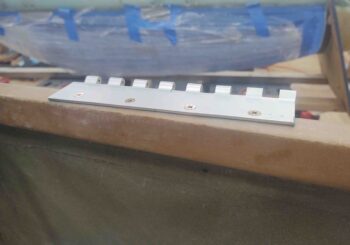
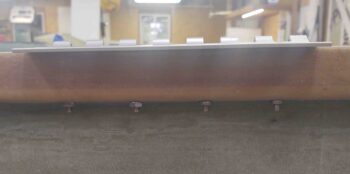
I started by spacing and drilling the holes, and then riveting the nutplates into place.

And then simply placed the Trig TY91 bracket on the top of Triparagon top shelf, with screws attaching it to the compression plate located on the bottom of the top shelf.

Worked a treat!

Next up will be the Trig TT22 Mode-S transponder install on this top plate. However, as I pointed out earlier, due to interference with panel instruments I’m mounting the TT22 sideways on the right side, hanging down for clearance.

The top shelf bolt holes for the right angle bracket will match those of the TT22 mounting bracket (which is the same as the TY91 btw) so if I change out panel instrument(s) that don’t interfere with the TT22 I can simply remove the right angle bracket and mount the TT22 back on top of the shelf next to the AHRS box.

Chapter 13/18 – First Glass

. . . in a long, long time.

I started off today spending a good hour compiling and pulling the trigger on an order with Aircraft Spruce. I needed some CAMLOC parts for the wheel pants, hardware and other stuff.

Today is the first day back for actual glassing here in NC. To do that I’d like to have a portable glassing table, which is why I bought this adjustable-height roll-around work table for the hangar.

Since I often glass components on a large board like the elevated one you see here, it often ends up sitting on top of my workbench covering whatever ends up underneath of it. So I thought starting out from the get-go I would simply put some short legs under it and make a mini-glassing table that will still provide me access to the stuff underneath.

The first glassing task today was to fill in the gaps created by my wild and wonderful method <grin> of glassing the nose to give me the hatch opening I have. Since it was actually glassed in multiple steps, using Napster as the line of demarcation between front and aft sections of the nose hatch, the resulting nose hatch perimeter flange has a gap in the glass on each side.

I trimmed the gnarly glass away the other day, leaving fairly level and even glass to work with on each side of the gaps. Before glassing today I of course gave it a good thorough sanding.

Here are the before close-ups of each side, right then left.

And a shot of my first glassing action in literally years.

I then laid up 2 plies of BID on the underneath side of the flange, with some filling plies in the gap openings themselves.

I then peel plied the layups top and bottom.

My next glassing task was the front corners of the turtle deck, where each side dives into the longeron. These layups have –of course– been long overdue.

First up however was I needed to trim the existing left side inboard glass edge {red circle} to have its profile and angle match more closely to the right side, which has the inboard edge diving more steeply towards the longeron.

After trimming the inboard edge on the left side, I then cleaned up both sides in general.

I also dug out the sides of the foam to create flox corners since the new layups will intersect and overlap just the existing turtle deck top glass edges (narrow), but not onto the existing (vertical) faces of the glass. That said, the new glass will overlap onto the longerons and just a bit onto the edge of the turtle deck just above the bare foam.

Here I’ve prepped the foam with micro and filled the foam edges with flocro… heavy on the flox.

Here we have each side with its respective 2-ply BID layup. And of course peel plied.

And that’s it for the evening.

It definitely feels good to get back into it and do some layups!

Chapter 22 – Low Hanging Fruit

Today I started off by printing off 3 batches of electrical wire labels, which included the label for the large (12 AWG) power feed wire from the SD-8 backup alternator-to-E-Bus control relay (RL018) to the mini-ANL15 current limiter (fancy name for “fuse”, IF010).

After heat shrinking the label in place, I then re-terminated the wire with a ring connector vs the previous FastOn connector I removed.

I then connected the wire to the ANL15.

I then figured out where I wanted IF010 placed on the right interior nose, and drilled two holes for the RivNuts that I’ll flox embed into the sidewall.

I then floxed the RivNuts that were temporarily attached to IF010 into the holes in the sidewall.

I then got to work on the GIB right armrest storage bin hinged cover.

I first needed to notch the outboard edge of the cover to allow for the hinge assembly. As you can see I used my small bandsaw for this task.

And here’s the result.

After filing and sanding the above edge straight and smooth, I then drilled some flox holes into the lower hinge half, and then drilled rivet holes in the cover and upper hinge half.

I then riveted the cover to the upper hinge half.

An underside view.

Then using flox and a few dabs of 5-min glue I floxed the lower hinge half onto the right fuselage sidewall.

I Gorilla-duct-taped popsicle sticks to the top of the cover overhanging onto the armrest top to create an even plane between the cover and armrest surfaces. I then weighed the edges down with my drills, etc. to ensure it all stayed flat and even.

As my flox projects were curing, I then got to work mounting the GRT AHRS to the top shelf of the Triparagon. On the aft side of the shelf I used 2x #6 nutplates.

Due to the lip on the front of the shelf, I’m simply using 2x traditional nut & bolts.

The bottom side shows all this more clearly.

I then got to work installing a Bose headset LEMO jack for the GIB. I thought about this a bit late last year and figured if I was ever going to use a Bose headset for the back seat –which I intend to– then I should install the LEMO jack before I build the strakes… after which working in the back seat area gets infinitely more difficult.

The installation hole isn’t perfect, or overly high craftsmanship, but it works and fits, and looks to be a secure installation. . . so I’m calling it a win. Especially since it just barely fit in there with the existing traditional headphone jacks.

I worked on cleaning up about a third of the inside glass edge of the canopy for about 45 minutes before going back to my initial task of the day: installing the mini-ANL15 base onto the right nose sidewall. Again, just aft of the Napster bulkhead.

Here are the ANL15 base embedded RivNut hard points after I cleaned them up a bit.

Earlier I made up a cross-connect cable between the Battery Bus post and the other post on the mini-ANL15 current limiter, which I installed at this point.

Here we have the finished install of IF010, the mini-ANL15 current limiter.

And finally, to cap off the evening I unencumbered the top of the GIB armrest storage bin cover and removed the tape to reveal how it looks. I have to say that I’m super happy with how it turned out.

And of course a shot with it open… ready for business!

I suspect I have at least another few days of getting some of this odd ‘n end stuff knocked out before I start sinking my teeth into some bigger build tasks.

Chapter 9 – Look Ma, no Clecos!

Today I finished the installation of the wheel pants… at least the major heavy lifting as far as the hardware installation is concerned. I still have one more CAMLOC assembly to install (maybe 2 even) and some minor tweaks with pant-to-tire clearance at the bottom wheel openings.

Here is my finishing up the left side wheel pant mid-hardware install.

And a shot of the finished left wheel pant, replete with installed screw and CAMLOC attach points.

And an inboard look at the left wheel pant.

Can’t let an event like this go to waste, so a couple shots of both wheel pants together.

With this task out of the way, I can obviously focus my time on other parts of the build.

I have to say I’m extremely pleased with how the wheel pants turned out. Of course I think they’ll look even better once they’re finished and painted!