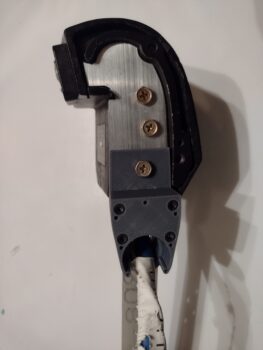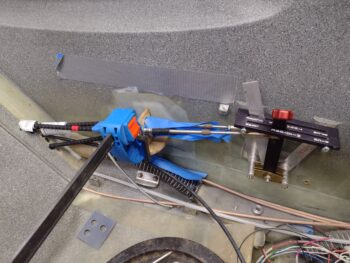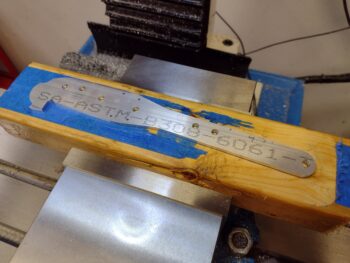
Chapter 16 – Left pilot armrest storage

Although I did do some research and initial postulating/planning on the throttle/mixture friction lock and RAM air can butterfly pivot lever, my shop work today was all about working on the left pilot armrest storage compartment.

I decided on the top forward edge to install a clickbond vs a RivNut since I may put an Adel clamp in that area for the wires that will eventually go to switches on the small panel just behind the throttle quadrant.  These switches will be used to control the 3 valve actuators for the oil heat system.  To be clear, I could have most likely installed an Adel with a bolt into a RivNut as well, but using a Clickbond puts one less hole in the wall and gets the Adel up off the wall so a bit more clearance for it as well.  Also, a second Clickbond provides another positive alignment guide for mounting the storage box… not that that should be a frequent occurance.

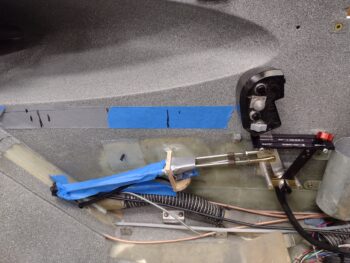
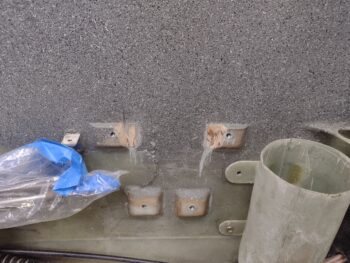
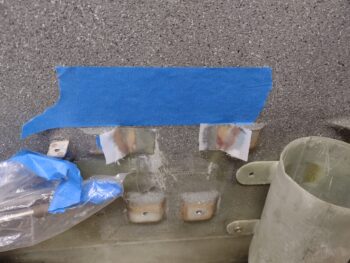
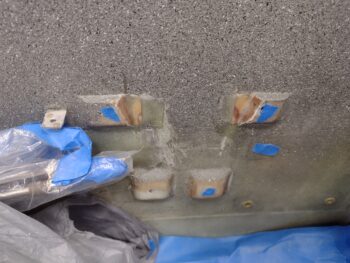
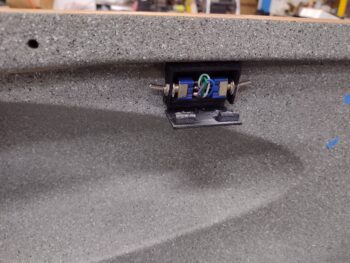
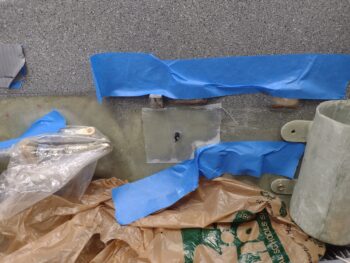
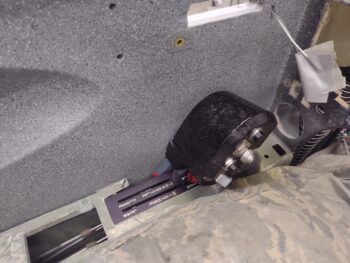
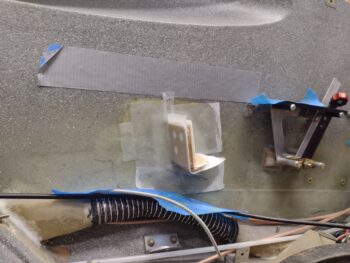
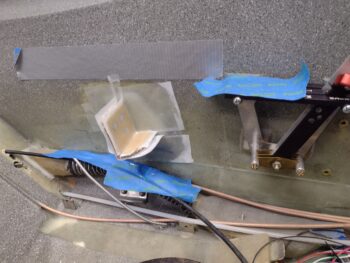
Regardless, I drilled out the mounting holes to 3/16″ and then taped up the flange to then mount taped up wide area washers and then the 3 prepped RivNuts on the aft side, and the Clickbond on the front edge.
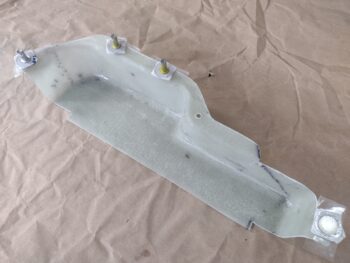
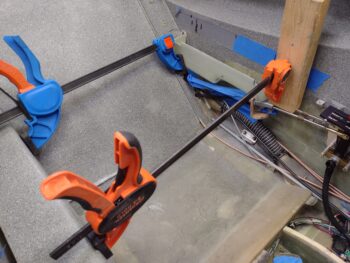
After drilling out the RivNut holes in the sidewall and prepping them, as well as sanding and prepping the site for the Clickbond, I then mixed up some epoxy and floxed all the attachment hardware into their respective positions.  I then used 2 spreader clamps to keep the RivNuts and Clickbond pressed firmly into place on the sidewall.
A few hours later I removed the clamps, tape and wide area washers, cleaned up the excess flox from the sidewall and remounted the storage bin.
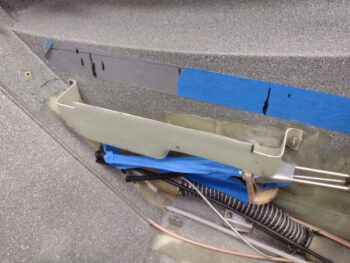
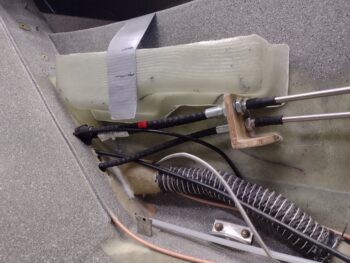
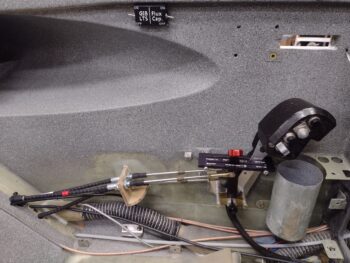
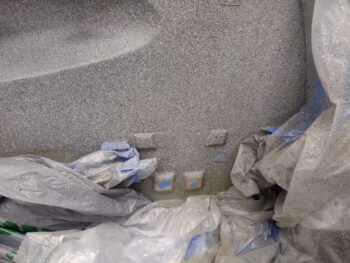
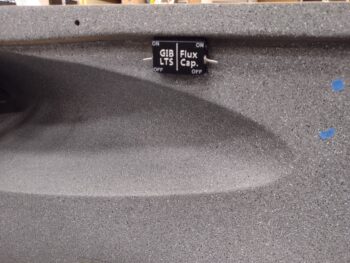
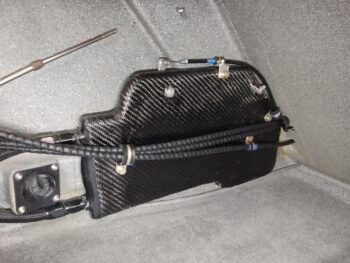
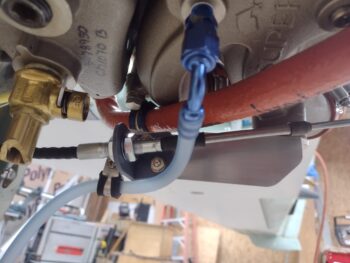
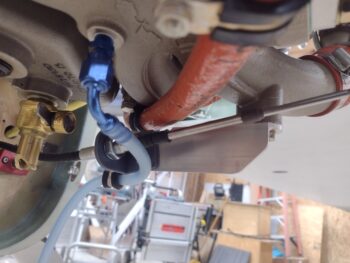
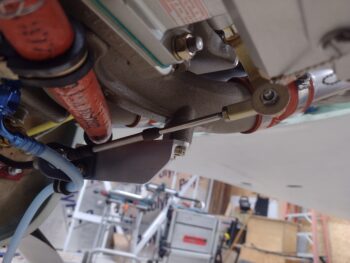
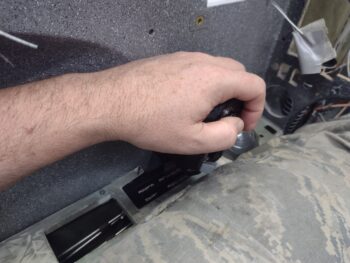
Here are a couple shots of the new hardware securing the left pilot armrest storage compartment into place (sorry for fuzzy photo #2).
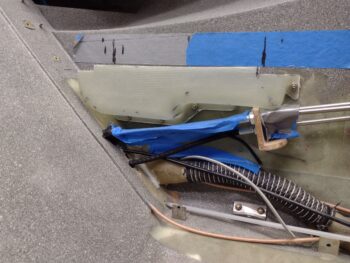
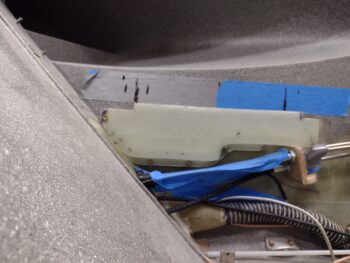
I had aligned and marked the storage compartment onto the inside of the armrest, and while the flox was curing I cut the storage access notch into the top of left armrest.
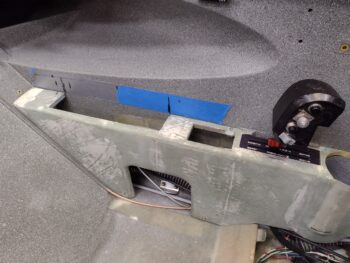
One thing I didn’t account for was the sizable gap that exists between the armrest and the sidewall, as I’m pointing to in the pic below.  I think I do have just a tad bit of interference at the aft side of the storage compartment that is pressing the armrest inboard just a hair, exacerbating this gap.  That being said, you can see much more of the inside (long) edge of the storage compartment wall than you should be able to… it should be pressed up tight against the inside edge of the armrest notch.  I’ll of course work this minor but time-sucking issue.
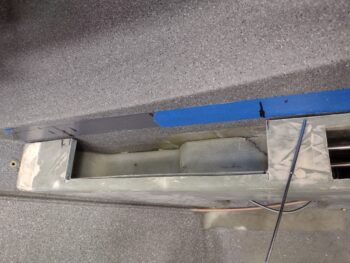
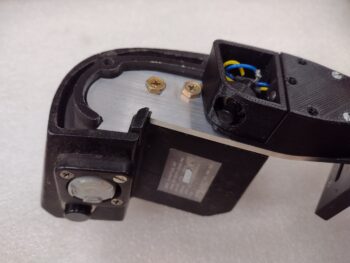
Also while the RivNut/Clickbond flox was curing I cut a 1/16″ thick G10 cover for the storage compartment as well as the hinge for it.  I then riveted the two together.
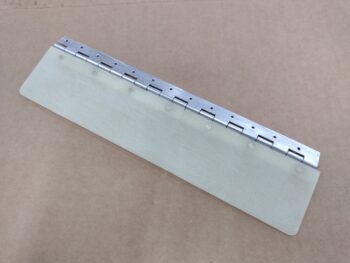
Here’s an inside shot of the hinged G10 storage compartment cover.
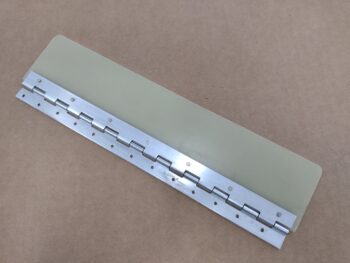
Of course the sidewall/armrest gap is negatively impacting my hinged cover fitting as well, and will be another variable I’ll have to contend with as this all gets installed.
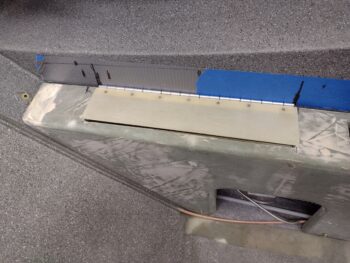
I’ll note that I’m looking more at functionality much more-so than I am aesthetics given that unless I’m actually accessing the armrest storage compartment, it will be hidden from view by the left armrest pad nearly all the time.
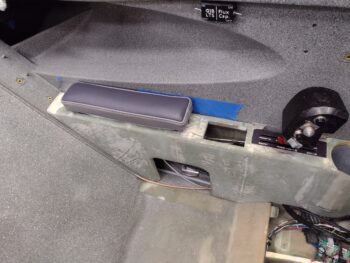
Before calling it a night, I did layup up a couple plies of BID on the Clickbond and also peel plied the layup of course.  I didn’t grab a shot of that, but will tomorrow.

I’ll reiterate that I’m trying to get the left sidewall components installed and tasks completed as I work my back to the engine compartment.  Tomorrow I plan to work more on this storage compartment, the left armrest and also the throttle/mixture friction lock.
Chapter 16/22/23 – Throttle cable set!

I started off today spending well over an hour assessing and updating circuits in my electrical diagrams.  Specifically those involving reporting from microswitches, relays and switches to the AG6 Warning Annunciator and instrument panel notification lights.  Over the years, I’ve updated/bought various components and not all my diagrams were annotated to reflect these changes.  For now I’ve chicken scratched in new circuits that reflect what they need to be… a couple of them I need to bench test to verify my circuit logic is right.

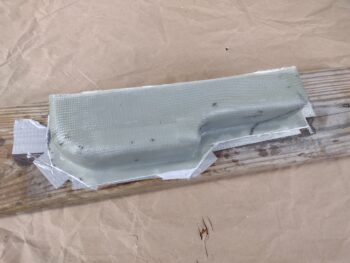
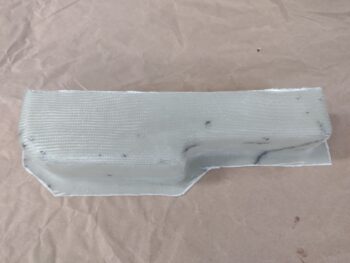
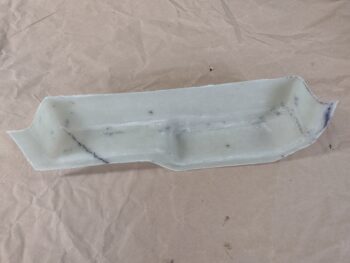
Out in the shop I removed the front left armrest storage compartment shell from its form.

I pulled all the internal peel ply, cleaned off the peel ply boogers and cleaned up the edges a bit to test its fit on the cockpit left sidewall.

At first it seemed like it might be significantly too tall and too big to fit, but I double checked it inside the armrest and it just fits.  Good thing, because although the dimensions don’t scream tons of storage, this will provide a good bit of it for a fair amount stuff.  And that’s always a good thing!

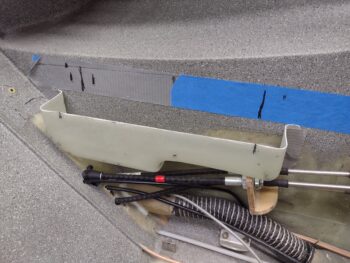
I temporarily put the armrest in place and marked the top of it with tape along the sidewall so I could fit this compartment in place.  I had already did a few rounds of trimming the outer flange by this point.

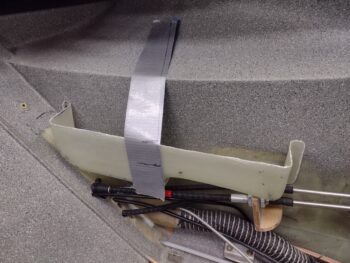
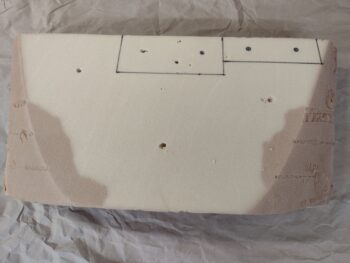
I designed this storage compartment to interface with the armrest in kind of a unique way: about 1.5″ on each end will actually sit under the armrest top while the hatch will open over the center 10″. That means I’ll leave the center 10″ close the height shown here so that it sits 1/16″ below the top of the armrest as a lip for the cover to rest on when closed.  Conversely, the height of each end —fore and aft— will get trimmed to fit under the armrest top… note the initially marked cut lines for the forward and aft section trim areas below.

I of course assessed the fit of the bottom side of the storage compartment as well.  It was here that I determined that I needed to change my thoughts on how to mount this thing.  I had originally planned to flox it into place with a single ply BID tape around the edge to secure it to the sidewall.  However, if I ever need to work on or replace any of the throttle/mixture cables I would be cutting this storage box out or working around it.  Too much of a pain.  In addition, making it removable will allow me to take it out when installing the 3 micro-actuators for the oil heat cables.

Thus, I determined it had to be removable.  After looking at it a bit more, I developed my plan to mount it: 1 Clickbond near the bottom center and 4 RivNuts… so 5 hardpoints for mounting total.

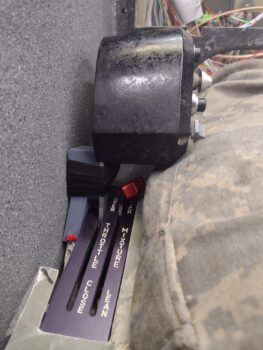
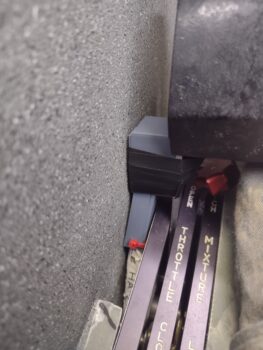
This shot below shows a few things.  First, note that I sanded the top of the sidewall cable bracket level to remove a bit of material to provide more room for the storage compartment to sit level, and slightly lower.

Second, I drilled a 3/16″ hole into the flange on the bottom edge of the storage compartment, taped it up and inserted a clickbond into the hole. I then floxed up the clickbond and used a spreader clamp to secure the storage box with clickbond into place on the sidewall.  While the flox cured I got to work on my next task . . .

I spent a good 30 minutes trying every configuration I could conjure up on the front and aft throttle cable rod ends to get the lever movements matched between quadrant and servo throttle levers.  I even drew up a truth table (another one!) to assess the contra-opposed actions of these rod end positions.  My analogy to describe this is simple: You have a large workshop that has 2 light switches for the shop.  You need all the lights on, but each time you flip one light switch on, it shuts the lights to half the shop off. The switch actions are opposing each other in the same way moving a rod end will give you the desired effect in one manner, but a totally opposite negative effect in another manner (i.e. closer or farther from the servo idle hard stop while creating a larger gap between lever and quadrant stop on the other end).

Clearly a variable needed to change.  That wasn’t going to happen at either the servo or quadrant side rod ends as I had exhausted virtually every configuration.  My end result always turned out with full movement at the servo (which is good) but with about a 0.1″ gap between the throttle lever and both the front and aft stop in the slot on the quadrant, respectively.  If I got the lever to either stop at the quadrant, it invariably meant that I wasn’t getting full rotation at the servo.  I needed just a hair more movement in both directions (push & pull) to get the lever to the quadrant slot end stops.

When I machined this new throttle handle lever, I added another hole for the slaved GIB throttle.  This hole sits nearly 0.5″ below the upper hole, so there was plenty of meat in between those holes to drill another one… which is exactly what I did.  I split the difference and drilled a 3/16″ hole right between the existing holes.

I then tested out my new throttle lever cable attach point.  Bingo!  Within 15 minutes I had the throttle cable dialed in so that with the quadrant throttle lever forward at the stop, the servo throttle lever is at its WOT stop position.  The same is essentially true in the aft idle position, as shown here, but I will note there is about a 0.005″ gap (1-2 pieces of paper thick) between servo lever and the idle stop pin.  This means I’m hitting the quadrant aft stop just very slightly before the servo lever hits the idle stop… actually good both directions since it virtually eliminates any added force on the servo lever or cable connect rod.  Moreover, I can always do some judicious sanding at the quadrant to remove a few thou to match these if need be.

With the throttle cable finally dialed in I went to dinner with Jess to celebrate.  Upon returning back home we went out to the shop where she helped me mix up epoxy and layup the BID on the floxed in place sidewall clickbond.

We then left the peel plied clickbond layup to cure overnight and called it a night.

Chapter 16/22/23 – Front seat storage

The gray granite interior paint needs to cure for 24 hours before getting clear coated as per the can, but I general start my cheating on that about the 16-18 hour mark.  Regardless, I still had a fair amount of time until mid-afternoon before I could clear coat all my painted areas.

I spent some time dialing in the requirements for some extended lever microswitches for the AG6 annunciator warnings and panel on/off indicators, to be mounted both on the aft side (idle) and forward side (WOT) of the throttle quadrant.  Since I need 2 separate circuits on each side, I doubled up the output of each switch and ID’d double DPDT micro switches so I only have to deal with mounting one physical switch each side.

In addition, although I was effortlessly able to run an added pair of wires to the upper sidewall, just under the longeron —where I added my 2-switch box for the GIB lighting circuit— unfortunately I was only able to run a single pair of wires to the canopy latch handle.  I have two separate canopy open warning systems: one via the AG6 warning annunciator and the other via a pair of red & green LEDs on the panel + horn.  I can’t piggy back off only 2 wires, so I had to add a DPDT relay into the circuit —controlled by this single pair of wires— that then acts as the respective individual microswitches.  So instead of 2 microswitches, with only a pair of wires to work with, I will now have 1 microswitch and 1 relay to do the same job. This of course required ginning up the new circuits on paper before I could know what parts to order.

I submitted an order with Mouser for all these electrical tidbits and also an order with McMaster-Carr for the thinnest black phenolic they had for possibly attaching to the sidewall at the lower part of the throttle quadrant as a slick glide-plate for the throttle cable.  I also picked up some 0.036″ stainless steel for the RAM air can open-close actuation lever, as well as some hardware.

With my parts ID and acquisition duties out of the way, I then spent a couple of hours on another sideline but required task —as I’ll reiterate I’m focusing on the left sidewall components (from panel aft) for a few days as I get the throttle quadrant installed… simply to knock out the last vestiges (at least a good majority) of cockpit components as I work my way back to the engine. This will leave pretty much panel forward to contend with when engine, cowlings and micro-finishing have been completed.

I digress. Back to the task at hand: I’m creating yet another storage compartment —much like the GIB right armrest storage— in the remaining aft area of the front left armrest.  Under the armrest I only have 3 micro-actuators remaining to mount for the Oil heat valves and after assessing the space requirement for these, I designed a storage compartment to fit the remaining upper aft area of the pilot left armrest.

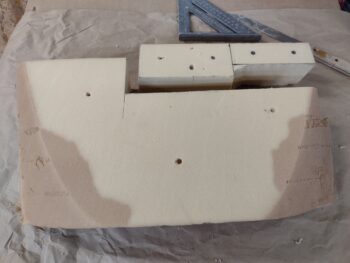
I grabbed the big urethane foam block I had used for the aft nose & avionics cover mold and took off the top couple of layers.  That gave me a nice flat canvass to draw out my next masterpiece… ha!

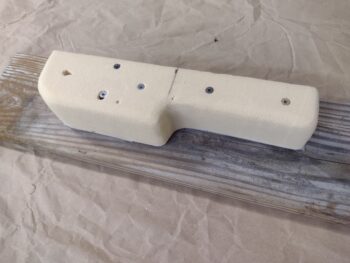
I know it’s hard to tell the actual size of this thing: it’s 12.5″ long by 2.3″ wide.  The front 6″ is 2″ deep while the aft 6.5″ is 3″ deep.  The different depth areas will be separated by a vertical divider to make two separate compartments.  Yeah, not a ton of room, but definitely enough for pens, eyeglasses, spare batteries, fuses, etc.

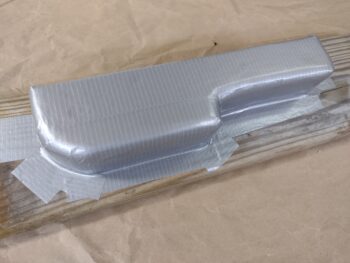
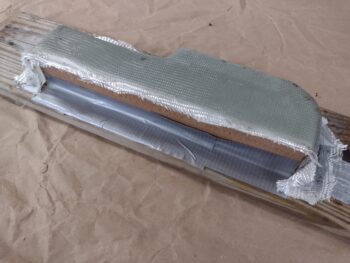
After extricating the foam I needed for my storage bin mold, I cut it to its 2.3″ width (a hair under allowing for glass thickness) and mounted it on its side on a length of scrap wood…  below is how it will look mounted on the sidewall.

I then taped up the foam mold…

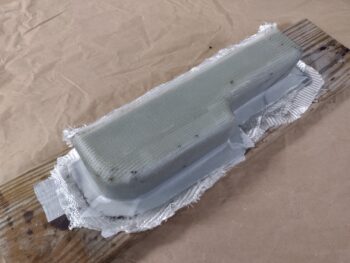
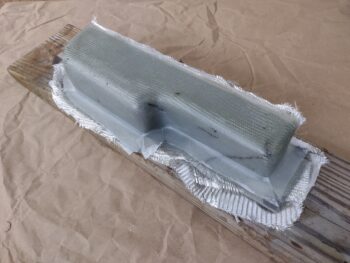
And glassed ‘er up. I actually covered the entire mold with peel ply first, before I started laying up glass.

All with scrap pieces of BID.  That being said, I had enough scraps to do one full first ply.  Then scraps for the next 1-2 layers (there’s overlapping plies here and there) and then one final large ply on the outside.

I peel plied just along the exterior mounting flange to allow laying up a BID tape around the edge when I install this in place in the cockpit.

I few hours later, while the glass was still somewhat pliable, I did some gross razor trimming around the edges.  I then left it to cure overnight.

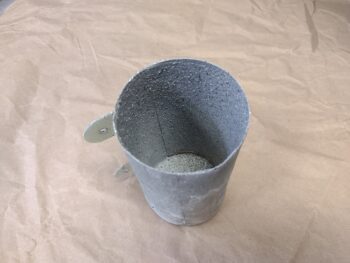
Towards the latter end of my left armrest storage bin mold making I clear coated the interior paint on the left sidewall in the nub vicinity.  I also clear coated the inside of the cup holder.

By the time I finished glassing the storage bin with another hour of messing about on securing the throttle and mixture cables in the backseat area, the clear coat was cured and I could then proceed with the installation and testing of my throttle handle and quadrant.  BTW, I’m happy to report my center-routing of the throttle handle electrical cable is working a treat and I have no more clearance issues with the cable.  I can now put that issue to be bed… so on to the next issue!

With my throttle and mixture cables secured into position from A-Z, I could now proceed with dialing in the operations of the quadrant handles to match the rotation of the respective levers on the fuel injection servo.  I spent over a good hour first on the throttle and got it close on each end, about an 1/8″ gap, without full pivot at the quadrant… while the fuel servo throttle lever was rotating stop to stop.

I took a break from the throttle handle and worked the mixture side, and was pleasantly surprised to have that dialed in within about 20 minutes.  The quadrant mixture lever pivots from aft stop to forward stop matching the fuel servo mixture lever doing the same.  At least one thing was easy on this thing!

I then messed around with the throttle lever for another good 45 minutes while trying my best to assess the nuances of how this geometry is playing out.  I’m thinking the hole on the throttle lever may need to be set just slightly lower… but I decided to stop for the night and re-engage on this issue tomorrow…

And with that, I called it a night.

Chapter 22/23/25 – Cable issue fixed

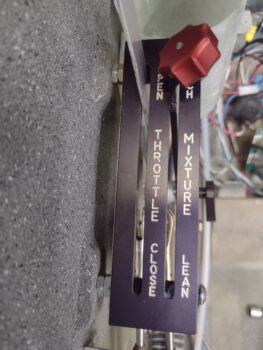
I started off today by reinstalling the pilot throttle quadrant to do a final assessment on the throttle cable situ and determine just how much of the sidewall nubs needed to be removed. I marked the nub cut lines . . .

And then took my trusty Fein saw to the nubs for a much needed nubectomy.

Although not pictured, I then remounted the throttle quadrant to check the cable clearance at each end of the throttle handle/lever pivoting.  The clearance was fine, but I discovered another issue: the throttle at WOT was fine, but when I came back to idle it was popping back forward about an inch.

I realized that with the law of unintended consequences, that my protective anti-abrasive heat shrink was changing the cable characteristics in that my 90º curved-aft cable routing was no longer working as before.  Since the added heat shrink is the only change I made, I’m fairly certain that it is the antagonist here causing the throttle to move forward off the aft stop.

After messing around with the configuration a bit, I found that running the throttle handle cable straight down between the lower quadrant mounting nubs, and pinned in place by the actual lower quadrant, that I was getting good movement, with good clearance, and no subsequent adverse movement of the throttle no matter where I set it.

I finally done figured out this mystery… I may not be the brightest, or the fastest, but I am persistent! <wink>

I then laid up a ply of BID on each freshly trimmed nub.  Of course I peel plied the layups as well.

A number of hours later I pulled the peel ply and cleaned up the layups.

I need to do a bit more securing of the cables in the back seat, and I know that pressure on these cables can change the settings a bit, so I decided to go ahead and touch up the paint on the nubs at this point since the backseat work still needs to be completed.  The way my throttle quadrant sits, not only will the nubs be exposed and visible, but that channel will as well.  There’s no time like the present and might as well get this over with… so I masked off a bunch of stuff and put plastic sheeting in to protect the panel forward.

I shot a couple rounds of paint and left it to dry overnight.  Tomorrow I’ll hit it with a couple coats of matte clear.

Since I had the paint out, and with the gray granite/rock paint there is a 15 minute wait time between coats, I went ahead and hit the inside of the cup holder with a coat of primer, then the first coat of interior gray rock paint.  After the second coat on the nubs, I then shot a final coat inside the cup holder.

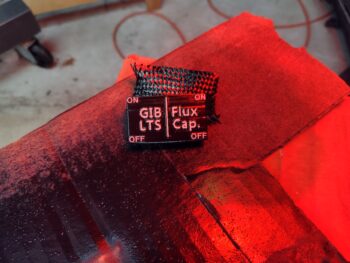
Speaking of painting, earlier in the day I took about a half hour and painted the raised lettering on the cover of my under-longeron 2-switch box.  After it cured for a couple of hours I then added the “ON” and “OFF” labels (from my label maker) in each corner before hitting the cover with a few coats of clear coat.  Here it is initially under the heat lamp to speed up the curing.

And here it is installed.  I designed the cover so that it could swing down without removing it fully, to expose the switches and wires inside the box —in case I ever want to swap out the switches for different uses or type.

I then closed up the cover and installed the screw on each side to hold it in the closed position.  Definitely a roll your own appearance on the box, but certainly good enough for what I need it for… Oh yeah, gotta have a little fun too!  Since the front switch is yet another spare switch I labeled it appropriately (I had enough room for 2 wire pairs through the NylaFlow conduit so I added an extra pair for any future need of another switched circuit).

Speaking of switches and wiring, I also installed the spare PTT momentary push button switch in its housing atop the throttle handle cable guide block.  I soldered the pair of wires to the switch and did a continuity check on the circuit (as I did on the switches/wires above).  Switch functional and pressing forward!
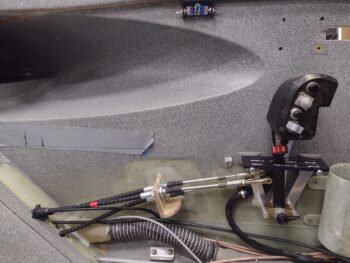
BTW, I noticed in my last video that the gray castle switch housing was loose, so I cracked open the throttle handle (a few days ago), added some lock nuts and a 3rd (slotted) screw.  That switch is now secure and ready for ops.

Yep, a lot of sideline, ancillary work going on here that has not a lot to do with the engine or the exhaust pipes.  As I noted yesterday, I’m working my way back to the engine compartment as I knock out a few items off the sidewall task list.  I’ll be working a few more ancillary items as I wait for the clear coat to dry, then I’ll install the throttle quadrant, get the throttle and mixture cable configuration set to final, and then get to work on the GIB throttle quadrant & cable install.

Chapter 22/23 – New throttle cable tab

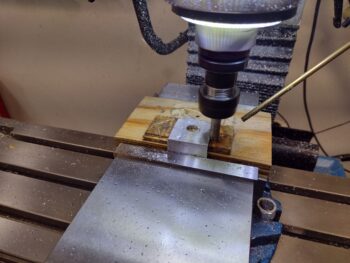
Today I machined the final throttle cable tab to finally get this part installed.

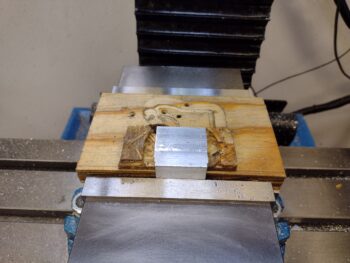
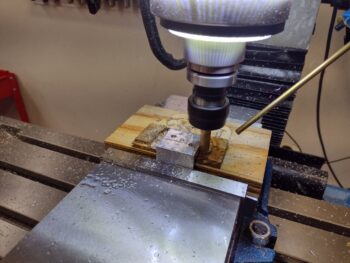
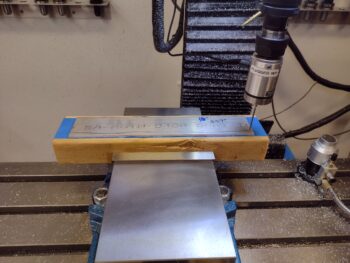
I cut off a 1.5″ wide piece of 2024 angle and mounted it in the milling machine’s vise.

I then milled each side to create a new throttle cable mounting tab.

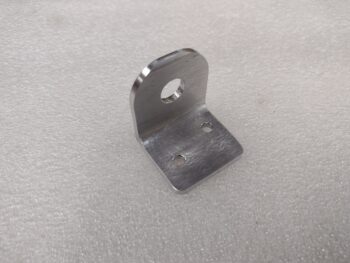
Here is the initially cleaned up final throttle cable mounting tab . . .

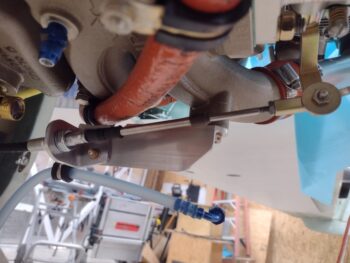
Which I then mounted the throttle cable into before mounting the tab to the throttle cable bracket.

With the throttle cable mounting tab position and configuration finally complete, I then got to work finalizing the throttle and mixture cables’ installation in both the front and back seat areas.

I have to say that it took a good few hours to actually get these cables installed.  Of course this area of the plane is one of the most difficult to work in, and, additionally, I also did a final install on the oil heat system’s 3 cables… which besides routing included swapping out temp hardware for final A/C grade hardware.

I installed the pilot throttle quadrant to test out my new throttle handle cable configuration with it secured in the Adel clamp.  The cable movement/clearance looked promising, but my cable clearance evaluation was cut short by the fact that my newly modified cable cover was too long… it was now the culprit in causing clearance issues.

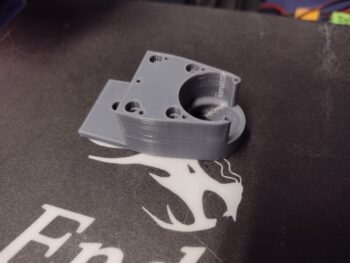
I went back in the house and reverted back to a shorter version of the cable cover and kicked off yet another 3D print.  Thankfully it took less than 20 minutes to print this thing out.

I then mounted the shorter version of the cable cover on the throttle handle/lever for another round of throttle handle cable clearance checks.  Note the black abrasive-resistant heat shrink I put on the throttle handle electrical cable.

I then reinstalled the throttle quadrant and checked the cable clearance with it pinned to the sidewall in an Adel clamp.  While the clearance is pretty darn good, I’m sorry to report that it’s not 100%.  I will need to trim a bit of the top mounting throttle quadrant mounting nubs on the sidewall a bit.  The good news is the amount I need to remove off of each nub is significantly way less than what I was planning on before.

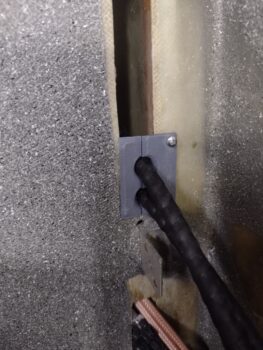
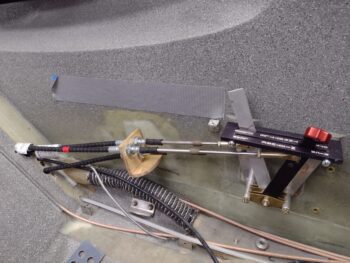
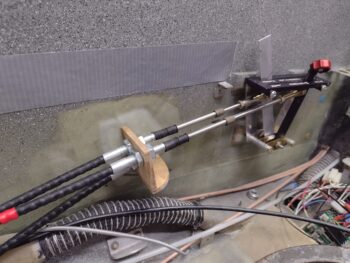
A few more things to point out in the pic below:  The throttle and mixture cables are final mounted into the sidewall cable bracket.  Also, it may be hard to see, but I have a thick piece of protective rubber wrapped and zip-tied around the throttle and mixture cable pair coming through the pilot back seat bulkhead.  Finally, note the electrical switch box at the top center of the pic . . .

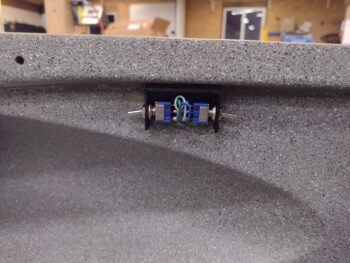
This is another sideline CAD/3D print project I’ve been working on the last few days as well… doing a print here and there either before or after my other larger 3D prints.  It’s a rather diminutive 2x mini-switch box for the GIB lights enable/disable circuit and a spare switch.  Here’s a closer look.
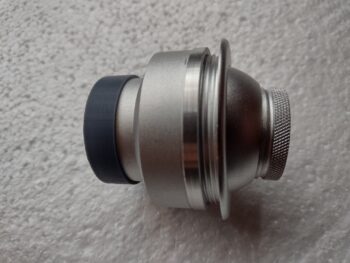
After trimming the 2 pairs of wires exiting the sidewall just under the longeron, I soldered the wires to the 2 mini switches.  I then installed the switches in the box exiting each end, and applied velcro on the box and the sidewall/longeron to secure it in place.
I had also 3D printed a cover for the box that didn’t look so hot, so I cleaned it up and hit it with a few coats of primer and then black paint.  I’ll show that here within another day or two when I install it as well.

My goal as I work the throttle & mixture cables and associated quadrants is to clean up and finalize the install of the left cockpit wall components, from the instrument panel aft.  Yes, it will add a few days to the throttle and mixture cable installs, but nearly everything will be done cable, duct and electrical -wise on the left sidewall… leaving pretty much only the panel forward requiring wiring and component installs.  That being said, tomorrow I plan to do the no kidding throttle and mixture cable configurations to dial those in once and for all.

Chapter 23 – K.I.S.S.

Overall, today was another one of those figuring it out days with not a lot of actual building, but I would say definitely a fair bit of progress.  Still a lot more CAD work and prototyping.  How much of it is required?  Probably less than I think, to be honest.

As I 3D print some objects I start baselining other parts that may need streamlining.  Having worked project management for years, I often go back to what my requirements are… the problem being sometimes I don’t remember them precisely in the mad rush of things.

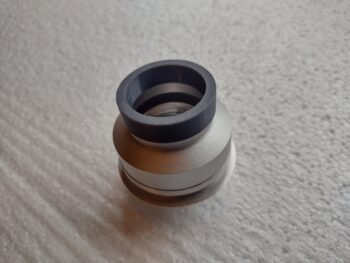
At one point I wanted an in-line butterfly valve in the air duct to the panel mounted eyeball vent.  Over the past few days I started down the road of making a 90º elbow with internal butterfly valve for the vent, with only a nascent effort of mic’ing up the part and printing off a few sub-10 minute rings for the initial interface.   This all being done with a few minutes of setup and then Bob whirring away as I do other stuff.

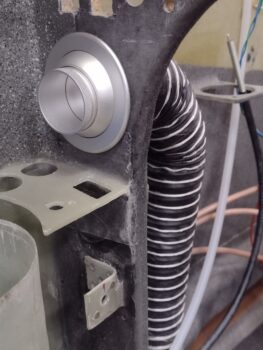
The initial fitting came out well, before remembering that I was going to start out with just the eyeball vent closing mechanism —sans butterfly valve— to shut off any unwanted air. At over $100 for the vent I would hope that it could handle this task!  Thankfully I had only about 20 minutes into this prototyping before I saw the light . . .  and reiterated to myself the true primary requirement: get this bird in the air!

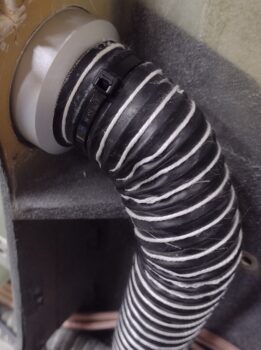
In short, just hook up the damn SCAT tube to the vent . . . done!

So yes, K.I.S.S . . . . is the emphasis on Simple or Stupid??  Or both?

I then repeated almost the same scenario in dealing with my throttle handle wire cable… although this has involved years of pondering and head scratching.  The main issue is getting the cable routed down between the sidewall and the quadrant.  Closely associated with that is protecting the cable so that it doesn’t get tore up or snag while the throttle handle/lever is moved forward and aft countless times over the coming years.

In focusing on protecting the cable with a hard-mounted, pivoting channel, I was running into the issue of the angled quadrant mounting nubs on the sidewall (I would use arrows here but apparently GoDaddy has forbade such tomfoolery!).  They were preventing any of my reasonably designed pivot action from reaching the range of motion required without jamming the throttle before reaching the fore or aft stops.

I had removed the new throttle lever and mounted handle, put the aluminum blank lever back in and was literally mere seconds from marking and cutting the inside edges of those mounting nubs when the thought of an Aeroquip info sheet on how to route hoses, which I had just unearthed half an hour earlier near the shop computer and gave a quick once-over, popped into my head.  It said not to run hoses straight from point A to point B, but to add in a curve for stress relief.

Ok, what if I employed that here?  I had always tried to run the cable pretty much straight up to the throttle handle, as it dragged the cable fore and aft strapped into the same motion as the throttle lever.  What if I disassociated the movement of the cable with that of the lever, to the best degree possible?  In other words, make the pivot point of the cable much higher than just matching it to the lever’s movements.

I tried pinning the cable to the sidewall with an Adel clamp smack dab in the middle, but it was a very tight fit with the levers and cable rod ends so close… of course I don’t want any jam-ups on this system.

Experimenting with it a bit more I realized that if I took the cable down the center of the quadrant with a 90º curve to horizontal that it did virtually the same thing as mounting the cable straight in the center.  It pinned the cable vertically near the center of the quadrant and it angled/pivoted itself much less than the throttle handle/lever, but didn’t limit any travel.

Bingo!  Voila!  Years of trying to figure this out and I found the answer serendipitously literally seconds before implementing a much less elegant (or simple) solution!  Sorry, I was so stoked that I failed to get a pic and jumped right into mounting a Clickbond for the Adel clamp.  I’m going 90º to the aft side since that gives me the best clearance for the cable, which is plenty long enough to make it to the P4 bulkhead connector forward of the panel.

On the other end of the plane, after one more final tweak I hit paydirt on my throttle cable tab that mounts the actual throttle cable to the engine throttle bracket.

Before I had been hyper focused on the clearance between the throttle cable and the fuel hose… just enough to ensure no contact even with engine vibrations.

Here’s another shot of the 3D printed mockup to lock down the angle and position of the throttle cable mounting tab onto the throttle cable bracket.

However, I noted with the previous position of the throttle cable tab it was just beyond the limit of the 7º up pivot range of the throttle cable rod.  It was barely noticeable when the servo throttle lever was near center travel, since that is its lowest point.  But moving this lever through its full range it became obvious that if I pushed it, it was going to tweak something in a bad way.

To be clear, it wasn’t like that originally, but minor movements can translate into being significant… clearly my clamped tab moved enough to cause the issue, even when I thought I was confirming good travel.  All is good now though and tomorrow I plan to machine another throttle cable mounting tab.

By the end of the day I had collected quite the bounty of 3D printed parts.  Note I switched to the black PETG plastic as these are the final versions… or at least I intend them to be the final versions, barring any unintended consequences dictating otherwise.

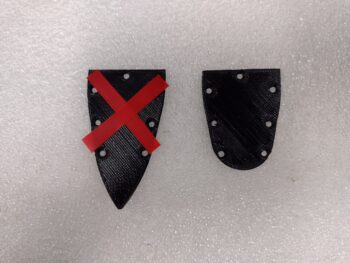
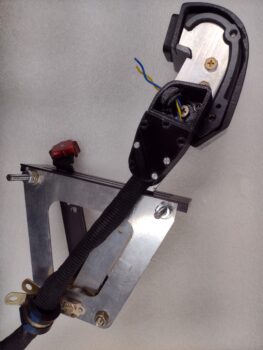
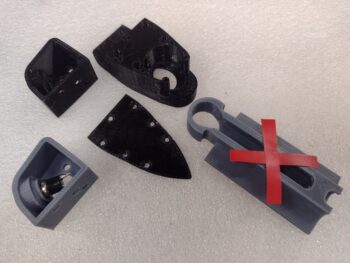
Starting in the top right (pic below), this is the final version of what I have in the lower left of the pic… I noted when testing out the position of the throttle handle that my pinky rested right on the top front corner of the throttle electrical cable routing block (middle top).  Since I had a spare PTT momentary push button switch I went ahead and made a recessed mount for it.  I also designed a conduit from the bottom of this button housing through the throttle electrical cable routing block for the pair of wires to run along with the main throttle handle wire cable.

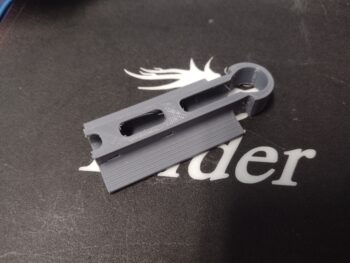
The iron looking thing in the middle is the cover plate that secures the cable into the routing block, and originally secured the pivoting cable guide on the right side (red X’d)… but I no longer will be using that since the cable will be pinned to the lower sidewall via an Adel clamp.  I did extend the bottom (pointed) end downwards over 1/2″ to help guide the cable and keep it off the sidewall.

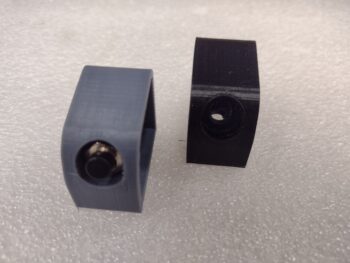
Here is another shot of the top PTT switch housing in gray (prototype) and black (final version).

Tomorrow I plan on getting these new, final components installed onto the throttle handle/lever and also get a new throttle cable tab machined to finalize the engine-side throttle cable installation.


Chapter 22/23/26 – Bob’s plane build

I jokingly refer to my 3D printer as “Bob” with my friends and family, and Bob has been quite busy today in his quest to help me build this plane.  I’m still working prototypes and versions of the throttle cable routing guide and other 3D printing projects for this bird as well.  I’ve been rolling from one 3D print to the next and spent a fair amount of time on CAD today tweaking all the modeled parts.

Here’s the latest version of the actual throttle cable guide pivot piece… I added wings to it which will be much easier to explain why when I mount it and grab some pics.

One part that I had to go back to was the throttle cable tab that attaches the cable to the throttle cable bracket.  I tested the geometry —which looked spot on— but something definitely got lost in translation and I’m now tweaking the tab placement to mount it in place. I’ll grab pics when it’s installed for good.  I’ll note that I had planned on doing the final, no-kidding setting of the throttle and mixture cables and levers to their final positions from A-Z, but this bracket tab being off gummed that up until I get the geometry set right.

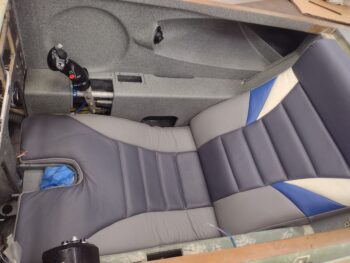
I then checked the height and configuration of my throttle handle mounted on its newly machined throttle lever.  To do this I mounted the left side armrest, put the front seat cores in, and even mounted the cupholder in place.

I then climbed in and made airplane noises for a good 30 minutes checking the fit and assessing the operation of the throttle handle and quadrant.

I have to say that I think I nailed the height of the throttle handle!  I was fully expecting to have to make another throttle handle lever but this one is spot on… I’m keeping this lever installed and pressing forward.

Here’s a shot specifically of my leg pressed up against the left armrest and the throttle handle.  You can see that if I brought the throttle handle down any lower that it would start digging into my thigh, especially at higher throttle settings.

Here’s a shot of the throttle handle wire cable guide on the outboard side of the throttle handle.  When I made my video the bottom bolts of the throttle quadrant were not seated in all the way, which resulted in the top of the throttle handle leaning outboard… which in turn resulted in the cable guide being pushed up much tighter to the sidewall than it actually is, as you can see here. Yes, it’s tight, but there is notable clearance.  I knew something was a bit awry but pressed forward to get the video finished and uploaded.

I’ll of course work this cable routing issue until it’s acceptably configured.  I’ll add that in addition to looking at this cable routing, I also did a bit of assessing on the micro-switches that will need to get mounted to the underside throttle quadrant frame to ensure no clearance or configuration issues rear their ugly heads betwixt the throttle cable routing and the micro-switches.  At this time I have 3 functions that require 2 micro-switches: one DPST on the front side (full throttle) and one SPST on the aft side (throttle <10%).

My last task of the evening in the shop (hours of CAD and 3D printing ensued afterwards) was to install my 0.03″ widened inboard GIB seatback throttle & mixture cable bulkhead pass-thru piece…. and boy was it tight.

When I got all the hardware I could the other day from a local hardware store (they have some smaller sizes: 4-40 and below), I picked up a small screw just for this install.  I drilled a small pilot hole and secured the cable guide with the screw.  I had planned on using flox or RTV to secure these pieces together and to the seatback, but these things are in there so TIGHTLY… and with the screw keeping them in place I’m calling this task complete.

I’m trying to get all the throttle and mixture cables and all their nitnoy associated components installed as much as I can before jumping back onto the engine: specifically the exhaust pipes.  Tomorrow I plan on getting the throttle and mixture cables dialed in, and then focusing on the GIB throttle quadrant install… interspersed with getting the RAM air can install complete to the point that once the firewall covering goes on and the RAM can is bolted into place it will be operational.

Chapter 22/23 – Throttle Handle Lever

Today I finished up some minor, albeit somewhat time-consuming, tasks to finish up the last little bit for my last video segment that I got too busy and too lazy to finish last night.

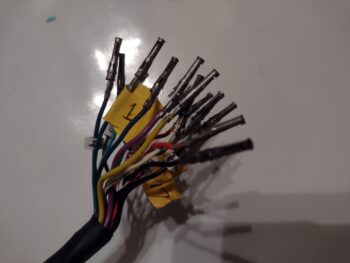
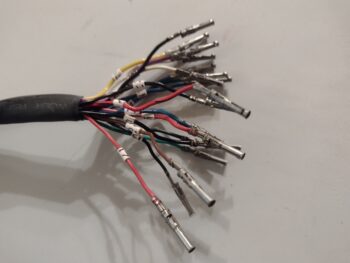
With the fervor of Bill Gates, I de-populated the P4B connector of its sockets and used temporary Post-It labels to ensure I knew what wire was what as each one went back into the connector.  I realized that if I had to do this again in the future this would be a fool’s errand if I didn’t label each wire permanently with its associated socket number.

So I spent a good little bit of time labeling all the throttle handle wires and double-checking them against my connector pin-out sheet.

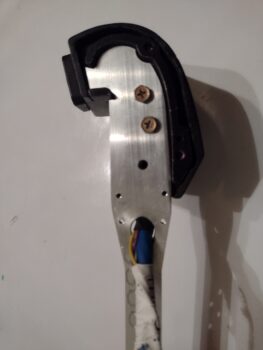
I then ran the connector-free throttle wire cable/wires through the hole in the new throttle handle lever.

And then through the 3D printed wire guide that I then mounted to the outboard side of the throttle handle lever.

With these tasks complete, I knocked out the last bit of my video and got ‘er uploaded.  Here it is.

Tomorrow I plan on verifying that the throttle handle height and clearance with the mixture lever is good.  I also plan on drilling and mounting the throttle cable tab to the throttle cable bracket on the engine before I dial in the throttle and mixture cable operations between throttle quadrant and fuel injection servo.  Once the primary throttle cable configuration is finalized, I’ll then move on to installing the GIB throttle.

Chapter 23 – Cable Bracket installed

Today I finalized the install of the throttle(s) and mixture cable bracket by laying up 2 plies of BID on all sides of the initially installed bracket.

I then peel plied the layups on the throttle(s) and mixture bracket.

After some clean-up, minor tweaking, drilling and thread-tapping on the new throttle handle lever, I also did a fair amount of CAD work polishing the 3D printed throttle handle cable guide components.

I also worked on editing the video but didn’t get nearly as far as I wanted to on it.  I really honestly should have it finished tomorrow.

Pushing forward!

Chapter 23 – Cable mount mounted

Today I got the throttle & mixture cables’ bracket that I made up yesterday floxed and glassed into place —with a ply of BID all around— onto the pilot seat left sidewall.

Before applying any flox or laying up any glass, I connected up the cables to the throttle and mixture levers on the quadrant to get the best alignment possible for the cables.  I then taped up the cables to protect them from any errant epoxy.

Jumping ahead to later in the evening, I pulled the tape from the cables and the peel ply from the layup.

I’ll note that before I headed out to the shop this morning to mount the cable bracket, I kicked off a multi-hour 3D print to create a prototype of the throttle handle/lever cable guide.

In the evening, as the cable mount flox and BID layups cured, I machined the throttle handle lever on the milling machine.

Here’s the end result.  I made a video of most of it and will work on editing it tonight and should have it posted tomorrow sometime.

And with that, I called it a NIGHT!